
Understand what impact bristle density has on the cleaning results, panel safety, and lifespan of a solar panel cleaning brush itself. Choose the right density for your system.
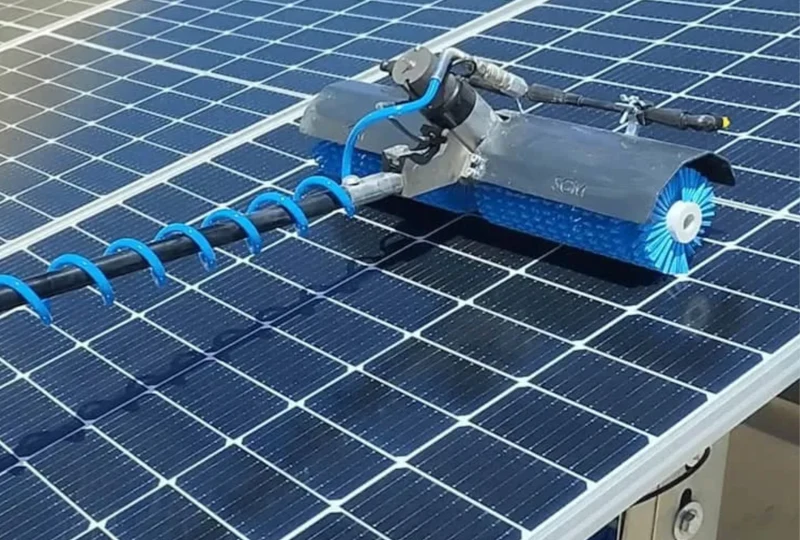
Why Bristle Density Matters More Than You Think
This is what wrong bristle density will translate to:
Inadequate cleaning and harm to the panel. With inappropriate density, it will be ineffective for cleaning and can also damage the glass of the panel. The right density you choose will work as a shield for the panel and raise its level of performance.
Bristle density is an aspect that most buyers do not consider when choosing a brush for cleaning solar panels. To many procurement teams, the diameter of the brush and the material of the filament take priority over how tightly or loosely the bristles sit on the roller core. In reality, it should determine three critical outcomes: cleaning efficiency, surface safety, and brush service life.
The Hidden Costs of Choosing the Wrong Density
A brush of the wrong density not only does poor cleaning but will also damage the photovoltaic glass. Feedback from the field is that measurable problems are caused by both too sparse and too dense configurations. This understanding of failure modes will help steer engineers and purchasing managers away from expensive mistakes. A broader introduction to this product category, the guide on what a solar panel cleaning brush covers the fundamentals.
Sparse and Dense Bristles Both Create Serious Problems
The Problem with Sparse Bristles – Scratching and Dust Trapping
Large gaps between sparse bristles allow dirt and dust to become trapped between passes. Static electricity on the surface of the panel pulls the loose particles back, so one trip does not work well. Too few hairs would mean all the downward pressure is concentrated on just a few filament tips. Such force would definitely scratch the anti-reflective coating on PV glass over many cleaning cycles.
This is a shortcoming that is found in most budget solar panel cleaning brush products. Thin brushes do not do well in dry, waterless cleaning environments mainly because there is no rinse water to flush away the grit that gets trapped.
The Problem with Dense Bristles – Sand Embedding and Coating Abrasion
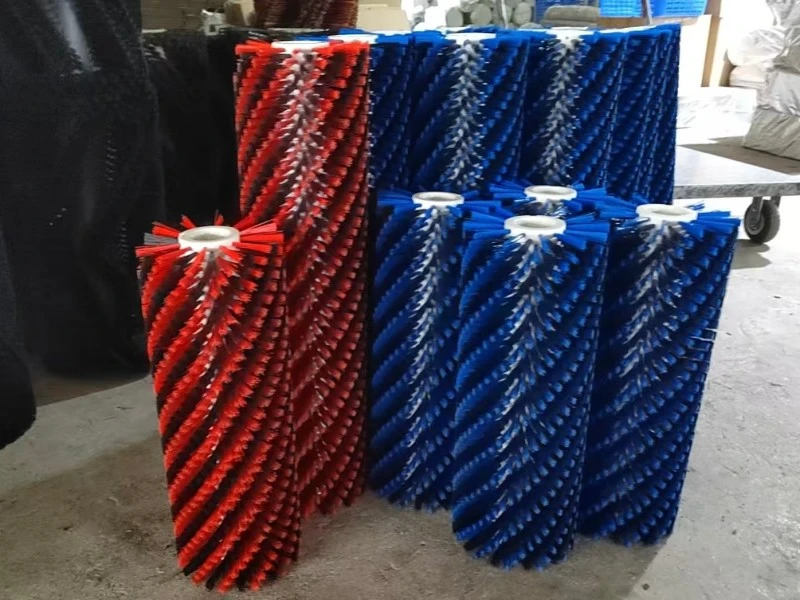
At the other extreme is a very dense bristle pattern. If, for instance, the filaments are packed very closely such that no space is left between them, then sand grains can’t fall through or out. Instead, the grit will be embedded within the bristle bed and will grind against the panel every time it is rotated; hence, the top layer will wear off sooner, and the power output will drop. This will eventually wear off the surface coating and also decrease the power output.
Sparse bristle beds encourage scratching and increase dust trapping by static re-adhesion. Sand is allowed to be embedded in the dense bristle beds. Coating abrasion is also another effect caused by prolonged UV exposure on the filaments; this makes the bristles brittle and snap. These then result in frequent brush replacements and higher maintenance costs.
In summary:
● Sparse bristles → scratching, trapping dust, static re-adhesion
● Dense bristles → embedding sand, coating abrasion, accelerated bristle aging
● Both extremes → shorter brush life and reduced panel efficiency
Medium, Cross-Pattern Bristle Density Becomes the Universal Standard
Why Medium Cross-Density Outperforms Both Extremes
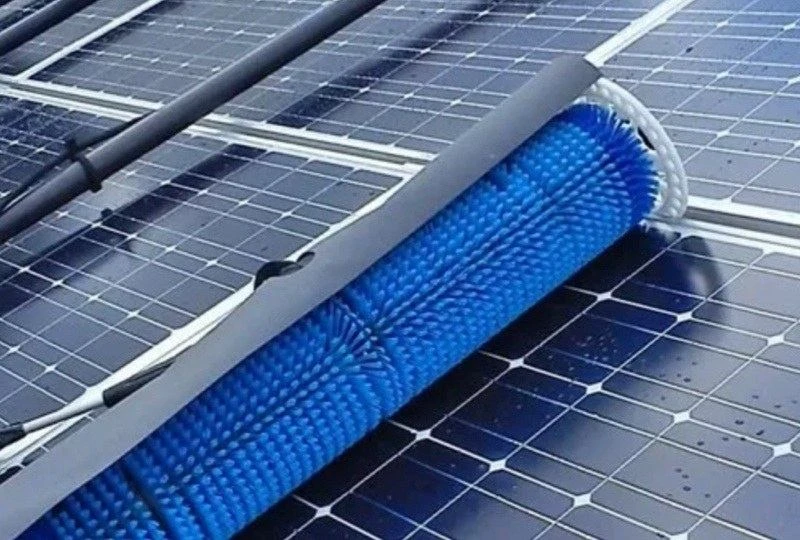
The most reliable configuration in thousands of field installations has the bristles set at medium density in a cross pattern. In this design, the filaments are evenly spaced around the roller core so that:
The cleaning pressure gets uniformly distributed over the whole width of the brush. Small clearances between the rows of bristles allow sand and dirt to fall out by themselves during rotation. No one bunch of filaments carries too much load, so no scratches on the glass.
The PA612 Advantage – Anti-Static and All-Climate Performance
The density pattern of the solar panel roller brush, coupled with anti-static PA612 filaments, makes it equally suitable for wet cleaning as well as dry sweeping, with no residue or charge left on the panel. A write-up on the salient features of a solar panel cleaning brush will detail how this anti-static property helps in providing long-term protection to the panel.
Medium cross-density brushes would meet the requirement on bristle density over the most extensive range of climates, from humid coastal farms to dusty desert arrays; hence, they are recommended defaults for most OEM and project-level orders. For any solar washing brush application, this medium cross-density configuration with PA612 offers the most reliable balance of cleaning effectiveness, surface protection, and long-term durability.
| Bristle Density Type | Pressure Distribution | Sand/Dust Discharge | Scratch Risk | Static Buildup | Best Cleaning Mode | Recommended Equipment | Typical Lifespan |
| Sparse Density | Concentrated on a few tips | Gaps trap big debris | High | High (with regular nylon) | Wet wash only | Not recommended | Short |
| Medium Cross Density | Even across the full width | Debris falls out on its own | Low | Low (with PA612 antistatic) | Wet and dry | Universal – from handheld to robotic | Long |
| High Density | Even traps grit | No way out for grit | Medium (abrasive grit) | Medium | Wet wash only | Not recommended | Short (UV aging, breakage) |
Bristle Density Should Match Type of Equipment and Filament Material
Lightweight Handheld Cleaners – Sparser Layout with PA6 Filaments
Not every cleaning machine would require the same density; the right specification would depend on the size of the equipment, its speed of rotation, and the method of cleaning.
The best choice for lightweight handheld cleaners would be a design with bristles that are somewhat more widely spaced. Because these devices are meant to be carried by hand, their weight becomes an issue. Using standard PA6 nylon fine filaments makes the brush lightweight and the cost low while still providing adequate cleaning on residential or small commercial arrays.
Fully Automatic Robotic Systems – Tight Packing with Anti-Static PA612
High RPMs and large vibrations come from the big, fully automatic cleaning bots. Tight bristle packing is what ensures the brush face maintains uniform contact with the panel surface throughout the entire stroke. In this case, the filament of choice is anti-static modified PA612 nylon—it balances softness and stiffness, kills static, and holds up to UV degradation outdoors far longer than regular nylon.
It will be very helpful for anyone who wants to understand how to define these attributes for an order in the first place – the guide on custom solar panel roller brush specifications.
On the flip side of the equipment type coin is the need to know general selection criteria. That decision framework is covered in detail in the article on how to choose a solar panel cleaning brush.
FAQ
Can a brush with sparse bristles help out robotic cleaning systems?
No. The robotic systems spin at very high speeds and need even, dense contact. Sparse bristles will only focus pressure, leaving dust behind on the glass and scratching it with no effect.
How does bristle density impact the replacement frequency of brushes?
Wrong density, either low or high, will accelerate the wearing out of filaments and eventually break them. A medium cross-density will ensure that stresses are uniformly shared and that it will have a much better life than other configurations.
What bristle density should we specify for a desert solar farm?
Use medium cross-density bristles with anti-static PA612 filaments. They will discharge sand during effective dry sweeping and will not be degraded by UV in the harsh desert.