
The global shift toward renewable energy has turned rooftops and vast desert landscapes into “blue gold” mines. However, there is a silent thief in the solar industry that many homeowners and plant managers overlook: soiling. Whether it is dust, pollen, bird droppings, or industrial soot, the buildup on a photovoltaic (PV) surface can significantly slash energy production. This is where the Solar Panel Cleaning Brush becomes an essential piece of hardware rather than a mere accessory.
It’s often observed that people assume rain will simply “wash away” the grime. In reality, light rain often turns dust into a muddy film that bakes onto the glass under the sun. To maintain peak efficiency, a mechanical intervention is required. A Solar Panel Cleaning Brush is specifically engineered to agitate these particles without compromising the integrity of the solar cells or the delicate anti-reflective coatings (ARC) on the glass.
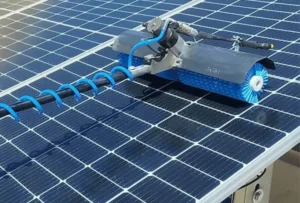
The Mechanics of Solar Surface Maintenance
A Solar Panel Cleaning Brush isn’t a “one size fits all” tool. Depending on the scale of the installation—ranging from a few panels on a residential porch to thousands of acres in a utility-scale farm—the technology shifts.
At its most basic, these brushes are designed to balance two competing needs: the stiffness required to dislodge bird droppings and the softness required to prevent micro-scratches. It is a bit of a delicate dance. If the bristles are too hard, they create tiny abrasions that catch light and create shadows on the cells. If they are too soft, they simply move the dirt around without removing it.
The Rise of the Cylinder Cleaning Brush
For large-scale operations, the manual “push-broom” style is quickly being replaced by the Cylinder Cleaning Brush. These are often mounted on tractors, specialized robots, or long-reach hydraulic arms. The rotating motion of a Cylinder Cleaning Brush provides a much higher “flicks per minute” count than manual scrubbing, which is virtually impossible to replicate by hand over several kilometers of panels.
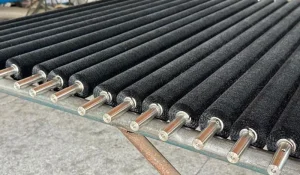
The centrifugal force of the rotation, combined with a water-fed system, allows the brush to lift dirt and whisk it away in a single pass. It’s quite a sight to see a large-scale cleaning rig in action; the efficiency gain is almost immediate.
Material Science: The Nylon Cylinder Brush
When looking at the specs of high-end cleaning systems, the Nylon Cylinder Brush is frequently cited as the gold standard. But why nylon? Why not polypropylene or natural fibers?
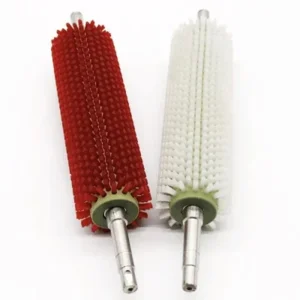
There is a certain logic to using Nylon 6/6 or Nylon 12 in these environments. Solar farms are, by definition, exposed to intense UV radiation. Many plastics become brittle and “shed” their bristles when exposed to the sun for long periods. Nylon, however, maintains its “memory”—the ability of the bristle to snap back to its original position—much longer than cheaper alternatives.
Key Advantages of Nylon Bristles:
Low Moisture Absorption: It doesn’t become heavy or soggy when used with water-fed systems.
Elasticity: It can bend over the aluminum frames of the panels without breaking.
Surface Safety: It is inherently smoother at a microscopic level than most recycled plastics.
Efficiency Comparison: Manual vs. Automated Cleaning
Choosing the right Solar Panel Cleaning Brush system usually comes down to a Return on Investment (ROI) calculation. While a manual brush is cheap upfront, the labor costs for a 5MW farm would be astronomical.
The Impact of Soiling on Energy Yield
The physics of a solar cell are relatively simple: photons hit silicon, and electrons move. When a layer of dust sits on top of that glass, it acts as a filter. It’s not just about the visible dirt; it’s about the spectral shift. Some types of dust specifically block the wavelengths of light that the cells are most sensitive to.
In desert regions, it’s been observed that a single sandstorm can reduce output by as much as 30% in a single day. Even in more temperate climates, a “clean-looking” panel might actually be underperforming by 5% to 10% due to a thin layer of pollen or industrial smog.
Technical Design of a Cylinder Cleaning Brush
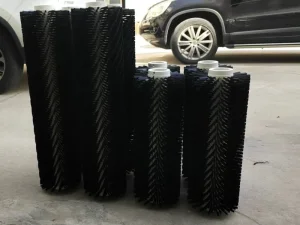
When engineers design a Cylinder Cleaning Brush, they have to account for “brush sag.” If a brush is three meters long, it tends to bow in the middle due to gravity. This would mean the ends of the brush scrub hard, while the middle barely touches the panels.
To solve this, many manufacturers use a “tapered core” or a high-strength aluminum shaft. The arrangement of the bristles—whether they are in a spiral, a staggered pattern, or a solid density—also dictates how well water is distributed across the panel surface.
Why the Spiral Pattern is Popular
A spiral-wound Nylon Cylinder Brush acts like a screw. As it rotates, it doesn’t just scrub; it channels the water and the suspended dirt toward the edge of the panel. This prevents the “muddy stripe” effect often seen with inferior flat brushes, where the dirt just gets pushed from one side of the panel to the other.
Subjective Observations from the Field
From an observational standpoint, there is a distinct psychological barrier to cleaning solar panels. Many owners feel that because the panels have no “moving parts,” they shouldn’t require maintenance. However, looking at the glass of a solar panel after six months of neglect is like looking through a dirty windshield—you can see, but the clarity is gone.
It seems that the most successful solar installations are those that treat the Solar Panel Cleaning Brush as a part of the electrical system itself. If the wire is too small, you lose power to resistance. If the glass is too dirty, you lose power to “soiling resistance.” Both are technical bottlenecks that can be solved with the right equipment.
The “Dry” Cleaning Debate
In water-scarce regions like Arizona or parts of the Middle East, using water to clean panels is either too expensive or environmentally irresponsible. In these cases, a specialized Solar Panel Cleaning Brush with ultra-soft, anti-static bristles is used.
Static Reduction: Rotating brushes can actually create a static charge that attracts more dust.
Specialty Fibers: High-end dry brushes often use a blend of synthetic fibers designed to dissipate this charge.
Choosing the Right Equipment for Your Needs
If you are a residential user, a telescoping pole with a water-fed Nylon Cylinder Brush head is usually sufficient. It’s light enough to handle and doesn’t require getting on the roof (which is a major safety plus).

For commercial installers, the choice is usually between a vehicle-mounted Cylinder Cleaning Brush or a track-based robot. The decision point is often the “tilt” of the panels. If the panels are at a steep angle, a heavy tractor-mounted brush might struggle with reach, making lightweight robots a more attractive (though more expensive) option.
Maintenance of the Brushes
It is worth noting—and this is a point of frequent failure—that the brushes themselves need care.
Rinsing: After a job, the brush should be rinsed to remove grit trapped in the bristles.
Storage: Never store a Cylinder Cleaning Brush resting on its bristles; this creates a “flat spot” that leads to vibration and uneven cleaning.
Inspection: Bristles eventually wear down. When the bristle length has decreased by 20%, the “flick” action is lost, and the cleaning efficiency drops off a cliff.
Conclusion: The ROI of a Clean Surface
Investing in a Solar Panel Cleaning Brush is effectively an investment in the “fuel” of the solar system. Since the sun’s light is free, the only way to get more “fuel” is to ensure the “tank” (the panel) is open and ready to receive it.
Whether it’s a simple handheld tool or a massive, automated Cylinder Cleaning Brush, the goal is clear: maximize the harvest. As solar technology continues to evolve and panels become even more efficient, the cost of “soiling” becomes even higher. A 5% loss on a high-efficiency panel is more “wasted watts” than a 5% loss on an old, inefficient one.