Rotating brushes for photovoltaic panels have become a central topic as the solar operations industry spends years debating how to clean photovoltaic panels without damaging them. Utility-scale farms now exceed a terawatt of installed capacity worldwide, and every percentage point of soiling loss cuts into the revenue forecast that financed these projects in the first place. Dust, bird droppings, industrial fallout, and pollen accumulate on panel surfaces at rates that vary wildly by geography — a farm in Rajasthan faces a different contamination profile than one in coastal California, and the same cleaning method cannot serve both equally well.
Water-only cleaning has become the default approach for many O&M teams. It is simple, requires no mechanical contact beyond a spray nozzle, and avoids the perceived risk of brush-induced micro-scratching. The method works adequately when contamination is light, and panels are accessible. But operators who have managed large portfolios across multiple climate zones know that water alone stops working at a certain threshold — and knowing where that threshold sits is what separates profitable solar assets from underperforming ones.
Rotating brushes outperform water-only cleaning when panels face cemented soiling — dust that has bonded to glass through humidity, dew cycles, or electrostatic adhesion — and when bird droppings, pollen crust, or industrial residues have hardened beyond what water pressure alone can dislodge. In arid regions with limited water access, rotating brush systems also deliver higher cleaning thoroughness per liter of water consumed, making them the more resource-efficient choice for utility-scale operations.
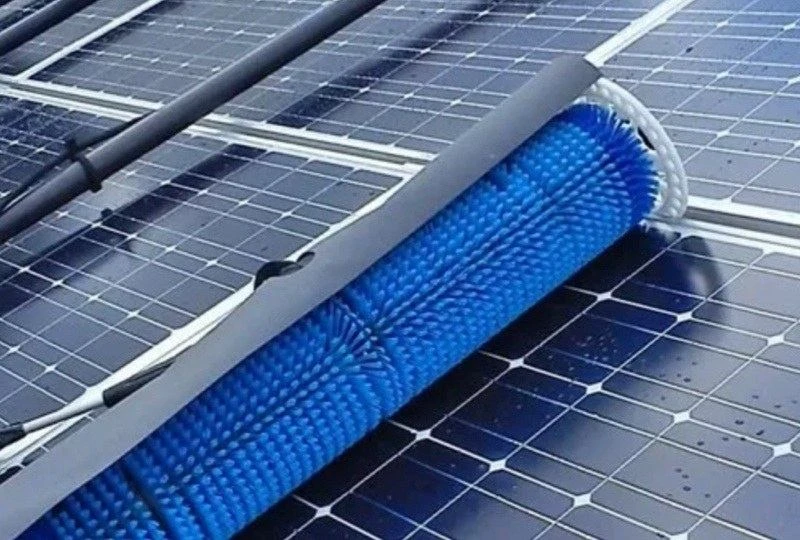
This article examines the conditions that tilt the balance toward mechanical agitation over rinse-only methods. It draws on field observations, material science fundamentals, and operational cost data to give procurement managers and O&M directors a framework for deciding which method makes sense for their specific site conditions.
The core question is not whether one method is universally better. It is about identifying the soiling type, environmental context, and economic threshold at which a rotary solar panel brush stops being optional and becomes the only practical solution.
What Water-Only Cleaning Actually Removes — and What It Leaves Behind
What Water-Only Cleaning Can and Cannot Remove
Water-only cleaning removes loose, non-adhered dust and light pollen from panel surfaces. It fails against caked-on bird droppings, cement dust that has set through dew cycles, oily industrial residues, and fine particulate that has bonded to glass through electrostatic forces — all of which require mechanical agitation to break the adhesion layer.
The Physics of Soiling Adhesion: Why Dew Cycles Cement Dust to Glass
The physics of soiling adhesion is more complex than most cleaning schedules account for. Dry dust resting on a tilted panel may blow off with wind or rinse away with the first rain. But when that same dust goes through a dew cycle — condensing moisture at night that dissolves minerals in the particulate and then evaporates by morning — it forms a cement-like bond with the glass. NREL field studies have measured soiling losses of 15 to 25 percent in regions where this daily condensation cycle repeats for weeks between cleaning events.
Water sprayed at pressures up to 4 MPa (40 bar) can knock loose particles off the surface, but it cannot break the chemical adhesion that forms when silica dust mixes with atmospheric moisture. This is the fundamental limitation: water transports loose debris, but it does not scrub. Operators in the Middle East and North Africa report that panels cleaned with water-only systems show measurable soiling residue within 48 hours of cleaning because the bonded base layer was never fully removed. Each subsequent dust deposition then adheres to that residual layer, accelerating the rate of efficiency loss.
The Water Consumption Paradox: High Volume, Incomplete Results
The water consumption numbers also matter. A pure water-only rinse cycle for a 1 MW installation uses roughly 12 to 15 cubic meters of water when done properly — flushing panels until runoff runs clear. In regions like Arizona, parts of Australia, or the Atacama Desert, that volume is either expensive, rationed, or both. The irony is that this much water still leaves the bonded contaminants in place.
How Rotating Brush Mechanics Solve the Adhesion Problem
Three Simultaneous Cleaning Mechanisms
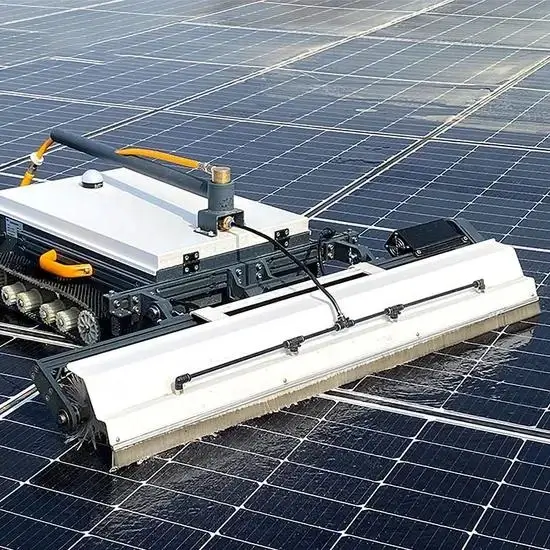
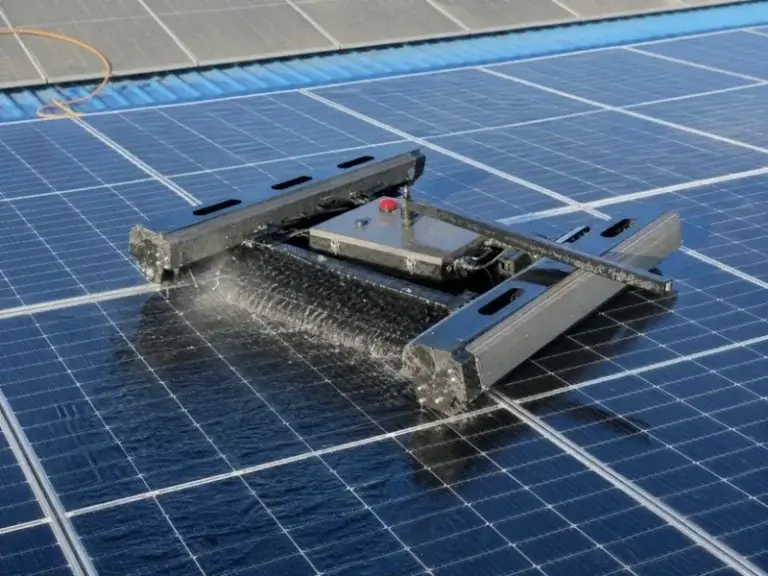
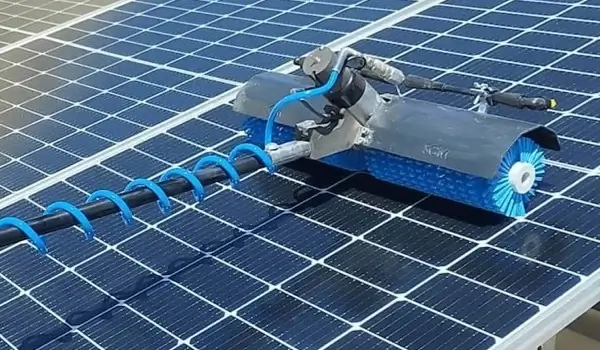
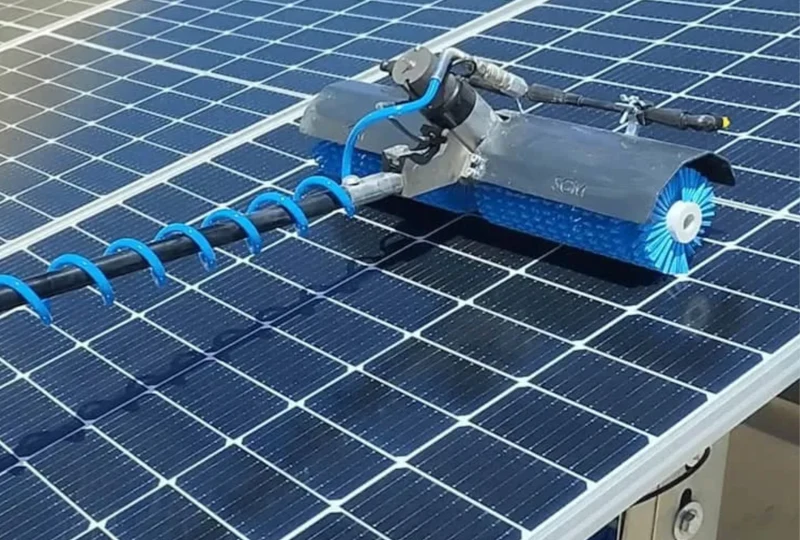
A rotating brush cleans through three simultaneous mechanisms: bristle tips mechanically fracture the adhesion layer between contaminant and glass, rotation channels loosen debris laterally off the panel edge, and integrated water spray lubricates the contact zone to prevent micro-scratching while flushing dislodged particles away from the brush path.
Active Debridement vs. Passive Rinsing: The Spiral-Wound Advantage
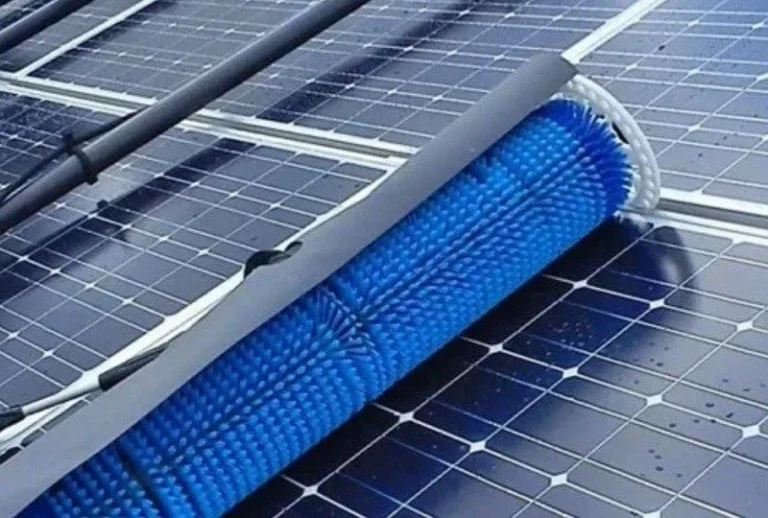
The technical distinction between a cylinder rotary brush and a static spray bar is the difference between passive rinsing and active debridement. When bristle tips rotate at 600 to 900 RPM against a wetted panel surface, each filament acts as a micro-scraper — not aggressive enough to score glass, but with enough tip velocity to crack the mineral bridge that dew-cycled dust has formed. The mechanical energy delivered at the point of contact is what water pressure alone cannot replicate.
Spiral-wound brush patterns add a directional advantage. As the brush rotates, the spiral channels water and suspended debris toward the panel edge rather than redistributing it across adjacent cells. This prevents the “mud stripe” artifact that flat or linear brush designs sometimes produce — where dirt gets pushed from one half of the panel to the other without ever leaving the surface. For farm operators tracking post-cleaning efficiency recovery, consistent edge-to-edge clarity across all panels in a string is the measurable outcome that validates brush geometry choices.
Water’s Real Role: Lubrication, Not Primary Cleaning
The lubrication function of water in a rotating brush system is worth emphasizing because it is often misunderstood. Water in this context is not the primary cleaning agent — the mechanical action of the bristles is. Water serves to reduce friction at the bristle-glass interface, to capture and transport dislodged particles, and to moderate surface temperature during daytime cleaning. This functional shift means rotating brush systems consume 3 to 4 liters of water per square meter — roughly 60 to 70 percent less than a pure rinse cycle for equivalent cleaning thoroughness.
The solar operations industry has spent years debating how to clean photovoltaic panels without damaging them. Utility-scale farms now exceed a terawatt of installed capacity worldwide, and every percentage point of soiling loss cuts into the revenue forecast that financed these projects in the first place. Dust, bird droppings, industrial fallout, and pollen accumulate on panel surfaces at rates that vary wildly by geography — a farm in Rajasthan faces a different contamination profile than one in coastal California, and the same cleaning method cannot serve both equally well.
Water-only cleaning has become the default approach for many O&M teams. It is simple, requires no mechanical contact beyond a spray nozzle, and avoids the perceived risk of brush-induced micro-scratching. The method works adequately when contamination is light, and panels are accessible. But operators who have managed large portfolios across multiple climate zones know that water alone stops working at a certain threshold — and knowing where that threshold sits is what separates profitable solar assets from underperforming ones.
When Environmental Conditions Demand Mechanical Agitation
Rotating brushes for photovoltaic panels become the necessary choice in any environment where soiling adhesion outpaces rinse frequency — deserts with daily dew cycles, agricultural zones with sticky pollen seasons, industrial areas with hydrocarbon-laced particulate, and coastal sites where salt spray crystallizes into a hardened film on panel surfaces.
The decision to move from water-only to mechanical cleaning is not about preference. It is forced by the contamination chemistry of the site.
Desert PV Sites: How the Dew Cycle Turns Loose Dust Into Bonded Scale
Desert installations present the most deceptively difficult case because the dust looks loose and the rain is rare — but the dew cycle is relentless. Every night that panel surface temperature drops below the dew point, atmospheric moisture condenses on the glass, dissolves minerals from whatever dust is present, and then evaporates at sunrise. After two to three weeks of this daily cycle, the bonded layer is mineralogically similar to a thin sedimentary rock — and no spray bar on the market can remove it.
Agricultural PV Sites: UV-Cured Pollen and Resin Films That Water Cannot Dissolve
Agricultural PV sites face a different but equally stubborn problem. Pollen and plant resins contain organic compounds that polymerize under UV exposure, forming a varnish-like coating that bonds to glass at the molecular level. Water alone has no solvent effect on these cured organic films. A solar panel cleaning brush with nylon bristles operating at controlled RPMs mechanically fractures this organic layer without the need for detergents that would introduce chemical compliance issues in runoff-sensitive farm environments.
Industrial PV Sites: Reactive Dust Makes Cleaning Frequency the Dominant Variable
Industrial zones near cement plants, steel mills, or coal-handling facilities add another layer of complexity. The particulate in these areas is chemically reactive — cement dust begins curing as soon as it contacts moisture, and iron-rich dust from steel production oxidizes into a rust-colored stain that etches into glass if left too long. Cleaning frequency becomes the dominant variable: in these environments, a water-only protocol would need to run weekly or even daily to prevent bonding, while a rotating brush system can extend the interval between cleanings because it restores surface clarity regardless of how set the contamination has become.
Cost-Per-Cleaning-Cycle: Rotating Brushes vs. Water-Only Over Time
When calculated over a five-year operational window, rotating brush systems deliver lower cost per effective cleaning cycle than water-only methods in moderate-to-heavy soiling environments. The savings come from three sources: reduced water procurement and transport costs, fewer cleaning passes needed to restore target efficiency levels, and lower labor hours per megawatt cleaned.
Upfront Cost Comparison: The Procurement Trap
The upfront cost comparison is the trap that leads many procurement decisions astray. A water-only spray rig has a lower capital cost — $3,000 to $8,000 for a trailer-mounted pump and spray bar system depending on tank capacity and pressure rating. A rotating brush system with dual-head configuration and integrated water delivery runs $8,000 to $15,000. At first glance, water-only wins on purchase price.
Cleaning Effectiveness and Frequency: How the Arithmetic Changes
But cleaning effectiveness changes the arithmetic. When water-only leaves 10 to 15 percent of soiling residue in place — typical for bonded dust environments — the cleaning cycle must repeat more frequently to keep efficiency losses within acceptable thresholds. A site that could maintain target output with monthly rotating brush cleaning might need bi-weekly water-only cleaning to achieve similar results. Over a year, that doubles labor mobilization, doubles water consumption, and doubles equipment wear.
Water Costs and Durability: The Long-Term TCO Shift
Water costs amplify this divergence in arid regions. A 100 MW farm in the Middle East using water-only cleaning at 15 cubic meters per MW per cycle, with bi-weekly frequency over a 10-month cleaning season, consumes roughly 30,000 cubic meters of water annually. At typical delivered water costs of $3 to $8 per cubic meter in remote desert sites, water alone becomes a six-figure annual line item. The same farm using rotating brush systems at 4 to 5 cubic meters per MW per cycle reduces water consumption by roughly two-thirds — and because cleaning thoroughness is higher, frequency can often drop from bi-weekly to monthly, cutting the annual cycle count in half.
The durability profile also shifts TCO. A well-maintained PA612 nylon rotary roller head lasts 300 to 500 cleaning cycles in standard dust conditions before bristle wear reduces cleaning efficiency below acceptable thresholds. Replacement heads are field-swappable in minutes and cost a fraction of the pump and hose replacements that high-pressure water-only systems require as seals and fittings degrade from continuous operation.
Bristle Material and the Surface Safety Question
Why Nylon Bristles Do Not Scratch Anti-Reflective Coatings
Nylon (PA6 and PA612) bristles with filament diameters between 0.15 mm and 0.25 mm, operated at 600 to 900 RPM with continuous water lubrication, do not scratch anti-reflective coatings on tempered solar glass when properly specified and maintained. The scratching risk associated with rotating brushes comes almost entirely from trapped abrasive grit in worn or poorly rinsed bristle packs — not from the bristle material itself.
The Real Risk: Trapped Abrasive Grit and Operational Discipline
The concern about brush-induced panel damage is legitimate and deserves a direct answer. Anti-reflective coatings on modern PERC and bifacial modules sit at roughly Mohs hardness 5.5 to 6. Nylon bristles register well below that threshold, meaning a clean nylon filament cannot mechanically score the coating. The real risk develops when silica particles — sand, essentially, with Mohs hardness 7 — become trapped between bristles and then dragged across the glass surface during dry or under-lubricated operation.
This is why operational discipline matters more than brush material selection alone. Brushes must be rinsed after each shift to flush grit from the bristle pack. Worn bristles that have developed hooked or mushroomed tips must be replaced — these deformations create capture points for abrasive particles. And dry rotation on heavily soiled panels should be avoided: the water is not just for cleaning; it is a continuous lubricating film that prevents grit from making direct glass contact.
Three Specification Parameters That Determine Surface Safety
For procurement teams evaluating brush specifications, three parameters determine surface safety. Filament diameter below 0.25 mm limits the force concentration per contact point. Bristle density calibrated for the site’s particulate size prevents grit entrapment — denser packs work well for fine dust with adequate water flow, while sparser configurations eject coarse sand more effectively. And the brush mounting system must maintain consistent contact pressure across the full working width, because uneven pressure creates localized high-friction zones where abrasion risk concentrates.
The rotary brush for PV farms is not the one with the highest RPM or the widest cleaning path — it is the one whose bristle specifications, water delivery design, and pressure control match the actual contamination profile of the site where it will operate.
Conclusion
The choice between water-only cleaning and rotating brush systems for photovoltaic panels is not a general preference question. It is a site-specific engineering decision driven by soiling chemistry, water availability, cleaning frequency requirements, and the long-term economics of efficiency recovery. Water-only methods serve low-contamination, high-rainfall sites adequately. Everywhere else — deserts, agricultural zones, industrial areas, and coastal installations — the mechanical agitation that rotating brushes provide is what separates surface-level rinsing from genuine contaminant removal.
Operators who treat cleaning equipment selection as a commodity purchase rather than a strategic operational investment end up paying for that decision in reduced energy yield, higher water bills, and more frequent maintenance mobilization. The data from large-scale farms operating in challenging environments consistently shows that rotating brush systems deliver the cleaning thoroughness and resource efficiency that water-only methods cannot match once soiling adhesion exceeds what rinse pressure alone can overcome.
FAQs
Q1: Does a rotating brush system consume more water than pressure washing?
No. Rotating brush systems typically consume 3 to 4 liters of water per square meter of panel surface, compared to 8 to 12 liters for pressure-wash-only methods. The brush does the mechanical work, so water volume is reduced to what is needed for lubrication and debris transport rather than for the cleaning action itself.
Q2: How often should nylon brush heads be replaced in a utility-scale solar farm?
In standard dust conditions, a PA612 nylon brush head lasts 300 to 500 cleaning cycles before bristle wear reduces cleaning effectiveness. Desert environments with abrasive sand can shorten this to 200 to 300 cycles. Operators should use wear indicator gauges and replace heads when bristle length has decreased by roughly 20 percent from original specifications.
Q3: Can rotating brushes be used on bifacial panels without damaging the rear glass surface?
Yes, provided the brush specifications are matched to the panel type. Bifacial panels use the same tempered glass on both sides, and the same nylon bristle parameters (0.15 to 0.25 mm filament diameter, controlled contact pressure) that protect front-side anti-reflective coatings apply to the rear surface. The operational consideration for bifacial cleaning is ensuring the brush mounting system can access both sides without repositioning the cleaning vehicle.