Industrial buyers who purchase cylinder brushes regularly know one thing: quoted prices for what looks like the same brush can swing by 200 to 400 percent across suppliers. A standard cylinder brush made of steel wire with a 100 mm diameter and a basic carbon steel core might land around $8 to $25 per unit. The same diameter in a precision-wound stainless steel configuration with a machined aluminum core and ESD-safe certification can push past $150.
That range catches procurement teams off guard. The spec sheet reads “steel wire, 100 mm OD, wound construction,” and quotes come back from $12, $38, and $65 for what appears to be identical hardware. The difference is not supplier markup. It is hidden in four or five engineering decisions that buyers rarely spell out in RFQs.
The price of a steel wire cylinder brush is driven by five main factors: wire material grade and filament diameter, core construction method and material, bristle density and trim length, the gap between standard and custom specifications, and order quantity. When buyers specify all five clearly, quotes converge. When they leave gaps, suppliers fill them with assumptions, and those assumptions land on the invoice.
Understanding these cost drivers before requesting quotes puts you in control. Instead of comparing prices blindly, you can compare engineering value. The following sections break down each factor with the detail that procurement teams and maintenance engineers need.
How Does Wire Material Choice Affect Steel Wire Cylinder Brush Cost
Wire material is the single largest cost driver for a cylinder brush made of steel wire, typically accounting for 50 to 60 percent of the finished product cost. Carbon steel wire is the baseline. Stainless steel wire costs roughly two to three times more. Copper-coated steel wire falls between the two. Each grade exists for a reason, and picking the wrong one for the application doubles the total cost of ownership through premature replacement.
Material Grades and Their Price Tiers
Carbon steel wire remains the workhorse material for general-purpose industrial brushes. Raw carbon steel wire trades at approximately $0.70 to $1.50 per kilogram. The wire is stiff, cuts aggressively, and handles heat up to roughly 200 degrees Celsius. Its weakness is corrosion. A carbon steel brush left in a humid environment rusts within days, and rust formation on wire tips accelerates wear by altering surface geometry.
Stainless steel wire, typically AISI 304 or 316, costs two to three times more than carbon steel at the raw material level. The price gap has widened since 2020 as nickel and chromium prices rose. A stainless steel brush made of wire costs more upfront but earns its premium in wet environments, food-grade applications, and any setup where cross-contamination from carbon steel rust is unacceptable. Stainless wire also tolerates higher operating temperatures, up to 250 degrees Celsius.
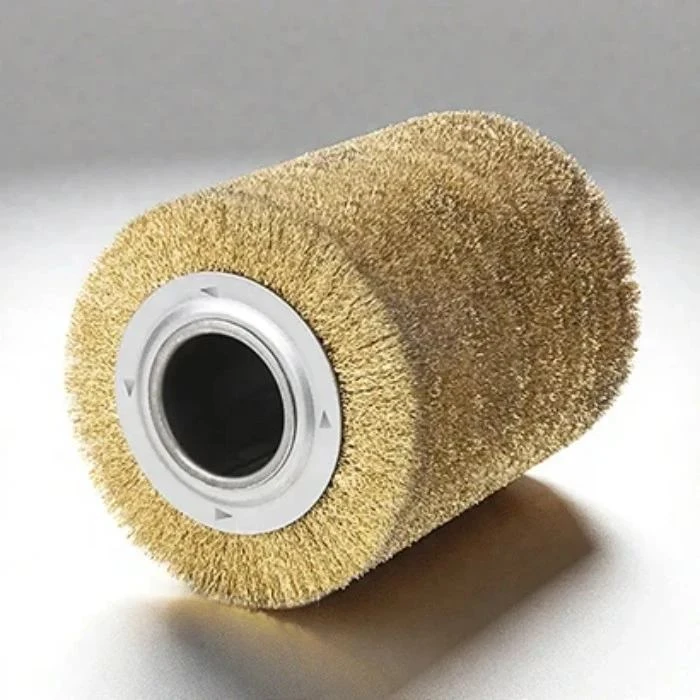
Copper-coated steel wire offers a middle ground. The copper plating costs more than bare carbon steel but significantly less than solid stainless. The coating provides moderate corrosion resistance and, more importantly, prevents sparking during use. This makes copper-coated steel brushes for cylinders the required choice in flammable environments and oil and gas maintenance. The raw material cost sits roughly 40 to 60 percent above carbon steel, depending on copper market prices and coating thickness.
The table below summarizes the wire material cost hierarchy for a typical 100 mm diameter cylinder brush:
A wooden core brush works fine on a slow-speed conveyor that turns at 300 RPM. On a deburring station spinning at 3,500 RPM, a wooden core will fail within hours. The cost jump from wood to steel tube is roughly 20 to 35 percent. From steel tube to precision-machined aluminum with a keyed bore, the core cost alone can triple. The right question when specifying core material is not “what costs less” but “what survives the operating speed and duty cycle.”
Machining Tolerance and Bore Specifications
A plain through-bore costs less than a precision-bored hole with a keyway. The difference in machining time is measured in minutes per unit, but across a batch of 50 brushes, those minutes add up. A keyed bore with H7 tolerance typically adds 10 to 15 percent to the core cost compared to a plain bore with standard clearance.
For high-speed applications, core balance becomes a cost factor. Dynamically balanced cores cost more to produce but eliminate the vibration that causes premature bearing wear on the drive system. The article on brush vibration troubleshooting covers how core imbalance translates into operational problems and why paying for a balanced core saves money on downstream maintenance.
How Do Custom Specifications Compare to Standard Configurations on Cost
Custom cylinder brushes made of steel wire carry a premium of 15 to 30 percent over equivalent standard catalog brushes. This premium covers dedicated setup time, non-standard tooling, and lower production efficiency. However, field-modifying a standard brush to fit non-standard equipment often costs more in labor and downtime than the custom premium.
What “Custom” Actually Means in Pricing Terms
Standard cylinder brushes are produced in batch runs with fixed tooling. The manufacturer sets up a winding machine for a specific diameter, trim length, and wire density, then runs hundreds of units without changes. Setup cost per unit approaches zero at volume.
Custom brushes interrupt this flow. A non-standard diameter requires a different mandrel. A mixed-filament pattern needs either manual intervention or a more complex winding program. A specific shaft keyway demands a separate machining operation after core fabrication. Each of these changes adds cost.
Common customizations and their typical cost impact:
- Non-standard diameter (not in the manufacturer’s catalog): 10 to 20 percent premium
- Specific shaft bore diameter and keyway: 10 to 15 percent premium
- Mixed-filament zones (steel wire in one section, nylon in another): 20 to 35 percent premium
- Non-standard overall length outside catalog range: 5 to 15 percent premium
- Specialized wire density (extra-high or extra-low fill): 10 to 20 percent premium
These premiums are additive when multiple customizations stack. A brush that needs a non-standard diameter, a custom keyway, and mixed filaments can push 50 percent above the closest catalog equivalent. The question is whether the alternative, adapting the machine to fit a standard brush, costs more.
When Custom Pays for Itself
A standard brush with the wrong shaft diameter requires either machining the shaft or fabricating an adapter. Both take production time. A standard brush that is 10 mm short on overall length leaves the edges of a conveyor belt uncleaned, creating a second cleaning step. The conveyor cylinder brush sizing guide details how small dimensional mismatches cascade into higher operational costs.
The break-even math is straightforward. If a custom brush costs $35 more than the closest standard option, and field-modifying the standard brush takes 45 minutes of maintenance labor plus 30 minutes of line downtime, the custom brush wins before the line restarts. Plants that run custom brushes report fewer mounting failures, less unplanned downtime, and lower total cost of ownership despite higher unit prices.
Does Order Volume Significantly Change Unit Pricing
Volume is the most direct lever buyers have on steel wire cylinder brush pricing. Orders of 20 to 50 units typically unlock 10 to 15 percent discounts. Orders above 100 units can reach 20 to 30 percent below single-unit pricing. Annual contracts with scheduled releases often yield the best rates because they let manufacturers plan production and purchase raw materials in bulk.
The Volume Discount Structure
Manufacturers optimize production around batch efficiency. Setting up a winding machine for a specific brush configuration takes time regardless of whether the batch is 5 units or 500. The setup cost amortizes across the batch, so larger batches carry lower per-unit overhead.
Typical volume discount tiers in the industrial brush market:
Annual contracts with staggered deliveries offer the best of both worlds. The manufacturer gets a volume commitment that justifies bulk raw material purchasing. The buyer gets bulk pricing without having to store and manage a year’s worth of inventory. A contract for 500 brushes delivered in monthly lots of 40 to 45 units often prices within 5 percent of a single 500-unit shipment, while reducing warehousing cost and the risk of wire corrosion during long-term storage.
Negotiating Beyond Unit Price
Volume negotiations open doors to concessions beyond the line-item price. Buyers ordering at scale can push for consignment inventory at their facility, where the supplier stocks brushes on-site and bills only when units are pulled from inventory. Free sampling of new configurations for testing becomes standard at volume, not a favor. Lead times compress because the supplier prioritizes customers who represent consistent revenue.
The single most effective negotiating point is consistency. A buyer who orders 50 brushes every quarter for three years is worth more to a manufacturer than one who places a one-time order of 500. Manufacturers value predictable demand because it stabilizes their raw material purchasing and labor scheduling. Buyers who can commit to a forecast, even a rough one, earn better pricing than those who cannot.
How Should Buyers Evaluate Total Cost of Ownership Versus Unit Price
Unit price is the number on the invoice. Total cost of ownership includes that number plus installation labor, downtime during replacement, the cost of premature failure, and the productivity lost to underperforming brushes. A $22 brush that runs for nine months costs less over a year than an $8 brush that needs replacement every three months.
The Replacement Cycle Economics
Brush life varies with application severity. In a light-duty conveyor cleaning application, a well-specified steel wire cylinder brush might run 12 to 18 months. In a heavy deburring application running 16 hours a day, the same brush might need replacement every 6 to 8 weeks. The math on replacement cost changes with the application.
Consider a deburring station that runs two shifts daily. A low-cost carbon steel brush at $12 lasts 6 weeks. A higher-grade industrial metal cylinder brush with optimized wire density at $28 lasts 18 weeks. Over a 52-week year, the $12 brush costs $104 in replacements (8.7 replacements) and requires 8 changeovers. The $28 brush costs $84 in replacements (2.9 replacements) plus 3 changeovers. The “cheaper” brush costs $20 more per year in parts alone, before counting the five extra changeovers.
Maintenance Labor and Downtime
Each brush change on a production line takes time. A straightforward swap on an accessible conveyor might take 15 minutes. A brush inside a guarded machine with hard-to-reach mounting bolts can take an hour to change. Those changeovers are not free, especially at a fully burdened maintenance labor rate of $45 to $75 per hour.
The formula for total annual brush cost:
Annual cost = (Brush unit price × Replacements per year) + (Changeover hours × Labor rate × Replacements per year) + (Downtime hours × Cost of downtime × Replacements per year)
For a production line where downtime costs $500 per hour, the difference between a brush that needs 3 changeovers and one that needs 8 can run into the thousands of dollars, completely dwarfing the unit price difference.
When to Pay More and When to Standardize
Paying more for a longer-lasting brush makes sense in high-utilization applications where downtime is expensive. It makes less sense in low-utilization applications where brushes are replaced on a calendar schedule regardless of wear, such as quarterly preventive maintenance that happens during planned shutdowns.
The cylindrical wire brush selection guide covers how to evaluate brush specifications against actual usage patterns. The key insight is that a brush optimized for one application often performs poorly in another. A brush designed for aggressive oil and grease removal will wear out quickly in a dry dust application, and vice versa. Matching the brush to the job is the first step in optimizing total cost.