
Production lines run on predictable cadences. A belt moves. A product advances. A brush spins. When any one of these steps falls out of rhythm, downtime starts stacking up. One of the most common failure points is a conveyor cylinder brush that does not match the line it sits on. Off-the-shelf brushes come in fixed diameters, fixed shaft sizes, and fixed bristle lengths. Lines are not built in fixed dimensions. If the brush face does not make full contact with the belt surface, residue slips through. If the shaft bore is a hair too small, mounting becomes a headache. If the overall length leaves a gap at the edge, material buildup starts right there.
Maintenance teams deal with these mismatches by shimming, trimming, or stacking spacers. That works for a shift or two. Over weeks, the workarounds wear out bearings, strip shafts, and leave belt sections uncleaned. The brush becomes a recurring line item on the repair log rather than a reliable cleaning stage.
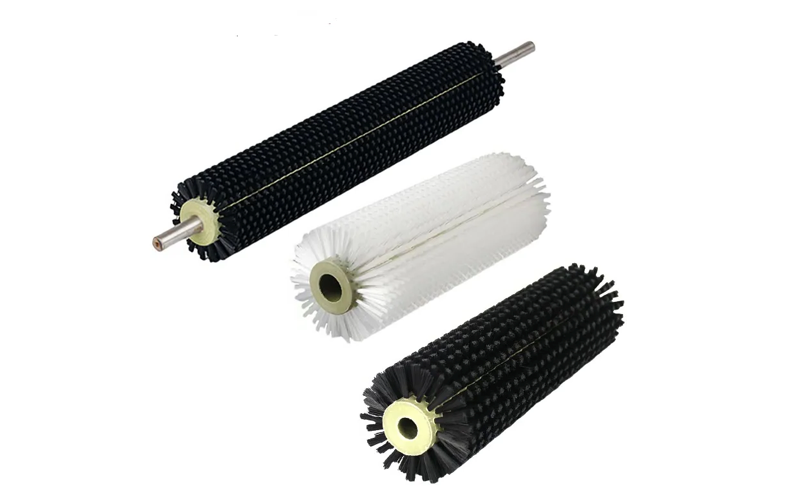
A custom-sized conveyor cylinder brush eliminates these fit problems before the brush ever reaches the line. Core dimensions—shaft diameter, brush outside diameter (OD), bristle trim length, and overall brush length—are built to the exact specs of the conveyor system. The brush arrives ready to mount with full-face contact and correct clearance, no field modifications needed.
Custom sizing shifts the burden of accuracy from the installer to the manufacturer. Instead of making the line adapt to the brush, the brush is built to fit the line. This approach matters most in high-speed food processing, material handling, and automated packaging, where a few millimeters of misfit mean product loss or sanitation gaps.
The sections below walk through the four dimensions that make or break a conveyor cylinder brush fitment: shaft compatibility, brush diameter, bristle trim length, and overall length. Each section covers what to measure, common pitfalls, and how to communicate specs to a brush manufacturer.
What Dimensions Define a Custom Conveyor Cylinder Brush
Four core dimensions control how a conveyor cylinder brush fits and performs in a production line: shaft diameter, brush outside diameter (OD), bristle trim length, and overall brush length. Getting these four numbers right at the specification stage removes the need for field adjustments and ensures consistent belt contact across the full brush face.
Every conveyor cylinder brush starts as a set of numbers. A manufacturer takes those numbers and builds the brush around a core shaft or tube. The shaft connects to the drive system. The bristles wrap around the core in a spiral, coil, or channel-mount pattern. The brush OD sets the contact depth against the belt. The bristle trim length determines how much filament extends from the core to the belt surface. The overall length defines coverage width.
Missing or rounding any one of these dimensions creates a cascade of fit problems that compound as the line runs.
Shaft Diameter and End Configuration
The shaft is the mounting interface between the brush and the conveyor drive. A shaft that runs undersized chatters in the bearing housing. One that runs oversized needs the housing bored out or the shaft turned down, both of which add labor and risk damaging the brush.
Shaft diameter is measured on the bare shaft section where bearings or drive couplings attach. Common shaft diameters for industrial conveyor brushes range from 0.75 inches (19 mm) to 3 inches (76 mm), though larger custom shafts are standard for wide-belt applications. The measurement must be taken with a caliper at the exact mounting point, not assumed from a parts catalog. Bearings wear, and housings shift over years of operation, so the measurement on the hardware in the line is more reliable than the original drawing.
End configuration is just as important as diameter. Options include:
- Keyed shafts for positive drive engagement
- Plain round ends for clamp-collar mounting
- Square ends for manual crank or ratchet drives
- Tapered or splined ends for quick-change systems
- Threaded ends for shaft-mounted sprockets
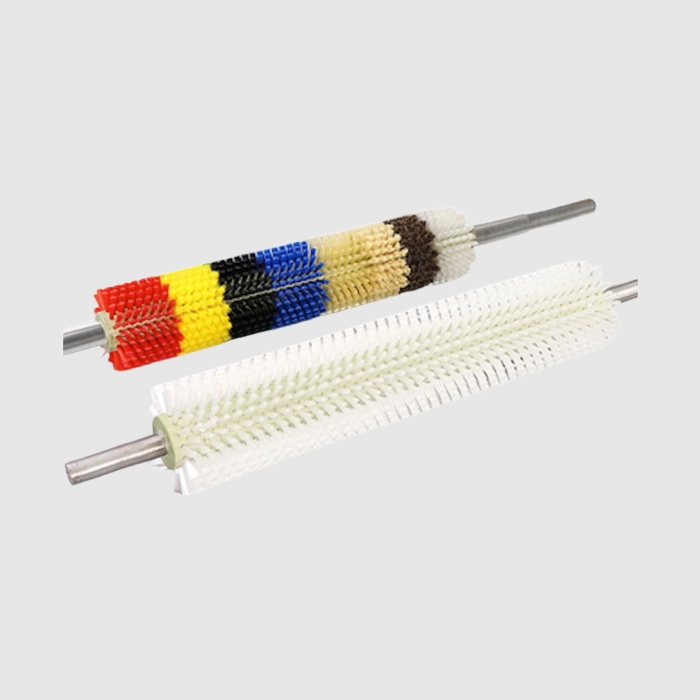
A cylinder rotary brush with the wrong end configuration will not engage the drive even if every other dimension is correct. Ask the manufacturer for a shaft-end drawing before production starts.
Brush Outside Diameter
The brush OD sets how deeply the bristle tips press into the belt surface. Too small an OD and the tips barely graze the belt. Too large and the bristles flex excessively, overheating at the root and snapping within weeks.
OD is measured as the distance across the brush at the bristle tips when the brush is new. Industry-standard ODs for conveyor cleaning applications run from 4 inches (100 mm) to 24 inches (600 mm). The correct OD for a given line depends on two variables: the clearance between the belt return side and the brush mounting position, and the desired bristle interference depth.
A good starting rule: set the brush OD so that bristle tips penetrate 2 to 5 mm past the belt plane. This depth gives enough contact to dislodge carryback without creating drag that loads the motor. For sticky materials like dough or wet clay, push toward 5 to 8 mm of interference and pair it with a nylon cylinder brush that has the abrasion resistance to handle deeper flex cycles.
The table below maps typical OD ranges to common conveyor widths:
Bristle Trim Length
Bristle trim length is the distance from the brush core surface to the bristle tip. It controls how far the filament can flex before it either releases the debris or snaps. Shorter trim lengths produce stiffer brush faces. Longer trim lengths give more wrap-around contact and are better for cleaning textured or ribbed belts.
Trim lengths between 0.75 inches (19 mm) and 3 inches (76 mm) cover most conveyor cleaning applications. The material being cleaned drives the length choice more than the belt type does:
- Dry, free-flowing materials like grain dust or plastic regrind: shorter trim (0.75 to 1.25 in) for a stiff, flicking action
- Sticky or wet residues like dough, batter, or pulp slurry: longer trim (1.5 to 3.0 in) for wrap-around wiping
- Abrasive carryback like sand, cement, or foundry slag: medium trim (1.0 to 2.0 in) in an abrasive-impregnated filament like silicon-carbide nylon
Bristle density works with trim length to tune the brush face stiffness. A densely packed brush with short trim cuts like a scraper. A sparsely packed brush with long trim wipes like a mop. Both have their place, and the right combination depends on what the line carries.
Overall Brush Length
Overall length is the dimension most likely to be ordered wrong. The number needed is the face-width coverage, not the shaft-tip-to-shaft-tip length. Face width is the section of the brush that carries bristles and makes contact with the belt. It should exceed the belt width by 0.5 to 1 inch (12 to 25 mm) on each side.
The reason for overhang is edge wear. If the brush face ends exactly at the belt edge, the outermost bristles take an uneven load and fail early. Overhang also catches material that drifts toward the belt edges before it can accumulate on return rollers.
A conveyor belt cleaning brush built to the correct overall length covers the belt without wasting filament on dead space beyond the edges.
What Bristle Materials Work Best for Custom Conveyor Brushes
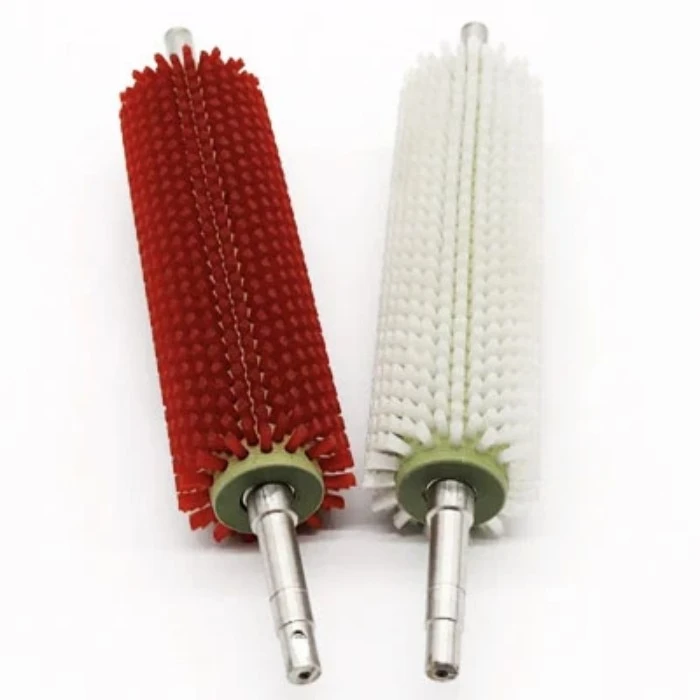
Nylon 6/6 and nylon 6/12 filaments handle the widest range of conveyor cleaning applications. Their balance of flex fatigue resistance, abrasion tolerance, and temperature stability makes them the default choice for custom brushes unless the application demands something else, like polypropylene for chemical exposure or abrasive nylon for heavy-duty scraping.
Material selection for a conveyor cylinder brush comes down to four factors: what is being cleaned off the belt, at what temperature, with what chemical exposure, and for how many hours a day.
Nylon: The Baseline Material
Nylon filaments absorb impact without snapping and recover their shape cycle after cycle. Nylon 6/6 stays dimensionally stable to around 200°F (93°C) in dry operation. Nylon 6/12 absorbs less moisture, which matters in washdown environments where filament swelling can close the gap between bristle tip and belt.
Abrasive nylon takes standard nylon and loads it with silicon carbide or aluminum oxide grit during extrusion. The grit runs through the full body of the filament, so fresh abrasive is exposed as the bristle wears. This material works for cleaning belts that carry sand, cement, glass cullet, or metal fines.
The trade-off with abrasive nylon is that it wears the belt surface itself. The grit that cuts through carryback also scuffs rubber and polymer belt covers. Match the grit grade to the soil, not to the belt material.
Polypropylene: Chemical and Moisture Resistance
Polypropylene bristles shrug off water, acids, and alkalis that swell or soften nylon. They work in wet scrubbers, chemical baths, and food lines where belts see continuous washdown with chlorinated cleaners. The trade-off is lower flex fatigue resistance. Polypropylene bristles take fewer bend cycles before snapping compared to nylon of the same diameter.
Polypropylene also generates less friction heat than nylon at equivalent RPM, so it can run at slightly higher surface speeds in dry conditions. But the temperature ceiling is lower: around 180°F (82°C) for continuous duty.
Wire and Abrasive Filament Options
Stainless steel and carbon steel wire bristles handle extreme temperatures and heavy, baked-on residues that polymer filaments cannot touch. A steel wire brush running against a steel or rubber belt at high RPM cleans aggressively. The risk is belt damage, especially at the edges where wire tips dig in.
For belts that carry hot asphalt, cured rubber flash, or furnace slag, a wire-filled brush is often the only option that survives the heat and abrasion. Flat wire, crimped wire, and knotted wire configurations each produce a different cleaning profile. Knotted wire is the most aggressive and should only be run on all-metal belts.
The comparison table below summarizes material performance:
How Filament Diameter Works with RPM
Filament diameter, measured in thousandths of an inch or millimeters, controls bristle stiffness. Thicker filaments are stiffer at the same trim length and hit the belt with more force at a given RPM.
Common filament diameters for conveyor cylinder brushes:
- 0.010 to 0.020 inch (0.25–0.50 mm): food-contact belts, gentle cleaning, baked goods
- 0.020 to 0.030 inch (0.50–0.76 mm): general industrial cleaning, moderate carryback
- 0.030 to 0.045 inch (0.76–1.14 mm): heavy residue, mining, aggregate
- 0.060+ inch (1.52+ mm): abrasive nylon, extreme-duty scraping
A brush with 0.020-inch nylon filaments at 400 RPM cleans bread crumbs from a bakery belt without damaging the belt cover. The same brush with 0.040-inch abrasive nylon filaments at the same RPM strips cured resin buildup from a composite manufacturing line.
Duty cycle matters as much as peak RPM. A brush running 24 hours on a continuous process line needs to be sized conservatively on both OD and RPM to push replacement intervals past 6 months. Undersize the brush or overspeed it, and you are swapping brushes quarterly. The article on selecting conveyor belt cleaning brushes goes deeper into filament selection for washdown and sanitary environments, where material choice and RPM interact with cleaning chemical exposure.
How Do You Communicate Custom Specifications to a Manufacturer
Send the manufacturer four measurements taken from the actual conveyor hardware, not copied from a parts catalog: shaft diameter at the bearing seat, clearance from shaft center to belt face, belt width at the cleaning station, and available bore for shaft ends. Add the material being cleaned, belt speed, and operating temperature. These seven data points are enough for a competent brush maker to produce a working quote.
Brushes ordered from catalog dimensions fail at roughly twice the rate of brushes built to on-site measurements. The gap between the drawing and the worn hardware kills fit. Take measurements with the line down, the belt tension released, and the bearing housings accessible.
The Seven-Point Specification Checklist
Send these seven values when requesting a quote:
- Shaft diameter at bearing seat: caliper measurement, not nominal. Record to 0.001 inch or 0.01 mm.
- Brush OD clearance: distance from shaft centerline to belt face, measured with the belt at rest. Subtract 2 to 5 mm for interference depth.
- Belt width at the cleaning station: the actual belt width, not the conveyor frame width.
- Available mounting space: the distance between bearing housings where the brush sits.
- Belt surface material: rubber, PVC, PU, metal mesh, modular plastic, or fabric. Different surfaces tolerate different bristle materials.
- Material being cleaned: be specific. “Flour dust” tells a manufacturer more than “food residue.”
- Operating temperature and washdown chemicals: both affect filament choice and core material selection.
Drawing Review Before Production
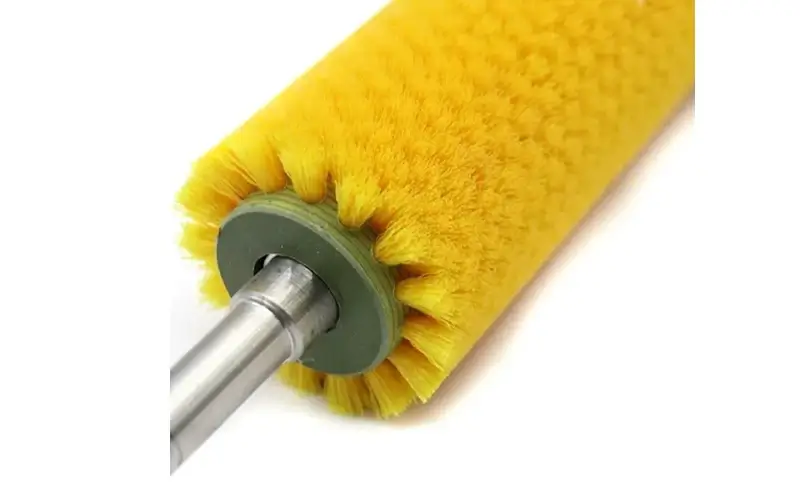
Any brush shop that does custom work should provide a shop drawing before cutting materials. Review it against the actual hardware. Check the shaft diameter, the brush OD, the trim length, and the overall length. If the drawing shows a dimension that differs from the site measurement, flag it before the first bristle gets wound.
The OEM conveyor cleaning brush specs page outlines the documentation package that a manufacturer should supply—shop drawings, material certifications, and a build sheet—before production begins. A manufacturer that ships brushes without these documents is guessing. Guesses cost production time.
Lead Time and Stocking Strategy
Custom brushes take longer to produce than stock brushes. Lead times of 2 to 6 weeks are typical for made-to-order conveyor cylinder brushes. Plan for this window by keeping at least one spare brush on the shelf per cleaning station. Order the replacement when the running brush hits 50% of its expected service life, not when it fails.
A brush that fails mid-shift stops the line. A replacement that takes four weeks to arrive stops it for a month. The math on spares is simple.
Common Misconceptions About Custom Conveyor Cylinder Brushes
A few persistent beliefs about custom brushes lead production teams toward wrong decisions. Clearing these up before ordering saves time and money.
“Custom brushes cost too much compared to stock.” The premium for custom sizing is typically 15 to 30% over an equivalent stock brush. That premium buys a brush that mounts the first time correctly. Stock brushes that need field modification—turning down shafts, cutting bristles, adding spacers—often end up costing more in labor and downtime than the custom premium. The total cost of ownership favors the brush that fits.
“Any brush with the right OD will work.” OD is one of four critical dimensions. A brush with the correct OD but the wrong shaft diameter will not mount. One with the correct OD and shaft but the wrong overall length leaves belt edges uncleaned. Fit requires all four dimensions to be correct simultaneously.
“Faster brush speed means better cleaning.” Beyond a material-specific threshold, faster RPM adds heat, accelerates wear, and increases motor load without improving cleaning. A brush running too fast also throws debris farther, spreading contamination rather than containing it. Speed should match the belt and the material, not the impulse to max out the drive.
“Nylon bristles work for everything.” Nylon is the most versatile material, but it is not universal. Chemical washdowns with strong acids break down nylon over time. Temperatures above 200°F soften nylon enough to fold the bristles. Wet belts in continuous immersion favor polypropylene. High-heat, high-abrasion applications need wire. Match the material to the conditions.
Sizing a Conveyor Cylinder Brush: A Step-by-Step Summary
A properly sized custom brush eliminates the gap between what the line needs and what a catalog offers. The process from blank page to installed brush follows a clear path:
- Measure shaft diameter, OD clearance, belt width, and mounting space directly from the conveyor hardware.
- Choose bristle material based on temperature, moisture, chemistry, and the material being cleaned.
- Select trim length and filament diameter for the right combination of stiffness and belt contact.
- Set brush OD to achieve 2 to 8 mm of interference depth against the belt.
- Calculate RPM to hit the target surface speed ratio for the belt speed.
- Submit the seven-point specification to the manufacturer and review the shop drawing.
- Order a spare when the running brush reaches mid-life.
A conveyor cylinder brush built to these steps arrives ready to mount. It makes full-face contact along the belt. Its shaft fits the bearing housing without modification. Its bristles clear carryback without damaging the belt cover. And it runs for months before needing replacement, not weeks.
When the line depends on consistent belt cleaning, the difference between a stock brush that almost fits and a custom brush that fits exactly is measured in production hours—not just maintenance minutes.
FAQ
What is the difference between a conveyor cylinder brush and a strip brush for belt cleaning?
A conveyor cylinder brush uses a cylindrical core with bristles radiating outward in all directions, driven by a motor or belt-driven shaft. It spins against the belt return side. A strip brush has bristles mounted along a flat, rigid backing and is held stationary against the belt. Cylinder brushes clean more aggressively because the rotating bristles flick material off rather than wiping it. Cylinder brushes also self-clean better since centrifugal force throws debris clear, while strip brushes can pack with material and lose contact. For continuous, high-speed lines, cylinder brushes handle higher throughput with less maintenance intervention.
How do I know if my brush needs a keyed shaft or a plain shaft end?
The drive mechanism answers this question. If the brush is driven by a sprocket, pulley, or gear that transmits torque through a keyway, get a keyed shaft. If the brush mounts into pillow block bearings and is driven by a clamped coupling or set-screw collar, a plain round shaft end works. Keyed shafts prevent slippage under load but cost more to machine. Plain shafts are simpler and cheaper but can spin in a clamp if the set screw loosens. For high-torque applications above 5 horsepower or for brushes over 12 inches in OD, a keyed shaft is recommended. Confirm the keyway dimensions (width and depth) with the manufacturer against the ANSI or metric key standard your drive hardware uses.
Can two different bristle materials be combined in the same brush?
Yes. Mixed-filament brushes combine materials to handle multiple cleaning objectives at once. A common configuration alternates rows of nylon and abrasive nylon: the nylon rows sweep loose material while the abrasive rows cut through hardened buildup on the same pass. Another pattern pairs nylon and stainless steel wire on belts that carry a mix of wet organic residue and mineral scale. The filament row spacing, trim length, and material ratio are all specifiable. Mixed-material brushes cost more than single-material builds and take longer to produce. For most single-material carryback situations, a well-chosen single filament does the job. Mixed filaments earn their premium on belts where two distinct soil types require two different cleaning actions in one pass.