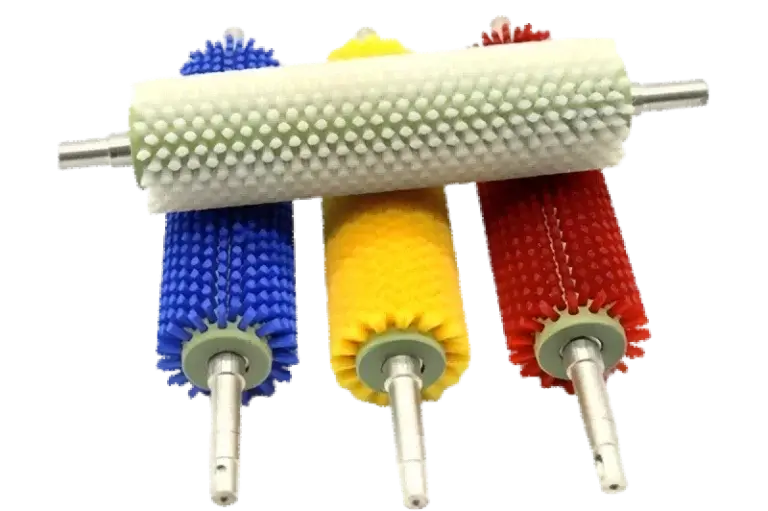
Boot washer machines sit at every controlled boundary of a modern production facility, at the doorway between a low-care changing room and a high-care processing hall, at the entrance to a pharmaceutical cleanroom, at the portal from a mine bench into a workshop. Everyone who walks through must be processed, and the component that performs the processing is a rotating cylinder of filament. When that cylinder is specified on price alone, boots pass through and come out looking clean while organic residue remains packed in the tread; disinfectant is applied over a protective layer of soil, and the entry control point quietly stops working.
Filament choice decides cleaning performance in a nylon roller brush for boot washer machines because the filament is the only element that actually contacts the boot. Its polymer grade sets how much stiffness it retains once permanently wet; its diameter and trim length set the contact force delivered to the sole; its density sets how much of the sole it contacts per pass; and its fatigue resistance sets how many operating hours pass before cleaning quality declines. Motor power, water pressure and machine design only enable the filament to do its job; they cannot compensate for a filament that softens, mats, flags or breaks under the conditions that boot washing imposes.
This article works through that chain of decisions in the order a specification actually has to be made, starting with why nylon is the default, moving through polymer grade, diameter, density and geometry, then through machine-side variables such as brush position, speed and balance, and finishing with wear criteria, maintenance and the data a supplier needs to quote accurately.
Why the Filament, Not the Machine, Sets the Cleaning Ceiling
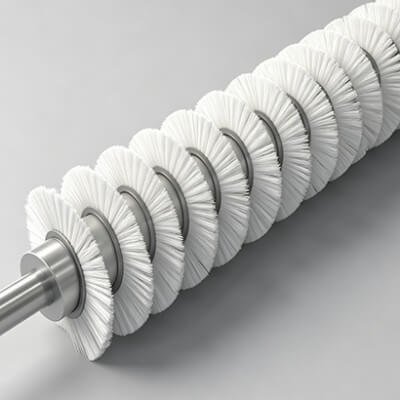
A nylon roller brush is a cylindrical brush built from polyamide filament anchored into a rotating core, mounted so that the roller contacts the boot upper and sole while water sprays flush the loosened contamination away. In a boot washer, it is the working element: every other component in the machine exists to position the filament correctly, drive it at the right speed, and remove what it dislodges.
The mechanism deserves closer attention than it usually gets, because it explains why filament selection has such outsized consequences. As the roller turns, individual filaments are driven against the boot surface and bend. Bending generates contact force at the tip, and the tip scrapes across the surface. The filament then leaves the contact zone, recovers its original shape, and strikes again on the next revolution. Each individual filament repeats this cycle several times per second for hours per day.
That cycle imposes two simultaneous and partly conflicting requirements. The filament needs enough stiffness to press into tread grooves and lift compacted material, and enough flexibility to survive the deflection without fatiguing at the root, matting, or abrading the boot. It also has to do this in water, which is the harshest possible environment for many polymers.
Nylon handles those conditions better than the available alternatives in this application.
- Abrasion resistance. Polyamide filament resists wear against rubber, leather, and grit far better than polypropylene, which softens more readily under friction and heat and tends to flatten rather than recover.
- Elastic recovery. Nylon returns to shape after deflection. This keeps contact pressure consistent across the whole service life rather than degrading as the brush ages.
- Chemical tolerance. Nylon endures oils, greases, and mild alkaline wash chemistry, which covers the cleaning agents and quaternary ammonium disinfectants typically used at hygiene control points.
- Surface safety. Unlike steel wire, nylon will not scratch boot compounds, tunnel flooring, or drainage grates, and it cannot shed rust particles into a clean zone.
- No biological degradation. Unlike natural bristle material, nylon does not support mould, mildew or insect damage in a permanently damp installation.
For a fuller description of the underlying polymer chemistry and its mechanical behaviour, the general reference on polyamide is a reasonable starting point.
The practical consequence of all this is that the brush, not the machine, sets the ceiling on cleaning performance. A boot washer with an oversized motor and a generously rated pump will still underperform if the filament in it has lost its wet stiffness, and no amount of additional water flow will remove contamination that the filament never reached.
The Hygiene Case for a Nylon Roller Brush
A boot washer is not an accessory in a facility operating under a recognised food safety scheme; it is a documented preventive control. HACCP, ISO 22000 and BRCGS-benchmarked standards all treat footwear as a contamination vector that must be controlled when personnel cross from low-risk into high-risk or high-care areas, and several schemes require that where a boot cleaning device replaces footwear changeover, its effectiveness must be verified through environmental monitoring.
The reason is straightforward. Footwear contacts every floor surface in a facility, then crosses the boundaries that the facility’s hygiene design is built to protect. Studies cited in facility hygiene literature estimate that a large majority of floor contamination transfer occurs through shoes and boots, and the arithmetic of daily movement makes the exposure volume enormous: a facility with 100 employees working two shifts generates up to 200 controlled boot-cleaning events every day, multiplied again wherever a site operates several hygiene-zone boundaries.
That volume is what makes the physical cleaning step non-negotiable, and it is worth stating plainly:
Cleaning is a prerequisite for disinfection. Residual organic matter protects microorganisms from sanitiser and can itself become a contamination reservoir.
A boot that has been sprayed with disinfectant while still coated in fat, blood, flour, or mineral slurry has not been disinfected, because the sanitiser never reached the surface. The filament is what removes that organic layer. If the filament does not reach into a tread groove where compacted residue sits, no downstream chemical step recovers the failure, and the boot washer becomes a compliance record rather than a control.
Matching Brush Zones to Hygiene Risk Levels
Different hygiene regimes justify different brush specifications, and a facility with several zone boundaries will normally need more than one.
| Zone Transition | Typical Contamination | Brush Specification Priority |
| Exterior to low-care or changing room | Grit, mud, mineral slurry, dust | Durable sole brushes, high contact pressure, abrasion resistance over softness |
| Low-care to high-care | Flour, food residue, general organic soil | Balanced upper and sole coverage, wet-stable filament, easy cleaning |
| High-care to ready-to-eat or packaging | Fat, protein, blood, biofilm precursors | Soft upper filament to protect hygiene-critical surfaces, dense and cleanable construction |
| Dry areas where floors are kept dry | Fine dust and powder | Softer, moderately dense filament; avoid heavy water-dependent designs |
Where footwear is changed rather than cleaned, the brush is not in the critical path. Where the boot washer is the control point, the filament is part of the food safety system and should be specified and documented with that status in mind.
Choosing the Nylon Grade: The Decision That Determines Everything Else
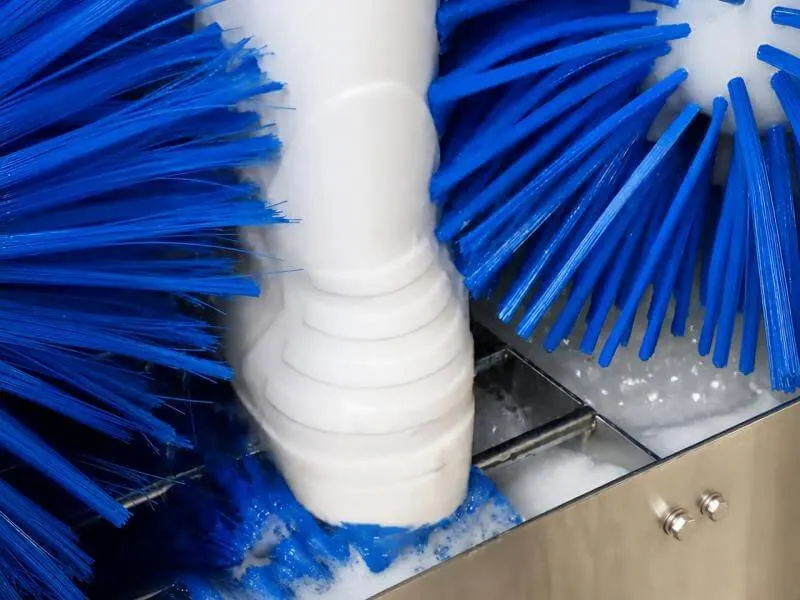
Polymer grade is the first decision, not diameter. In a permanently wet application such as boot washing, the decisive property is moisture absorption, because absorbed water acts as an internal plasticiser: it swells the filament and softens it, so a filament that feels appropriately stiff when dry delivers noticeably less contact force once the brush has been running wet for days. Grades with low moisture absorption retain their working stiffness in service, which is why they outperform nominally stiffer grades in this environment.
The magnitude of that effect is the single most useful number in this whole specification exercise. A general-purpose PA6 filament exposed to continuous wet operation may retain only around 55 to 70 percent of its dry stiffness. A low-absorption grade such as PA610, in the same conditions, retains approximately 85 to 92 percent. Two brushes with identical declared diameter can therefore behave completely differently after a month in a boot washer, and the difference is invisible on a purchase order that lists only the diameter.
PA6, PA66, PA610 and PA612 Compared
The numeric suffix in each grade encodes the carbon chain length of the monomers used to polymerise it. Longer chains produce filaments with lower moisture absorption, better chemical resistance, and greater flexibility, at some cost in room-temperature tensile strength and in raw material price.
| Property | PA6 | PA66 | PA610 | PA612 |
| Moisture absorption at equilibrium | 3.5 to 4.5 percent | 2.5 to 3.5 percent | 1.3 to 1.8 percent | 1.2 to 1.6 percent |
| Flexural modulus | 2.5 to 3.2 GPa | 2.8 to 3.5 GPa | 1.6 to 2.2 GPa | 1.5 to 2.0 GPa |
| Wet stiffness retention | 55 to 70 percent | 65 to 80 percent | 85 to 92 percent | 88 to 94 percent |
| Melting point | approx. 215 to 225 C | approx. 255 to 265 C | approx. 212 C | approx. 212 C |
| Continuous use temperature | approx. 100 C | approx. 120 C | approx. 110 C | approx. 110 C |
| Relative cost | Low | Moderate | High | Highest |
| Key limitation | Significant stiffness loss when wet | More brittle at low temperature | Lower modulus at equal diameter | Highest raw material cost |
The practical mapping for boot washing equipment follows directly from that table.
- PA610 and PA612 are the natural candidates for wet boot washing. Low moisture uptake means the brush behaves in service much as it behaves on the specification sheet. PA610 offers the better balance of moisture stability and cost; PA612 is reserved for the most demanding cases where dimensional consistency matters more than unit price.
- PA66 suits hot wash cycles and heavy contamination. Its higher melting point and hardness make it appropriate above roughly 100 C and for compacted mineral or clay contamination, but its greater stiffness applies more contact force to the boot upper, which is not always desirable.
- PA6 is the economy option for short-duty or intermittent installations. It is tough and cost-effective, and it can work well where the brush is not permanently saturated. Where it is specified for continuous wet duty, the diameter must be selected from the wet-conditioned stiffness rather than the dry figure.
- PA46 and PA1010 cover extremes. PA46 addresses sustained temperatures above 120 C, though its own moisture absorption is high and it requires drying before processing. PA1010 offers the lowest moisture absorption of the group alongside extreme chemical resistance, at the cost of a limited supplier base.
For a broader reference on how these grades behave as structural materials, consult a filament selection guide that publishes conditioned specimen data rather than dry-state figures, and always request the material datasheet for the specific grade being quoted.
Chemical Compatibility With Wash and Sanitizer Chemistry
Filament grade selection does not end with water. Boot cleaning stations routinely dose detergents and sanitisers, and compatibility between the filament and the chemistry determines whether the brush lasts its expected life or degrades quietly.
| Chemical Environment | PA6 | PA66 | PA610 | Note |
| Water and aqueous solutions | Fair | Fair | Good | Low-absorption grades hold stiffness better |
| Dilute acids, pH 4 to 6 | Fair | Fair | Good | Avoid extended contact below pH 4 |
| Strong mineral acids | Poor | Poor | Poor | Specify PVDF or PPS instead |
| Alkalis, including caustic wash systems | Good | Good | Good | Polyamides perform well in mild alkaline regimes |
| Quaternary ammonium sanitisers | Good | Good | Good | Standard for food factory footbaths |
| Chlorine and peracetic acid solutions | Fair | Fair | Good | Concentration dependent; verify with the supplier |
| Aliphatic hydrocarbons, oils and greases | Fair | Fair | Good | Longer carbon chain improves resistance |
| Aromatic solvents | Poor | Poor | Poor | Use polypropylene or PVDF with caution |
Two conclusions follow. First, the alkaline and quaternary ammonium chemistry typical of food factory boot stations is well within the capability of properly selected polyamide filament. Second, neither the sanitising chemistry nor the cleaning chemistry should be finalised independently of the brush specification; the brush supplier and the chemical supplier are both affected by the outcome.
Abrasive-loaded filament deserves separate mention. Filament impregnated with silicon carbide or aluminium oxide removes hardened mineral scale and rust effectively, and it is a reasonable choice for a first-stage position on a heavy industrial site. It is not appropriate against a boot upper, where its cutting action will degrade the boot surface and shorten the life of footwear.
Filament Diameter and Trim Length: Where Cleaning Force Comes From
Filament diameter is the most consequential physical dimension after polymer grade, because stiffness scales with the fourth power of diameter. A filament of twice the diameter is approximately sixteen times stiffer under equivalent bending load. This relationship explains both why small diameter changes produce large performance differences and why the common practice of substituting a slightly thicker filament to improve cleaning can overshoot badly and cause surface damage, fatigue failure, and motor overload.
Diameter selection for a boot washer is best approached by position rather than by a single sitewide figure.
| Diameter Band | Behaviour | Appropriate Boot Washer Position |
| 0.20 to 0.30 mm | Low contact force, gentle, needs high density to be effective | Fine upper and seam cleaning, delicate or coated footwear |
| 0.30 to 0.50 mm | The common industrial range; usable stiffness maintained across humidity range | Side brushes and general upper cleaning |
| 0.50 to 0.80 mm | Firm contact, effective debris lift | Sole and bottom brushes, moderate contamination |
| 0.80 to 1.20 mm | Rod-like behaviour, high contact force | Heavy contamination sole stations on mining and construction sites |
| Above 1.20 mm | Very aggressive, high motor torque required | Rarely justified; restrict to dedicated pre-clean stations at reduced speed |
Two further points govern whether the chosen diameter performs as intended.
Tip contact force. Published brush engineering guidance indicates that for cleaning without substrate damage, filament tip contact force should stay below roughly 0.05 N per filament in sensitive applications, rising to 0.5 N or more only in aggressive deburring work. Diameter selection controls this parameter directly, and it is the reason a specification that improves cleaning on a mineral-scaled mine boot can cause visible wear on a food factory boot upper.
Diameter tolerance. Mass-produced filaments are typically drawn to tolerances of plus or minus 5 to 8 per cent, while precision-drawn filament is held to plus or minus 2 per cent or tighter. Because stiffness depends on the fourth power of diameter, a 5 per cent diameter spread across a filament population translates into roughly a 22 per cent spread in stiffness. In a brush with thousands of filaments, this means some proportion of the filaments are doing noticeably more work than others, wearing faster, and determining when the brush as a whole deteriorates. Tighter tolerance is not a marketing claim; it is a factor in both cleaning consistency and service life.
Trim length is the distance the filament projects beyond the core, and it interacts with diameter to set the effective stiffness of the working element. Long unsupported filament deflects more freely and conforms well to irregular shapes, which suits curved boot surfaces, but delivers lower pressure. Short filament behaves as a stiffer element and delivers higher pressure but conforms less well. A useful working rule is to set trim length slightly greater than the boot tread depth, so the filaments reach the bottom of the grooves instead of skating across the tops. Deflection in service should also be kept within the ratio recommended for the grade, since excessive deflection raises cyclic stress and accelerates fatigue at the filament root.
Bristle Density, Tuft Pattern and Tip Geometry
Density determines how much of the boot surface is contacted during a single pass and how much load the drive has to carry. Higher density increases scrubbing force but restricts water flow between filaments and raises torque demand; lower density improves drainage and reduces load but leaves gaps that appear as streak marks on the boot.
| Density Level | Cleaning Effect | Water Flow | Motor Load | Suitable Position |
| Low | Soft, light contact | High | Low | Upper brushes on delicate footwear, dry dust applications |
| Medium | Balanced contact and coverage | Moderate | Moderate | General side positions, mixed boot populations |
| High | Strong scrubbing force | Restricted | High | Heavy contamination sole stations |
Choosing density independently of the other parameters causes two characteristic failures. Density set too high restricts water penetration between filaments, so the brush scrubs through a thin film rather than a flowing stream; cleaning quality falls even though the motor is working harder and drawing more current. Density set too low leaves proportionally larger gaps between tufts, producing bands on the boot that were never contacted, which is often misdiagnosed as a machine alignment fault.
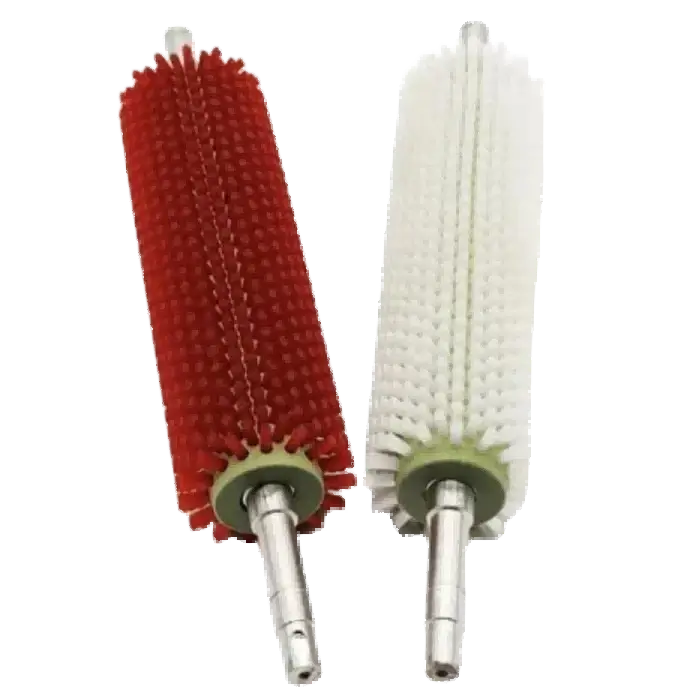
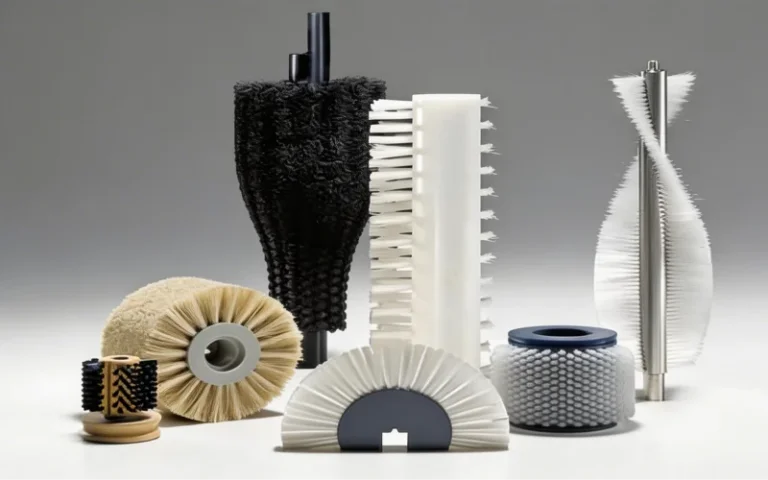
Tuft pattern matters for the same reason. In a tufted cylinder brush, spiral or outward-helical winding patterns move debris along the roller toward the ends, which helps ejection but means the contact footprint shifts continuously, which suits sole cleaning where the goal is deep penetration into tread grooves. Straight or aligned tuft patterns on a tufted cylinder brush produce a more uniform footprint, which suits upper cleaning. Worn or damaged filament in either pattern changes the distribution of mass and contact, so a partly damaged tufted cylinder brush can run differently from a new one even before visible wear becomes obvious.
Filament cross-section and end treatment are the details most often overlooked in this category.
- Round cross-section is the default: predictable stiffness, even contact, straightforward to specify.
- X-shaped or hollow cross-section filament drains water faster and carries more liquid into the contact zone, which improves rinsing and reduces residue left on the boot. It costs more and is used where wash quality matters more than unit price.
- Square-cut ends present a relatively sharp edge. As-manufactured filament is cut square, and that edge can scuff boot uppers and glazing.
- End-rounded filament contacts the surface over a small area rather than a point, which reduces friction-induced surface damage and extends the period before the tips flatten and lose efficiency. For any position that touches the boot upper, end rounding should be specified explicitly; it is not included by default in every quotation.
Brush Positions, Rotation Speed and Spray Coordination
A boot washer normally uses a combination of vertical and horizontal brush positions, and each position has different filament requirements. The vertical brushes handle the uppers and sides with softer filament; the horizontal brushes handle the soles with stiffer filament; and the entry point benefits from a light pre-clean brush that removes large loose material before it reaches either.
Vertical Brushes for Uppers and Sides
Vertical, or side, roller brushes are mounted in a symmetric arrangement so both sides of the boot are contacted at once. They should be positioned ahead of the sole brushes so that loose material is swept away rather than driven into the tread. Because these brushes contact the boot upper, their filament carries the smallest diameter in the assembly, typically 0.30 to 0.50 mm, with the lowest stiffness and end-rounded tips, and they must never be fitted with abrasive or wire filament. Adjustable spacing is valuable here, because boot widths vary substantially between light safety footwear and heavy mining boots, and a fixed gap either misses smaller footwear or over-compresses larger.
Horizontal Brushes for Soles and Treads
Horizontal, or bottom, brushes are the workhorses of the machine. They meet the sole, where contamination is most compacted and most difficult to remove, and they run the largest filament, the highest density, and the highest contact pressure. A slight installation angle offset from perpendicular improves coverage by spreading contact across the sole instead of concentrating it on a single line, which also reduces the risk of untouched bands. On mining and heavy industry installations, the horizontal brush diameter and length are usually the largest single specification on the machine.
Pre-Clean Brushes at the Entry Point
A light brush set at the tunnel entrance, before the main stages, removes large loose particles that would otherwise be driven into the tread by the primary brushes and then have to be extracted again. It is a small addition that measurably extends the life of the main brush set, because it reduces the size and abrasiveness of the material the primary filaments have to move.
Speed Selection and Centrifugal Stiffening
Speed is not an independent variable; it changes the effective stiffness of the filament. Above roughly 1,000 rpm, the centrifugal component becomes significant, stiffening filaments beyond their static behaviour, with the effect increasing approximately as the square of peripheral velocity. At 3,000 rpm on a 150 mm roller, peripheral speed approaches 23.5 m/s, at which point even a relatively soft 0.3 mm filament behaves markedly stiffer than it does at rest.
The practical rule that follows is to select a filament one diameter band smaller than you would for slow-speed or manual work performing the same duty. Oversized filament at high speed causes surface damage, elevated heat generation, and rapid fatigue failure at the filament root.
Boot washer brush systems typically run far below that threshold, in the range of roughly 30 to 60 rpm on the roller, with vertical brushes usually slower than horizontal ones because they contact the delicate boot upper. The outcome still depends heavily on speed.
| Speed Regime | Result |
| Below the specified range | Insufficient scrubbing force; residue remains in tread grooves |
| Within the specified range | Effective cleaning with acceptable filament fatigue |
| Above the specified range | Filament fatigue and breakage, heat build-up, spray splash-out, faster wear |
Speed and spray must be tuned together rather than treated as separate settings. Rotation loosens contamination and spray carries it away, so a correctly specified brush with an undersized or partially blocked spray pattern simply redistributes soil along the tunnel. Conversely, high flow with inadequate rotation wastes water without improving results. Spray nozzles that become clogged with debris and scale are one of the most common causes of an apparently underperforming brush.
Core, Shaft, Mounting and Dynamic Balance
The core, shaft and mounting system determine whether the filament’s carefully specified contact behaviour is delivered consistently across the full face of the roller. A correctly filled brush on a bent shaft, an off-centre bore or a misaligned mount will vibrate, wear unevenly and transfer load into the machine’s bearings, and the resulting symptoms are routinely mistaken for a filament problem.
Core material. Steel and stainless steel cores carry torque and span long working faces. Stainless grades are effectively mandatory in washdown environments, where a plain steel core can corrode faster than the filament wears. Plastic and PVC cores are lighter and cheaper, reduce rotating mass and energy consumption, and resist corrosion well, but they are not appropriate for heavy loads or long spans. For a boot washer, where the roller is permanently wet and often exposed to sanitiser chemistry, the core material is a service-life decision rather than a cost decision.
The mounting method should follow the maintenance strategy as much as the drive arrangement.
| Mounting Method | Best Suited To | Consideration |
| Keyway and set screw | Fixed-speed standard drives | Simple and reliable; alignment must be checked on assembly |
| Flange mount | Larger diameter rollers | Provides positive axial location |
| Expanding shaft | Frequent changeover or replacement | Allows tool-free brush changes, reducing downtime |
| Quick-release bearing housing | Modular brush systems | Supports individual roll removal for cleaning |
Whichever method is used, the mounting must be verified after fitting. A brush that runs true on the bench can still wobble in the machine if the mount is misaligned or the bore is eccentric.
Runout and balance. Concentricity of the finished assembly should be checked and specified. Excessive total indicated runout produces vibration, uneven bristle wear on one side of the roller, and premature bearing failure in the machine. Balance quality is governed by recognised standards for rotating machinery, and the general framework for balance quality requirements is described under ISO 1940-1. Not every boot washer brush requires formal dynamic balancing; a short, low-speed cleaning roller may need only correct dimensions, good concentricity and a stable fill. Long rollers, larger finished diameters and heavier fills justify a balance review before release.
The symptoms that indicate a balance or alignment problem rather than a filament problem are recognisable:
- Visible vibration or shaking that appears as the roller reaches operating speed.
- Uneven wear across the working face, with one side of the brush consumed faster than the other.
- Streaks, chatter marks, or inconsistent cleaning across the width of the boot path.
- Noise that increases with rotational speed.
- Premature bearing wear, loosening mounts, or recurring shaft-end problems.
- Measurable brush face runout or wobble when viewed from the side.
Before concluding that a brush was manufactured incorrectly, clean and inspect the roller. Debris, mineral scale, grease, and residue accumulating in the filament bed create genuine imbalance in a brush that was balanced when new, and this is common in boot washers handling wet, sticky contamination. Uneven wear caused by blocked spray or a misaligned mount will also mimic a fill defect.
Modular and sectional construction is worth evaluating on life-cycle grounds. Brushes built as independently replaceable sections cost more initially and less over the life of the machine, because a worn contact zone can be renewed without scrapping the entire roller. On installations where the mid-span of a long roller wears faster than the ends, this can meaningfully reduce consumable spend.
Wear Modes, Service Life and Replacement Criteria
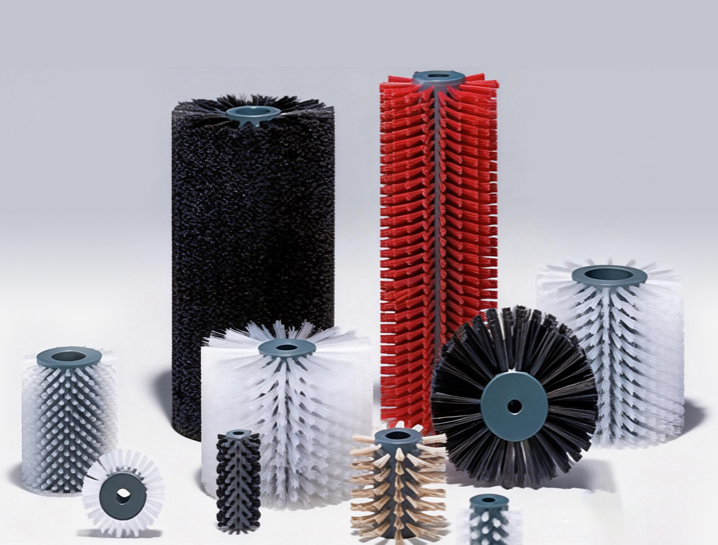
A nylon roller brush should be replaced when it has lost roughly 20 to 25 per cent of its original trim length, when visible tuft gaps appear across the working face, or when cleaning performance drops noticeably even after the brush has been cleaned and the spray system verified. Under correct specification and normal duty, a well-built brush set in an industrial boot washer can serve six to twelve months, with lighter-duty installations reaching several years.
Brush life is a fatigue problem rather than a strength problem, and understanding that distinction changes how the failed brush should be diagnosed. Each filament in a working brush experiences a continuous cycle: deflection as it contacts the boot, stress as it bends, recovery as it leaves the contact zone, and repetition on the following revolution. Thousands of cycles per hour accumulate as fatigue at the filament root and at the bend radius. A filament does not fail because it was too weak for a single event; it fails because it was cycled too many times under too much stress.
That framing explains why more force is not the answer to declining performance. Increasing contact pressure raises filament deflection, which raises cyclic stress, which accelerates fatigue, which increases breakage and shortens life. At the same time, excessive pressure reduces the ability of individual tips to travel efficiently across the surface. The result is a genuine paradox that operators encounter regularly: more force, but not proportionally more cleaning, and a brush that fails sooner.
The stages through which a boot washer brush deteriorates are reasonably consistent.
| Wear Indicator | Underlying Cause | Correct Action |
| Filament tips bent over or matted, not recovering | Filament flagging, usually from running above specified speed or from heat build-up | Reduce speed; check spray; clean the filament bed |
| Trim length reduced against original specification | Normal abrasive wear | Replace when loss exceeds 20 to 25 percent |
| Tufts missing, leaving bands or streaks | Root fatigue, filament pull-out, or excessive deflection | Replace the brush; review deflection ratio and speed |
| Uneven wear across the working face | Imbalance, runout, misalignment, or a blocked spray pattern | Inspect mount and balance before replacing |
| Filament breaking at the root | Fatigue from overspeed or overpressure; possible fill compression damage during manufacture | Review both the operating parameters and the brush construction |
| Debris packed hard at the base of tufts | Inadequate rinsing between shifts | Deep clean, then reassess whether the brush is genuinely worn |
| Chemical degradation, softening or discolouration | Filament grade incompatible with the wash chemistry | Re-specify the polymer grade |
The most reliable single check is measurement. Comparing the current trim length against the original specification gives an objective answer that visual inspection cannot, because a flagged but full-length brush and a heavily worn brush can look similarly tired to the eye while requiring opposite responses.
A related planning error is to treat longer service life as automatically better. Consider two brushes: one that lasts considerably longer but cleans at a lower rate, and one that wears sooner but processes more boots to a higher standard per operating hour. If the shorter-lived brush delivers substantially more useful cleaning before replacement, the longer-lived brush is not automatically the more economical choice. The productive question is not how many hours a brush lasts but how much useful work it produces before it must be changed.
Maintenance, Cleaning and Cost of Ownership
Maintenance for a nylon roller brush is mostly about removing what the brush has collected. Debris packed at the base of the tufts prevents the filament from flexing through its full range, which is functionally equivalent to shortening the brush, and it creates the imbalance described earlier. A short routine performed consistently will extend service life more than any other action available to the maintenance team.
A practical schedule for a boot washer installation looks like this.
| Frequency | Task |
| Each shift | Rinse brushes and clear debris from the filament bed; verify spray nozzles are unobstructed |
| Weekly | Inspect filament for flagging, matting, tuft loss and embedded material; check for vibration or unusual noise; verify sanitiser concentration and reservoir level |
| Monthly | Measure trim length against specification; inspect mounts, fasteners and bearing housings for corrosion or loosening; verify alignment |
| Quarterly to annually | Review wear pattern across all brush positions; assess whether the specification still matches actual contamination; check structural fixings and drainage |
Design features that reduce the labour cost of that routine are worth requesting. Clean-in-place capability allows the brush to be flushed without removal, which matters considerably at shift-end when maintenance windows are short. Quick-release bearing housings and modular brush sections allow individual rollers to be taken out for inspection without dismantling the machine. Rollers that are difficult to remove are rollers that are inspected less often.
Maintenance documentation has a second purpose beyond machine care. In facilities operating under a recognised food safety scheme, records showing that brushes were inspected and replaced on schedule are evidence that the control point was functioning. A brush replacement log is a compliance document.
Cost of ownership should be evaluated the same way. Unit purchase price is only the first term. The full comparison includes the cost of the brush itself, the labour and downtime associated with each replacement, the risk exposure of a control point that is underperforming between inspections, and the cost of premature wear in the machine’s bearings and drive components caused by an unbalanced or misaligned roller. A lower-cost brush that fails a season early typically costs more than the initial savings once the replacement, the downtime, and the verification activity are counted.
Specifying a Nylon Roller Brush: Data Checklist
To receive an accurate quotation and a brush that fits the first time, provide the supplier with the machine’s mounting dimensions, the required brush diameter and length, the filament grade and diameter, the bristle density or required stiffness, the planned rotation speed, and a description of the contamination and wash environment. A dimensioned drawing removes almost all ambiguity.
| Parameter | What to Provide |
| Brush outside diameter | Measured over the filament tips, in millimetres |
| Overall brush length | Working face length plus end configuration detail |
| Core inner diameter | Shaft bore, keyway dimensions and end fitting detail |
| Filament grade | PA6, PA66, PA610, PA612 or other, with any food-contact requirement |
| Filament diameter | In millimetres, together with the acceptable tolerance |
| Trim length | Filament projection from the core surface; state the intended deflection ratio |
| Bristle density | Tufts per unit area, or the required cleaning stiffness and substrate sensitivity |
| Mounting method | Keyway, set screw, flange, expanding shaft, or quick-release housing |
| Operating speed | Design rpm and maximum rpm, plus rotation direction |
| Environment | Wash water temperature, detergent and sanitiser chemistry, duty cycle, hygiene zone |
| End treatment | Square cut or end rounded, and cross-section if other than round |
Alongside the physical specification, request documentation rather than accepting general assurances. Ask for conditioned material data covering moisture absorption and flexural modulus for the specific grade being quoted; abrasion and wear test data where the supplier holds it; confirmation of the core material grade; a stated concentricity or runout tolerance for the finished assembly; and, for food, pharmaceutical, or drinking-water- adjacent installations, the appropriate contact-approval certificate for the filament grade. A supplier willing to provide a sample or trial order before full production is worth preferring for a first-time specification, because a boot washer brush is a machine-specific part and the cost of getting a large order wrong is measured in both money and downtime.
FAQS
Is a full boot washer brush set necessary, or is a sole cleaner enough?
It depends on the contamination and the hygiene zone. A sole cleaner is appropriate for dry environments with light contamination, where the goal is preventing dust and grit from being tracked in. Where there is moisture, fat, protein, blood, or heavy mineral contamination, sole cleaning alone is insufficient, because the boot upper and shaft also carry soil that transfers to hands, clothing, and surfaces. Facilities transitioning between hygiene zones should match the equipment to the contamination profile rather than installing the smallest unit that appears to satisfy the requirement on paper.
How often should the brush in a boot washer be replaced?
Visual inspection should happen weekly and measurement monthly. Replacement is due when the brush has lost 20 to 25 per cent of its original trim length, when tufts are missing, or when cleaning quality declines after the brush has been cleaned and the spray verified. In practice, most food factory installations replace their brush set every six to twelve months depending on traffic volume, while lighter-duty or single-shift operations can run considerably longer. The inspection record matters as much as the interval, because it is what demonstrates the control point is working.
Why is the brush wearing out faster than expected?
The usual causes, in rough order of frequency, are running above the specified rotation speed, a blocked or undersized spray pattern causing the brush to work in a contaminated slurry, debris packed at the tuft roots preventing full filament flex, and filament grade incompatible with the wash chemistry. Worn or damaged filament also changes the distribution of mass in the roller, so a brush that begins to wear unevenly tends to deteriorate faster on one side, which accelerates the whole process. If the brush has lost stiffness rather than length, the grade selection is the more likely explanation than the machine.