Fresh produce arrives at the packing line covered in field soil, clay, and spray residue that has to go before grading, waxing, or boxing. The part touching every piece of fruit on that journey is the brush, and it is usually specified last by matching a part number to a worn sample.
A fruit cleaning brushes is a food-contact assembly, not a generic scrubbing brush: a defined filament anchored to a core or shaft, trimmed to a controlled length and density, and mounted to rotate, convey, and clean produce without damaging the skin. Four variables must be specified together: filament material and diameter, stiffness and trim, fill pattern, and core or shaft construction. Choose one based on price alone, and you compromise the other three.
The guide below covers what these brushes are, why general-purpose brushes fail, how the shapes differ, and how to specify one for your fruit and washdown.
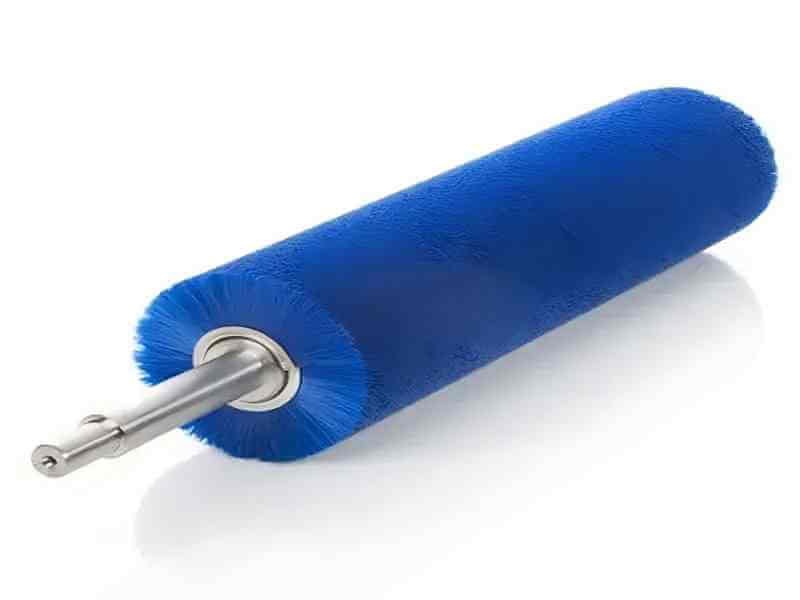
What Is a Fruit Cleaning Brush
A fruit cleaning brush is an engineered roller or strip assembly fitted to washing, grading, waxing, drying, or peeling equipment, built from food-contact filament fixed to a corrosion-resistant core or shaft, and designed to apply a controlled scrubbing force as produce passes through the machine. It is a wear part with a defined service life and is treated in any hygiene program as a direct food-contact surface.
What separates a produce brush from a workshop brush is documentation rather than appearance: resin declaration, diameter tolerance, flat trim, and sealed ends.
Why Can’t You Use a General-Purpose Brush for Fruit Washing
A general-purpose brush fails on a produce line for four reasons: a filament too stiff for fruit skin, a core that is not corrosion resistant, no food-contact documentation, and harborage points that no washdown can reach. Cleaning power is rarely the problem.
Stiffness. Industrial scrubbing filament runs 0.5 mm to 0.9 mm and is formulated for abrasion. Pressed against an apple at line pressure, it abrades the cuticle and bruises the lenticels, and the brown patches appear two weeks later.
Corrosion. Galvanised cores are fine in a dry workshop, but they rust at the end caps and allow rust to migrate into the filament bundle when they are on a line that runs water for eight hours a day and undergoes a nightly caustic wash. Galvanized cores rust at the end caps and allow rust to migrate into the filament bundle when they are on a line that runs water for eight hours a day and undergoes a nightly caustic wash.
Documentation. Compliance is a paper trail before it becomes a material property. Nylon resins for food-contact articles fall under FDA 21 CFR 177.1500 and, in Europe, under Regulation (EC) 1935/2004 with Regulation (EU) No 10/2011. A supplier who cannot produce a migration test report is selling a plastic article, not a food-contact part.
Harbourage. Staple-set tufts leave open holes, hollow cores leave an internal cavity, and unsealed end rings leave a gap. Cornell’s National GAPs Program classifies brushes and rollers as Zone 1 contact surfaces, which must be inspectable, maintainable, and cleanable. A brush that cannot be opened and flushed does not qualify.
What Are Fruit Cleaning Brushes Used For
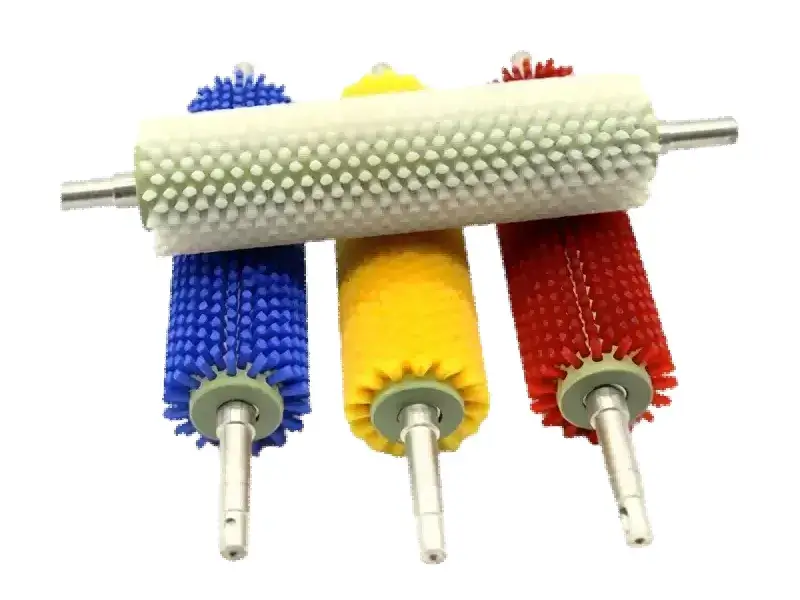
Fruit cleaning brushes do three jobs on a produce line: removing soil and surface residue, moving and orienting product for grading, and distributing wax or polishing the skin. Each calls for a different balance of stiffness, density, and speed.
Cleaning and Residue Removal
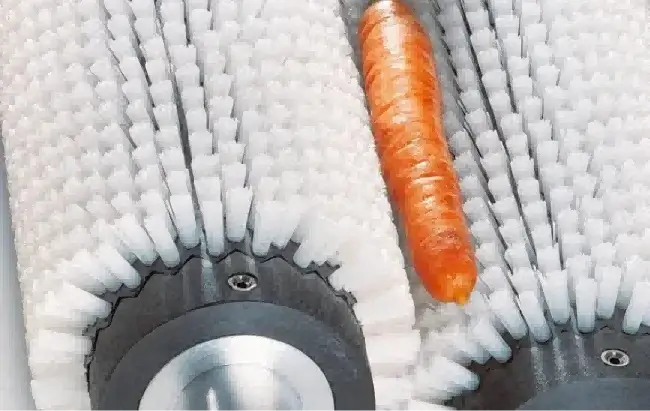
Brushing works with water, not instead of it: the filament lifts soil while the spray carries it off, and a brush run dry only redistributes it. Washing rollers, ranging from 50 mm to 150 mm, operate at 100 to 300 rpm, with contact time being more important than pressure. Counter-rotating pairs turn the product; co-rotating pairs just convey it.
Grading and Conveying
Brush rollers rotate fruit so every side reaches cameras or inspectors, and separate sizes go through gaps. A filament that is too soft allows produce to slide without rotating, so one side is washed while the other is not. Alternating and stepped patterns force rotation rather than transport.
Waxing and Polishing
Waxing needs a soft filament of 0.15 mm to 0.3 mm, high density, low speed, and flat trim. The brush spreads the coating and must never scrub it off. Citrus is the sensitive case: ruptured oil cells release peel oil that dulls the finish, so pressure stays low.
Brush Roller Shapes and What Each One Does
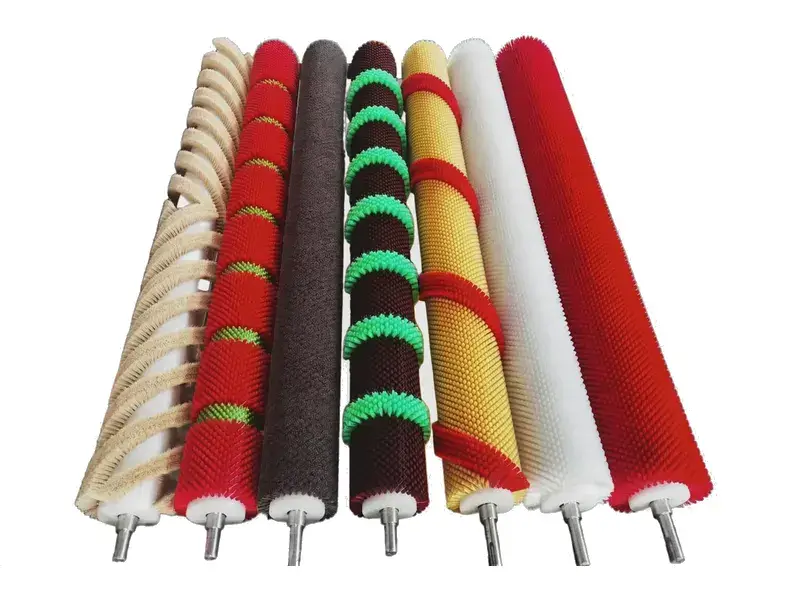
The four shapes used on produce lines—steel-shaft tufted, alternating tufted, stepped, and herringbone—differ in how they present filament to the product and which way they push it. The shape decides whether fruit tumbles in place, travels sideways, or sits still and gets polished.
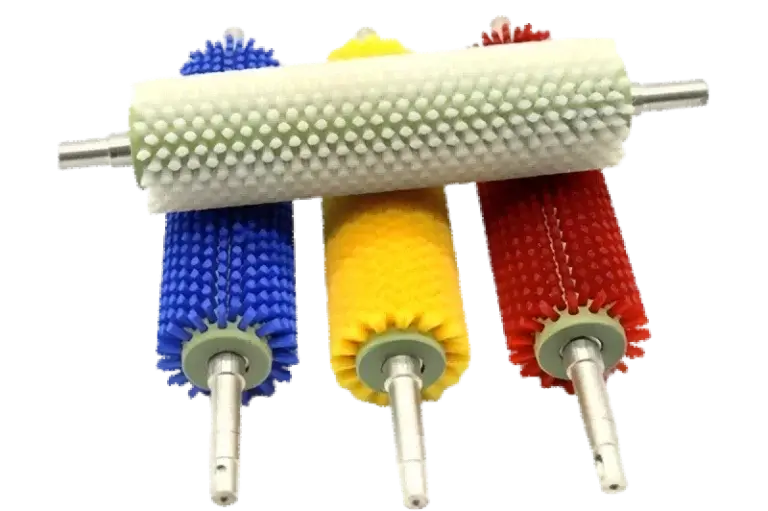
Steel-Shaft Tufted Roller Brush
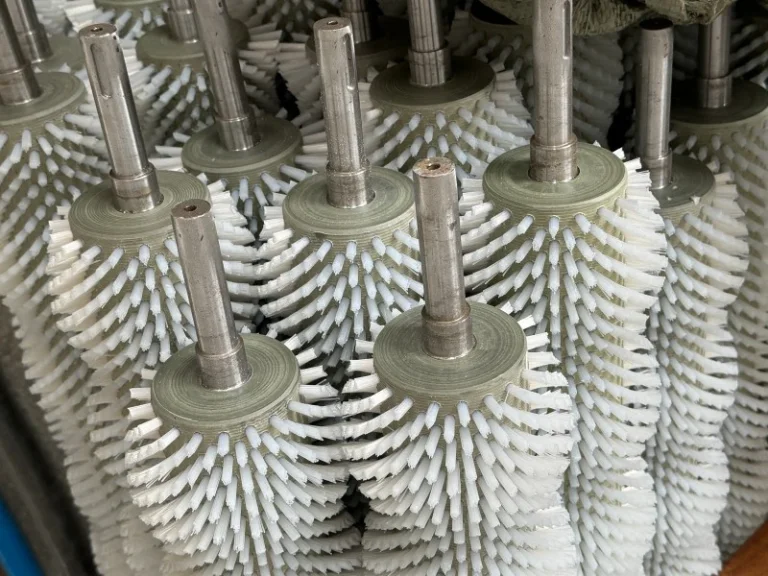
Tufts are stapled into holes drilled in a polyethylene sleeve or stainless body and sealed with food-grade epoxy. Density is high, tooling is cheap, and a worn section can be replaced on its own. The weakness is hygiene: every tuft hole is a harborage point, and shedding risk climbs when the epoxy is not rated for the washdown chemistry.
Alternating (Staggered) Tuft Roller Brush
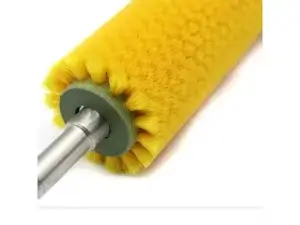
Tufts are offset so the roller never fully contacts its circumference. The brush meets the fruit in an interrupted rhythm, lowering peak impact and bruising and giving debris somewhere to fall. It suits apples, tomatoes, peaches, and citrus, where surface quality drives grade.
Stepped (Tapered) Roller Brush
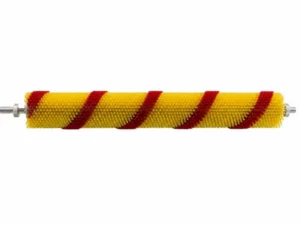
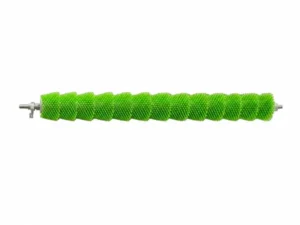
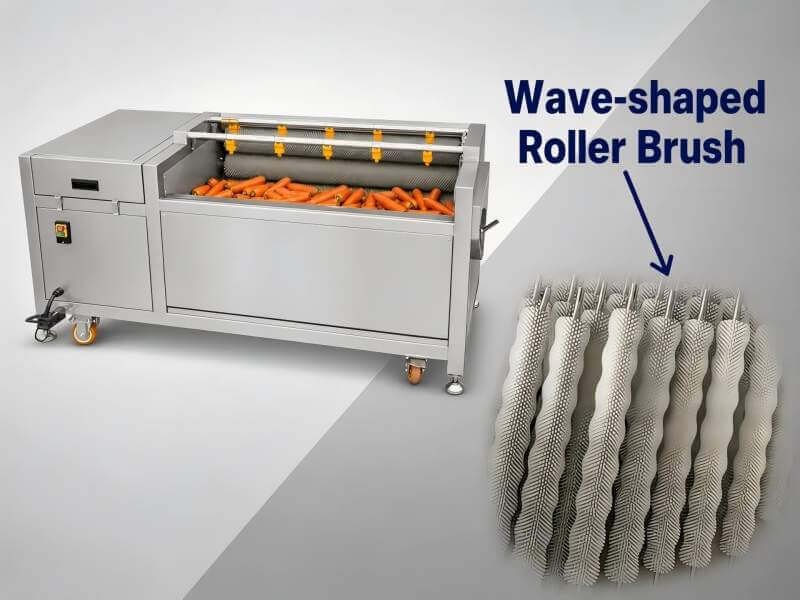
The profile changes along the roller, as it has stepped diameters or a concave contour, so the contact line follows the product instead of a straight cylinder. That reaches stem bowls, shoulders, and the ends of elongated root crops. It is standard on peeling machines and rollers for ginger, taro, and irregular carrots, where a plain cylinder leaves soil in the grooves.
Herringbone (Chevron) Roller Brush
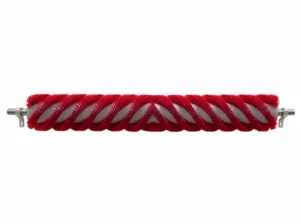
Filament is laid in a V meeting at the center, so rotation generates axial thrust toward the middle. Product drifting to one side of a crowned conveyor is pushed back to the centerline, pile-ups break up, and the bed spreads into a single layer for inspection.
Filament Materials and Roller Construction
Filament material limits cleaning force and chemical resistance, while core and shaft construction determine service life and how easily the brush can be cleaned. On a production line, the washdown is usually harder on the brush than the fruit is.
Filament Materials
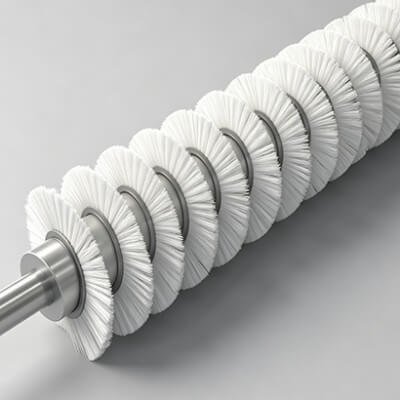
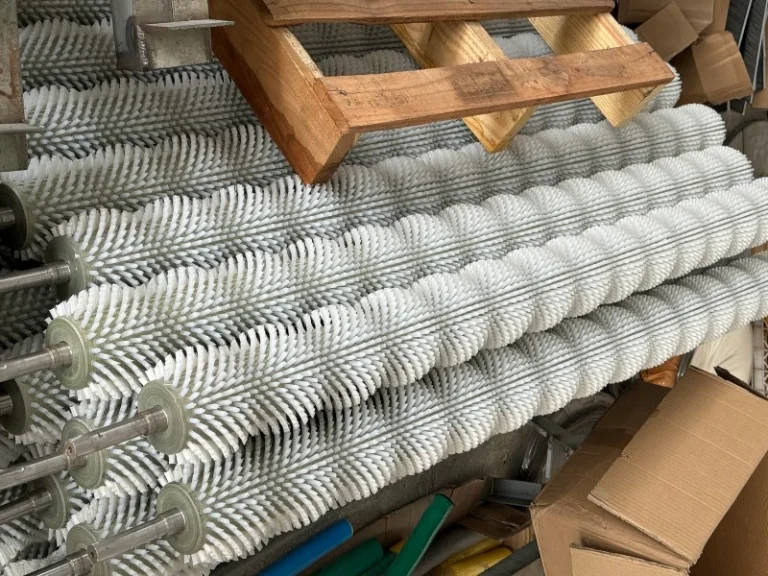
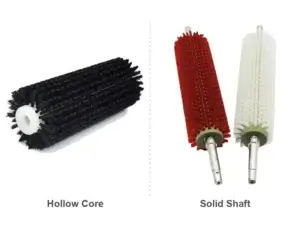
spiral-wound brushes are wound to grip a hollow core at about two turns per inch, so you can slide them onto your machine’s existing shaft and swap only the sleeve when they wear out. Tufted roller brushes hold their tuft pattern by physical anchoring, so they usually need a solid shaft or rigid plastic body—more rigid, but you replace the whole assembly.
Common Application Scenarios
One catalogue covers very different duties: a washing line, a waxing machine, a root-crop peeler, and a drum washer each impose a different mix of soil load, chemical exposure, and mechanical stress, so a vegetable cleaning brush specification shifts even when the machines look alike.
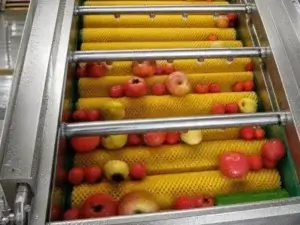
Vegetable and Fruit Washing Lines in Processing Plants
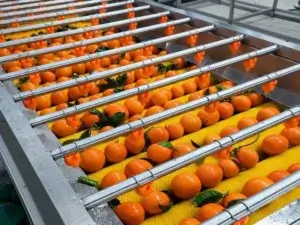
Four to six rollers in series under an overhead spray, 100 to 300 rpm, wavy or spiral fill in food-grade nylon or PP at 0.3 mm to 0.5 mm, and 304 shafts with sealed ends. Heavy field soil belongs in a pre-wash stage: a brush loaded with mud cleans nothing and spreads contamination.
Waxing and Polishing Machines
Soft filaments, with a diameter of 0.15 mm to 0.3 mm, are high-density, flat trim, and low speed, sometimes with a horsehair or soft-nylon blend. Coverage matters more than force: the aim is a continuous film, and a pressure spike shows up later as a mottled finish.
Potato and Carrot Peeling Machines
Abrasive or hard nylon at 0.6 mm to 0.8 mm, stepped or concave contours, higher pressure, and a continuous flush to carry away skin and starch. This is the harshest duty in the catalogue; yield, not cleaning speed, is the number to watch.
Drum (Trommel) Washers
Brush segments or spiral strips wound inside a rotating drum assist tumbling and scrub the load as it cascades. Soil load is high, so the filament is thicker and density higher, and the maintenance focus shifts to debris packing between segments.
Three Key Factors When Choosing an Industrial Fruit Cleaning Brush
Specify a vegetable cleaning brush in this order: filament stiffness matched to the fruit, food-grade materials with documentation, and a 304 stainless shaft with sealed ends. If you get the first one wrong, you risk damaging the product; the second, you risk failing an audit; the third, the brush may fail within weeks.
Match Filament Stiffness to the Fruit
Stiffness depends on diameter, trim length, and modulus together, so two brushes with identical filaments can behave quite differently: a longer trim flexes more and cleans less. Specify trim length with diameter, or results are not repeatable.
Use Food-Grade, Antimicrobial Materials
Antimicrobial additives deserve a precise description. A silver-ion additive inhibits bacterial growth on the filament, but it does not sanitize the brush and does not replace cleaning; what it buys is a slower build-up between washdowns. Pair it with color coding, white or blue, so a broken filament shows against the product.
The Shaft Must Be 304 Stainless Steel
Grade 304 covers most wet produce lines and is the practical minimum, not a premium. Grade 316 is justified where chlorides are present, the sanitizer concentration runs high, or the machine sits wet between shifts. Inspect what fails first: welds, exposed threads, end-ring gaps, and blind holes that hold water.
Related reading: How to Choose the Right Fruit Cleaning Brush for Your Equipment
FAQ
Q1: What filament should I use for soft berries such as grapes and raspberries? Can I use nylon?
Yes, at the soft end of the range: 0.15 mm to 0.20 mm PA6 or PA612, low density, low speed, and flat trim, and PA612 if the line also runs a hot rinse. For fully ripe raspberries, brushing is usually the wrong tool, and most lines rely on flume conveying or air knives.
Q2: Will nylon filament soften and wear faster under continuous hot-water spray?
PA6 will. It absorbs water, and immersion near 80°C strips much of its stiffness, so the filament mats never fully recover; caustic at 60°C swells it further. PA612 and PBT hold stiffness far better, so daily hot or caustic washdown should specify one of those.
Q3: How often do the brushes need replacing, and at what wear level is replacement mandatory?
Measure trim length monthly at three points along the roller. Replace at roughly 15 to 20 percent trim loss when filaments no longer spring back, when matting appears, when tufts shed, or when a second pass is needed. Expect 6 to 12 months for washing duty and 3 to 6 months for peeling.
Q4: What are typical lead times and minimum order quantities for custom brush rollers?
Standard diameters of 100 mm to 150 mm in common lengths ship in two to four weeks, with minimums of 10 to 50 pieces. Custom builds with non-standard shaft ends or stepped profiles take three to six weeks plus drawing approval, with minimums of 20 to 100 pieces.