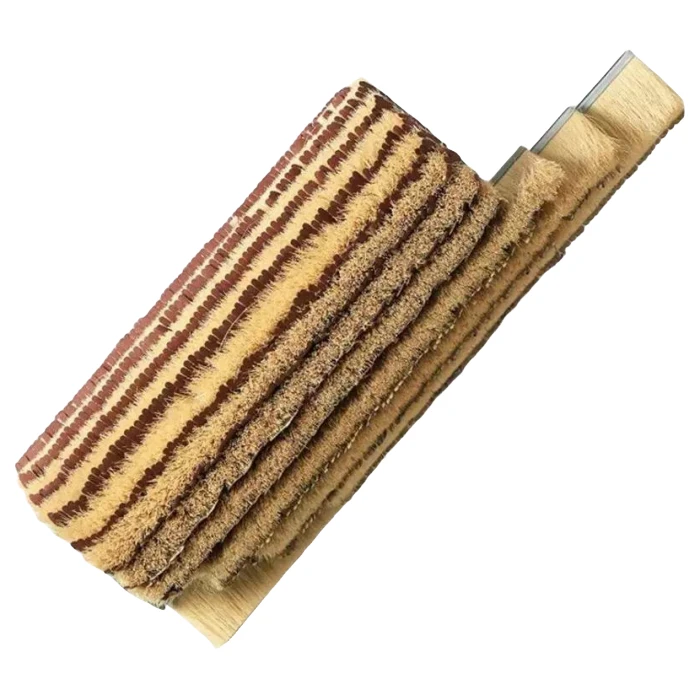
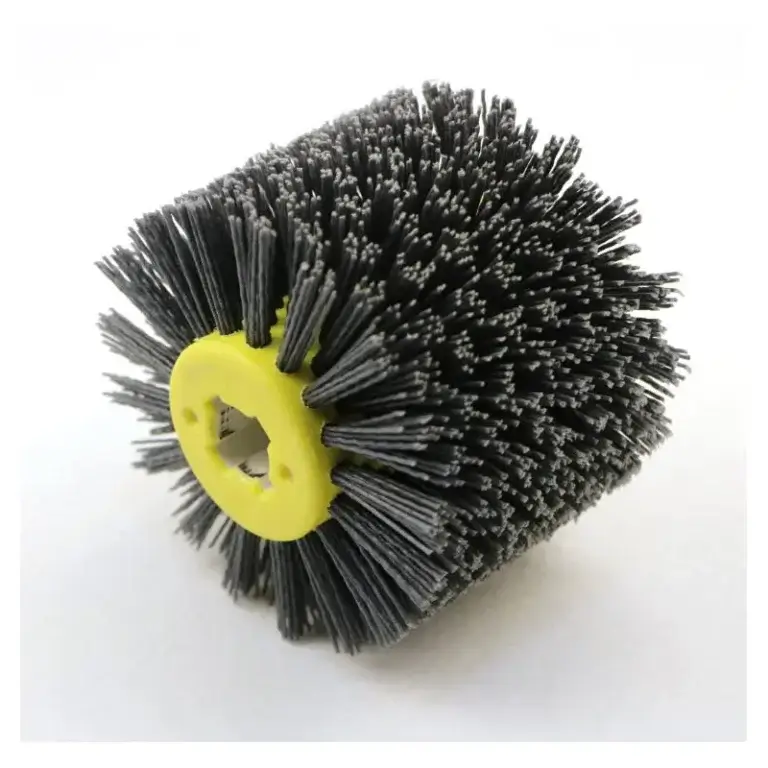
Buyers rarely reject a fabric for being dull or soft; they reject it for being inconsistent. A few meters of dense, even peach skin followed by a lighter, streakier stretch is enough to downgrade an entire roll, because the defect is visible to the consumer and cannot be corrected later in the finishing route. Mills spend heavily on dyes and softeners to control appearance, yet the variable that most directly determines whether the whole width looks the same is the tool that touches every square centimeter of the goods.
Fabric uniformity starts with an abrasive roller brush because it is the one component that contacts 100 percent of the fabric width on every revolution, so any irregularity in filament density, grit condition, roller geometry, or contact pressure is transferred directly into the fabric as visible variation. A uniform surface therefore depends on four controllable factors working together: an evenly filled brush in consistent wear condition, a geometrically true roller running at correct engagement depth, stable selvedge-to-selvedge tension, and extraction that removes dislodged fiber before it redeposits.
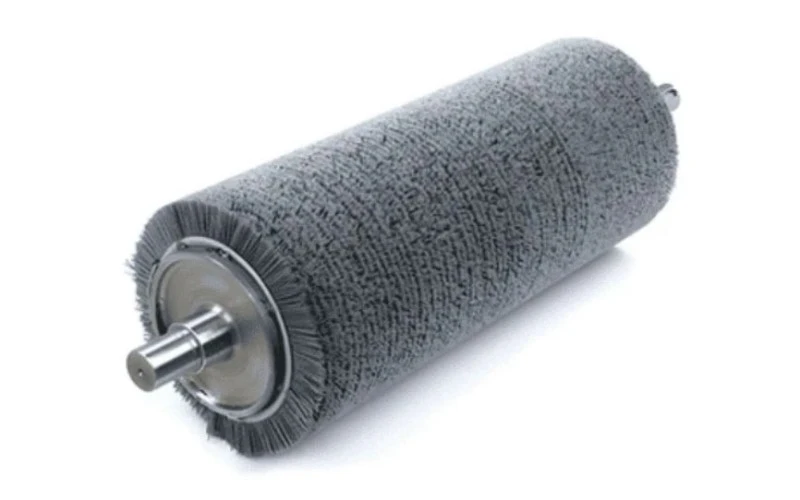
The sections below cover why the brush governs uniformity, which design factors set the achievable ceiling, which machine settings protect it, how to diagnose defects, and how to verify the result objectively.
Why the Abrasive Roller Brush Controls Fabric Uniformity
The abrasive roller brush controls fabric uniformity because it applies the mechanical action that creates the surface itself. Where the brush cuts evenly, nap height, sheen reduction, and hand feel are even; where filament density, grit sharpness, or contact pressure varies, the fabric records that variation permanently. Uniformity is both a widthwise and a lengthwise property, and the brush governs both.
Uniformity has three dimensions. Widthwise variation shows up as longitudinal stripes or side-to-center shading, lengthwise variation as periodic banding repeating at a fixed interval, and batch-to-batch variation as the slow drift in results as the brush wears across a production order. All three trace back to the condition and geometry of the abrasive surface.
Variation also hides in normal viewing, which is why defects escape early detection. A surface can look acceptable under diffuse light and reveal obvious shading under raking light or after coating, by which time the roll is finished, and the cause has moved on to the next lot.
The Mechanics of Uniform Abrasion
Abrasive filaments cut rather than scrape. Each filament tip presents embedded abrasive grain to the fiber ends and lifts a controlled amount of surface fiber. Because cutting is done by the tip rather than by a solid abrasive belt, the brush conforms to slight surface contours while maintaining light, repeatable engagement.
Abrasive nylon adds a further advantage for consistency: as the filament wears, fresh grain is progressively exposed along its length, so the brush keeps cutting at a comparable rate through most of its service life before the tips finally glaze over. That self-sharpening behavior lets one brush hold surface character steady across a long run, unlike wrapped abrasive media whose cut rate decays from the first meter.
Where Uniformity Is Won or Lost
- Widthwise variation from unequal contact pressure edge to edge, abrading harder in high-pressure zones and leaving denser, darker nap there
- Lengthwise banding from a roller that is not perfectly cylindrical, producing abrasion intensity that varies with rotation frequency and repeats at intervals equal to the roller circumference
- Incremental drift from a brush that loads or wears during a run, so the start and end of the roll are not the same product
Brush Design Factors That Determine Surface Consistency
Brush design determines the ceiling on achievable uniformity. Even filament fill, a debris-shedding row pattern, grit matched to the target finish, and a core rigid enough to resist deflection under load together decide whether a line can produce a streak-free surface or whether operators will spend every shift compensating for a tool that cannot deliver it.
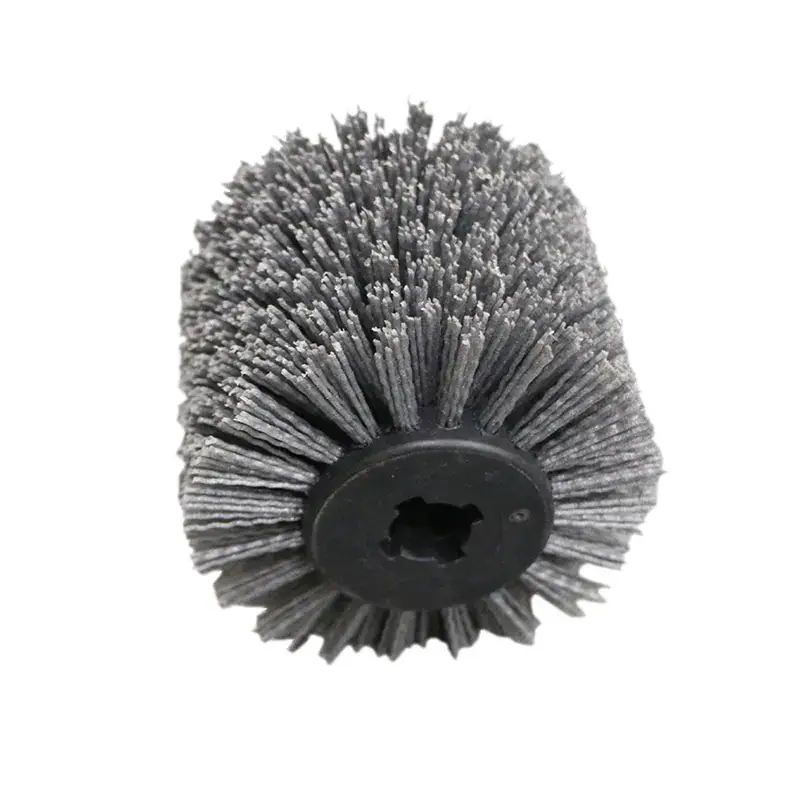
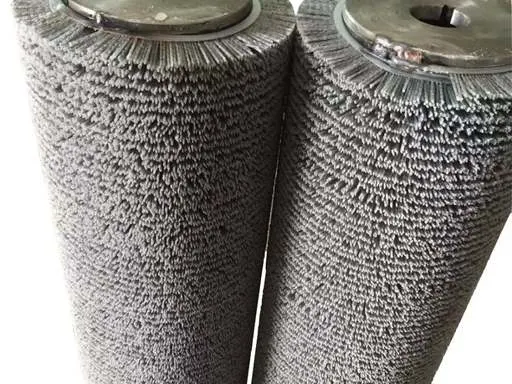
How filament is attached to the core matters as much as how much is used. Bonding individual strands to the core provides uniform density, superior balance, and even wear over the life of the brush. Uniform density is what produces streak-free finishing, because any sparse zone cuts shallower than its neighbors and reads as a stripe.
Open spiral construction also keeps the brush from loading with fiber and is easier to clean, which sustains uniformity across a shift rather than only at start-up.
Grit, Abrasive Type, and Filament Stiffness
Grit selection sets the character of the finish, and consistency depends on that choice matching the fabric rather than being changed mid-order.
Stiffness should follow substrate weight. Soft filament protects delicate goods and fine-gauge knits, while stiffer filament provides firmer action for heavier woven fabric. Mismatching stiffness produces insufficient development or fiber damage, and both appear as surface variation.
Core, Shaft, and Deflection Control
On wide machines, the most overlooked uniformity risk is deflection. A single shaft spanning the working width can bow at the center under engagement pressure, so mid-width abrades less than the selvedges and produces side-to-center shading. Countermeasures include a heavier shaft, a segmented brush arrangement, crown correction on the roller body, and differential end bearing pressure on adjustable systems.
Machine Settings That Protect Uniformity
A correctly specified brush still produces uneven fabric if the machine is set wrong. Contact pressure, fabric tension, moisture, and temperature are the four variables that most often drift, and each changes the abrasion result across the width or along the length of the roll. Settings should be locked into a narrow operating window per fabric style, then adjusted one variable at a time.
Contact Pressure and Engagement Depth
A reliable starting point is to set roller pressure so abrasive grain penetrates the yarn surface by about one third of the yarn diameter, no more. Beyond that, the action moves from surface development to structural damage. Pressure uniformity should be verified rather than assumed: run a test strip of known weight through the machine, measure weight loss per unit area at several points across the width, and adjust deflection compensation until variation across the width falls within tolerance.
Raising pressure to compensate for a dull brush is the single most reliable way to destroy uniformity. It increases heat and fiber damage without restoring cut rate, and it accelerates the wear that caused the problem.
Fabric Tension and Guiding Stability
Fabric entering the abrasive zone with uneven selvedge-to-selvedge tension abrades differently in loose and tight regions, because contact pressure between fabric and roller varies with local tension. Spreader elements and edge tension sensing at the machine entry are the standard engineering response, and width should be measured at entry, in the processing zone, and at exit.
Knits require particular care. They stretch, and excess tension distorts the loop structure permanently, so a controlled overfeed is normally used at machine entry. Creases are the worst case, because a fold entering the abrasive zone is ground into a permanent mark that no later process recovers.
Moisture and Temperature Control
Moisture variation within a batch or across the width of a single layer changes fiber mechanical properties, so the same settings abrade differently at different moisture levels. Pre-drying or conditioning the fabric to a consistent moisture content before the abrasive zone removes that variable.
Temperature matters most for synthetics. Exceeding the glass transition point of a polyester microfiber can scorch or harden the fiber, which removes the supple hand that the finish is meant to create and leaves an uneven surface. Cylinder temperature should therefore be held within a defined ceiling, with tight accuracy on delicate microfiber styles.
Diagnosing and Fixing Uniformity Defects
Most uniformity defects trace back to five recurring causes: uneven contact pressure across the width, a loaded or uneven abrasive surface, uneven fabric tension, roller cylindricity error, and moisture variation. Because the same visible symptom can have different roots, the defect signature, and in some cases its physical interval, should identify which variable is responsible before any setting is touched.
The interval test is worth using routinely. If the spacing between bands in the fabric matches the roller circumference, the fault is geometric, and no amount of pressure adjustment will resolve it.
Uneven abrasion also changes how the surface reflects light, which makes a single dye lot read as several different shades across the width. This is why uniformity problems are frequently misreported as dyeing faults and why variation that looks minor on the inspection table becomes obvious after coating: the coating changes the surface’s reflective behavior and amplifies every difference the brush left behind. The corrective sequence should always be mechanical first, because adjusting softener chemistry to hide a mechanical root cause leaves the underlying variation intact.
Inspecting and Maintaining Abrasive Rollers for Repeatable Output
Uniformity is maintained by measurement, not by appearance. Roller geometry should be verified before each new fabric batch, the abrasive surface inspected under strong side lighting for loading and worn patches, and the brush treated as a consumable replaced on a meterage-based schedule rather than on visual judgment.
Cylindricity and total runout should be checked with a dial gauge or non-contact profilometer before starting a new batch, with runout held within a tight tolerance to prevent periodic banding. Visual inspection under strong side lighting is the fastest way to detect loading or worn patches that would produce differential abrasion. The objective acceptance test remains weight-loss uniformity across the width.
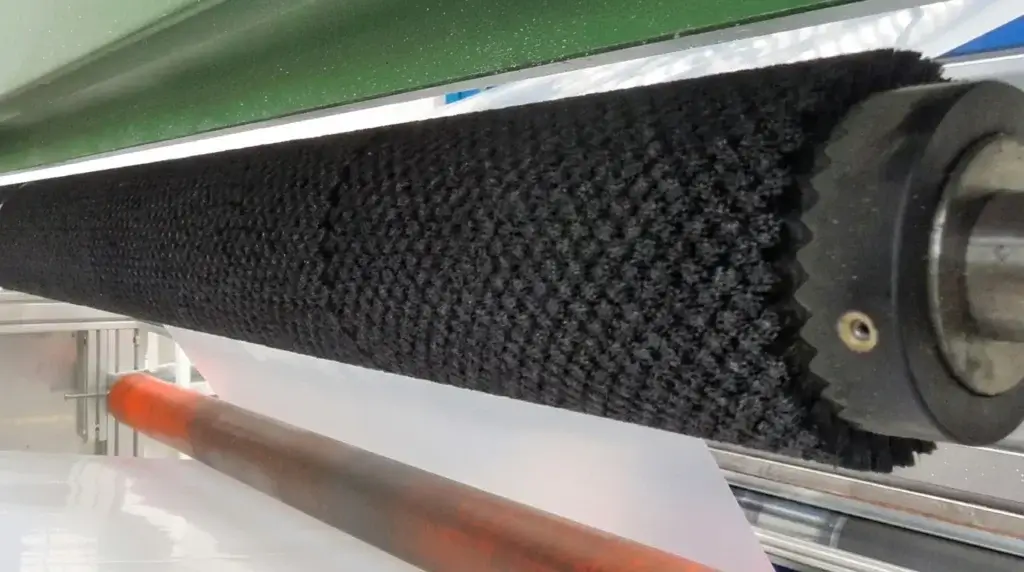
A loaded abrasive surface must be cleared by reverse rotation in the absence of fabric, combined with vacuum extraction of accumulated lint. If cleaning cannot restore surface uniformity, the brush should be replaced. Replacement triggers include filament length loss beyond the specified threshold, declining cut rate at unchanged settings, permanently deformed filament that no longer springs back, and rising vibration or roller temperature. Scheduling replacement based on total meterage processed, rather than elapsed time, keeps output consistent over a long production program.
Weak extraction compounds these problems, causing defects that resemble finishing marks: patchy dull zones, fine streaks, and greyish contamination that is difficult to remove later. Dust control should therefore be treated as a quality parameter, and filters, ducts, and airflow monitored so extraction performance does not decay unnoticed over a shift.
Measuring the Result and Confirming Uniformity
Uniformity must be confirmed with objective tests rather than operator opinion. Pilling resistance and strength retention are the leading indicators of whether the process is correctly balanced, and documenting the settings that produced a passing result is what makes that result repeatable on the next order.
The ISO 12945-2 modified Martindale method evaluates a fabric’s propensity to surface pilling, fuzzing, and matting by reproducing wear under controlled friction and rating the result visually. When abrasion and any subsequent shearing are correctly sequenced, the loose fiber ends that would otherwise tangle into pills have largely been removed, so the finished fabric typically scores higher than an untreated fabric of the same construction. Conversely, over-processing leaves fiber ends too short and weakly anchored, and pilling after the first wash becomes the clearest evidence that uniformity was bought at the cost of fiber integrity.
Surface finishing also removes a share of fabric weight as fiber debris, and that share should be monitored per pass. A moderate loss consistent with the target hand feel is normal, while a rising loss signals over-processing and predicts reduced abrasion life. Recording weight loss, roller settings, abrasive grade, tension, and extraction status per fabric style turns a consistent result into a documented recipe, which is ultimately the most practical form of uniformity control.
Frequently Asked Questions
Q1: Does abrasive roller finishing weaken fabric strength and stretch recovery?
Surface abrasion removes a small amount of surface fiber while the base yarn structure stays intact when the process is correctly controlled, so tensile loss is limited. Excessive abrasion, coarse grit on a fine construction, or excessive tension during finishing will thin the fabric and reduce stretch recovery, particularly on knits containing elastane.
Q2: Why does sueded fabric pill after the first wash?
Pilling after one or two washes almost always indicates that long surface fibers were left intact and tangled during washing. It points to insufficient shearing after abrasion, or to a grit that was too coarse for the fiber blend, which breaks fibers instead of forming a soft, short pile.
Q3: How often should abrasive roller brushes be replaced to keep surface consistency?
There is no fixed interval, because wear depends on meterage, substrate, and grit. Base replacement on measured triggers instead: filament length loss beyond threshold, declining cut rate at unchanged settings, permanently deformed filament, and rising vibration or roller temperature.