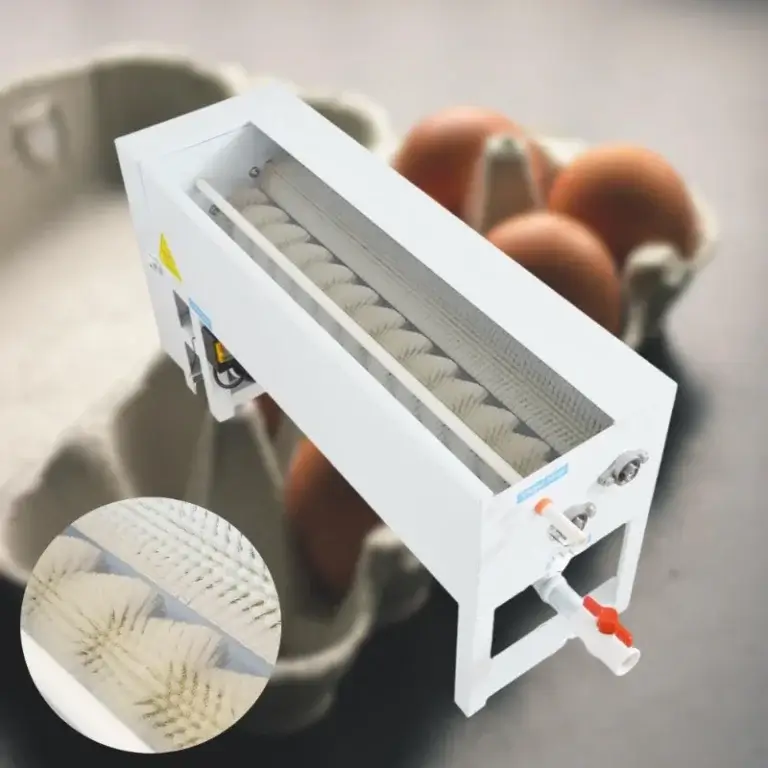
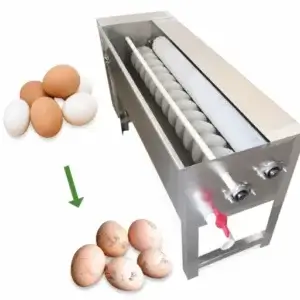
In modern poultry processing facilities, automated egg washing lines represent a critical junction where productivity meets product integrity. Every hour, thousands of eggs pass through rotating brush assemblies designed to strip away fecal matter, dirt, feather debris, and surface contaminants. The cleaning mechanism looks straightforward on the surface: cylindrical brushes rotate against egg shells under a spray of water or sanitizing solution, mechanically dislodging foreign material. Yet beneath this apparent simplicity lies a persistent challenge that costs the industry millions annually: shell micro-cracks.
Micro-cracks are hairline fractures invisible to the naked eye but catastrophic to egg quality. Unlike obvious breakage that removes eggs from the line immediately, micro-cracked eggs often pass visual inspection only to fail later during transport, refrigeration, or consumer handling. Worse still, these minuscule fissures create entry points for bacterial pathogens, turning a seemingly intact egg into a food safety liability. Research from food safety authorities confirms that bacteria such as Salmonella can penetrate through microscopic shell defects, multiplying rapidly once inside the nutrient-rich egg environment. The resulting recalls, rejection rates, and reputational damage make micro-crack prevention an urgent operational priority, not merely a quality benchmark.
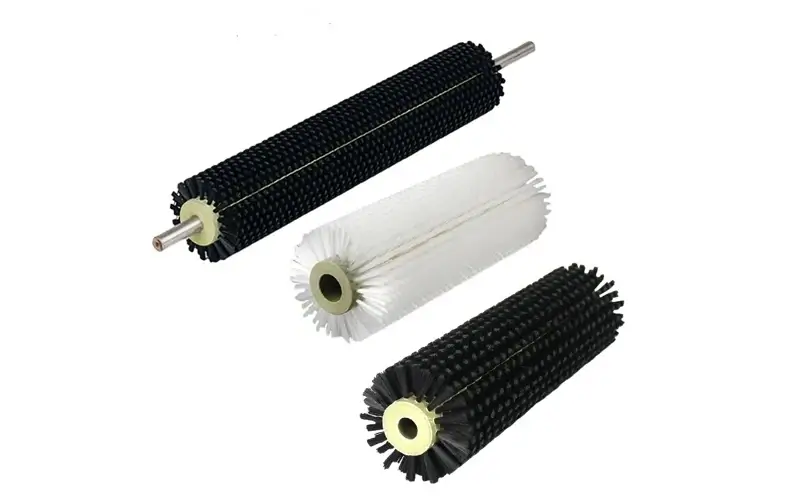
The single most effective variable for preventing micro-cracks in commercial egg washing systems is the bristle type used in cleaning brush rollers, with food-grade nylon roller brush filaments consistently outperforming natural fibers, metal bristles, and conventional synthetics by combining precisely controlled stiffness, smooth surface finish, superior bend recovery, and low moisture absorption into a single cleaning element that removes contaminants effectively without compromising shell integrity.
The dominance of nylon-based brush rollers in egg processing is no accident. Decades of material science advancement, coupled with direct operational feedback from high-volume poultry facilities, have refined nylon filament engineering to a point where brand-name differentiation is less relevant than understanding the underlying polymer properties and tufting specifications. The difference between a brush that causes 2% micro-crack rates and one that reduces that figure below 0.3% often comes down to filament diameter tolerance, tuft density, and polymer grade—not marketing claims.
Understanding how nylon cylinder brushes for cleaning function at the material level empowers processing managers, maintenance teams, and procurement specialists to make informed decisions. This article examines the mechanics of shell micro-crack formation, why nylon tufted cylinder brush designs provide superior protection over competing materials, the critical specifications to evaluate when sourcing replacement brushes, and the maintenance protocols that extend both brush service life and shell quality outcomes. The goal is not to endorse any single supplier but to equip you with the technical framework needed to evaluate bristle options against your specific line speed, egg variety, and contamination profile.
The Mechanics of Shell Micro-Cracks in Automated Egg Washing
Shell micro-cracks form during automated washing when the mechanical stress applied by rotating brush filaments exceeds the localized fracture threshold of the calcium carbonate shell structure, a process exacerbated by filament surface roughness, excessive stiffness, uneven tuft density, and the presence of abrasive particles embedded in worn bristles.
The Delicate Architecture of an Eggshell
An eggshell is a remarkable biological structure. Composed of approximately 94% calcium carbonate in a protein matrix, it achieves an optimal balance between strength and gas permeability. The shell averages 0.3 to 0.4 millimeters in thickness, with thousands of microscopic pores that allow oxygen exchange during embryo development. This architecture is strong enough to withstand up to 3 to 4 kilograms of vertical compression, yet brittle enough to fracture under targeted impact or sustained abrasion. During washing, eggs rotate against cylindrical brush rollers operating between 60 and 200 RPM, depending on the line configuration. The contact zone where filaments meet the shell surface is where micro-crack formation initiates.
The Trinity of Damage: Friction, Fatigue, and Chemistry
Three primary forces contribute to micro-crack generation in egg washing machines. First, abrasive friction occurs when filament tips scrape across the shell surface. Smooth, high-quality nylon filaments create uniform surface contact that distributes pressure across the shell curvature, while rough or irregular filaments concentrate force at microscopic contact points. Second, impact fatigue accumulates as each filament repeatedly strikes the shell during rotation. Even when individual strikes fall below the fracture threshold, repeated cyclic loading over thousands of revolutions can propagate existing micro-defects into visible cracks. Third, moisture-assisted crack growth accelerates damage because water penetrates surface imperfections and reduces the fracture toughness of the shell matrix through a stress-corrosion mechanism.
Reading the Warning Signs on Your Brushes
The severity of micro-cracking correlates strongly with specific brush properties rather than machine settings alone. Facilities that experience unexplained shell damage despite optimized water temperature, spray pressure, and line speed should first examine their brush filament condition. Common warning signs include filament tips that appear flattened or “mushroomed” rather than tapered, tufts that have become matted or clumped together, and brush surfaces that retain residues even after cleaning cycles. Each of these indicators points to filament degradation that directly increases micro-crack rates.
Material Comparison: Why Nylon Roller Brushes Outperform Alternatives
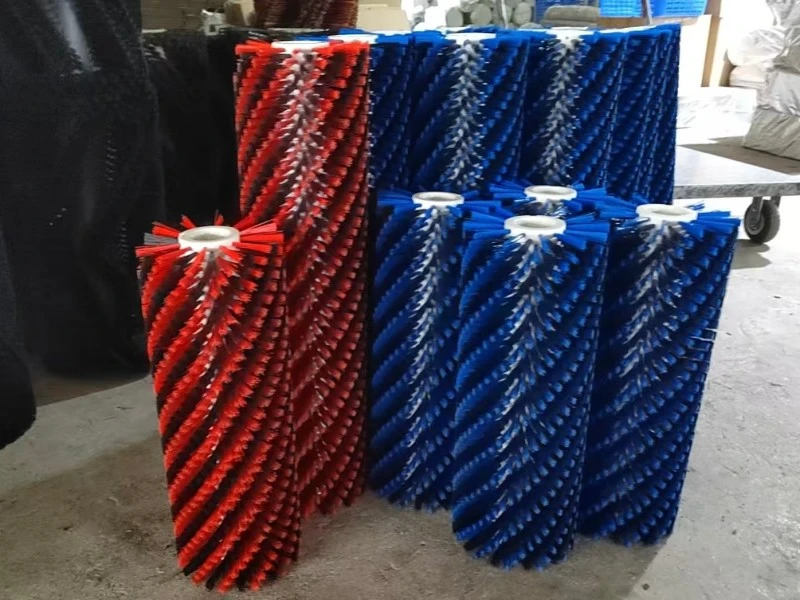
Nylon roller brush configurations, particularly those using nylon cylinder brushes made from food-grade PA6 or PA66 polymer, deliver the optimal combination of cleaning efficacy, shell protection, chemical resistance, and operational longevity compared to natural animal hair, plant fibers, metal wire, and commodity-grade synthetic alternatives.
Industrial brush rollers have been manufactured from a wide range of materials over the decades, each presenting distinct trade-offs in egg washing applications. The following comparison table distills the key performance attributes that matter most for shell protection and cleaning quality:
Natural animal hair brushes, particularly hog bristle, were once common in egg washing equipment. Their natural tapered structure provides a soft tip that is gentle on shells, which explains their historical appeal. However, natural hair absorbs significant amounts of water during operation, swelling and losing stiffness as the processing shift progresses. This inconsistency means the cleaning performance at hour eight is substantially different from that at hour one. More critically, the porous structure of natural hair provides an ideal harbor for bacterial colonies, including Salmonella and E. coli, which can then transfer back to egg surfaces during washing. The humid, nutrient-rich environment inside an egg washing machine effectively turns natural hair brushes into incubation chambers for pathogens.
Metal wire brushes present the opposite problem: excellent cleaning power and zero bacterial harboring, but unacceptably high shell damage rates. Steel filaments, even those marketed as “fine” or “soft,” concentrate impact force at tiny contact points that easily exceed shell fracture thresholds. Metal brushes also create micro-scratches that are structurally similar to micro-cracks and serve the same function as bacterial entry points. Their use in egg washing applications has been largely abandoned by the commercial poultry industry due to documented increases in both visible breakage and downstream contamination events.
Nylon cylinder brushes for cleaning occupy the performance sweet spot that neither natural nor metal materials achieve. The key lies in nylon’s unique combination of properties: high tensile strength with controlled flexibility, a naturally smooth filament surface that minimizes shell abrasion, excellent bend recovery that maintains consistent contact geometry throughout the brush life, and inherent resistance to microbial colonization. When manufactured from virgin food-grade polymer rather than recycled or industrial-grade nylon, these brushes also eliminate concerns about chemical leaching, odor transfer, or particulate shedding into the washing environment.
Critical Specifications for Nylon Cylinder Brushes for Cleaning
The protective performance of nylon cylinder brushes for cleaning in egg washing applications is determined by four interdependent specifications: filament diameter, tuft density, trim length, and polymer grade, each of which must be calibrated to the specific egg type, line speed, and contamination level of the processing environment.
Selecting the correct nylon cylinder brush specification is not a one-size-fits-all decision. A configuration that delivers near-zero micro-crack rates for sturdy chicken eggs on a low-speed line may prove inadequate for thin-shelled duck eggs or fail prematurely on a high-throughput goose egg operation. Understanding each specification parameter allows processing teams to make informed procurement decisions rather than relying on generic part numbers.
The Four Parameters That Define Shell Safety
Filament Diameter is the single most impactful parameter for shell safety. Measured in millimeters or mils, filament diameter directly controls bristle stiffness. In egg washing, common diameters range from 0.15 mm to 0.50 mm (approximately 0.006 to 0.020 inches). Thinner filaments below 0.20 mm provide excellent gentleness but may lack the stiffness needed to dislodge dried-on contaminants. Thicker filaments above 0.30 mm offer superior cleaning action but require careful testing to confirm micro-crack rates remain acceptable. Many commercial operations standardize around 0.20 to 0.30 mm filament diameter as the optimal balance range for standard chicken egg processing. For operations handling multiple egg varieties, maintaining separate brush sets with different filament specifications for each egg type produces measurably better results than using a single compromise specification.
Tuft Density refers to the number of filament bundles per unit area on the brush core surface. Higher tuft density provides more filament tips per revolution, increasing cleaning thoroughness but also increasing the number of shell contacts per egg. Lower tuft density reduces total shell impacts but may leave gaps in cleaning coverage. The relationship between tuft density and micro-crack rate is not linear: there exists an optimal density range where cleaning is complete before the point where additional filament contacts generate diminishing returns in cleanliness while linearly increasing the probability of shell damage. A nylon tufted cylinder brush with strategically calculated tuft spacing ensures that cleaning is both thorough and gentle.
Geometry Meets Material: Trim Length and Polymer Grade
Trim Length defines how far the filament extends from the brush core surface. Longer trim provides deeper cleaning reach but increases the bending moment on each filament, which can amplify impact forces when filaments snap back after deflection. Shorter trim creates stiffer overall brush behavior. The correct trim length depends on egg diameter and brush core diameter, with the goal being a contact geometry where filaments approach the egg surface at a shallow angle rather than head-on. Most egg washing brush rollers use trim lengths between 20 mm and 40 mm, with the exact dimension calculated based on the specific roller-to-egg spacing in the target machine model.
Polymer Grade is a specification that is often overlooked but critically important. Food-grade nylon filament must comply with regulatory standards for direct food contact. Beyond compliance, the polymer’s intrinsic viscosity, crystallization behavior, and additive package determine real-world durability. Filaments manufactured from recycled or mixed-source nylon exhibit inconsistent stiffness, unpredictable wear patterns, and a higher likelihood of surface defects that abrade shells. Virgin PA6 or PA66 polymer with food-grade certification should be considered the industry baseline for egg washing applications.
Understanding Nylon Tufted Cylinder Brush Design and Construction
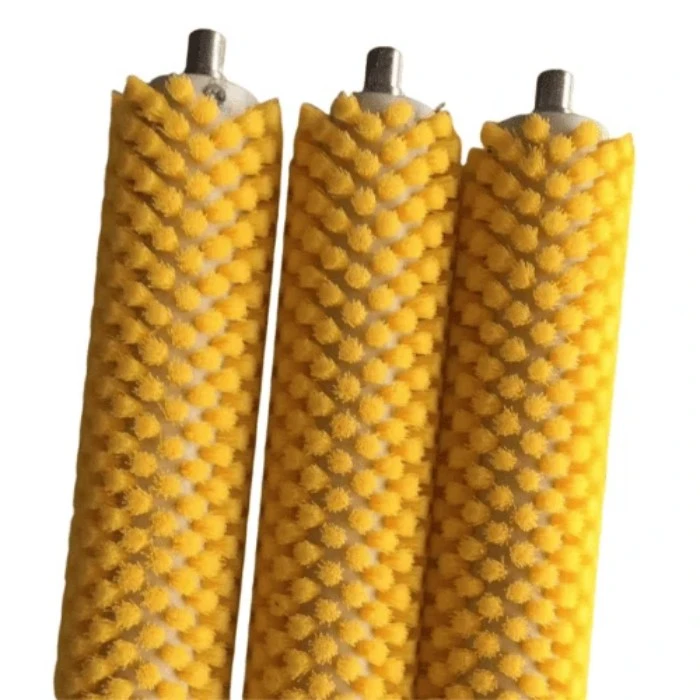
A nylon tufted cylinder brush achieves its egg-safe performance through the engineered interaction of filament material, tufting pattern, core material, and manufacturing precision, with each design element contributing to the overall balance between cleaning effectiveness and shell protection.
What Is Tufted Construction
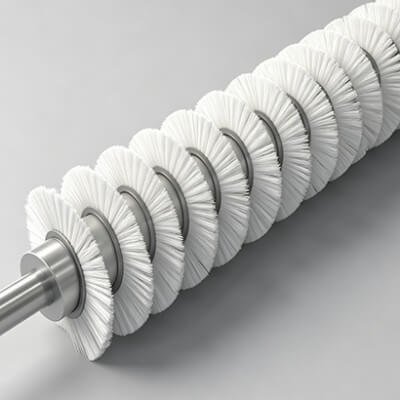
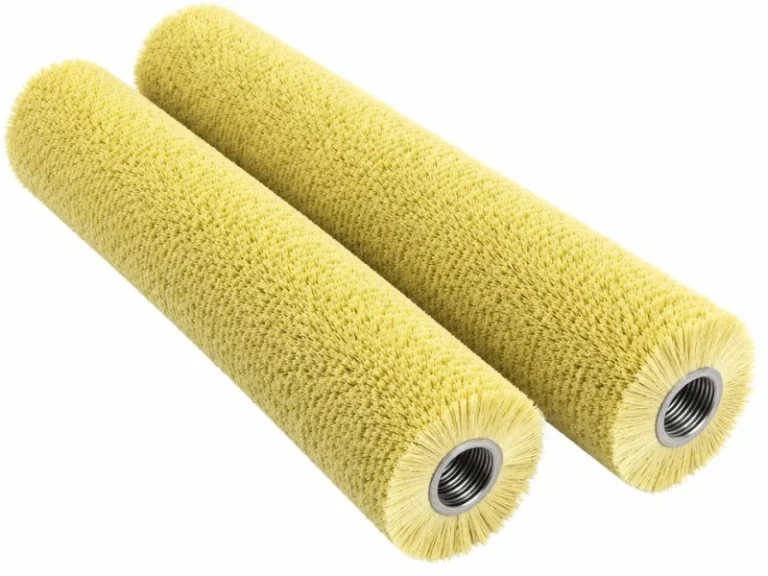
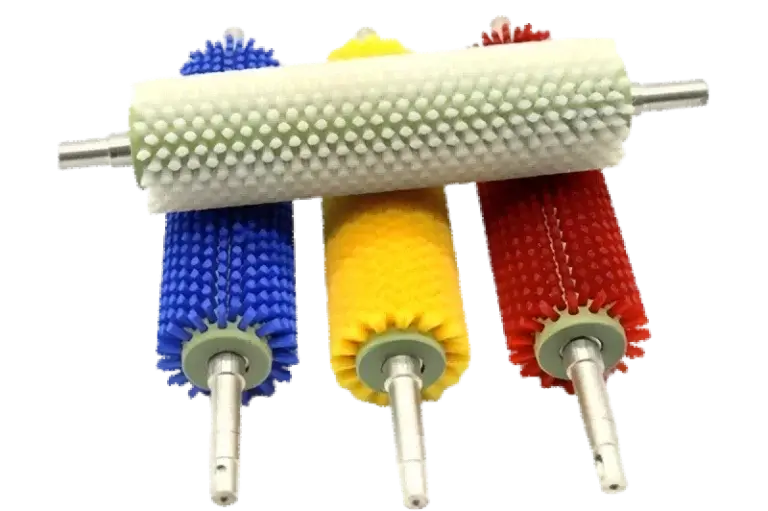
The term “tufted cylinder brush” refers to a specific construction method where bundles of filaments are mechanically inserted and secured into pre-drilled holes along a cylindrical core. This differs from strip brushes, where filaments are crimped into a metal channel, or spiral-wound brushes, where filaments are continuously wound around a core. Tufted construction offers distinct advantages for egg washing applications because it allows precise control over filament angle, density, and distribution.
Tufting Patterns and Shell Contact
The tufting pattern determines how filaments are arranged across the brush surface. Common patterns include straight-line (filament rows aligned parallel to the core axis), spiral (rows follow a helical path), and staggered (offset rows that fill coverage gaps). For egg washing, staggered spiral patterns generally provide the most consistent shell contact because they eliminate the “beating” effect where aligned rows create rhythmic impact pulses. The spiral geometry also assists in moving eggs along the conveyor path, contributing to material handling as well as cleaning.
Core Material Selection
Core material selection has important implications for hygiene, weight, and compatibility. For egg washing environments, common core options include polypropylene (PP), nylon, and stainless steel. PP cores offer excellent chemical resistance and light weight at lower cost, making them suitable for standard-duty applications. Nylon cores provide better dimensional stability under temperature variations and higher mechanical strength for heavy-duty lines. Stainless steel cores offer maximum durability and the easiest sanitization, but add significant rotational inertia that may affect machine balance on smaller washers. The core must also be designed with drainage features to prevent water accumulation inside the brush body, which can lead to imbalance, accelerated bearing wear, and bacterial growth.
Manufacturing Precision and Quality Control
Manufacturing precision in brush construction directly affects brush performance consistency. Filament lengths should be uniform within a tolerance of plus or minus 0.5 mm to maintain balanced rotation. Tufting density should be consistent across the entire brush surface; sparse areas create cleaning gaps while overly dense areas concentrate impact forces. Filament tips should be cut cleanly rather than crushed or melted, as damaged tips exhibit unpredictable bending behavior and increased shell abrasion. Quality nylon cylinder brushes undergo dynamic balancing after assembly to verify smooth rotation at operating speeds, because imbalance-induced vibration not only accelerates bearing wear but also creates irregular shell contact patterns that increase micro-crack rates.
Best Practices for Brush Maintenance and Shell Protection
Routine inspection, systematic cleaning, timely rotation, and scheduled replacement of nylon roller brush assemblies constitute the operational foundation for sustained micro-crack prevention, with the most effective programs combining daily visual checks with weekly deep-cleaning protocols and data-driven replacement scheduling.
The Predictive Maintenance Shift
Even the highest-quality nylon cylinder brushes for cleaning will degrade over time. The key to consistent shell protection lies not in preventing this degradation entirely—which is impossible under commercial operating conditions—but in detecting and responding to it before micro-crack rates begin to climb. Facilities that transition from reactive replacement (changing brushes only when visible damage or high breakage occurs) to predictive maintenance (monitoring brush condition indicators and replacing on a schedule) typically see micro-crack rates drop by 40% to 60%.
Three Daily Checkpoints
Daily visual inspection should focus on three indicators: filament tip condition, tuft integrity, and surface cleanliness. Healthy nylon filaments exhibit clean, slightly rounded tips. Filaments showing flattened, split, or mushroom-shaped tips indicate advanced wear that increases shell abrasion. Tufts should stand upright and separated; matted or clumped tufts have lost their cleaning geometry and create uneven pressure zones. Brush surfaces should appear clean between shifts; residues that remain after washing cycles indicate a loss of the filament’s self-cleaning property, which is a defining characteristic of high-slip nylon formulations.
Beyond the Daily Rinse
Weekly deep cleaning removes accumulated organic residues, mineral scale, and biofilm that daily rinse cycles may miss. A recommended protocol involves removing brush rollers from the machine, soaking them in a food-grade alkaline cleaning solution at the concentration and temperature specified by the filament manufacturer, gently agitating to dislodge particles from between tufts, thoroughly rinsing with potable water, and completely air-drying before reinstallation. Avoid pressure washing nylon cylinder brushes at close range, as high-pressure water jets can damage filament structure and alter tuft alignment.
Calendar vs. Condition: Why Data Wins
Rotation and replacement scheduling should be based on documented brush performance data rather than fixed calendar intervals. Different positions on the same washing line experience different wear rates; entrance brushes typically degrade faster because they encounter the highest contamination loads. Rotating brushes between positions at half their expected service life distributes wear more evenly and extends the overall replacement interval. When micro-crack monitoring data shows an upward trend that correlates with brush condition deterioration, replacement should proceed regardless of the calendar. The cost of premature brush replacement is almost always lower than the cost of increased shell damage, product downgrades, and potential recall exposure.
Economic Impact of Bristle Selection on Processing Operations
Investing in properly specified nylon roller brush systems reduces total processing cost per egg by simultaneously lowering breakage losses, decreasing brush replacement frequency, reducing maintenance labor, and minimizing downstream quality claims, with the combined savings typically exceeding the brush cost premium by a factor of 3 to 5 times.
The Hidden Cost of Low-Price Procurement
The procurement temptation to select the lowest-priced brush option is understandable in thin-margin poultry operations. However, focusing exclusively on brush unit price obscures the far higher costs that brush quality influences. A comprehensive economic analysis of bristle selection must account for all cost categories affected by brush performance.
Quantifying Breakage Losses
Consider a mid-size processing facility handling 100,000 eggs per day. A 2% micro-crack rate versus a 0.3% rate represents a difference of 1,700 eggs per day that are either downgraded, rejected, or become sources of customer complaints. Over a 300-day operating year, this translates to 510,000 affected eggs. If each affected egg represents a loss of USD 0.05 to USD 0.10 (accounting for downgrade price differential, handling costs, and occasional claims), the annual financial impact ranges from USD 25,500 to USD 51,000. This figure alone often exceeds the entire annual brush procurement budget.
Total Cost of Ownership: Replacement Frequency and Labor
Brush replacement frequency adds another layer of cost distinction. A premium nylon tufted cylinder brush with food-grade virgin filament and precision tufting may cost 30% to 50% more than an economy alternative yet last two to three times longer. When labor costs for brush changeovers—which require line stoppage, disassembly, and recalibration—are factored in at USD 200 to USD 500 per changeover event, the total cost of ownership picture shifts decisively toward quality brushes. Fewer changeovers also mean fewer opportunities for incorrect installation, which itself introduces micro-crack risk.
Indirect Costs and Operational Consequences
Indirect costs, though harder to quantify, are no less real. Facilities with high breakage rates often compensate by reducing line speed, directly sacrificing throughput to protect yield. Maintenance staff diverted to brush-related troubleshooting are unavailable for preventive work elsewhere. Customer quality audits that reveal micro-crack patterns trigger corrective action requests that consume management attention and may jeopardize supplier qualification status. Each of these secondary impacts traces back to the bristle material and construction quality decisions made during brush procurement.
A Data-Driven Approach to Brush Specification
The most successful egg processing operations treat brush specification not as a commodity purchasing decision but as a process engineering parameter. They test candidate nylon cylinder brushes on a single line segment, collect micro-crack data over statistically meaningful sample sizes, and make procurement decisions based on total cost per clean, intact egg delivered to packaging. This data-driven approach transforms bristle selection from a cost-center activity into a competitive advantage that simultaneously improves product quality, food safety compliance, and operational profitability.
Conclusion
Preventing shell micro-cracks in automated egg washing is fundamentally a materials engineering challenge disguised as an operational problem. The evidence from commercial poultry processing consistently points to bristle type as the dominant controllable factor, with food-grade nylon roller brush systems representing the current best practice for operations seeking to maximize cleaning effectiveness while minimizing shell damage.
Nylon cylinder brushes offer a combination of properties that no natural or metallic alternative can match: controlled stiffness through filament diameter specification, smooth surface finish that minimizes abrasion, excellent bend recovery for consistent contact geometry, low moisture absorption for stable performance across long shifts, and inherent resistance to microbial colonization. The nylon tufted cylinder brush construction method further enhances these advantages by enabling precise control over tuft density, pattern, and filament angle.
Achieving the full shell protection potential of nylon cylinder brushes for cleaning requires more than material selection alone. Proper specification of filament diameter, tuft density, trim length, and polymer grade must be matched to the specific egg type and processing parameters of each line. Equally important is a disciplined maintenance program that monitors brush condition proactively and replaces brushes based on performance data rather than fixed schedules.
For processing facility managers, the path forward is clear: evaluate current brush specifications against the criteria presented in this article, implement systematic micro-crack rate monitoring if not already in place, and conduct controlled trials of optimized nylon brush configurations on representative line segments. The economic case for quality bristles is compelling, but the operational case—consistent production of clean, intact, food-safe eggs—is ultimately what sustains customer relationships and brand reputation in the competitive poultry products market.