
Industrial potato processing lines handle thousands of tons of raw product every day. From French fry manufacturers to potato chip producers, the first critical step in any processing chain is cleaning and peeling, and the quality of this step directly determines downstream yields, product appearance, and overall operational profitability. For decades, food processors relied on conventional straight-bristle roller brushes inside their peeling machines. These traditional configurations served the industry adequately, but they left significant gaps in cleaning coverage, caused unnecessary product damage, and demanded frequent brush replacements that drove up maintenance costs.
Wave-shaped bristles clean potato peeling machines better because their undulating profile creates dynamic contact zones that penetrate potato eyes, crevices, and irregular surfaces that straight bristles simply cannot reach. The wave geometry stores and releases mechanical energy during rotation, generating a natural tumbling action that delivers 360-degree cleaning coverage while using gentler friction, thus reducing skin damage, increasing throughput by up to 30 percent, and extending brush service life by minimizing uneven wear.
As food processing operations face mounting pressure to reduce waste, improve yield, and meet increasingly stringent food safety standards, the engineering behind seemingly simple components like roller brushes has evolved dramatically. The shift from straight bristles to wave-shaped configurations represents one of the most impactful yet underappreciated innovations in root vegetable processing. Understanding why this design change matters and how it directly affects your bottom line is essential for any operation looking to optimize its peeling line.
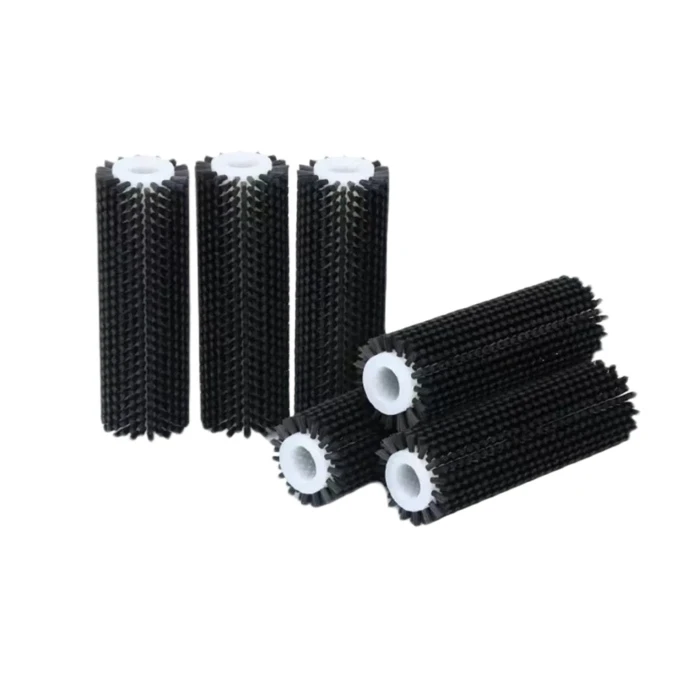
What Makes Wave-Shaped Bristles Fundamentally Different from Straight Bristles
Wave-shaped bristles differ from straight bristles in their undulating, non-linear filament profile that creates alternating high and low contact zones along the roller surface, whereas straight bristles present a uniform, flat contact plane that engages product surfaces with consistent but limited friction patterns.
The structural difference between wave-shaped and straight bristles begins at the manufacturing level. Straight bristles are trimmed to a uniform length across the entire roller circumference, producing a cylindrical brush profile where every filament tip sits at an identical distance from the core shaft. When these rollers rotate against potatoes, all bristles make contact simultaneously and uniformly, creating a single-plane friction zone. This concentrated contact works adequately for flat or uniformly round surfaces, but potatoes are anything but uniform: they feature deep eyes, irregular bumps, ridges, and varying diameters even within the same batch.
Wave-shaped bristles are manufactured with a deliberate oscillation pattern, where bristle trim length varies in a sinusoidal wave profile along the roller axis. This creates a series of peaks and valleys across the brush surface. During rotation, the wave profile engages potato surfaces at multiple angles and depths simultaneously. The peak bristles reach into eyes and crevices while the valley bristles provide supporting contact on raised surfaces. This multi-plane engagement fundamentally changes the physics of the cleaning action from a two-dimensional friction interface to a three-dimensional enveloping contact zone.
The mechanical behavior under load also differs significantly. Straight bristles deflect uniformly when compressed, and once they pass their elastic limit, they remain bent, losing effective cleaning force. Wave-shaped bristles, by contrast, store mechanical energy as their curved profile compresses and release it as they rebound during rotation. This energy storage-and-release cycle creates a continuous propulsion effect that actively tumbles potatoes rather than simply dragging them across the brush surface. According to industrial brush manufacturers, this tumbling action is the mechanism that enables wave-shaped brushes to achieve complete surface coverage without the need for manual repositioning or additional mechanical agitation.
How Wave-Shaped Bristles Achieve 360-Degree Cleaning on Irregular Potato Surfaces
Wave-shaped bristles achieve 360-degree cleaning by combining multi-plane contact geometry with a natural tumbling propulsion effect that continuously reorients potatoes during processing, ensuring every surface, including eyes and crevices, receives direct bristle contact.
The challenge of cleaning potatoes thoroughly has always been their irregular surface topography. Potato eyes, in particular, are recessed pockets where soil, bacteria, and pesticide residues accumulate and where straight bristles, constrained to a single contact plane, simply skim over the top without penetrating. In a conventional straight-bristle peeling machine, achieving coverage of potato eyes requires extended residence time and manual repositioning, both of which increase labor costs and reduce hourly throughput.
The Wave-shaped brushes solve this through two complementary mechanisms. First, the peak-to-valley geometry means that during any given rotation, some bristle tips extend further than others along the roller axis. These extended tips function like fingers that probe into surface depressions, dislodging embedded debris that shorter, uniform bristles would glide past. The alternating pattern ensures that as the potato rolls, every square millimeter of its surface eventually encounters an extended bristle tip.
Second, the propulsion effect generated by the wave pattern actively tumbles the potato, continuously changing its orientation relative to the brush surface. Unlike straight brushes, where potatoes tend to slide in a fixed orientation, wave brushes create uneven resistance across the contact zone that induces rotation along multiple axes. This is not random motion but a predictable mechanical outcome of the bristle geometry: the alternating high and low zones create differential friction that causes the potato to spin, flip, and rotate end-over-end as it travels along the roller path. The result is that no surface remains in shadow; every region of the potato receives direct exposure to the cleaning bristles multiple times during a single pass through the machine.
Processing line operators report that this tumbling effect is particularly valuable when handling mixed-size potato batches. Small potatoes, which might sit in the valleys between straight bristles and receive inadequate cleaning, are lifted and rotated by wave peaks. Large potatoes, which in straight-bristle machines might only receive cleaning on their bottom surface, are actively rolled to expose all sides. The 360-degree cleaning coverage means that output quality remains consistent regardless of input size variation, reducing the need for upstream sorting and grading.
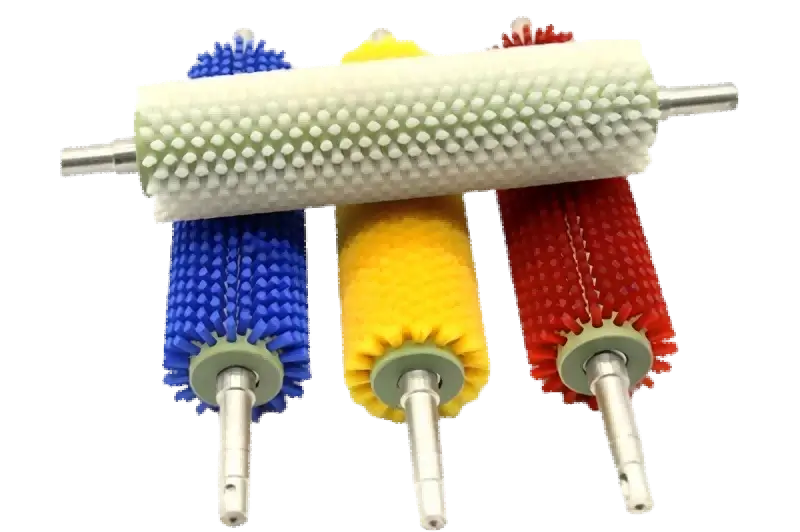
Why Nylon Is the Preferred Material for Food-Grade Roller Brush Bristles
Nylon, specifically food-grade Nylon 6/12 and Nylon 6.6, is the preferred bristle material for potato peeling roller brushes because it combines the optimal balance of stiffness for effective peeling, elasticity for gentle product handling, abrasion resistance for long service life, temperature tolerance for continuous operation, and compliance with FDA food-contact safety standards.
The material science behind roller brush bristle selection is more nuanced than it appears. Bristles must withstand continuous mechanical stress, resist chemical degradation from cleaning agents and potato starch, maintain performance across temperature fluctuations, and above all, meet strict food safety regulations. Among all candidate materials, including polypropylene, polyester, and natural fibers, nylon consistently outperforms across every relevant performance dimension.
Nylon 6.6 offers the highest tensile strength and stiffness among food-grade synthetic filaments, making it the ideal choice for aggressive peeling applications where thicker potato skins require more forceful abrasion. Its melting point exceeds 250 degrees Celsius, well above any temperature encountered in normal processing conditions, and its low moisture absorption rate of approximately 2.5 percent means it maintains dimensional stability and consistent stiffness even in the wet, high-humidity environment of a peeling machine. Nylon 6/12, with even lower moisture absorption at approximately 1.5 percent, provides superior flexibility and is often specified for gentler cleaning applications where the goal is soil removal rather than aggressive peeling.
The abrasion resistance of nylon filaments directly translates to brush service life. Independent testing by industrial brush manufacturers shows that nylon bristle rollers can process between 500 and 800 tons of potatoes before requiring replacement, compared to 200 to 400 tons for polypropylene equivalents. This wear advantage stems from nylon’s high crystallinity and strong intermolecular hydrogen bonding, which resist the micro-fractures that accumulate in lower-grade polymers under repeated flexural stress.
From a food safety perspective, FDA-compliant nylon bristles are manufactured without plasticizers, heavy metal stabilizers, or processing aids that could migrate into food products. The material is also resistant to bacterial colonization when combined with proper sanitation protocols, as its non-porous surface does not provide the microscopic crevices where biofilm-forming microorganisms can establish colonies. This is particularly important for potato processing lines, where starch-rich wet environments create ideal conditions for microbial growth if equipment surfaces are not inherently resistant.
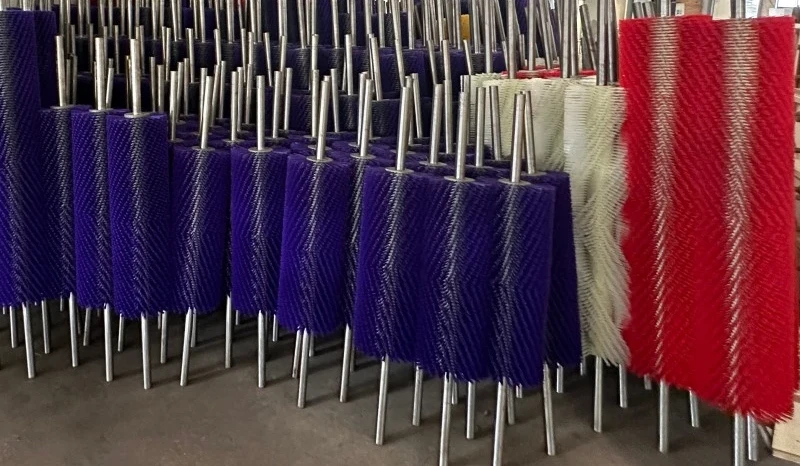
How Wave-Pattern Design Reduces Product Damage and Improves Yield
Wave-pattern bristle design reduces product damage by distributing contact pressure across a larger surface area through multi-point engagement, while the elastic energy storage in the wave geometry prevents the concentrated abrasive force that causes gouging, bruising, and excessive flesh removal in straight-bristle systems.
Yield loss during mechanical peeling is one of the most significant cost factors in potato processing. Research data indicates that conventional abrasive peeling methods can result in weight losses of 15 to 25 percent, while brush-type peeling systems with straight bristles typically achieve loss rates in the 10 to 15 percent range. The introduction of wave-shaped bristle configurations has been shown to reduce peel loss to as low as 7 to 10 percent, representing a meaningful improvement in product yield that directly impacts processing profitability.
The mechanism of damage reduction operates at the microscopic level of bristle-to-product interaction. Straight bristles, with their uniform tip height, concentrate the full rotational force of the roller onto a narrow contact band. When a potato presents an irregular surface, this concentrated force can exceed the local compressive strength of the potato flesh, causing bruising beneath the skin or gouging into the flesh itself. These defects are not always visible immediately after peeling but become apparent as dark spots hours later, leading to quality downgrades or product rejection at later inspection stages.
Wave-shaped bristles mitigate this through distributed contact mechanics. Because the wave profile creates bristles of varying lengths within the same contact zone, the applied force is shared across multiple tips engaging the potato at different angles and pressures. No single bristle bears the full brunt of the rotational energy; instead, the load is distributed across a broader contact area with variable pressure gradients. The longer peak bristles provide the penetrating force needed for eye cleaning, while the shorter valley bristles provide supporting contact that stabilizes the potato position without applying excessive local pressure.
Additionally, the elastic energy storage characteristic of the wave geometry acts as a mechanical buffer. When a wave-shaped bristle encounters a raised surface feature, it flexes and stores potential energy rather than transmitting the full impact force directly to the potato. Straight bristles, which deflect uniformly and more abruptly, transmit a sharper impulse that is more likely to cause tissue damage. This buffering effect is especially important when processing thin-skinned potato varieties or potatoes that have been stored at warmer temperatures, where skin adhesion is weaker, and flesh is more susceptible to mechanical injury.
Operational Efficiency Gains from Wave-Shaped Bristle Roller Brushes
Wave-shaped bristle roller brushes increase operational efficiency by enabling faster processing speeds, reducing the need for manual product repositioning, decreasing water and energy consumption through shorter cycle times, and maintaining consistent output quality across mixed-size batches.
Processing throughput is a function of residence time multiplied by the number of units processed per cycle. In a straight-bristle machine, achieving acceptable cleaning quality on challenging potato batches often requires extending residence time, running multiple passes, or stationing operators to manually reposition potatoes that have missed coverage on certain surfaces. Each of these adjustments erodes the theoretical throughput capacity of the line.
Wave-shaped bristle rollers address throughput at the root cause level by making every second of residence time more effective. The 360-degree tumbling action means that a potato passing through a wave-brush machine experiences effective cleaning contact on all surfaces within a single pass, eliminating the need for recirculation or extended dwell times. Industrial brush manufacturers and food processing equipment suppliers report that switching from straight to wave-configuration rollers can increase effective throughput by 20 to 30 percent on potato peeling lines, depending on the specific potato variety and contamination levels.
The reduction in manual intervention has compounding benefits beyond direct labor savings. Every instance of operator intervention into a running processing line introduces variability. Different operators apply different levels of scrutiny, reposition products at different speeds, and make different decisions about when a potato is adequately cleaned. Wave-shaped brushes, by delivering inherently more consistent mechanical cleaning, reduce dependence on operator judgment and produce more uniform output that downstream processes like cutting, blanching, and frying can handle more predictably.
Water and energy consumption also benefit from the efficiency improvements. Many potato peeling machines use high-pressure water spray systems in conjunction with mechanical brushing. When brush cleaning action is more effective, water pressure and volume can be reduced without compromising results. Shorter cycle times mean less total running time for drive motors, pumps, and conveyors, translating to measurable reductions in kilowatt-hour consumption per ton of product processed. For high-volume operations processing hundreds of tons per day, these incremental efficiency gains compound into significant operational cost savings over a fiscal year.
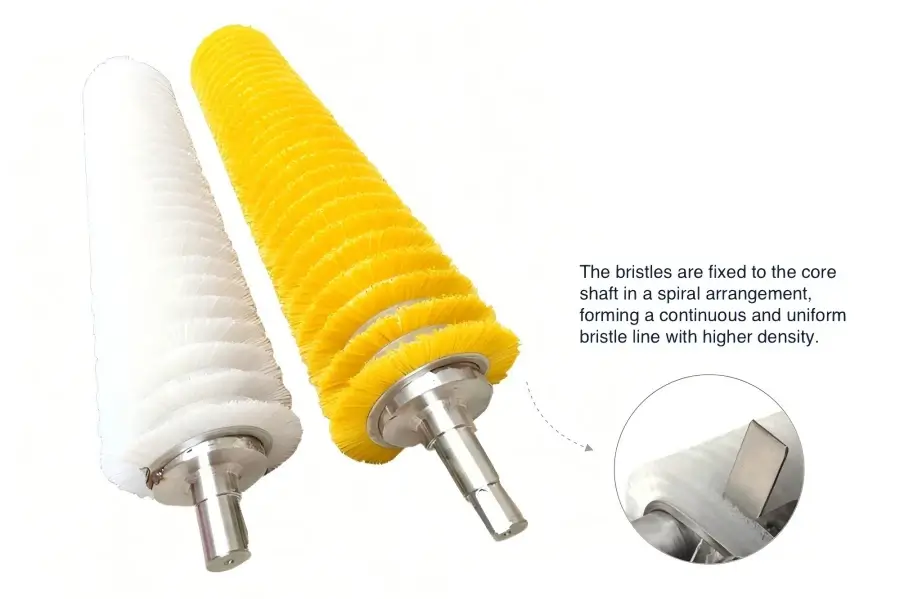
Maintenance, Durability, and Long-Term Cost Advantages
Wave-shaped nylon roller brushes deliver long-term cost advantages through extended service life resulting from even wear distribution, reduced replacement frequency, lower unplanned downtime, and compatibility with standard sanitation protocols that preserve bristle integrity over repeated cleaning cycles.
The total cost of ownership for roller brushes extends far beyond the unit purchase price. The hidden costs of brush replacements include production downtime during changeovers, labor for removal and installation, disposal costs for worn brushes, and the quality impacts of running brushes past their optimal service window. A brush design that extends service life by even 30 percent can deliver a disproportionately large impact on overall processing economics.
Straight bristles tend to wear unevenly because the uniform contact pattern creates high-wear zones aligned with the most common potato contact positions. Once these zones flatten or develop a permanent set, the brush loses effective cleaning action across its surface even though much of the bristle length remains unused. Wave-shaped bristles distribute wear more evenly because the alternating peak and valley geometry ensures that no single filament group bears a disproportionate share of the mechanical load. The continuous flex-and-recover cycle of the wave pattern also prevents permanent bristle deformation or “memory” that afflicts straight bristles after extended use.
Material selection amplifies the durability advantage. Food-grade nylon filaments, particularly when manufactured with UV stabilizers and anti-hydrolysis additives for wet processing environments, maintain their mechanical properties through thousands of operating hours. The stainless steel cores used in food-grade roller brushes, typically 304 or 316 grade, resist corrosion from water, cleaning chemicals, and potato starch residues, ensuring that the structural integrity of the brush remains sound even as the bristles eventually reach the end of their life.
From a maintenance scheduling perspective, the more predictable wear curve of wave-shaped brushes allows processing plants to plan replacements during scheduled maintenance windows rather than reacting to unexpected failures. This shift from reactive to planned maintenance reduces the frequency and duration of unplanned downtime events, which in food processing can cascade into raw material spoilage, downstream line stoppages, and missed delivery commitments. Operations that track brush service life data report that wave-configuration nylon rollers consistently outlast straight-bristle alternatives by 40 to 60 percent under comparable operating conditions.
Conclusion
The transition from straight to wave-shaped bristle configurations on nylon roller brushes represents one of the most cost-effective upgrades available to potato processing operations. The engineering principles are straightforward: wave geometry creates dynamic, multi-plane contact that achieves 360-degree cleaning coverage, penetrates potato eyes and crevices that straight bristles miss, reduces product damage through distributed pressure mechanics, and extends brush service life through even wear distribution. When combined with the proven material advantages of food-grade nylon, including abrasion resistance, temperature stability, and FDA compliance, wave-shaped roller brushes deliver measurable improvements in throughput, yield, product quality, and total cost of ownership.
For processing plant managers evaluating equipment upgrades, the decision often comes down to return on investment. Nylon roller brushes typically carry a modest premium over straight-bristle equivalents, but the payback period measured in reduced product loss, higher throughput, lower labor costs, and extended replacement intervals is consistently measured in months rather than years. In an industry where margins are tight, and every percentage point of yield improvement flows directly to the bottom line, the wave-shaped bristle advantage is not merely a technical curiosity: it is a proven competitive edge.