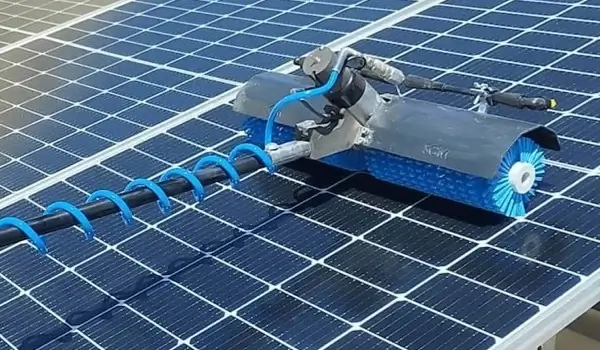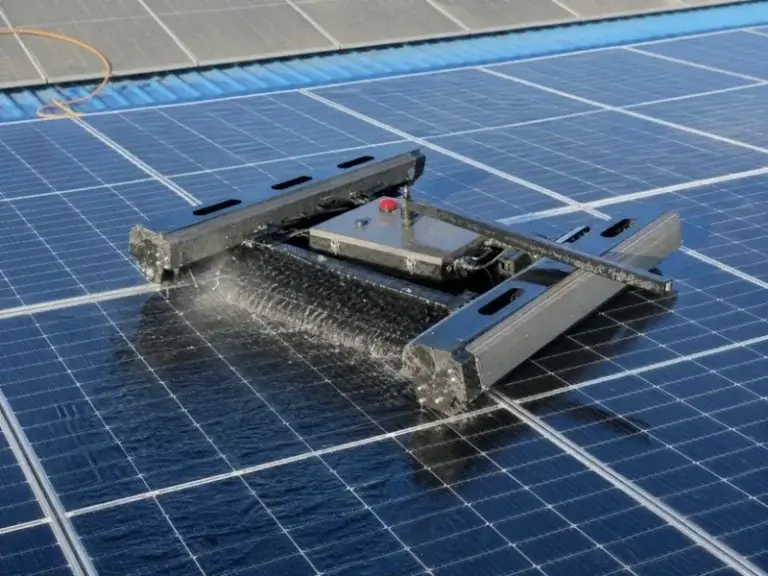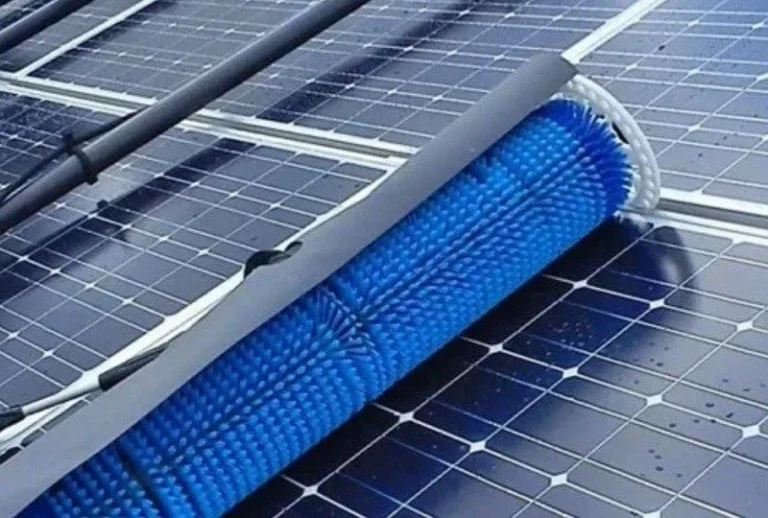
Anti-static PA612 solar panel cleaning brush with ultra-fine filaments and a UV-resistant design to prevent scratches and static in arid regions. Much better than nylon cylinder brushes for dry cleaning. The standard nylon cylinder brushes often create static and can scratch the panels, especially in arid regions.
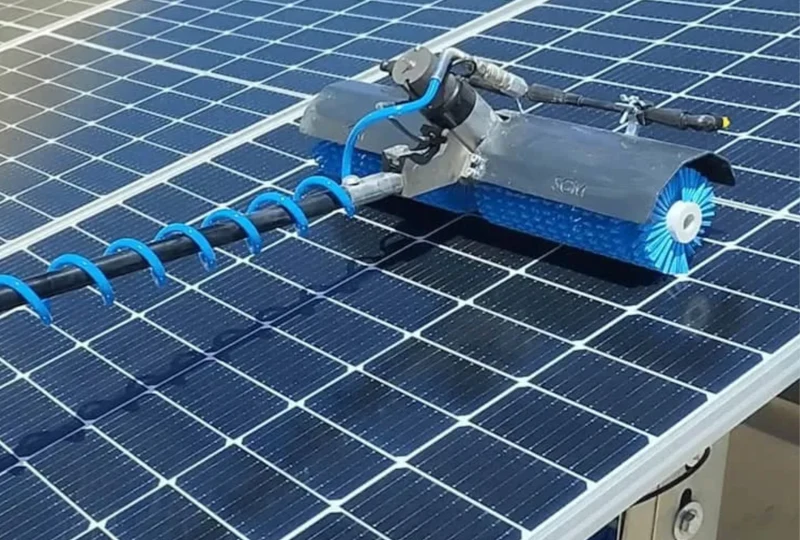
Standard Brushes Fail in Arid Environments
Learn more about the safest solar panel cleaning brush for dry regions—anti-static PA612 filaments, ultra-fine soft bristles, and UV-resistant design for dry cleaning.
The solar panel cleaning brush should be as specialized as the dry cleaning brush for waterless arid regions. It should have anti-static PA612 filaments, ultra-fine soft bristles, and UV-resistant construction.
Arid Solar Panel Cleaning Brushes
Solar farms in deserts and arid plains or in the Gobi face a special kind of menace that has nothing to do with the sun: dust. Fine, hard, abrasive sand is deposited on the panels daily, cutting energy output to 15-35%. Obviously, cleaning is the right solution. But in arid environments, the wrong cleaning brush would do more damage than the dust itself.
Static discharge, micro-scratches on anti-reflective coatings, and brittle filaments breaking onto panel surfaces—these are actual problems with standard brushes in dry, sandy conditions. A brush designed for operators who run large-scale arid solar farms should, therefore, not create any of these problems.
This paper will describe the exact reasons why standard cylindrical brushes do not perform well under arid conditions and why one should consider a brush designed for use in an arid environment as the best choice.
Cylindrical Brushes Unsuitable for Arid Sandy Areas
Most nylon filaments in standard cylindrical solar cleaning brushes are made of PA6 or PA66. In general climates, with regular water-assisted cleaning, these materials work just fine. Arid environments, however, compound four challenges—and with them, the weaknesses of generic brushes.
- Static charge accumulates when sweeping dry, and it worsens with extreme dryness.
- High-hardness mineral dust, like quartz and feldspar, acts as micro-abrasive sandpaper.
- Filaments will be degraded rapidly due to intense UV radiation and wide temperature swings.
- Water scarcity forces dry-cleaning methods that demand specialized brush designs.
A regular brush will not consider any of these. The results would be scratched anti-reflective coatings, static-triggered micro-arcing, premature filament failure, and rising O&M costs. Knowing these failure modes is the first step. Knowing how to choose the right solar panel cleaning brush is next.
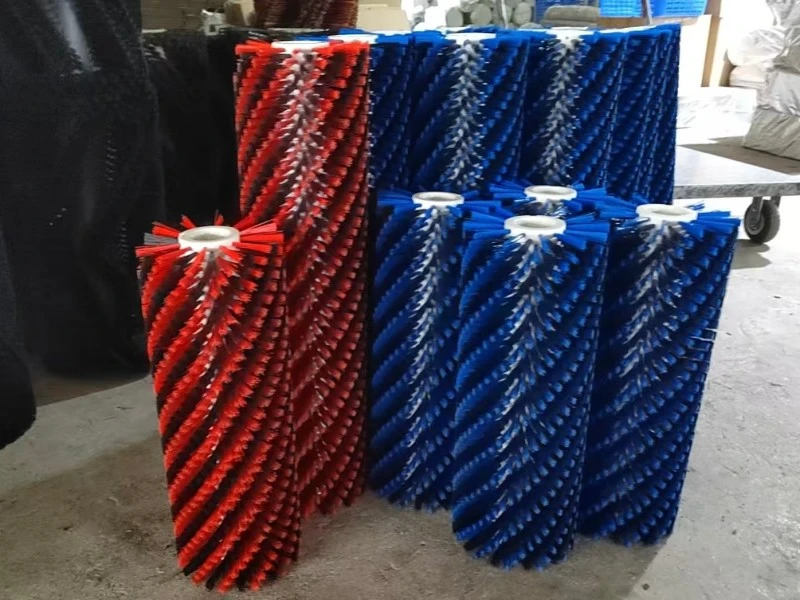
Anti-Static PA612 Filaments Prevent Static Damage
Significant static electricity is built up in the dry air, where humidity is generally less than 20%, due to friction between the filaments of the brush and the glass. Nylon of the standard PA6/PA66 type is a good insulator; it traps the static charge at the surface of the panel. This trapped charge does two things:
- It can be discharged through the panel structure, which in turn risks damage to the bypass diodes and junction boxes.
The problem is solved using a purpose-built solar cleaning brush for arid environments, which uses anti-static modified PA612 filaments. PA612 has lower moisture absorption inherent in it, and when compounded with conductive additives, it can dissipate electrostatic charge continuously during operation. The brush never allows the accumulation of dangerous voltage.
Ultra-fine soft filaments and high-density tufting will not allow hard desert dust to scratch. This single material change eliminates the root cause of static-related panel damage during dry cleaning, which is a critical advantage that no standard nylon cylinder brush provides out of the box.
Desert dust is not like normal household dust. Gobi and sandy desert region particles often tend to register 6-7 on the Mohs hardness scale. When such particles are pressed against tempered glass using a stiff, coarse brush filament at high rotational speed, they cause micro-scratching on the anti-reflective (AR) coating.
Repairs to AR coatings cannot be made. Even a 2% loss of transmittance across thousands of panels can lead to a major reduction in revenue over the 25-year life of a plant. The solution put forward by engineers has a dual part that works jointly in design.
- Ultra-fine filaments (0.06–0.10 mm diameter): Such fine and flexible bristles would shape around solid particles instead of forcing them into the glass surface.
- High-density cross-pattern tufting: In this technique, dense and uniformly spaced filaments help ensure that the contact force is spread over a wide area, thereby reducing point pressure on any single spot.
This blend provides full dust removal without scratching. For a more in-depth technical analysis of how filament diameter and brush weight work together to prevent scratches and cut costs, the data consistently support ultra-fine filament designs for abrasive-dust environments.
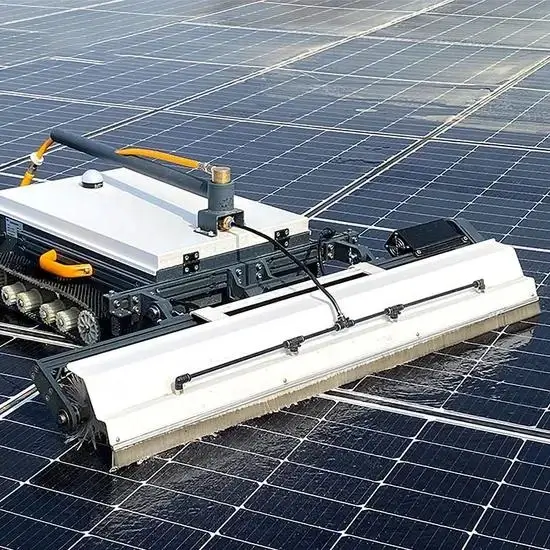
UV-Resistant Gap-Tufted Brushes for Low-Cost Arid Use
An arid solar site experiences over 70°C during the day and less than 0°C at night. Annual UV exposure can be over 2,500 kWh/m² in desert regions. Under these conditions, standard nylon filaments become brittle within 3-6 months. Brittle filaments crack and shed onto the panel surfaces, creating new contamination.
This brush is designed for cleaning solar panels in cylindrical arid environments and ensures durability through two improvements:
- The first one is compounding UV-stabilized and anti-aging additives directly into the base resin PA612, which extends the service life of the filament to 2× or more.
- A controlled-gap tufting structure would allow sand and dust to fall through the brush body freely, so particle accumulation—which leads to clumping and hardening—is prevented.
This controlled-gap design is especially critical for the dry-sweep system—without water. A standard tightly-packed brush loads up quickly with compacted sand. This reduces cleaning performance and increases the risk of panel abrasion. This will help procurement teams understand the most important features of the solar cleaning brush so that they can specify the right product for their specific site conditions.
Work with manufacturers to define filament material, diameter, tufting density, and gap spacing for arid projects. This will be an outline for detailed incorporation in a custom solar panel cleaning brush specification that can go a long way in eliminating expensive mismatches between brush design and site conditions.
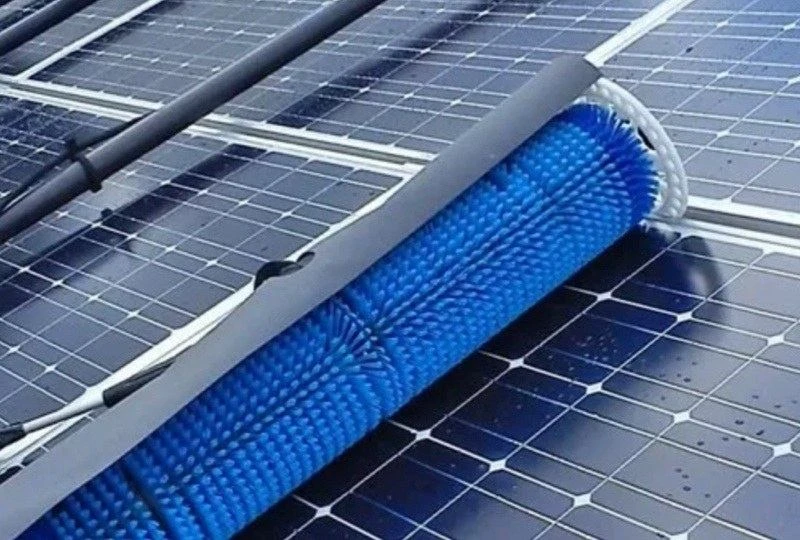
Standard vs Arid Solar Cylindrical Cleaning Brushes
| Feature | Standard Cylindrical Brush | Specialized Arid-Environment Brush |
| Filament Material | PA6/PA66 nylon | Anti-static modified PA612 |
| Static Dissipation | No charge accumulates | Charge dissipates safely |
| Filament Diameter | 0.15–0.30 mm (coarse) | 0.06–0.10 mm (ultra-fine) |
| Tufting Pattern | Standard uniform rows | High-density cross-pattern with spaced gaps |
| UV / Aging Resistance | Low — Brittle within 3–6 months | High — UV-stabilized for 12+ months |
| Dust Self-Cleaning | Poor — Sand clumps up | Excellent — Particles shed automatically |
| Dry-Cleaning Compatibility | Limited | Full, designed for waterless operation |
| AR Coating Safety | Risk of micro-scratching | Minimal risk — force distributed evenly |
This comparison really puts the performance gap into perspective. For solar farms in arid regions, that specialized brush is not a luxury — it’s what makes long-term energy yield possible. Find all solar panel cleaning brush Types and Nylon Cylinder Brush Configurations to fit your specific Cleaning Equipment and Panel Layouts.
FAQ
Can this brush for arid environments be used in robotic dry-cleaning systems?
Yes. The controlled-gap tufting and standard dimensions of the core allow it to be directly integrated with most robotic and automated dry-cleaning systems used in solar farms in deserts.
What is the replacement frequency for cleaning brushes in arid-solar cleaning?
UV-stabilized PA612 brushes typically last between 12 and 18 months in the harsh desert conditions, which is almost double the lifespan of standard PA6 brushes; this cuts the frequency of replacements and maintenance costs by half.
What filament diameter is best for desert dust that is high in hardness?
A filament of between 0.06 and 0.10 mm would bring out the best results. These filaments bend around the hard sand particles, as opposed to pushing them into the glass, thus offering better protection to the anti-reflective coating.