
Steel rotary brushes show up in almost every metal shop: weld bays, fabrication lines, pipe mills, and maintenance crews. They strip rust, knock off mill scale, clean weld seams, and deburr cut edges before coating or assembly. The tool looks simple, but the choice of diameter decides whether it works with the equipment on your floor or works against it.
Pick a brush that is too large for the spindle and the bristle tips run at excessive speed. The wire overheats, sheds early, and can overload the motor. Pick one that is too small, and you get a narrow working band, slow coverage, and a finish that varies across the part. Either way, the cost shows up in consumable spend, rework, or downtime.
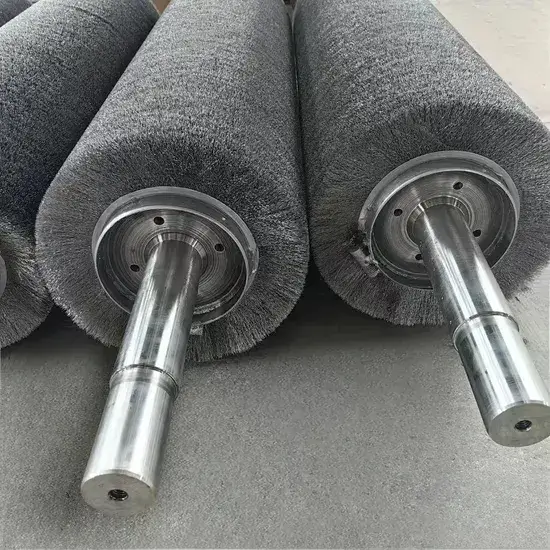
There is no universal steel rotary brush diameter that fits every machine. The right size starts with the equipment: check the spindle power and maximum RPM rating on the machine, then choose the largest diameter that keeps the brush inside its rated speed range, covers the working width you need, and clears the workpiece and guards. In practical terms, that usually means 4–6 in. (100–150 mm) for portable tools, 6–10 in. (150–250 mm) for bench and pedestal machines, and custom sizes for automated lines.
The rest of this article walks through the selection logic the way a plant engineer would apply it: why diameter matters, how each class of equipment changes the answer, which secondary factors refine the choice, and how to confirm the fit before you place the order.
Why Brush Diameter Matters in Surface Preparation
Diameter controls three things at once: the surface speed at the bristle tips, the width of material the brush contacts in one pass, and the torque the motor must deliver. Change any one of them and the whole operation changes.
Surface Speed and the Diameter Formula
The most important technical consequence of diameter is surface speed. For a fixed spindle RPM, the speed at the bristle tips grows in direct proportion to the diameter:
surface speed = π × diameter × RPM
A 6-inch brush at 3,600 RPM produces roughly 5,650 surface feet per minute (SFPM). A 10-inch brush on the same spindle produces about 9,425 SFPM. Carbon steel wire brushes perform best between 5,000 and 7,500 SFPM in most cleaning and deburring work. Below that range, the brush polishes more than it cuts; above it, the wire runs hot, work-hardens the surface, and sheds bristles faster than normal.
Contact Width and Throughput
Diameter also sets the practical footprint on the workpiece. A wheel brush contacts the part along a chord, not a single point, so a larger diameter spreads the brushing force across more bristles and covers a wider band per pass. That raises throughput on flat panels and long weld lines. The trade-off is that a bigger brush carries more energy, so on thin sheet or soft material it can gouge the surface if the operator leans on the tool.
Power and Torque Demand
Power consumption follows the same curve. A larger brush drags more wire through the work, so the motor has to deliver more torque. On an underpowered spindle, the speed drops, the finish changes character, and the brush can stall mid-pass. This is why the spindle rating, not the brush catalog, should be the starting point for diameter.
Material Speed Limits and Safety
Material also sets the speed ceiling. Carbon steel tolerates the 5,000–7,500 SFPM range without much trouble, but stainless steel work-hardens when brushed too fast, which makes the next pass even harder and can leave a smeared surface that resists coating. Aluminum and soft alloys need lower speeds and finer wire to avoid gouging. When the same spindle has to handle several materials, choose the diameter that keeps the brush inside the slowest material’s safe range and adjust feed pressure rather than speed.
Speed ratings matter for safety as well as performance. Every wire brush carries a maximum RPM rating, and exceeding it can throw loose bristles at high velocity. OSHA’s abrasive wheel machinery standard, 29 CFR 1910.215, covers grinding wheels on bench equipment, and the same guarding and speed-limit logic applies to rotary wire brushes used in that setting.
How Equipment Type Changes the Right Diameter
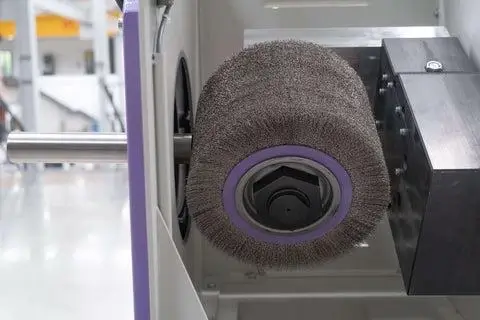
Portable tools, bench machines, and automated cells run at different speeds and have different power and clearance limits, so each class points to a different diameter range. Match the brush to the machine first, not the other way around.
Angle grinders and handheld tools
Handheld angle grinders commonly run at 10,000–12,000 RPM. At those speeds, a large brush would exceed safe wire speed almost immediately, which keeps the practical range at 4–6 in. (100–150 mm). A 4.5-inch brush at 11,000 RPM delivers roughly 13,000 SFPM, hot for carbon steel but common for quick weld cleaning and rust removal work. Pick the smaller end for tight corners and access between flanges; pick the larger end when you want more coverage on flat panels. For heavy rust and mill scale on structural steel, a rust removal brush in the 4.5–6 in. range balances cutting action with control in one hand.
Bench grinders and pedestal machines
Bench grinders and pedestal buffers spin at 1,750–3,600 RPM, which opens the door to larger brushes. Common choices are 6 in. (150 mm) at 3,600 RPM and 8–10 in. (200–250 mm) at 1,750 RPM. These machines give the operator the best control for deburring, edge blending, and finishing because the part can be moved slowly and steadily across the brush face.
For example, a fabrication shop that deburrs laser-cut parts up to 12 in. wide will get a cleaner result from an 8 in. brush with a wide face on a 1,750 RPM pedestal machine than from a 6 in. brush at 3,600 RPM. The lower speed gives the operator time to guide the part, and the larger face covers more edge per pass. If the job is wide flat stock, a steel roller brush mounted on a shaft can span the full part width and remove the need for multiple passes entirely.
Automated and robotic cells
Automated lines need a brush matched to the robot arm payload, the spindle duty cycle, and the indexing interval for wear compensation. Diameters in this class usually run from 8 in. up to 16 in. or more for wide-pass descaling and conveyor-fed finishing. The deciding factors are part geometry, line speed, and how much brush life the cell can tolerate before an automatic index or a manual change-out.
Robotic cells also force a decision about brush life. A larger diameter gives more usable wire before the brush reaches minimum working size, which extends the interval between change-outs. Many integrators size the brush at the top of the spindle’s rating for this reason, then program a diameter-based wear check into the cell.
Cylinder brushes for pipes, bores, and profiles
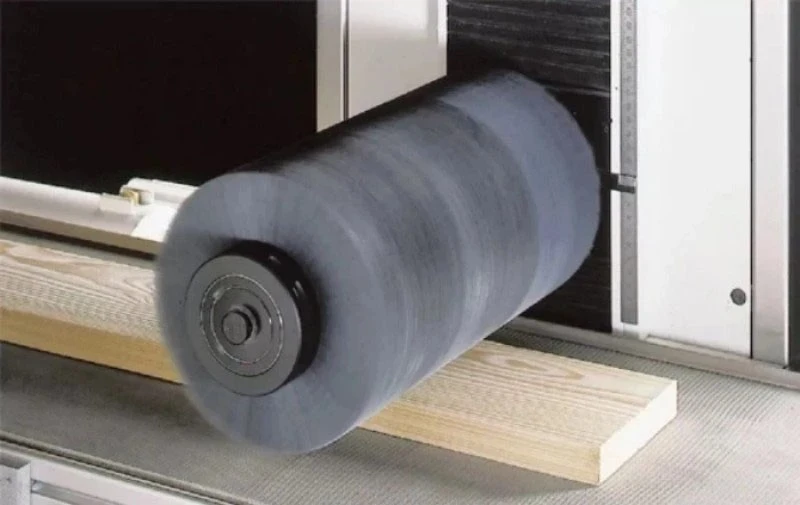
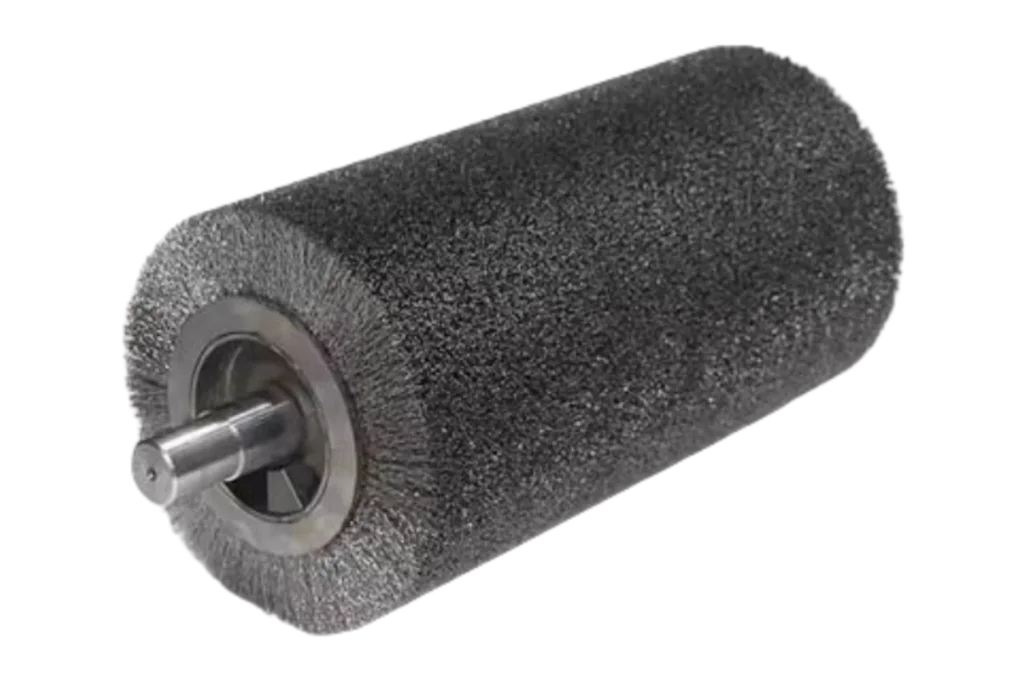
When the workpiece is a pipe bore or a contoured profile, the brush is usually a cylinder form rather than a wheel. The diameter must clear the opening with a controlled interference fit, normally 1/8 to 1/4 in. of bristle compression against the wall, so the wire reaches the surface without binding the spindle. A steel wire cylinder brush sized to the bore also suits furniture and profile polishing, where the softer action of a longer trim protects the surface while the cylinder shape follows the contour.
Secondary Factors That Refine the Diameter Choice
Diameter tells you the size of the tool. Wire gauge, trim length, bristle material, and density tell you what the brush actually does to the part, and they work with the diameter rather than instead of it.
Wire Gauge and Trim Length
- Wire gauge. Coarse wire, roughly 0.020–0.035 in., removes heavy rust and scale but cuts hard and draws more power. Fine wire in the 0.006–0.012 in. range polishes and lightly deburrs with less heat. At the same diameter, a coarser brush needs more spindle power.
- Trim length. The length of wire that extends past the hub sets the stiffness. Short trim gives an aggressive, stiff cut; long trim flexes more, reaches into crevices, and produces a softer finish. A long-trim brush at the same diameter feels like a smaller, gentler tool.
Bristle Material, Density, and Face Width
- Bristle material. Carbon steel is the default for rust removal on ferrous parts. Stainless steel wire prevents contamination on stainless workpieces. Brass and synthetic filaments suit softer metals and polished surfaces.
- Density and face width. More bristles per hole cut faster but raise power draw and heat. A wider face covers more area but demands a heavier spindle.
Mounting and Arbor Fit
Mounting and arbor fit. The brush must match the spindle arbor or accept the correct bushing. A brush that runs off-center wears unevenly and leaves a striped finish, and an unbalanced assembly shortens both brush and spindle life. When a brush does start wearing unevenly, it is worth checking the cause before replacing it, because the same misalignment will damage the new brush too; our guide to what causes uneven wear on a steel rotary wire brush walks through the common culprits.
Power Matching
Power matching deserves its own comment. A brush that fits the arbor and the speed rating can still stall a machine that lacks torque. As a rule of thumb, allow more headroom for coarse wire and wide faces, and check the motor’s rated current during the trial run. If the current sits near the nameplate limit at full brush engagement, the combination is too heavy for the spindle.
Common Diameter Mistakes and How to Avoid Them
Most diameter problems come from buying on price or habit instead of matching the brush to the spindle. Four mistakes account for the majority of failures on the shop floor.
- Oversizing for the spindle speed. A large brush on a high-speed portable tool pushes the bristle tips past the safe wire speed. The result is overheating, fast bristle loss, and a burned or smeared finish. If the machine spins fast, choose a smaller diameter or a brush rated for high RPM.
- Undersizing for the working width. A small brush on a wide panel forces many overlapping passes, which leaves crosshatch marks and uneven material removal. Measure the widest surface in the job and let it drive the face width and diameter.
- Ignore the RPM rating. The maximum RPM is printed on the brush for a reason. Exceeding it is a safety risk and a warranty killer. When the spindle speed sits between two brush sizes, calculate the surface speed for each and pick the one inside the rating.
- Forgetting clearance and arbor size. A brush that fits the arbor can still foul the guard, the table, or the part fixture. Confirm the arbor diameter, the bushing options, and the clearance envelope before ordering.
- Ignoring the workpiece material. A brush sized for carbon steel rust removal can be too aggressive for aluminum or coated panels. Match the diameter and wire spec to the softest material in the job, then verify on scrap.
How to Verify the Fit Before You Buy
You can confirm a diameter choice in four checks: read the machine plate, calculate the surface speed, measure the working width and clearance, and run a short trial on scrap.
- Read the spindle plate. Note the motor power in horsepower or kilowatts and the maximum RPM. These two numbers rule out half the catalog.
- Calculate the surface speed. Use surface speed = π × diameter × RPM. Keep carbon steel wire between 5,000 and 7,500 SFPM for cleaning and deburring, and step down for stainless or thin-gauge work.
- Measure the working width and clearance. Compare the brush face to the widest part you process, then check the distance to the guard, table, and fixtures.
- Run a 60-second trial on scrap. Run at full speed on a piece of the actual material. Listen for vibration, watch for bristle loss, and inspect the finish. A stable run with a clean pattern means the diameter is right.
- Plan for wear compensation. Automated cells should size the brush so there is usable life left after indexing, and manual setups should keep a spare in stock at the same diameter and specification.
The Four-Check Process
Confirm fit before purchase with the checks above — spindle plate, surface speed calculation, working width and clearance, and a short trial on scrap. Together they rule out mismatched diameters before the brush ever runs a full shift.
Cost Per Part, Not Cost Per Unit
Cost follows diameter as well. Larger brushes carry more wire and cost more per unit, but they also last longer between change-outs because the wire has more volume to wear through. The cheaper small brush can end up costing more per hour of use on a high-volume line. Total cost per brushed part is the number that matters, not the unit price.
FAQ
Can a larger brush raise surface speed on a low-speed grinder?
Yes, within the brush’s rated RPM. Surface speed scales with diameter, so a 10-inch brush at 1,750 RPM produces roughly the same tip speed as a 5-inch brush at 3,500 RPM. The catch is torque: the larger brush drags more wire through the work, so confirm the motor has enough power to hold speed under load.
What happens if I exceed the rated RPM?
Bristles can break loose at high velocity, the finish quality drops, and the brush wears out much faster. The danger is real enough that most safety guidance for rotating abrasive tools, including OSHA’s machine guarding rules, treats speed limits as a hard ceiling rather than a suggestion.
When should I replace a worn brush instead of increasing pressure?
Replace the brush when the cutting action drops noticeably, when the face is no longer round, or when bristle loss becomes visible during a pass. Increasing pressure to compensate masks the wear, overheats the workpiece, and can overload the spindle. Measure the brush diameter against the original spec and set a replacement threshold for your process.