
Today’s architectural and automotive markets are both ruled by Low-E glass; one bad wash, and the whole panel is ruined. The coating is softer than standard glass, and with conventional brush filaments, there’s usually a layer of micro-scratches left that compromises both appearance and thermal performance. Not the right filament — it’s not an option; it’s the single most important decision when it comes to specifying an industrial glass washing brush for Low-E production lines.
Three filament characteristics matter most: Soft material free of hard particles, ultra-fine round-tip geometry, and anti-static water-resistant construction paired with gap tufting. Each one targets a specific scratch-causing mechanism. The reason for the importance of these features and how they work in unison will be detailed in the following sections.
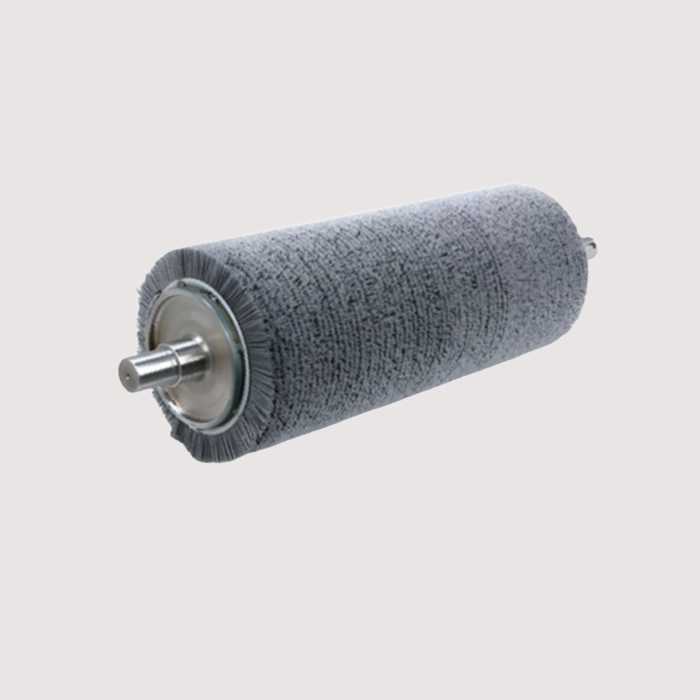
Causes of Low-E Glass Washing Scratches
In most cases, Low-E coatings are made up of ultra-thin layers of metallic oxides, often only a few nanometers thick. These layers reflect infrared radiation very well, but they have almost no mechanical resistance. Even particles that are invisible to the naked eye can gouge through the coating when the brush traps and drags them across the surface.
In a regular float-glass plant, the glass washing brush rotates so fast while the panel is being flushed with water. Any defect in the filament—hardness, rough tip, static cling—turns the brush into an abrasive tool, not a cleaning one. More than 60% of coating defects that line engineers experienced trace to the post-wash stages, and it is because of problems with the filament, not the washing machine.
Understanding these risks makes the filament selection criteria much clearer. Anyone looking to understand the broader role of this equipment can refer to what a glass washing brush is for for a complete overview.
Modified PA612 Avoids Coating Damage
The base material of the filament is what makes a brush clean or damage it. Most of the time, standard plastic and generic nylon filaments are rather stiff by nature. To make matters worse, manufacturers usually fill the filaments with sand, glass fiber, or minerals to increase stiffness and wear resistance. Those hard particles act as sandpaper on a Low-E surface.
This problem is addressed at the molecular level by Modified PA612.
The main benefits are:
- Low hardness by nature: PA612 has lower Shore hardness compared to PA6 or PA66—gentler touch on coated glass.
- Soft-only additives: Production uses only plasticizers and UV stabilizers; no abrasive fillers enter the compound.
- Consistent quality: Each filament batch maintains uniform softness—no rogue hard spots to contact the coating.
- It removes all dirt without ever endangering the Low-E layer. Construct the glass washing brush using filaments made from modified PA612.
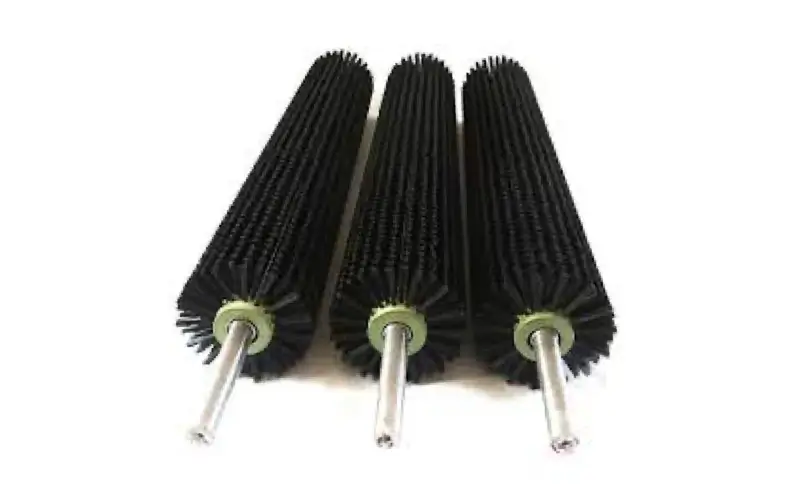
Round-Tip Fine Filaments Disperse Pressure
Even the soft material can scratch if force is focused on a tiny point. Thick filaments press against the glass with a small contact patch. If there is any trapped sand grain, it gets driven into the coating under high localized pressure.
Two design features achieve this in the specialized PA612 filaments:
- Reduced diameter: flexibility is inversely related to diameter — finer filaments flex more readily. The load is spread over a wider area instead of being pushed straight down.
- Thermal tip rounding: after the cutting process, each tip of the filament passes through a heat-polishing process meant to round off the sharp edge by melting it to a smooth hemispherical end.
This means that the glass cleaning roller brush makes contact with the panel using thousands of soft, rounded points rather than a few hard ones. Sand particles are sitting loosely on the surface rather than being forced into the coating, and the rinse water is carrying them away harmlessly.
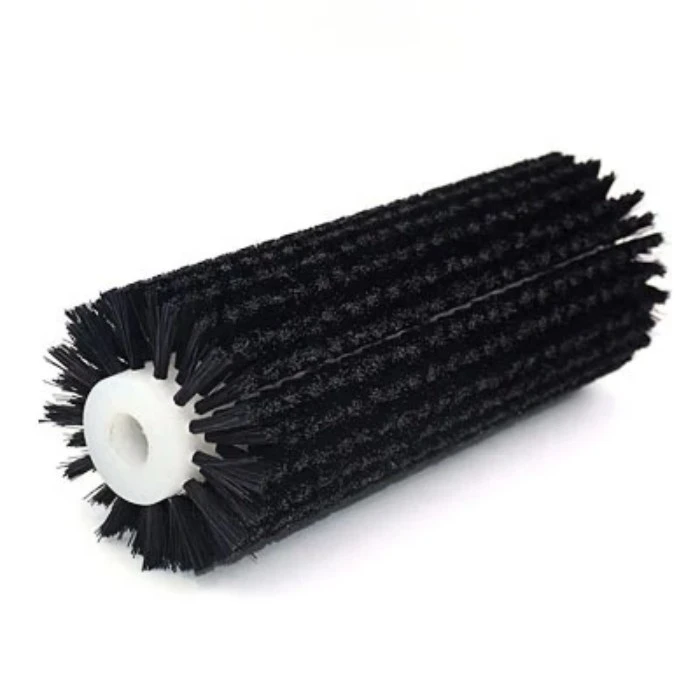
Anti-Static Waterproof Filaments Reduce Abrasion
The brushes have two primary jobs: to prevent these two issues by keeping them clean and keeping the glass from wearing down the brushes. First, scratching does not always happen on the first pass. More often, dust and grit filaments accumulate over hours of operation, and that then turns the brush into a grinding wheel. Two material properties and one structural design feature will stop this cycle:
- Anti-static performance: The surface charge on dry filaments is dissipated by the modified PA612 so that airborne dust does not cling to them between wash cycles.
- Standard nylon absorbs water, loses strength, and ultimately breaks. Broken filament stubs create sharp edges. PA612 resists hydrolysis and remains flexible even after prolonged water immersion.
Standard vs Modified PA612 for Low-E Glass Cleaning
Gap tufting pattern: It’s a different way of setting the brush — not packing the filaments wall-to-wall. Instead of that, it makes tufts with space left between them on purpose. And with this kind of structure, it becomes easy for water to just flow through the gaps and, therefore, flush out the sand and sludge that gets stuck inside the core of the brush.
These features will make sure that the glass washer brush remains clean for the whole working shift, thus never re-depositing abrasive particles onto the Low-E surface. Some of the practical differences line operators usually observe are shown in the table below:
| Performance Factor | Standard Nylon/Plastic Filaments | Modified PA612 Filaments |
| Base hardness | High (Shore D 75-80) | Low (Shore D 60-65) |
| Abrasive fillers | Sand or glass fiber | Soft additives only |
| Filament tip | Sharp, cut flat | Heat-rounded, smooth |
| Static dust attraction | High | Low |
| Water immersion durability | Breaks, becomes brittle | Remains flexible |
| Tufting compatibility | Dense pack standard | Supports gap tufting design |
| Low-E coating scratch risk | High | Very low |
FAQ
Can it use the same glass washing brush for Low-E and standard float glass?
Yes. Modified PA612 filaments clean standard glass as effectively while staying gentle enough to protect sensitive Low-E coatings.
Does gap tufting reduce cleaning efficiency as compared to dense-packed brushes?
No. Gap tufting optimizes the flow of water and debris — so it’s actually more consistent cleaning performance over longer periods of operation.
What is the replacement frequency of Low-E glass cleaning line PA612 filaments?
Most facilities replace the modified PA612 roller brushes every 3 to 6 months, depending on their daily throughput and the conditions of the water.