
Packed fruit keeps showing layers of wax that are not smooth and even, and the packing line team keeps attributing this to factors ranging from wax viscosity to room temperature. However, industry data paints a much different picture—approximately 80% of defects in the wax finish relate directly to the waxing brush roller. A worn shaft, a rusty core—anything so tiny as the least error in concentricity, even by a fraction of a millimeter, and a high-speed waxing station turns into a defect generator.
The paper will describe in detail the process of making wax streaks with lousy brush rollers and the two engineering standards that every purchaser must look into before making the next buy.
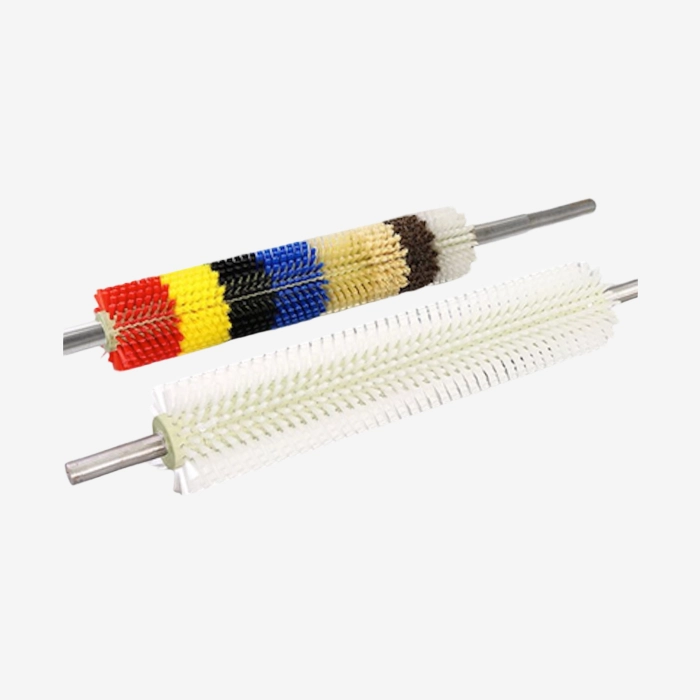
How Poor Waxing Rollers Cause Waxing Defects
1. Corroded Shafts Create Uneven Bristle Pressure
Common carbon-steel shafts go in a waxing machine that sprays water, citric-acid-based cleaners, and food-grade wax all day. In a couple of weeks, the surface of the shaft is attacked by moisture; rust forms, the metal becomes weak, and the shaft will gradually bend under the rotational load.
The instant the shaft gets a little bend, one side of the roller will be pressed more on the fruit, and the other side will barely touch it. The result will be patches of wax, like sheets, that no brush station for cleaning the fruits downstream will ever remove.
2. Concentricity Errors Break High-Speed Balance
A waxing brush roller usually rotates at 200–600 RPM. At this speed, even a 0.1 mm concentricity deviation will cause noticeable vibrations. It bounces microscopically against the fruit surface, leaving a parallel stripe pattern of wax marks across each piece it touches.
In many instances, the operators slow the speed of the line to compensate, thus sacrificing throughput rather than addressing the root cause.
3. Defects Raise Hidden Costs
The harm caused by streaks in the wax is more than just superficial:
- Rejection details—Retail customers will either downgrade or refuse shipments if coating defects are present.
- Re-work labor—Hand sorting and re-waxing the fruits that are affected by this condition, which also reduces the general output rate.
- Premature roller replacement: Warped shafts lead to accelerated bristle wear; rollers do not last as long, by between 40 and 60%.
For an operation already investing in high-quality cylindrical cleaning brushes at the upstream section, the value being lost at the waxing stage is an avoidable waste.
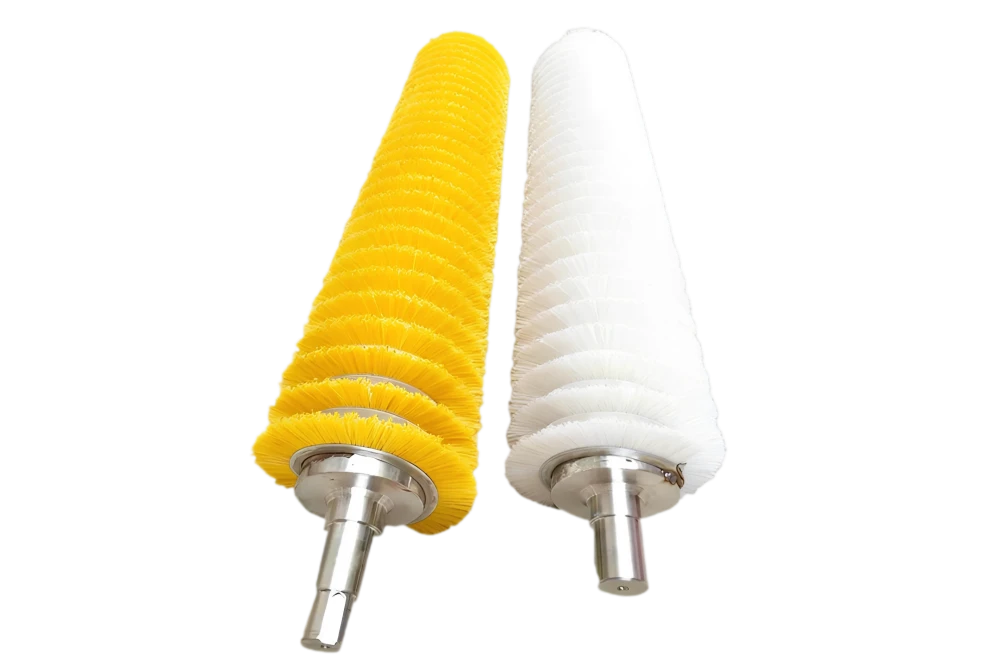
SUS304/316L Anti-Rust Anti-Warp Shaft Standard
In a typical fruit waxing workshop, the equipment would be exposed to: Constant water spray and high ambient humidity, often 80% or more, acidic residues from the pre-wash stages, and alkaline detergents used in daily sanitation. This cannot be resisted by carbon steel. First production season pitting corrosion starts long before outside rust becomes visible.
SUS304/316L Shafts Fit All Conditions
Changing the material of the shaft to SUS304 or 316L stainless steel overcomes all the above environmental challenges: it offers complete resistance to acids and alkalis. 316L, in particular, can withstand washdowns with chlorides without pitting. There is zero rust and zero flaking. Not even years of continuous wet-environment service will produce surface degradation.
Superior rigidity — Higher yield strength keeps the shaft from bending under sustained rotational load. This maintains even bristle pressure across the full roller face.
Processors already following best practices for choosing a durable fruit cleaning brush on their wash lines will recognize the same material logic here.
Carbon & Stainless Shaft Long-Term Cost Comparison
| Parameter | Carbon Long Shaft | SUS304/316L Long Stainless Shaft |
| Average Service Life | 6-10 months | 3-5+ years |
| Corrosion Resistance | Poor: rusts within a few weeks in a wet environment | Excellent: zero rust in continuous wet operation |
| Shaft Deflection Over Time | Bows progressively after the rust weakens the cross-section | Maintains straightness over service life |
| Replacement Frequency | 2 to 3 times a year | Once every 3 to 5 years |
| Annual Total Cost (Shaft + Downtime + Rejects) | High | Significantly lower |
The first cost of a stainless-steel-core roller may be high. But total ownership cost will reduce drastically when replacement cycles and reject losses are taken into account.
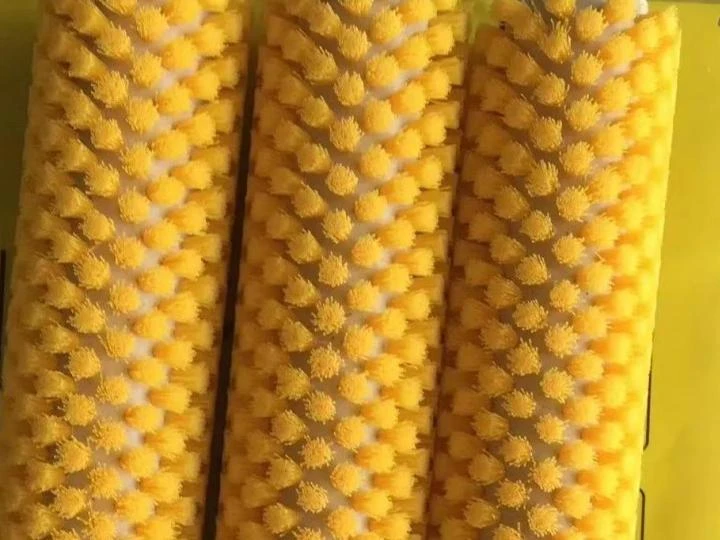
< 0.02 mm Concentricity for Dynamic Balance
1. Excess Concentricity Destabilizes Rollers
The ability to CNC grind with runout monitoring in real time is what it takes to hold concentricity to 0.02 mm — not basic lathe turning. And the same manufacturers who can do one generally tick off all these boxes, too:
- Bristle-tuft insertion depth uniformity
- Overall roller weight distribution
- End-journal dimensional accuracy
All these factors will determine the quality of the wax coat that comes out of the waxing brush roller — smooth or streaked. When you’re vetting a supplier of cylindrical cleaning brushes, if you ask for documented specs on concentricity, you immediately separate the precision manufacturers from the generic vendors.
2. On-Site Concentricity Inspection
Buyers can check the quality of the rollers during incoming inspection using minimal tooling: Mount the roller between two V-blocks or lathe centers. Dial the indicator at the midpoint of the roller.
Rotate the roller slowly by hand through one complete revolution.
Check the TIR; readings above 0.05 mm will mean that there is a concentricity problem, and this will affect the quality of the wax coat.
Ordinary vs Precision Waxing Rollers
| Specification | Substandard Roller | Precision Roller |
| Shaft material | Plain carbon steel | SUS304/316L stainless steel |
| Concentricity tolerance | > 0.08 mm | ≤ 0.02 mm |
| Dynamic balance at 400 RPM | Noticeable vibration | Smooth, free from vibration |
Frequently Asked Questions
Service Life of Fruit Line Waxing Brush Rollers
Typically, assuming it has a stainless steel shaft and undergoes proper maintenance, a good waxing brush roller will have its bristles wear out within 3-5 years of optimal use, so replacement is primarily attributed to wear.
Universal Waxing Rollers for Citrus & Apples?
Yes, but the bristle should be of the same stiffness as the fruit. Normally, a choice of soft and firm bristles is offered by suppliers within the same shaft specification.
MOQ for Precision Brush Roller Manufacturers
MOQ varies by manufacturer. Most professional factories will work with orders beginning at 10-50 pieces, especially for standard diameter and length configurations.