Egg processing facilities lose an estimated 3-5% of their total throughput to shell damage during the washing stage alone. For a mid-sized operation processing 15,000 eggs per hour across a single shift, that translates to roughly 3,600 to 6,000 broken or micro-cracked eggs every working day. While multiple factors contribute to this loss — water temperature, conveyor speed, operator handling — field audits consistently identify the brush roller as the single most influential variable. Selecting the right nylon roller brush is not a commodity purchasing decision; it is a process optimization exercise that directly impacts yield, food safety compliance, and total operational cost.
To select the right cylindrical nylon brush for an egg washing machine, evaluate five interconnected specifications in this order:
(1) Nylon material grade — PA6 for standard operations or PA612 for high-moisture environments;
(2) Filament diameter — 0.18- 0.25 mm for chicken eggs, adjusted by shell thickness;
(3) Tufting density and pattern — spiral or staggered at 35-50 tufts per 100 cm² for uniform coverage;
(4) Core and shaft material — 304 stainless steel shaft with food-grade PP or nylon core body;
(5) Dimensional compatibility — outer diameter matched to machine roller spacing and overall length within ±1mm of the original specification. All five parameters must be validated against the specific egg type, soiling condition, line speed, and wash chemistry used in your facility.
This guide walks through each selection parameter with actionable thresholds and decision frameworks.
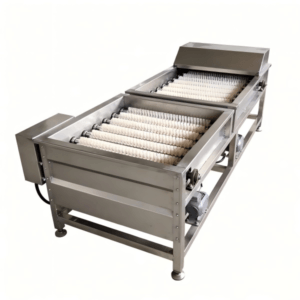
Step 1: Identify Your Operational Requirements
Before evaluating any brush specification, document three baseline operational parameters: the egg type and average shell thickness being processed, the typical soiling condition (light dust to heavy mud), and the production line speed in eggs per hour. These three variables alone determine 70% of the correct brush specification.
Egg Type and Shell Characteristics
Different egg types present fundamentally different cleaning challenges. Shell thickness, surface texture, and typical contaminant type all influence brush selection:
| Egg Type | Avg. Shell Thickness | Shell Hardness | Typical Soiling | Brush Hardness Recommendation |
|---|---|---|---|---|
| Chicken (commercial) | 0.30-0.35mm | Medium | Light dust, light fecal | Soft-Medium (Shore A50-D60) |
| Chicken (free-range) | 0.30-0.35mm | Medium | Moderate mud, fecal | Medium (Shore D55-D65) |
| Duck | 0.35-0.45mm | Medium-High | Heavy mud, clay | Medium-Firm (Shore D60-D70) |
| Goose | 0.45-0.55mm | High | Heavy mud, field debris | Firm (Shore D65-D75) |
| Quail | 0.12-0.18mm | Low | Light dust | Very Soft (Shore A40-A50) |
Chicken eggs — representing over 90% of commercial egg washing volume globally — sit in the middle of the hardness spectrum. Their 0.30-0.35mm shell thickness provides reasonable structural integrity, but the cuticle layer is easily abraded by overly aggressive bristles. For standard commercial chicken eggs, a nylon roller brush with Shore hardness between A50 and D60 and filament diameter of 0.18-0.22mm is the safe starting point.
Duck and goose eggs can tolerate — and often require — firmer brushes because their thicker shells withstand higher contact pressure and their typical soiling (mud, clay, field debris) demands more aggressive mechanical action for complete removal.
Soiling Condition Assessment
The type and tenacity of contaminants on incoming eggs should be systematically categorized:
Light Soiling (Grade 1): Loose dust, minor feather debris, light feed residue. Typical of cage-layer operations with automated egg collection. Requires the gentlest brush configuration to avoid unnecessary shell abrasion.
Moderate Soiling (Grade 2): Dried fecal spots, moderate dust accumulation, some organic residue. Common in barn and aviary systems. Requires balanced cleaning power with good filament bend recovery to maintain consistent contact.
Heavy Soiling (Grade 3): Heavy mud, caked fecal matter, clay residues, wet organic material. Typical of free-range and field-collected eggs, as well as salted and preserved eggs in Asian markets. May require a multi-stage wash with progressively softer brushes or pre-soaking before brush contact.
Production Throughput
Line speed directly influences brush specification because contact time between the brush and each egg decreases as throughput increases. A line running at 4 m/min conveyor speed provides approximately 2-3 seconds of brush contact per egg through a standard three-brush wash zone. At 8 m/min, that contact time halves.
For lines above 8,000 eggs per hour, consider increasing tufting density by 10-15% to compensate for reduced dwell time, rather than increasing filament stiffness — which would raise micro-crack risk. The more efficient path to cleaning at speed is more bristle tips making contact, not harder bristle tips.
Step 2: Choose the Right Nylon Roller Brush Material Grade
PA6 nylon is suitable for 80% of egg washing applications due to its balanced flexibility, wear resistance, and cost profile. PA612 nylon should be specified when the brush operates in sustained high-humidity conditions above 85% RH or when the wash water temperature consistently exceeds 40°C, as its lower water absorption (0.3% vs. 1.5-3.0%) maintains dimensional stability and consistent stiffness throughout multi-shift operation.
Nylon Grade Comparison for Egg Washing machine
| Property | PA6 (Nylon 6) | PA66 (Nylon 66) | PA612 (Nylon 612) | PA610 (Nylon 610) |
|---|---|---|---|---|
| Water Absorption (24h) | 1.5-3.0% | 1.0-2.5% | 0.3% | 0.5% |
| Flexural Modulus (GPa) | 1.5-2.8 | 2.0-3.0 | 1.8-2.5 | 1.6-2.6 |
| Continuous Use Temp | Up to 100°C | Up to 120°C | Up to 90°C | Up to 95°C |
| Bend Recovery | >95% | >95% | >93% | >94% |
| Food-Grade Availability | Widely available | Widely available | Available | Limited |
| Best For | General egg washing | High-temp or high-abrasion | Wet/humid continuous operation | Chemical resistance needed |
PA6 is the workhorse material. Its molecular structure — with amide groups spaced at regular six-carbon intervals — provides an excellent combination of flexibility, elastic recovery, and abrasion resistance. The material of PA6 roller brushes is available in food-grade formulations certified to FDA 21 CFR 177.1500, EU 1935/2004, and GB 4806 standards from multiple global suppliers. For a standard egg washing line operating one or two shifts, PA6 delivers reliable performance through its full 1,500-2,000 hour service life.


PA612 represents a meaningful upgrade for demanding environments. The longer carbon chain between amide groups reduces the material’s affinity for water molecules, which translates into two practical advantages: the filament maintains its designed stiffness throughout prolonged wet operation rather than progressively softening, and dimensional swelling is minimized, preventing the slight diameter increase that can alter tufting density mid-shift. For processors running three-shift operations or washing eggs in high-humidity tropical environments, the 30-50% price premium for PA612 is typically recovered through extended brush life and more consistent cleaning results.
When to Avoid PA66
Despite its higher heat resistance and tensile strength, PA66 is generally not recommended for egg washing applications. Its higher flexural modulus (2.0-3.0 GPa vs. 1.5-2.8 GPa for PA6) translates to stiffer bristles that generate approximately 15-20% higher peak contact pressure at equivalent filament diameter. This stiffness differential pushes micro-crack rates upward, particularly when processing thin-shelled eggs or operating at brush speeds above 400 RPM. PA66 is better suited to industrial deburring and heavy surface preparation where shell integrity is not a concern.
Step 3: Specify Filament Diameter
Filament diameter is the most precise lever for controlling cleaning aggressiveness. For chicken eggs, 0.18-0.22mm provides the optimal window: diameters below 0.15mm lack the tip stiffness to dislodge dried organic matter, while diameters above 0.25mm generate peak contact forces that approach shell fracture thresholds and should only be used for duck or goose eggs with confirmed shell thickness above 0.40mm.
The Physics of Filament Contact
When a single bristle tip contacts an eggshell, the force it exerts depends on the filament’s cross-sectional area, its flexural modulus (material stiffness), the free length of the bristle from core to tip, and the rotational speed of the brush. Of these, filament diameter has the most dramatic effect because contact pressure scales with the square of the radius.
A 0.30mm filament has approximately 2.8 times the cross-sectional area of a 0.18mm filament and exerts proportionally higher force at the same deflection. This is not a linear relationship — it is geometric — which is why seemingly small diameter differences produce meaningfully different cleaning outcomes.
Diameter Selection Table
| Filament Diameter | Bristle Feel | Contact Force (Relative) | Shell Impact | Recommended For |
|---|---|---|---|---|
| 0.10-0.15mm | Very soft, hair-like | 1x (baseline) | Negligible | Quail eggs, thin-shell breeds |
| 0.15-0.18mm | Soft, flexible | 1.5-2x | Very Low | Light soiling on chicken eggs |
| 0.18-0.22mm | Medium-soft | 2-3.5x | Low | Standard chicken eggs, moderate soiling |
| 0.22-0.25mm | Medium | 3.5-5x | Moderate | Heavily soiled chicken eggs, duck eggs |
| 0.25-0.30mm | Firm | 5-8x | Moderate-High | Duck, goose, salted eggs |
| >0.30mm | Stiff | >8x | High | Not recommended for shell eggs |
Crimped vs. Straight Filaments
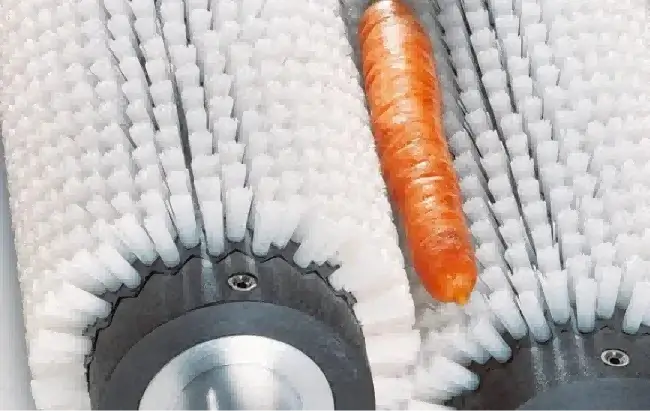
Filament geometry — whether the individual bristles are straight or crimped (waved) — also influences cleaning behavior. Crimped filaments create a larger effective contact area because the wave pattern presents more bristle surface to the egg, and the crimp acts as a micro-spring that absorbs impact energy. Crimped nylon filaments are preferred for egg washing when the priority is gentle, even cleaning across the entire egg surface. Straight filaments provide more aggressive scrubbing action and are better suited for root vegetable applications.
For high-volume egg processing, a cleaning roller brush with crimped PA6 filaments at 0.18-0.22mm diameter represents the industry-standard configuration that balances throughput, cleanliness, and shell protection.
Step 4: Determine Tufting Density and Pattern
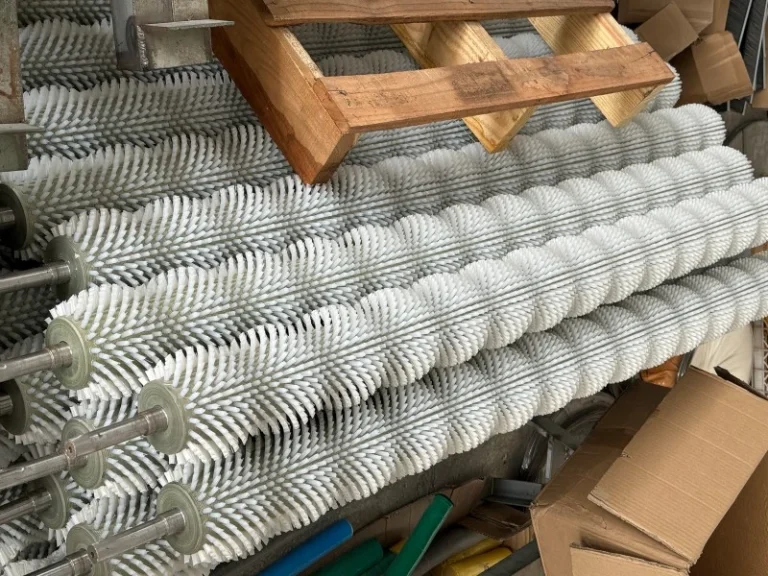
Spiral-wound tufting with 35-50 tufts per 100 cm² and 25-40 filaments per tuft provides the optimal balance of coverage and pressure distribution for egg washing. Straight-row tufting at the same density creates linear cleaning gaps that leave contaminants on 10-15% of the shell surface and should be avoided for egg applications.
Density Effects on Cleaning Performance
Tufting density influences three performance dimensions simultaneously:
Cleaning Coverage: Higher density means more bristle tips per unit area, reducing the size of any gap between adjacent tufts. At 30 tufts per 100 cm², the gap between tuft bundles measures approximately 4-5mm — large enough that small-diameter eggs may pass through without bristle contact on certain surface areas. At 50 tufts per 100 cm², the gap narrows to 2-3mm, ensuring complete coverage.
Aggregate Friction: More bristles contacting the egg simultaneously means higher total friction. This is beneficial for cleaning but potentially harmful for shell integrity if density is excessive. The ideal density creates enough aggregate friction to remove contaminants in a single pass without requiring the egg to make multiple rotations through the wash zone.
Water and Debris Clearance: Overly dense tufting traps wash water, organic debris, and dislodged contaminants within the brush. This creates a secondary contamination risk and promotes bacterial growth. A density of 35-50 tufts per 100 cm² maintains sufficient open space between tufts for effective water flushing and debris shedding.
Tufting Pattern Comparison
| Pattern | Surface Coverage | Cleaning Uniformity | Debris Clearance | Shell Safety | Recommendation |
|---|---|---|---|---|---|
| Straight Row | 75-85% | Poor (linear gaps) | Good | Moderate | Not for egg washing |
| Staggered Row | 88-95% | Good | Good | Good | Acceptable for low-volume |
| Spiral / Helical | 95-99% | Excellent | Excellent | Excellent | Recommended for all volumes |
| Full-Face (Maximum) | >99% | Good | Poor (traps debris) | Moderate | Only for light |
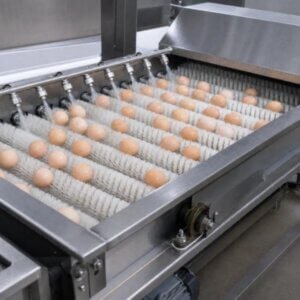
The spiral-wound pattern has become the standard in commercial egg washing because it creates a helical contact path that ensures every point on the egg surface encounters bristles at multiple approach angles as the egg rotates and translates through the wash zone. This eliminates the directional scratch marks that straight-row brushes can produce and delivers more uniform cleaning with lower peak contact pressure at any single point.
Step 5: Select Core and Shaft Materials
A 304 stainless steel shaft with a food-grade polypropylene or nylon core body is the recommended configuration for egg washing applications. Avoid carbon steel shafts (rust contamination risk), low-density polyethylene cores prone to cracking, and any core material with internal porosity that harbors bacteria.
| Shaft Material | Corrosion Resistance | Strength | Food Safety | Recommendation |
|---|---|---|---|---|
| 304 Stainless Steel | Excellent | High | Yes | Recommended |
| 316 Stainless Steel | Superior (chloride) | High | Yes | For aggressive sanitizers |
| 45# Carbon Steel | Poor (rusts) | High | No | Not for food contact |
| Galvanized Steel | Moderate | High | Conditional | Not recommended |
The shaft bears the full mechanical load of brush rotation and must resist corrosion despite continuous exposure to water, detergents, and sanitizing chemicals. 304 stainless steel is the default specification for food processing equipment and is adequate for most egg washing environments. If your sanitization protocol uses chlorine-based chemicals at concentrations above 200 ppm, upgrade to 316 stainless steel for its superior pitting resistance.
Core Body Material of Nylon cylinder brush
The core body — the cylindrical structure into which filaments are anchored — must be food-grade, dimensionally stable, and resistant to water absorption:
Food-grade polypropylene (PP): Lightweight, zero water absorption, excellent chemical resistance. The most common core material for egg washing brushes. Ensure the PP grade is virgin material certified for food contact, not recycled.
Food-grade nylon (PA6): Higher strength than PP, slightly better dimensional stability at elevated temperatures. Slightly higher cost. Preferred for large-diameter brushes or applications with higher mechanical loading.
Avoid: PVC cores (potential plasticizer leaching), wood cores (bacterial harborage, swelling), and low-cost injection-molded cores with internal air pockets that can crack under sustained rotational stress.
Dimensional Specifications
When ordering replacement brushes or specifying for new equipment, provide these five dimensions:
- Overall length (mm): Tip-to-tip including end fittings. Tolerance: ±1mm.
- Outer diameter (mm): Including filament tips at rest. Standard ranges: 80-200mm for egg washers.
- Core/Inner diameter (mm): The shaft bore or core body ID. Must match machine mounting system exactly.
- Filament trim length (mm): Bristle exposure from core surface to tip. Typically 15-35mm for egg applications.
- Shaft diameter and end configuration: Diameter, keyway dimensions, or bearing journal specifications.
Step 6: Match Industrial Brushes Dimensions to Your Machine
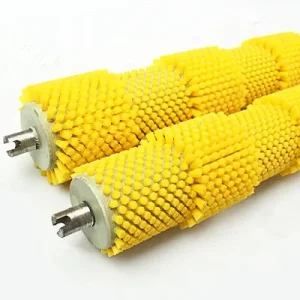
Measure the existing brush roller’s overall length, outer diameter, shaft diameter, and mounting configuration directly from the machine rather than relying on equipment manuals, which may reference superseded part numbers. A dimensional mismatch as small as 2mm on shaft diameter prevents proper mounting and can damage both the brush and the machine drive system.
Measurement Protocol
Take these measurements with a calibrated caliper or micrometer, not a tape measure:
- Remove the existing brush from the machine following lockout/tagout procedures.
- Measure overall length from end-face to end-face. Record to 0.5mm precision.
- Measure outer diameter at three points (left, center, right). The worn brush diameter will be slightly less than the new specification — consult the machine manual for the original OD or measure the housing clearance.
- Measure shaft diameter at the bearing journals and drive coupling. Record both.
- Document the shaft end configuration: plain round, keyed, splined, threaded, or flanged.
- Photograph the mounting interface from multiple angles.
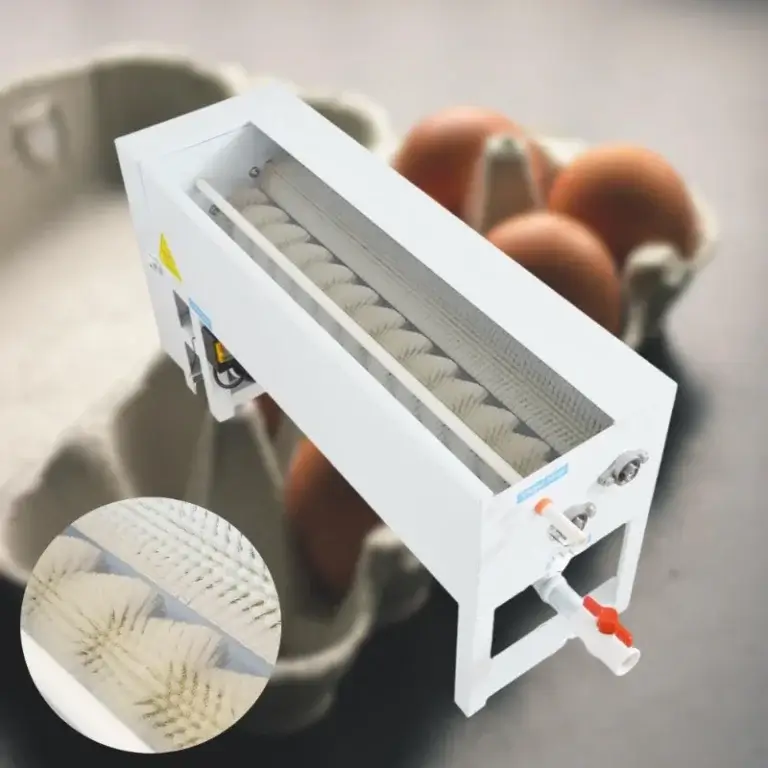
Compatibility Checklist
| Parameter | Why It Matters | Tolerance |
|---|---|---|
| Overall length | Too long: won't fit housing. Too short: inadequate egg coverage | ±1mm |
| Outer diameter | Affects egg-to-brush contact pressure and machine clearance | ±2mm |
| Shaft diameter | Must match bearings exactly | +0.00/-0.05mm |
| Filament trim length | Determines brush flexibility and cleaning aggressiveness | ±2mm |
| Mounting type | Must match drive coupling | Exact match required |
Conclusion
Selecting the right nylon roller brush for an egg washing machine is a structured engineering decision, not a simple procurement transaction. The five-parameter framework outlined above — material grade, filament diameter, tufting density, core and shaft materials, and dimensional compatibility — provides a systematic path from operational requirements to a validated brush specification.
The most common selection error is defaulting to the cheapest available brush that physically fits the machine. This approach typically results in brushes with inconsistent filament diameter, unreported recycled content, surface micro-burrs from low-grade extrusion, and cores that crack after 500 hours of operation. The true cost is not the purchase price but the downstream losses: elevated breakage rates, increased sanitation downtime, more frequent replacement cycles, and potential food safety compliance gaps.
A correctly specified egg washing machine brush roller with food-grade PA6 or PA612 filaments, spiral-wound tufting at 35-50 tufts per 100 cm², 304 stainless steel shaft, and dimensional accuracy within ±1mm delivers measurable returns: breakage rates below 0.1%, consistent cleaning through 1,500-2,000 operating hours, and predictable replacement scheduling.
FAQ
Q1: What shape is a typical egg washing machine brush?
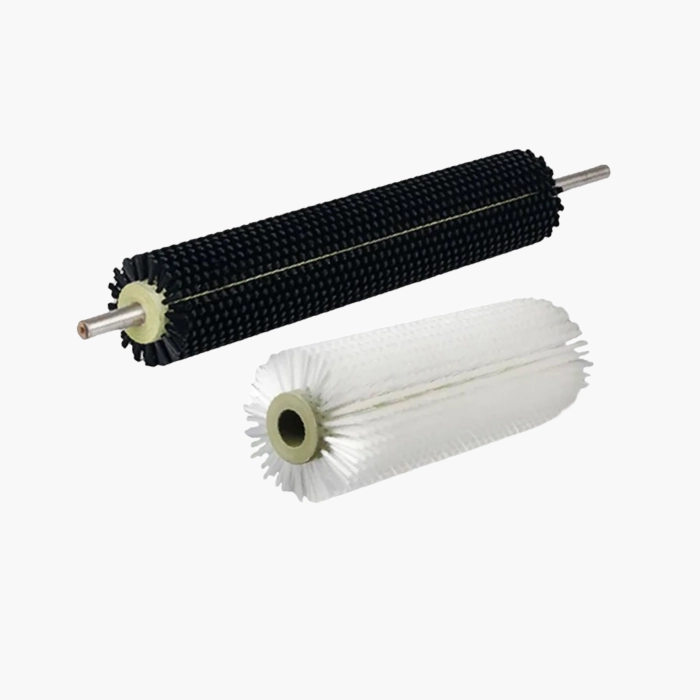
Most nylon roller brushes are cylindrical, with bristles arranged in a spiral or helical pattern around a central shaft. This shape allows continuous contact as eggs rotate through the wash zone, ensuring even cleaning across the entire shell surface.
Q2: How often should the nylon roller brush be replaced?
Under normal commercial use, a nylon roller brush typically lasts 1,500-2,000 operating hours before bristle stiffness and cleaning performance decline. Actual replacement timing depends on egg soiling level, line speed, and water chemistry, so periodic inspection matters more than a fixed calendar date.
Q3: I only have my machine’s dimensions — can a nylon roller brush still be custom-made?
Yes. Overall length, outer diameter, and shaft diameter are usually enough to start a custom nylon roller brush. However, providing egg type and soiling condition helps suppliers recommend the right filament diameter and hardness for optimal results.
Q4: Can the same nylon roller brush clean both chicken and duck eggs?
Not always. Chicken eggs need a softer nylon roller brush (Shore A50-D60) to avoid cuticle damage, while thicker duck eggshells tolerate firmer bristles. Using one brush for both may under-clean duck eggs or over-abrade chicken eggs.