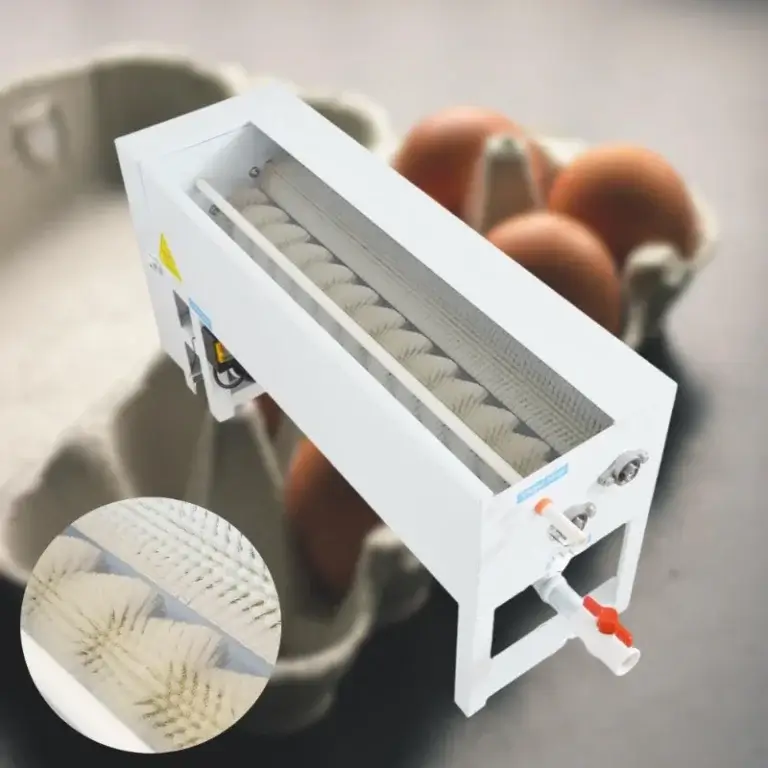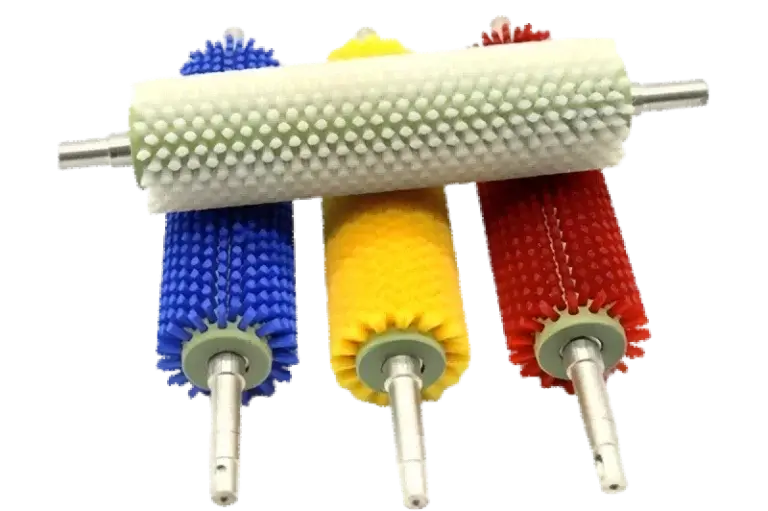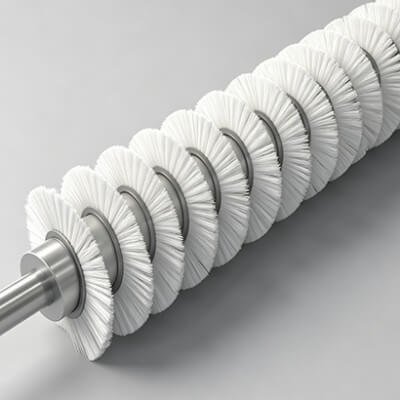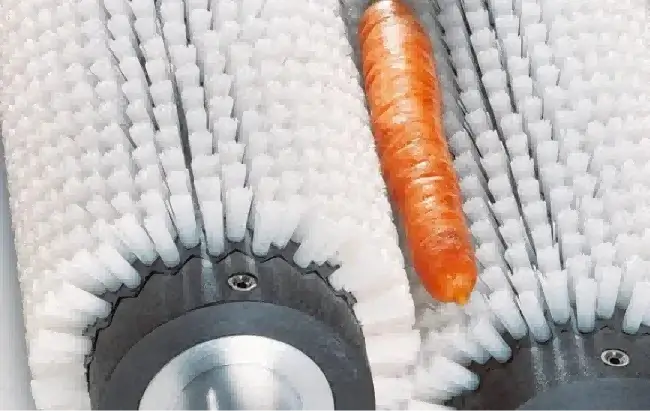
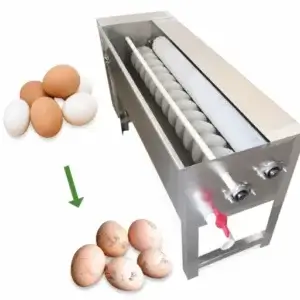
Egg washing is a critical step in commercial egg processing, where cleanliness must be achieved without compromising the structural integrity of the shell. At the heart of every egg washing machine lies a deceptively simple component: the nylon roller brush. These cylindrical cleaning tools, also referred to as Nylon Cylinder Brushes or Nylon Tufted Cylinder Brush assemblies, are responsible for the gentle yet effective removal of dirt, debris, and surface contaminants from thousands of eggs per hour. The softness of the bristles on these nylon roller brush components directly determines whether an egg emerges from the washing line spotless and intact or with micro-cracks that invite bacterial ingress and reduce shelf life.
Bristle softness standards for food-safe egg washing machines are defined by a combination of filament material grade, filament diameter, tufting density, and the specific durometer or bending recovery characteristics of the nylon polymer used. In practice, a bristle diameter between 0.10 mm and 0.30 mm in PA6, PA66, or PA612 nylon, combined with medium to medium-soft tufting density, is the industry benchmark for achieving effective cleaning without shell damage.
Egg producers and equipment specifiers face a balancing act: too firm a brush risks scratching or cracking eggshells, while overly soft bristles fail to dislodge adhered contaminants. This article examines the science behind bristle softness, the material properties of food-grade nylon filaments, standardized measurement approaches, and practical guidelines for selecting and maintaining Nylon Cylinder Brushes for Cleaning in egg processing environments. Whether you are specifying a new nylon roller brush installation or troubleshooting an existing Nylon Tufted Cylinder Brush setup, understanding these standards is essential for consistent food-safe operation.
Why Bristle Softness Matters in Egg Washing Applications
Food Safety Starts with the Right Softness
Getting bristle softness right in egg washing is not a cosmetic preference; it is a food safety imperative. An eggshell is only approximately 0.3 mm thick and is covered with a natural cuticle that provides a barrier against microbial penetration. A nylon roller brush that is too stiff can abrade this cuticle, create hairline fissures, or even cause outright breakage, all of which dramatically increase contamination risk and product loss rates.
The Mechanical Dynamics: RPM, Filament Stiffness, and Contact Pressure
The mechanical dynamics at play inside an egg washing machine are deceptively complex. Eggs travel through a series of rotating Nylon Cylinder Brushes while spray nozzles deliver water and food-grade detergents. Each egg makes contact with hundreds of bristle tips per second as the brush rotates at speeds typically ranging from 100 to 300 RPM. The cumulative force exerted on the shell surface is a function of individual filament stiffness, the number of filaments making contact at any instant, and the rotational speed of the brush assembly. Even a seemingly minor specification error, such as selecting 0.40 mm filament instead of 0.20 mm, can multiply the contact pressure on the shell by a factor of four.
Operational Economics: Breakage Rates and Cleaning Effectiveness
Beyond food safety, bristle softness also affects operational economics. A brush that is too abrasive will increase the egg breakage rate, which directly erodes yield and profitability. Industry data suggests that a well-calibrated Nylon Tufted Cylinder Brush installation should keep breakage below 0.3% during normal operation. When breakage rates climb, operators often find that worn or improperly specified nylon roller brush assemblies are the root cause. Conversely, Nylon Cylinder Brushes for Cleaning that are too soft may fail to remove stubborn contaminants such as dried fecal matter or feather debris, leading to visual grading downgrades and potential regulatory non-compliance.
Temperature Matters: How Heat Softens Nylon Bristles
The interaction between bristle softness and water temperature further complicates the picture. Nylon filaments exhibit measurable stiffness reduction as wash water temperature rises toward the typical operating range of 38 degrees Celsius to 45 degrees Celsius (100 degrees Fahrenheit to 113 degrees Fahrenheit). This thermal softening effect means that a nylon roller brush that feels appropriately firm at room temperature may become significantly more compliant under actual operating conditions. Experienced equipment engineers account for this by testing filament recovery and bending modulus at elevated temperatures, not just under ambient laboratory conditions.
Key Material Choices for Food-Grade Nylon Roller Brushes
PA6, PA66, PA610, PA612 – Comparing the Four Nylon Grades
The four primary nylon grades used in food-safe egg washing brushes are PA6, PA66, PA610, and PA612, each offering a distinct balance of stiffness, wear resistance, moisture absorption, and thermal stability. PA6 and PA66 provide higher baseline stiffness and are preferred for medium-duty cleaning, while PA610 and PA612 offer lower moisture absorption and superior bending recovery, making them ideal for applications where consistent softness across wet and dry cycles is critical.
The following table summarizes the key physical properties of these nylon materials as they relate to brush filament performance in egg washing environments, highlighting why material selection is a foundational step in specifying any Nylon Cylinder Brush:
Filament Diameter: The Single Most Impactful Parameter
Filament diameter is arguably the single most impactful parameter when specifying a nylon roller brush for egg washing. Filaments in the 0.10 mm to 0.20 mm range produce a soft, highly compliant brush face that is well suited to delicate eggs such as quail or duck eggs. The 0.20 mm to 0.30 mm range represents the sweet spot for standard chicken egg processing lines, offering sufficient stiffness to dislodge typical field contaminants while maintaining a gentle contact profile. Filaments above 0.30 mm should generally be reserved for heavy-duty vegetable or root crop washing, as they risk damaging eggshells at standard rotational speeds. In practice, most food-grade Nylon Cylinder Brushes for Cleaning deployed in egg processing facilities use filaments in the 0.15 mm to 0.25 mm window.
Straight vs. Crimped Filaments – Cleaning Action and Sanitation Trade-Offs
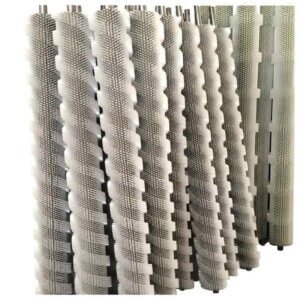
Beyond the base polymer and filament diameter, the processing form of the filament also influences perceived softness. Straight filaments provide uniform contact across the brush face, while crimped or wavy filaments create a more textured surface that can improve cleaning action on irregularly shaped eggs. However, crimped filaments tend to trap debris more readily, which means they require more frequent cleaning and inspection. Many food processing facilities prefer straight Nylon Cylinder Brushes specifically because they are easier to sanitize between production runs and present fewer harborage points for bacterial growth.
Shaft and Core Materials – Supporting Food-Grade Integrity
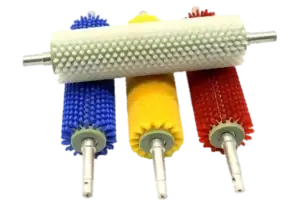
The shaft and core materials that support the nylon filaments also deserve attention. Stainless steel shafts (typically SUS304 grade) are standard for food-grade applications because they resist corrosion from constant exposure to water and cleaning chemicals. The brush body, into which filaments are tufted or injection-molded, is commonly made from polyethylene (PE) or nylon tubing. A high-quality brush body must be free of internal voids and air pockets, as these can harbor moisture and support microbial colonies even after sanitation cycles. When evaluating any Nylon Tufted Cylinder Brush product for food processing use, the integrity of the brush body is equally as important as the filament specifications.
Measuring and Classifying Bristle Softness: A Technical Overview
The Four Pillars of Bristle Softness Measurement
Industrial nylon roller brush softness is quantified through filament diameter measurement, bending modulus testing, tuft density calculation, and recovery angle assessment. There is no single universal softness number, but rather a multi-parameter profile that must be evaluated against the specific cleaning requirements of each egg washing application.
Filament Diameter: Precision Tolerances and Quality Control
Filament diameter is measured using a digital micrometer or optical comparator systems with an accuracy of plus or minus 0.01 mm. For food-grade Nylon Tufted Cylinder Brush products, the allowable diameter tolerance is typically plus or minus 0.02 mm. Tighter tolerances are critical because even small deviations compound across the tens of thousands of filaments on a single brush roller. A brush specified at 0.20 mm that ships with filaments averaging 0.23 mm will feel perceptibly stiffer and may cause elevated breakage rates. Quality assurance protocols for Nylon Cylinder Brushes used in food processing should include per-batch verification of incoming filament diameter.
Bending modulus testing provides a direct measure of how much force is required to deflect a single filament by a given amount. The test is performed by clamping a filament horizontally and applying a known load at a set distance from the clamp point, then measuring the resulting deflection. For egg washing applications, the ideal bending modulus range depends on the base polymer, and suppliers of Nylon Cylinder Brushes for Cleaning should be able to provide this data on request.
Tuft Density: Distributing Contact Force for Shell Protection
The tuft density, expressed as the number of filament bundles per square centimeter of brush surface, is the third pillar of softness specification. A higher tuft density means more filaments are in contact with the egg at any given moment, distributing the cleaning force over a larger area and reducing the per-filament pressure. Typical Nylon Cylinder Brushes for egg washing have tuft densities between 4 and 12 tufts per square centimeter, with each tuft containing 20 to 80 individual filaments. The following table provides a reference matrix for matching density to application:
Recovery Angle: Predicting Long-Term Brush Performance
Recovery angle testing evaluates how well a filament returns to its original orientation after being bent, which directly correlates with long-term brush performance. A filament with poor recovery will develop a permanent set (the bristles remain bent in the direction of rotation), leading to uneven cleaning and the need for premature replacement. High-quality PA612 filaments demonstrate recovery angles above 85 degrees after 10,000 bend cycles at 40 degrees Celsius, making them a preferred choice for high-volume egg processing lines that operate continuously. When specifying a Nylon Tufted Cylinder Brush for demanding production environments, recovery angle data should be a standard part of the technical evaluation.

Matching Bristle Softness to Egg Types and Production Scale
Chicken Eggs: The Standard Configuration
Egg type is the primary determinant of appropriate bristle softness, with quail eggs requiring the softest nylon roller brush configurations and large duck or goose eggs tolerating firmer bristle contact. Production scale further influences the specification because high-throughput lines demand brushes that maintain their softness characteristics over extended continuous operation without sagging or developing permanent set.
Chicken eggs, which dominate global egg production, present a relatively standardized shell thickness of 0.30 mm to 0.35 mm. The cuticle layer is thin but biologically important, and any abrasive action that removes it also eliminates a natural defense against Salmonella and other pathogens. For standard chicken egg lines producing 2,000 to 10,000 eggs per hour, the recommended Nylon Cylinder Brush configuration uses PA6 or PA612 filaments of 0.20 mm to 0.25 mm diameter at a medium tuft density. This configuration has been validated across numerous commercial installations and represents the safest starting point for most operators.
Duck Eggs: Thicker Shells, Porous Structure, and Firmer Brushes
Duck eggs require a slightly different approach. Duck eggshells are marginally thicker than chicken eggshells but have a more porous structure and a thicker cuticle. This means the Nylon Cylinder Brushes for Cleaning must be firm enough to penetrate the cuticle layer and remove embedded dirt from the pore structure, yet still gentle enough to avoid cracking. Filament diameters in the 0.25 mm to 0.30 mm range, combined with a medium to medium-firm tuft density, are widely used. Some processors also specify a wave-cut profile on the brush surface, which creates alternating high and low zones that improve the mechanical agitation of water across the shell surface when using a nylon roller brush arrangement.
Quail Eggs: Ultra-Delicate Shells Demand the Softest Brushes
Quail eggs represent the end of the delicacy spectrum, with shells as thin as 0.15 mm. For these applications, only the softest Nylon Cylinder Brushes are acceptable. Filaments should be no thicker than 0.15 mm, and tuft density should be on the higher end (8 to 12 tufts per square centimeter) to distribute contact force as widely as possible. Some specialty processors even use PA612 filaments with a reduced bending modulus specifically formulated for ultra-delicate shell contact. When designing a Nylon Tufted Cylinder Brush for quail egg lines, the filament diameter tolerance must be held particularly tight, as any upward deviation in thickness can quickly cross the threshold from gentle cleaning to shell damage.
Production Scale: Wear Rates and Lifecycle Cost Considerations
Production scale introduces wear-rate considerations that small-scale operators may overlook. A farm washing 500 eggs per day can tolerate a brush that needs replacement every six months. A commercial grading station processing 100,000 eggs per day experiences vastly accelerated wear. In high-throughput environments, the selection of Nylon Cylinder Brushes for Cleaning with PA66 or PA612 filaments becomes economically justified despite the higher unit cost because their superior abrasion resistance extends service intervals and reduces downtime. The cost per thousand eggs processed is often lower with premium brushes when total lifecycle costs are calculated.
Maintenance, Wear Patterns, and Replacement Indicators
A Structured Maintenance Program: Daily, Weekly, and Monthly Checks
A structured maintenance program for nylon roller brush assemblies should include daily visual inspection, weekly tuft density checks, monthly filament diameter measurements at multiple points along the brush, and a documented replacement schedule based on cumulative operating hours rather than waiting for visible failure. Proactive replacement is always cheaper than reactive replacement after a spike in breakage has already eroded yield.
Three Common Wear Patterns: Tip Rounding, Tuft Loss, and Chemical Degradation
The most common wear pattern observed in egg washing Nylon Cylinder Brushes is progressive filament tip rounding, where the sharp, clean-cut tips of new filaments gradually wear into dome-shaped profiles. This rounding reduces the effective cleaning action because rounded tips slide over contaminants rather than mechanically dislodging them. Operators should measure filament length at three to five points along the brush axis monthly using a depth gauge. When the average filament length has decreased by more than 15% from the original specification, replacement should be scheduled regardless of whether breakage rates have yet increased.
A second wear pattern is tuft loss, where individual filament bundles detach from the brush body of a Nylon Tufted Cylinder Brush. Even a single missing tuft creates a gap in the cleaning surface that can allow eggs to pass through without adequate contact. More critically, detached filaments can become foreign object contaminants in the wash water, potentially lodging in downstream equipment or, in the worst case, ending up in egg cartons. Food safety protocols should mandate immediate brush inspection and quarantine whenever tuft loss is detected in any nylon roller brush assembly.
Chemical degradation from cleaning agents is another factor that accelerates bristle softening beyond normal wear. Sodium hydroxide and chlorine-based sanitizers, while effective against pathogens, attack nylon polymers over time. PA612 exhibits superior chemical resistance compared to PA6, making it the preferred choice in facilities that use aggressive sanitation chemicals between production runs. Signs of chemical attack on Nylon Cylinder Brushes for Cleaning include surface pitting on filaments, color changes, and a measurable loss of tensile strength.
Replacement Indicators and Action Thresholds
The table below summarizes key replacement indicators and the recommended action threshold for any Nylon Cylinder Brush in food processing service:
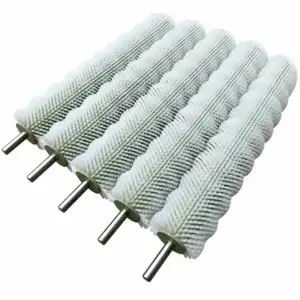
Establishing a replacement log for each brush position on the washing line is a simple but powerful operational practice. By tracking installation dates, cumulative operating hours, and reasons for replacement, maintenance teams can optimize replacement intervals and identify whether certain brush positions wear faster than others. Position-specific wear data often reveals mechanical issues such as bearing misalignment or excessive spray pressure that would otherwise go undiagnosed. A well-maintained set of Nylon Cylinder Brushes delivers consistent cleaning quality throughout its service life, minimizing variability in egg safety outcomes.
Conclusion
Softness Is a Multi-Parameter Engineering Decision, Not a Subjective Feel
The softness of a nylon roller brush’s bristles is more than a purchasing specification; it directly determines egg safety, product quality, and operational profitability in commercial egg washing. Selecting the appropriate filament material, diameter, and tuft density directly determines whether a Nylon Cylinder Brush performs as intended day after day. Selecting the appropriate filament material, diameter, and tuft density for your Nylon Cylinder Brushes requires balancing cleaning effectiveness against shell integrity, all while accounting for egg type, production volume, and operating environment. PA6, PA66, PA610, and PA612 each bring distinct trade-offs in stiffness, wear resistance, moisture stability, and chemical tolerance that must be evaluated against the specific demands of the processing line.
Measuring softness is a multi-parameter exercise that goes well beyond filament diameter alone. Bending modulus, tuft density, recovery angle, and thermal response all contribute to how a Nylon Tufted Cylinder Brush performs under real operating conditions. Standardized measurement protocols, combined with a disciplined maintenance and replacement schedule, keep breakage rates low and cleaning performance high throughout the brush assembly’s service life.
The Payoff: Reduced Product Loss, Fewer Regulatory Issues, and Safer Eggs
Ultimately, the investment in properly specified and maintained Nylon Cylinder Brushes for Cleaning pays for itself many times over through reduced product loss, fewer regulatory issues, and cleaner, safer eggs reaching the consumer. As egg processing lines continue to operate at ever-higher speeds and throughput volumes, the importance of precision-engineered nylon roller brush components will only grow. Facility managers and equipment engineers who treat bristle softness as a quantifiable engineering parameter rather than a subjective feel will consistently outperform those who rely on guesswork.
FAQ
Q1. How often should I replace my egg washing nylon roller brushes?
Replace when filament length loss exceeds 15% of original specification, or when breakage rates climb above 0.3%. High-volume lines (100,000+ eggs/day) typically need replacement every 3–6 months; smaller operations may get 12–18 months. Track operating hours, not just visual condition.
Q2. Can I use the same brush for different egg types (chicken, duck, quail)?
Not recommended. Quail eggs (0.15 mm shell) require 0.10–0.15 mm filaments with high tuft density. Chicken eggs need 0.20–0.25 mm. Duck eggs tolerate 0.25–0.30 mm. Using a firmer brush on delicate eggs cracks shells; using a softer brush on larger eggs leaves contaminants behind.
Q3. Does water temperature affect bristle softness during operation?
Yes. Nylon filaments soften as water temperature rises. A brush that feels firm at room temperature becomes more compliant at typical wash temperatures of 38–45°C. Always evaluate brush performance at operating temperature, not room temperature.
Q4. How do I know if my breakage rate is caused by brushes or other equipment issues?
Run a controlled test: replace all brushes with new, properly specified units. If breakage drops to baseline (below 0.3%), brushes were the cause. If breakage persists, check bearing alignment, conveyor speed, spray pressure, and egg orientation before the brush section.
Q5. Are more expensive PA612 brushes worth the cost?
For high-volume continuous operations, yes. PA612 absorbs less moisture, maintains consistent softness across wet/dry cycles, and offers superior chemical resistance. The higher upfront cost is offset by longer service life and fewer replacements. For low-volume or seasonal operations, PA6 offers better value.