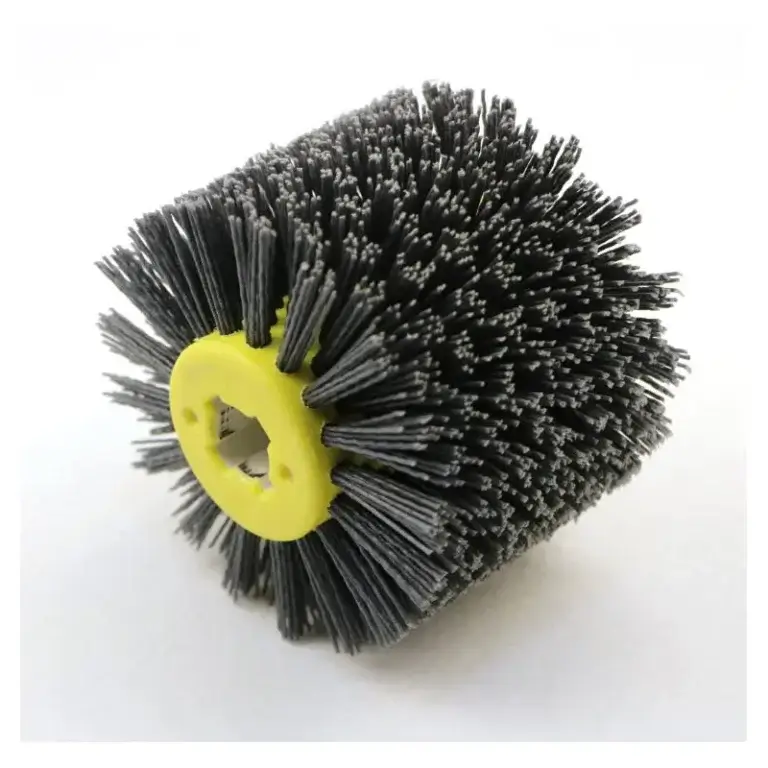
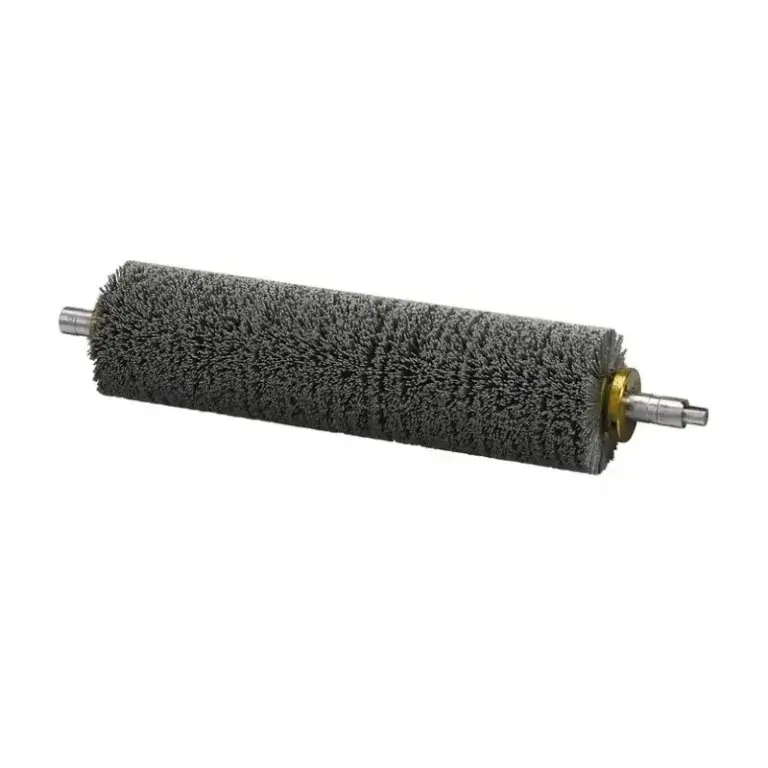
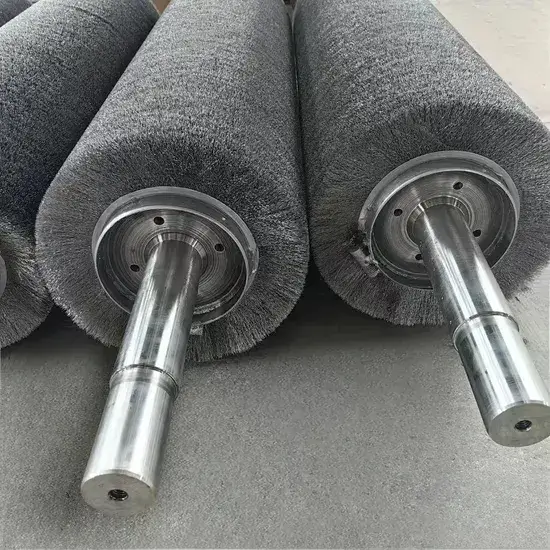
A cleaning stage that runs inside a production line rarely fails loudly. The parts keep moving, the brushes keep turning, and the first sign of trouble usually arrives somewhere else entirely, as a coating that lifts or a batch rejected for contamination nobody saw on the line.
A cylindrical brush boosts workpiece cleaning effect because it delivers continuous, uniform filament contact across the full working width without stopping the process, and because filament material, diameter, trim length, rotational speed, and depth of engagement can all be specified and controlled. The gain does not come from the brush being aggressive. It comes from the brush being predictable, so that performance stays inside a known window from the first part to the ten thousandth rather than drifting as the filament wears.
The sections that follow take the subject in the order a specification is actually built: what the tool does at the contact point, how it differs from a disc brush, how filament and core geometry are chosen, which operating parameters decide the outcome, and how to correct the problems that appear once the line is running.
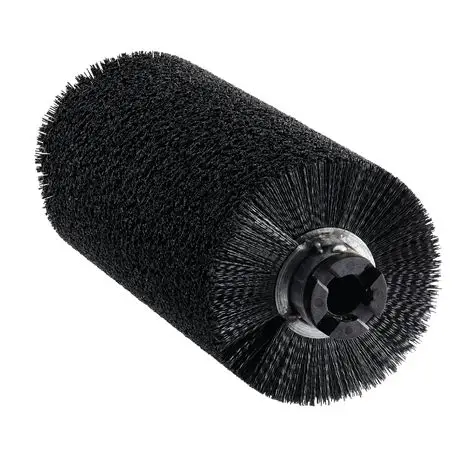
What a Cylindrical Brush Actually Does on a Workpiece
A cylindrical brush cleans by rotating a dense band of filament tips against the workpiece, so that thousands of individual contact events per second remove dust, debris, light burrs, and surface contamination along a continuous line of engagement. It is a contact tool rather than a cutting tool, and the work is done by the tips of the filaments, not by their sides.
Because the tips do the work, the result depends on how many tips touch the surface per unit time, how much force each carries, and how far the filament is allowed to bend. Increase any of those beyond the material’s tolerance, and the brush stops cleaning the surface and starts damaging it.
A brush in a production line also maintains contact for as long as the workpiece is under it, so the cleaning action is spread evenly rather than concentrated where an operator would naturally scrub hardest. A hand-scrubbed surface tends to be over-worked where contamination was obvious and untouched where it was not, and a coating applied over it fails first in the untouched areas. The continuous mode makes the result repeatable, which is what allows a downstream process such as painting, anodising or adhesive bonding to be specified with confidence.
The Filament Tip as the Working Edge
Filament tips are flexible, so they conform to contours, edges, cross-holes and surface irregularities that a rigid abrasive tool cannot follow without cutting into the part. That conformability is why cylindrical cleaning brushes are used on parts with complex geometry, and why they are often specified on features where dimensional accuracy must be preserved.
The same flexibility sets the limit. A filament that bends too far stops wiping and starts bouncing, so contact becomes intermittent at the tip level even though the brush is still touching the part. Running the tool fast enough to cause this is the most common error in brush operation, and it produces the paradox of a brush that spins faster, cleans less, and wears out sooner.
Cylindrical Brush vs Disc Brush: Which Fits the Workpiece?
Choose a cylindrical brush when the cleaning must be continuous, span a wide or long surface, and be integrated into a moving line. Choose a disc brush when the contamination is local, stubborn, or adhesive, and the cleaning can be performed at a station rather than in line. The two are not competitors so much as different contact geometries, and the decision follows the shape of the work and how the part moves.
A cylindrical brush presents a line of contact across its face width, and the workpiece travels through it. Coverage comes from the relationship between brush width, workpiece width, and line speed, which is why a cylindrical brush can be sized to match a conveyor exactly, and why overlap between passes becomes a machine setting rather than an operator habit. A disc brush presents a circular face instead, and while it reaches localised defects well, its outer edge travels considerably faster than its centre. That speed gradient is why disc brushes can leave a visible ring pattern on a large flat area while a cylindrical brush does not.
Three situations still favour the disc format: adhesive residue and tacky contamination respond better to concentrated scrubbing than to a swept pass; deposited material on a small area, such as weld spatter on a joint, needs the higher local force a disc provides; and parts presented at a station rather than conveyed, particularly irregular castings, are easier to clean with a tool the operator can position freely.
Filament and Core Geometry: The Choices That Decide the Result
Select filament by matching three properties to the job: material for compatibility with the workpiece, diameter for stiffness against the contamination being removed, and density for how much load the brush face can carry. Material is the constraint that cannot be traded away, because the wrong filament damages the workpiece in ways that no parameter change can undo. Core construction and diameter then set how evenly the brush face is loaded and how fast it can safely run.
| Filament material | Typical duty | Notes and limits |
| Nylon | General cleaning, wet or dry, deburring of soft metals and plastics | Best general-purpose choice; filaments recover their shape after flexing, which keeps contact consistent as the brush wears |
| Polypropylene | Wet and high-moisture environments, chemical exposure | Good chemical resistance; less spring-back than nylon, so contact consistency depends more on setup |
| Carbon steel wire | Descaling, rust removal, aggressive pre-treatment on steel and iron | Never use on stainless steel or aluminium, where embedded ferrous particles start new corrosion |
| Stainless steel wire | Stainless workpieces, aluminium, food-contact and wet environments | Safe general default where any contamination risk exists; keep segregated from carbon steel brushes |
| Brass wire | Non-ferrous metals, spark-sensitive areas, light cleaning | Suitable where a carbon steel brush would cause galvanic problems; too soft for thick scale |
| Natural fibre (sisal, tampico) | Polishing, woodworking, delicate surface conditioning | Pairs with abrasives; not a metal-cleaning filament |
Filament diameter works in the opposite direction to trim length. A thicker filament is stiffer and removes more material but fatigues faster and follows contours less well; a finer filament is gentler and more conformable but may be too delicate for heavy contamination. Use the finest filament that will still remove the contamination in an acceptable number of passes.

Matching Filament to Workpiece Material
Cross-contamination is the failure that catches buyers most often, because it does not appear immediately. A carbon steel filament run across stainless steel or aluminium leaves microscopic ferrous particles embedded in the surface, and those particles corrode. Because they sit in a material chosen specifically for its corrosion resistance, the resulting pitting looks like a defect in the workpiece rather than a contamination event caused by tooling. The control is procedural: stainless and non-ferrous brushes should be physically segregated and labelled, and a stainless brush that has touched carbon steel should never return to stainless work. This is why a cylinder wire brush should be specified with its workpiece named, not just its dimensions.
Filament Construction and Core Type
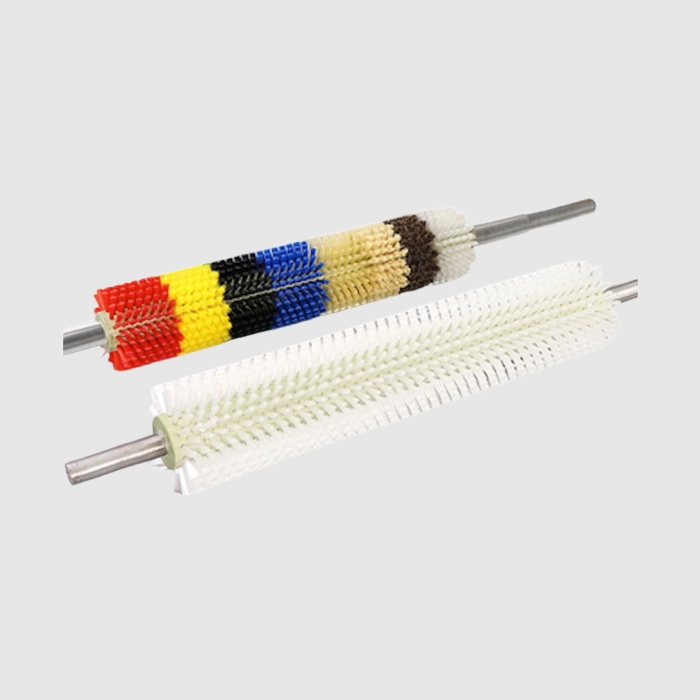
Three filament constructions cover most cleaning duties. Crimped filament is waved along its length, so it presents many light contact points and produces a finer, more blended surface, which suits general cleaning and light deburring. Straight or rectangular filament is more aggressive for the same diameter and is used where a defined cutting action is wanted, such as edge radiusing. Abrasive filament embeds silicon carbide or aluminium oxide grit into the nylon, so the grit becomes the cutting element rather than the tip alone, which raises removal rates and extends the brush into surface conditioning at the cost of greater heat sensitivity. Abrasive nylon has a narrow operating window because, if run too fast or pressed too deep, the nylon softens and smears onto the workpiece.
Cores are built by one of two methods. Spiral wound construction winds filament continuously around the core, producing a dense and even brush face with consistent contact across the full width, and it generally balances more easily at higher speeds. Tufted or staple-set construction punches filament tufts into pre-drilled holes, which allows specific tuft patterns but gives lower density for a given core. Either can be supplied on metal, plastic, or composite cores, and the core decides the mounting, the maximum safe speed, and how the brush behaves when balance degrades.
| Size band | Typical behaviour | Common duty |
| Small diameter, short trim | Stiff, aggressive, limited area | Heavier cleaning, confined or narrow work areas |
| Medium diameter, medium trim | Balanced; the general-purpose case | General deburring, cleaning and pre-treatment |
| Large diameter, long trim | Soft, conformable, wide coverage | Delicate surfaces and continuous in-line cleaning |
Diameter sets the surface speed for a given RPM and the reach of the brush into the work area, while trim length sets the stiffness of the contact, with short trim making the face rigid and long trim improving conformity on irregular surfaces. Because diameter and RPM are linked through surface speed, resizing a brush without rechecking the speed setting is one of the fastest ways to change the result unintentionally.
Setting the Operating Parameters That Drive Cleaning Effect
Speed, depth of engagement, and feed rate act together, and adjusting any one of them changes what the other two need to be. The governing rule is that filament tip speed must stay within the range where tips wipe across the workpiece rather than bouncing off it, and that depth of engagement should be expressed as a percentage of trim length rather than as an absolute figure. Slower brushes with deeper engagement usually outperform faster brushes with light contact, and the same settings determine how safely the installation can be guarded and operated.
| Parameter | Effect when increased | Practical guidance |
| Spindle speed | Raises tip speed and heat; beyond a point reduces contact and finish quality | Higher speeds favour finishing and light deburring; excessive speed causes bouncing, melting and smearing |
| Depth of engagement | Increases aggression and contact pressure | Set as a percentage of trim length, not as a fixed distance; deeper cuts require lower speed |
| Feed rate | Controls dwell time over the workpiece | Slower feeds are more aggressive; faster feeds favour uniformity and throughput |
| Contact pressure | Raises removal rate up to a point, then wastes filament life | Use the least pressure that achieves the result |
| Coolant or lubricant | Reduces heat and flushes debris | Recommended for production; extends filament life and improves finish consistency |
Why Faster Is Usually Worse
Beyond an optimum, filament tips begin to flare and rebound off the workpiece instead of wiping across it, so contact becomes intermittent, and the effective number of working tips falls even as the brush turns faster. The symptoms are a surface that looks inconsistently cleaned and a filament that wears prematurely. Excessive speed also generates heat, and heat is what limits abrasive nylon most severely, because softened nylon smears onto the workpiece and clogs the brush face in a way no amount of extra pressure restores. The maximum speed marked on a brush is a safety limit, not a working recommendation.
Depth of Engagement, Feed Rate and Fluid
Set depth of engagement as a proportion of the filament’s free length rather than as a measured interference, because the same absolute depth means very different things on a short-trim and a long-trim brush. Start with a light engagement on the finest filaments and a slightly deeper one on coarser filaments, then reduce spindle speed as engagement increases so the filaments conform smoothly to the part. Feed rate is where the material enters the calculation: harder materials and larger burrs need slower feeds, which increase dwell time and let the tips work the surface.
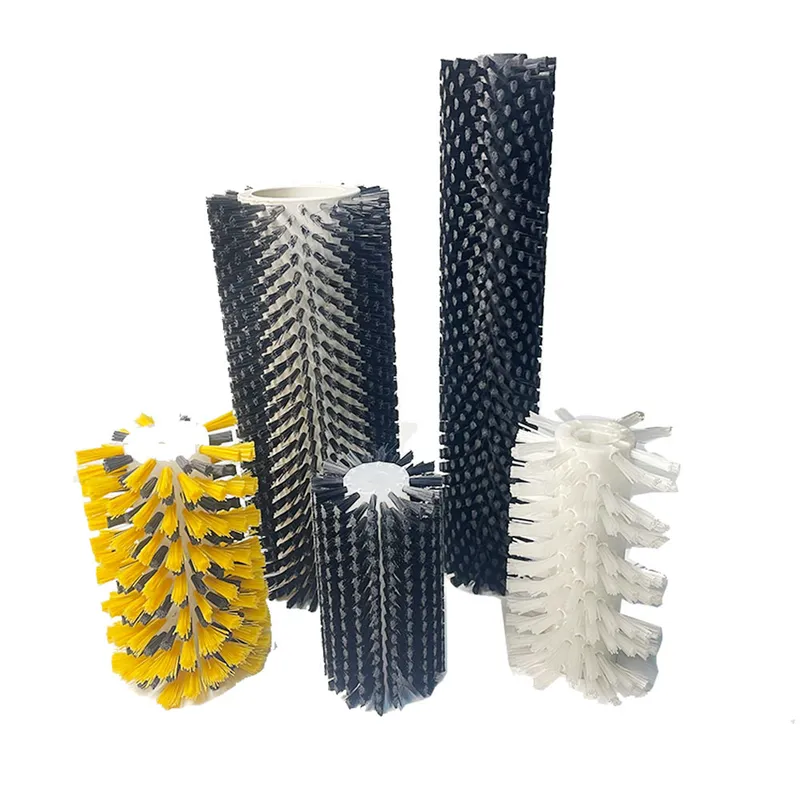
Running a cylinder rotary cleaning roller brush wet changes three things at once. Coolant removes heat from the contact zone, which widens the safe operating range for abrasive nylon and reduces the risk of smearing; it flushes loose debris and worn grit away from the brush face so the tips keep cutting instead of riding on their own residue; and it usually improves finish consistency at the same speed. The trade-offs are containment and disposal, because fluid must be captured and filtered, and recirculated debris will re-contaminate parts if filtration is too coarse.
Guarding and Safe Operation
A rotating cylindrical brush presents the same hazards as any other driven machine element: an in-running nip point where the brush meets the workpiece or a conveyor, exposed rotating parts, and the risk of filament fragments being ejected at speed. Under the general machine guarding requirements of OSHA 29 CFR 1910.212, guarding must be provided to protect operators from the point of operation, ingoing nip points, rotating parts, flying chips and sparks, and any guard must be affixed to the machine and must not itself create a hazard.
The engagement zone where brush and workpiece meet is the point of operation and must be enclosed so that no part of an operator can enter it during the operating cycle. Guards should be fixed or interlocked rather than held in place by convenience, and bypassing one to improve access during a jam is the situation most likely to produce an injury. The maximum safe speed marked on a brush is a free-running limit, which means a tool’s no-load speed must not exceed it.
Because brush cleaning is a surface preparation method with defined capability limits, it also helps to know where those limits sit. ISO 8501-1 specifies rust grades and preparation grades for steel surfaces treated by hand and power tool cleaning and by blast cleaning, and it makes clear that these methods rarely produce comparable results. Specifying a preparation grade a rotating brush cannot physically reach is a coating failure built into the process before the first part is run.
Common Problems, Maintenance and Replacement Timing
Most instances of a cylindrical brush failing to clean properly are caused by setup and parameters rather than by the brush, and the checks below resolve the majority of them without replacing anything. The pattern to watch for is a change that appeared gradually, because filament wear, contamination build-up, and speed drift all degrade performance slowly, and slow degradation is easily mistaken for a brush that has reached the end of its life.
| Symptom | Likely cause | Corrective action |
| Cleaning effect declines gradually | Filament tips worn or glazed; brush face loaded with residue | Clean the brush face, check remaining filament length, verify speed has not drifted |
| Uneven cleaning across the width | Brush not parallel to the workpiece, or core out of balance | Realign the mounting, check runout and dynamic balance |
| Inconsistent results between shifts or batches | Parameters adjusted informally; no recorded setting | Lock the settings, record them, and verify against a reference part |
| Surface scratched or marked | Filament too coarse, speed too high, or wrong material for the workpiece | Step down filament diameter, reduce speed, confirm material compatibility |
| Smearing or plastic residue on the part | Nylon overheating from excessive speed or engagement | Reduce speed and depth; introduce coolant or filtration |
| Filament shedding or premature breakage | Trim too short for the deflection, or contamination causing snagging | Increase trim length or reduce engagement; clear the debris path |
| Vibration and noise at operating speed | Imbalance, damaged core, or worn bearings | Replace the brush, inspect bearings and mounting hardware |
Uneven cleaning across the brush width almost always points to alignment rather than to the brush itself, and it is worth checking before ordering a replacement. Gradual decline, on the other hand, is the normal wear signature, so treating it as a fault leads to premature replacement.
Replacing on Measured Wear, Not on the Calendar
Replace a cylindrical brush on measured filament wear rather than on a calendar, because the same brush can last months or weeks depending on material, speed, and contamination load. A filament worn to roughly half its original length is the usual replacement point on general duties, and a filament worn to about a third of its original length should be replaced immediately. Measuring length with a gauge and logging it makes the schedule self-correcting.
| Replacement trigger | Measurement | Action |
| Normal wear | Filament at about 50 percent of original length | Replace at the next scheduled downtime |
| Advanced wear | Filament at about 30 percent of original length | Replace immediately |
| Uneven wear pattern | Visible taper or heavy wear at one side | Replace and investigate alignment and balance |
| Missing or broken filaments | Any visible gaps in the brush face | Replace immediately; loose filament is a contamination risk |
| Performance loss | Cleaning effect reduced noticeably at unchanged settings | Verify wear and loading before replacing |
Routine care is what makes this schedule achievable, and it is mostly inspection rather than intervention.
- Clear the brush face of debris at the end of each shift, using compressed air for wire filament and a soft brush or clean water for nylon.
- Check filament length and look for gaps, deformation, or embedded material on a regular cycle, tied to the plant’s own production rhythm.
- Verify mounting alignment, runout, and fastener torque, and treat any new vibration as a signal to stop and investigate.
- Keep a log of installation dates, filament measurements, and replacement reasons so the actual service life becomes visible and the interval can be adjusted on evidence.
- Store spare brushes dry and unloaded, so filaments do not take a permanent set and cores do not corrode between installations.
FAQ
Q1: How do I know when a cylindrical brush needs replacing?
Replace on measurement rather than on a fixed interval. A filament at roughly half its original length is at the normal replacement point for general cleaning duties; at about a third of original length it should come out immediately, because by then the brush has lost most of its conformability and is working more by pressure than by tip contact. Track filament length alongside operating hours and parts processed, and after a few replacement cycles you will have a service life figure specific to your process that is more reliable than any generic recommendation.
Q2: Can a cylindrical brush run wet, and does it change the result?
Yes, and wet operation usually improves both finish consistency and filament life. Coolant removes heat from the contact zone, which matters most with abrasive nylon, and it flushes debris and worn grit out of the brush face so the tips keep cutting rather than riding on residue. The requirements are filtration and containment: recirculated fluid must be filtered finely enough to keep removed particles from being redeposited on the parts, and the fluid has to be captured rather than allowed to spread. Dry operation works but should be run at more conservative speeds with extraction in place.
Q3: Can a cylindrical brush be used for deburring and edge finishing?
It can, within limits set by filament type. Abrasive nylon filament with embedded silicon carbide or aluminium oxide is the usual choice, since the grit does the cutting and produces a controlled edge radius rather than a sharp cut. Standard nylon filament handles light burrs and surface conditioning without altering part dimensions, which makes it suitable where dimensional tolerance must be preserved. The limits appear on large burrs and hard materials, where a brush removes material too slowly to be economical, and on heat-sensitive workpieces, where excessive speed causes the filament to smear rather than cut.