Solar panel maintenance is one of those topics that sounds simple on the surface but reveals layers of complexity once you dig deeper. Most system owners understand that dirty panels lose output. What far fewer realize is that the type of water used during cleaning can make the difference between restored performance and slow, invisible degradation. Across commercial solar farms, residential rooftop arrays, and industrial installations, the question keeps surfacing: is deionized water a genuine necessity or just an upsell? The answer has far-reaching implications for energy yield, panel longevity, and long-term return on investment.
Yes, deionized water is strongly recommended for solar panel brush washing and cleaning. It is not merely a preference; it is a critical factor that directly affects cleaning effectiveness, long-term panel health, and energy output consistency. Tap water and hard water leave mineral residues that form light-scattering films on panel surfaces, gradually reducing efficiency by 3% to 8% within months. Deionized water eliminates this risk by evaporating without leaving any residue behind.
Consider what is at stake. A commercial 100 kW installation operating in a dusty environment may lose 15% to 25% of its annual output to soiling if left uncleaned. Yet cleaning with the wrong water can create a different problem: mineral scale that accumulates layer by layer, turning what looked like clean glass into a hazy filter that silently saps kilowatt-hours. The cost of a portable deionization system is measured in thousands of dollars; the cost of permanently reduced efficiency across a large array is measured in tens of thousands. This article examines the science behind water quality in solar panel maintenance, compares water types, outlines best practices for brush cleaning, and evaluates the financial case for making the switch to deionized water.
What Happens When You Use Tap Water to Clean Solar Panels
Mineral Deposit Formation: The Limescale Problem
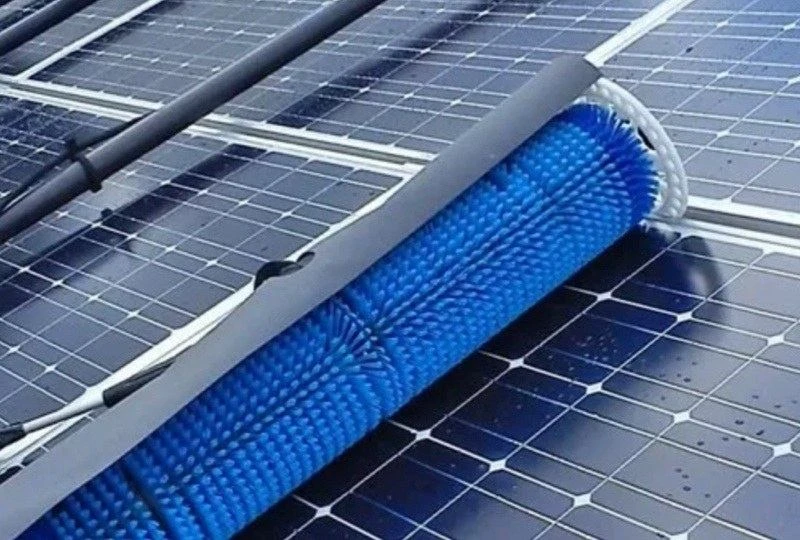
Tap water leaves mineral deposits on solar panel surfaces after evaporation. These deposits, primarily calcium and magnesium carbonates, form a chalky film known as limescale that scatters incoming sunlight and reduces the panel’s effective light transmission. Field studies indicate that panels consistently cleaned with hard tap water can suffer a 5% to 8% power output drop within six months due to mineral scaling alone.
The Chemistry of Hard Water and Scaling
Municipal tap water contains varying concentrations of dissolved minerals, with calcium (Ca²⁺) and magnesium (Mg²⁺) ions being the most prevalent. The hardness of water is measured in parts per million (ppm) of calcium carbonate equivalent. In regions where water hardness exceeds 150 ppm, the scaling effect is particularly pronounced. When tap water is applied to a heated solar panel surface, the water evaporates rapidly under sunlight, leaving behind a crystalline mineral residue. This residue does more than simply look unsightly; it acts as a physical barrier between sunlight and the photovoltaic cells beneath the glass.
Cumulative Damage: Efficiency Losses Over Time
The damage accumulates in cycles. Each cleaning session that uses tap water deposits a new layer of minerals. Over repeated cleanings, what began as a faint haze thickens into a stubborn white film. Research from the National Renewable Energy Laboratory (NREL) has documented that panels rinsed with hard water lost 5% to 8% of their power output within six months compared to panels cleaned with purified water. A separate case study from a solar farm in the Middle East reported that panels cleaned with unfiltered groundwater for three years exhibited a component power degradation rate of 7.2%, significantly exceeding normal aging curves. The economic impact is direct: a 5% efficiency loss on a 100 kW system operating at $0.12 per kWh translates to approximately $5,250 in lost annual revenue.
Long-Term Surface Damage: Scratching the Anti-Reflective Coating
Beyond the immediate efficiency penalty, mineral deposits also create long-term surface damage. Hard water minerals can lodge into microscopic surface imperfections on the panel glass. When solar panel cleaning tools are used in subsequent cleaning cycles, these embedded mineral particles act as abrasives, scratching the anti-reflective coating that manufacturers apply to maximize light capture. Once this coating is compromised, the panel’s light transmission is permanently reduced. Tests following ASTM D4265 standards have shown that micro-scratches caused by mineral-laden cleaning can increase surface reflectivity by 2% to 4%, losses that cannot be recovered without replacing the panel entirely.
What Is Deionized Water and Why Is It Ideal for Solar Panel Cleaning
Deionized Water: The Gold Standard for Residue-Free Cleaning
Deionized water is water that has been processed through ion-exchange resins to remove virtually all dissolved mineral ions, including calcium, magnesium, sodium, chloride, and sulfate. For solar panel cleaning, it is the gold standard because it evaporates completely without leaving any residue, ensuring that the panel surface remains optically clear and free from scale buildup.
The Deionization Process: How Resin Beds Purify Water
The deionization process works by passing water through two types of resin beds. The first contains cation-exchange resins that capture positively charged ions and replace them with hydrogen ions (H⁺). The second contains anion-exchange resins that capture negatively charged ions and replace them with hydroxide ions (OH⁻). The hydrogen and hydroxide ions then combine to form pure H₂O. The purity of the resulting water is typically measured by its electrical resistivity. While ordinary tap water has a resistivity of approximately 0.001 to 0.005 MΩ·cm, properly deionized water reaches 15 to 18 MΩ·cm, indicating that nearly all conductive ions have been removed.
TDS Levels: Why Purity Matters for Panel Performance
For solar panel maintenance specifically, the key metric is Total Dissolved Solids (TDS), which is closely related to conductivity. Industry best practices recommend using water with TDS below 50 ppm for panel cleaning, and ideally below 10 ppm. Deionized water routinely achieves TDS levels below 1 ppm. This level of purity means that when a technician sprays a panel and the water evaporates, there is virtually nothing left behind. The surface dries clean, clear, and ready to capture the maximum amount of sunlight.
Operational Benefits: Protecting Coatings and Warranties
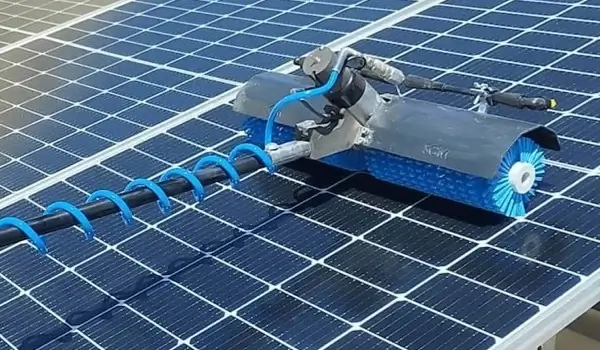
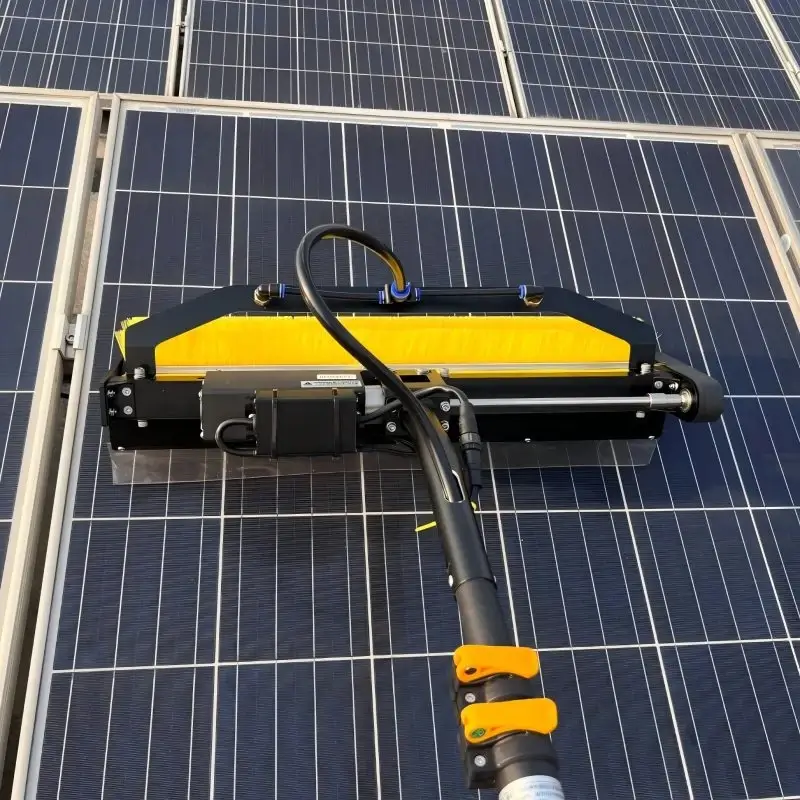
The operational advantage extends beyond cleanliness. When deionized water is paired with soft-bristle brushes, the cleaning action lifts and suspends dirt particles without grinding them against the glass. Because there are no dissolved minerals in the water, no new deposits are introduced during the process. Many professional cleaning services now use telescopic carbon-fiber poles with brush heads fed by a deionized water supply, allowing them to clean rooftop panels from ground level. This method is approved by most major panel manufacturers and carries no risk of voiding product warranties, unlike detergent-based cleaning or high-pressure washing.
Deionized Water vs. Other Water Types for Panel Cleaning
Deionized water outperforms all other commonly available water types for solar panel cleaning. Tap water leaves mineral residue, distilled water is purer but often cost-prohibitive at scale, and reverse osmosis (RO) water is a strong alternative but may not match the ionic purity of properly maintained DI systems. For large-scale or professional operations, deionized water offers the best balance of purity, cost-effectiveness, and field practicality.
The comparison between water types is best understood through a side-by-side analysis of their key characteristics. The table below summarizes how each water type performs on the metrics most relevant to solar panel maintenance.
| Characteristic | Tap Water | Distilled Water | Reverse Osmosis (RO) Water | Deionized (DI) Water |
| TDS Level (typical) | 100–500 ppm | 1–10 ppm | 5–50 ppm | <1 ppm |
| Mineral Residue Risk | High | Very Low | Low | Negligible |
| Conductivity | Moderate | Low | Low | Very Low |
| Cleaning Effectiveness | Moderate | High | High | Very High |
| Cost per Liter (bulk) | Negligible | $0.30–$0.50 | $0.03–$0.10 | $0.05–$0.08 (on-site) |
| Scalability for Commercial Use | Easy | Difficult | Good | Excellent |
| Risk of Surface Scratching | High (over time) | Unlikely | Unlikely | Unlikely |
Each water type occupies a distinct role in the maintenance ecosystem. Tap water, while essentially free at the point of use, carries the highest long-term cost due to efficiency losses and surface degradation. Distilled water is produced by boiling water and condensing the steam, a process that removes most minerals and organic contaminants. It is purer than tap water but energy-intensive to produce at scale, making it impractical for commercial operations that may use hundreds of liters per cleaning cycle.
Reverse osmosis water, produced by forcing water through a semi-permeable membrane, removes 90% to 99% of dissolved solids. It is widely used in residential and light commercial settings. However, RO membranes can be fouled by chlorine and organic matter, and their rejection rate declines over time without proper maintenance. For solar farms operating in remote locations, the water waste ratio of RO systems (typically 3 to 4 liters of wastewater per liter of purified water) can create logistical challenges.
Deionized water occupies the top tier. When produced on-site using portable DI tanks or regeneration systems, it delivers consistent, verifiable purity at a per-liter cost comparable to or lower than bottled distilled water. The portability of DI systems is a significant practical advantage: a single DI tank can be mounted on a service vehicle and produce hundreds of liters of pure water before requiring resin replacement or regeneration. For operators managing multiple sites, this translates to lower transportation costs and less downtime.
Best Practices for Brush Cleaning Solar Panels with Deionized Water
Brush Specifications: Nylon, Diameter, and Density
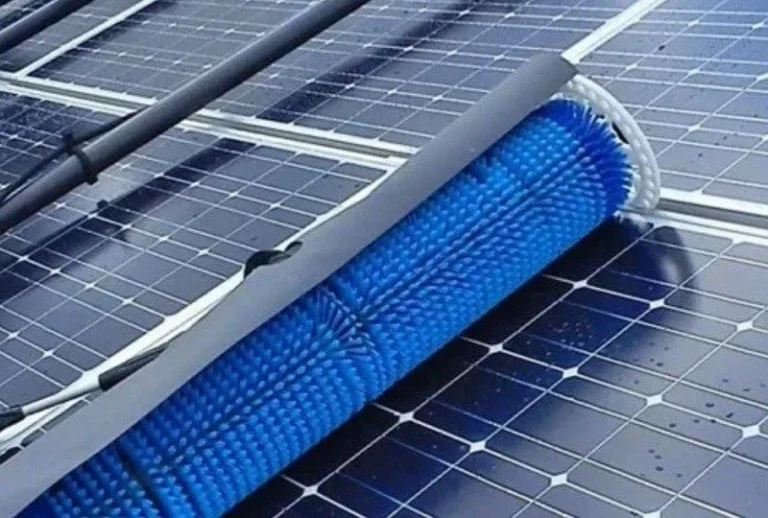
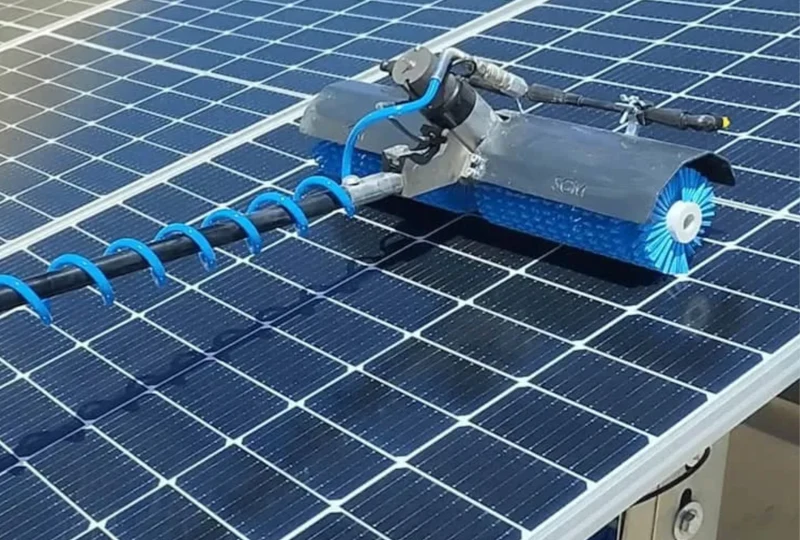
Effective brush cleaning with deionized water requires matching the right rotary solar panel brush specifications with proper water delivery technique to achieve the cleanest surface without causing micro-scratches or coating damage. The key parameters are using nylon 6.6 bristles of 0.15 to 0.3 mm diameter, maintaining a DI water flow rate of 2 to 4 liters per minute per panel, and rinsing immediately after brushing to prevent mineral deposition.
The solar scrubbing head is the physical interface between the cleaning system and the panel surface, and its specifications matter enormously. Research published in the journal Solar Energy Materials tested 12 brush types across more than 200 panels and found that nylon-bristle brushes outperformed steel, hard plastic, and natural-fiber alternatives by approximately 30% in scratch resistance while delivering equivalent or superior cleaning power. The ideal bristle diameter falls between 0.15 mm and 0.3 mm: thinner bristles lack the stiffness to dislodge caked-on debris, while bristles thicker than 0.3 mm increase the incidence of micro-scratches by roughly 40%.
Bristle density is the second critical factor. A density of 80 to 100 bristles per square inch provides the optimal balance between coverage and flexibility. Lower densities leave gaps that miss fine particles; higher densities cause bristle tangling and uneven pressure distribution. The brush handle material should be UV-resistant polypropylene or anodized aluminum. PVC handles, while cheaper, degrade approximately 60% faster under continuous sun exposure and can crack within six months.
Water Delivery Technique: Spray Angle and Flow Rate
The water delivery technique is equally important. Deionized water should be applied through a fan-spray nozzle set at a 25 to 40 degree spray angle, held 12 to 18 inches from the panel surface at approximately a 30 degree angle. Research from the University of Texas demonstrated that this approach reduces water consumption by roughly 20% compared to perpendicular spraying without sacrificing coverage. The flow rate should be maintained at 2 to 4 liters per minute per panel. Higher flow rates waste water and increase cost without meaningful improvement in cleaning quality; lower rates risk leaving dissolved dirt on the surface.
Timing and Rinsing: Preventing Redeposition
Timing is critical in the overall workflow. Brushing should be followed by rinsing within 45 seconds, particularly in hot or windy conditions where rapid evaporation can redeposit suspended particles. The rinse step should use only deionized water, with no detergents or chemical additives. Pure water’s high solvent capacity, a result of its lack of dissolved ions, makes it naturally effective at lifting and carrying away dirt. Post-rinse, panels should be allowed to air-dry naturally. Forced drying with air blowers or cloths introduces unnecessary mechanical contact and potential for scratching.
Cleaning Cycle Workflow Checklist
The following checklist summarizes the recommended workflow for a single cleaning cycle:
- Conduct a pre-cleaning visual inspection to identify areas of heavy soiling, bird droppings, or physical damage
- Pre-rinse panels with deionized water at low pressure (under 500 PSI) to remove loose dust and grit
- Apply deionized water continuously while brushing with soft nylon bristles, working from top to bottom along the panel’s slope
- Use overlapping strokes of 12 to 18 inches at a rate of approximately 0.5 meters per second
- Pay extra attention to edges and junction box areas, which accumulate roughly twice the debris of center surfaces
- Rinse thoroughly with deionized water within 45 seconds of brushing
- Inspect for residual spots; re-rinse any areas showing water marks
- Allow panels to air-dry completely before conducting a post-cleaning performance check
DI Water for Solar Maintenance – Cost-Benefit Analysis
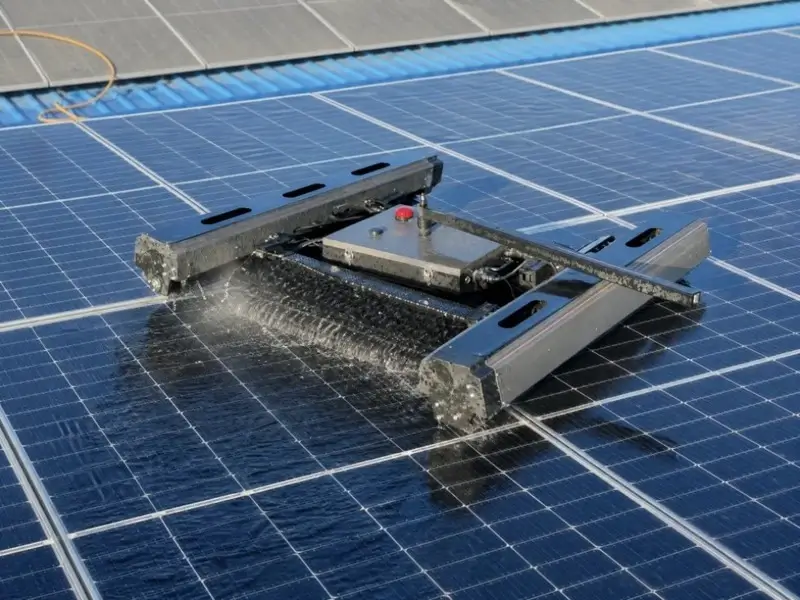
The financial case for deionized water is compelling: the upfront cost of DI equipment is typically recovered within months through higher energy output, reduced cleaning frequency, and extended panel lifespan. For commercial systems exceeding 100 kW, the annual energy gains alone often exceed the total cost of setting up and operating an on-site DI water system.
To analyze the economics properly, both costs and savings must be quantified across a realistic timeframe. The table below presents typical figures for a 100 kW commercial installation in a moderate-soiling environment, cleaned on a monthly schedule.
| Cost / Savings Factor | Using Tap Water | Using Deionized Water |
| Annual Cleaning Cost (water only) | Negligible | $1,200–$2,500 (on-site DI system amortized) |
| Efficiency Loss from Mineral Buildup | 5%–8% annually | 0% |
| Annual Energy Lost to Mineral Scaling | 4,400–7,000 kWh | 0 kWh |
| Revenue Lost at $0.12/kWh | $530–$840 / year | $0 |
| Panel Lifespan Impact | Shortened by coating wear | Maintained at manufacturer spec |
| Cleaning Frequency Required | Potentially higher | Standard schedule |
For larger installations, the numbers scale proportionally. A 1 MW solar farm losing 5% efficiency to mineral scaling forfeits approximately 44,000 to 70,000 kWh per year. At $0.12 per kWh, that equates to $5,280 to $8,400 in lost annual revenue attributable solely to water quality choices. The cost of a commercial-grade on-site deionization system capable of servicing a 1 MW installation ranges from $3,000 to $5,000 for the initial setup, with ongoing resin replacement or regeneration costs of $800 to $1,500 per year. The payback period is measured in months, not years.
There are secondary financial benefits that are harder to quantify but equally real. Panels that are never exposed to mineral scaling maintain their anti-reflective coatings for their full design life, typically 25 to 30 years. Premature coating degradation, by contrast, can force early panel replacement that costs $150 to $300 per panel. Cleaner panels also run cooler. Mineral films can create localized hot spots by unevenly scattering light, which accelerates cell degradation and increases the risk of thermal runaway in affected areas. Infrared thermography studies have documented temperature differentials of 8°C to 15°C between clean panel sections and those covered by mineral film, a gap that directly impacts both immediate output and long-term reliability.
From a maintenance logistics standpoint, deionized water also reduces the total number of cleaning interventions required. Because the panels dry spotless after each cleaning, the interval between necessary cleanings can be extended by 25% to 50% compared to tap-water cleaning, which leaves residues that trap dirt more quickly. For a 100 kW system cleaned 12 times per year at $200 per cleaning visit, eliminating even three visits saves $600 annually in labor and equipment costs alone.
Conclusion
The decision to use deionized water for solar panel brush washing is ultimately a question not of whether it works but of whether the alternatives are worth the hidden cost. Tap water appears free at the nozzle, yet it deposits minerals that compound into measurable efficiency losses, surface degradation, and shortened panel life. Research from the National Renewable Energy Laboratory and field data from installations worldwide consistently point to the same conclusion: panels cleaned with deionized water maintain higher output, require less frequent cleaning, and reach their full design lifespan.
For residential system owners, the practical path forward is to use either a small portable DI system or purchase deionized water from a local supplier. For commercial operators and solar farm managers, investing in an on-site deionization setup is one of the highest-return operational decisions available, with payback periods often falling under 12 months. The equipment is portable, the process is straightforward, and the results are immediately visible in both panel appearance and energy production data.
The principles are clear: use the right cleaning tool, apply water at the right pressure and angle, rinse promptly, and always choose water that leaves nothing behind. Deionized water is not an optional upgrade. It is the foundation on which effective, sustainable solar panel maintenance is built.
FAQ
Q1. Can I use rainwater or filtered tap water instead of deionized water for solar panel cleaning?
Rainwater and filtered tap water still contain dissolved minerals and airborne contaminants. While they are better than hard tap water, they do not match the purity of deionized water and can still leave residues over time. For best results, especially on anti-reflective coatings, deionized water is recommended.
Q2. How often should I replace the resin in my on-site deionization system?
Resin replacement frequency depends on water usage and incoming water hardness. Typically, resin lasts 6 to 12 months for moderate use. Monitor the water quality with a TDS meter — when TDS readings exceed 10 ppm, it is time to regenerate or replace the resin.
Q3. Is deionized water safe for all solar panel types, including thin-film and bifacial panels?
Yes. Deionized water is safe for all panel types, including thin-film, monocrystalline, polycrystalline, and bifacial modules. It does not contain chemicals or minerals that could react with panel materials, making it the safest cleaning option across all solar technologies.