
The Conveyor Cleaning Challenge: Build-Up, Traction Loss, and Contamination
Conveyor systems move millions of tons of material every day across mining sites, food processing plants, manufacturing facilities, and logistics centers. During operation, fine particles, sticky residues, and abrasive debris accumulate on belt surfaces. This buildup reduces belt traction, shortens equipment life, and can contaminate products traveling on the line. Maintenance teams spend hours each week scraping and washing belts, often with tools that only partially remove the fouling.
Why Custom-Sized Brushes Outperform Off-the-Shelf Alternatives
A custom-sized conveyor cleaning brush removes material buildup from belt surfaces automatically during operation. Unlike off-the-shelf brushes that may leave gaps or apply uneven pressure, a brush built to your conveyor’s exact width, diameter, and rotational speed delivers consistent cleaning across the entire belt surface without causing belt wear or requiring frequent adjustment.
Key Variables That Shape Brush Selection: Width, Speed, Material, and Environment
Selecting a conveyor cleaning brush is not a one-size-fits-all decision. Belt width, speed, material type, and operating environment all influence which brush design will perform reliably. A food-grade conveyor carrying sticky dough needs a different brush than a mining conveyor covered in coal dust. The following sections explain how these variables shape brush selection and why custom engineering often produces better long-term results than generic alternatives.
Key Topics Covered
- What a conveyor cleaning brush is and how it works
- Why custom sizing matters for different conveyor types
- Material options for conveyor cylinder brushes
- How to specify the right brush for your system
- Industries that rely on custom conveyor cleaning brushes
What Is a Conveyor Cleaning Brush and How Does It Work
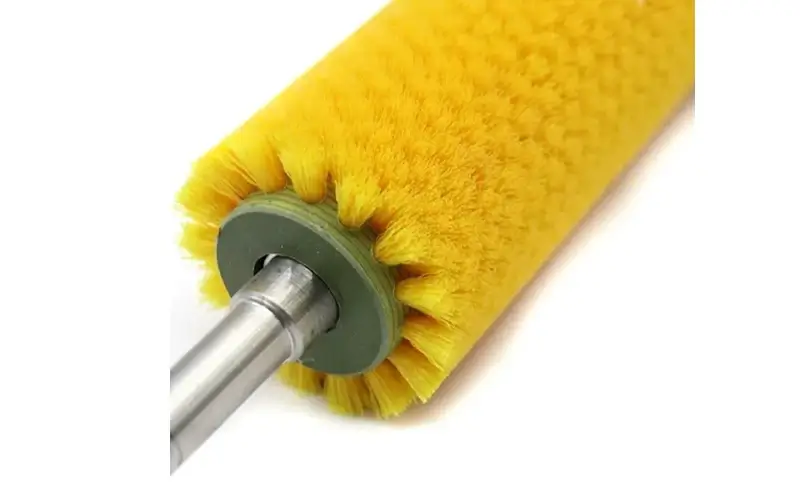
A conveyor cleaning brush is a cylindrical brush mounted against a conveyor belt to sweep away debris, dust, and material residue during belt operation. The brush rotates either in the same direction as the belt or in counter-rotation, using bristle contact to dislodge particles before they accumulate and cause belt tracking issues or product contamination.
The brush itself is built around a central core, typically metal or reinforced polymer, with filaments secured along its surface. When installed on a conveyor return line or at a discharge point, the rotating bristles make contact with the belt surface and mechanically remove stuck material. The dislodged debris falls into a collection tray or chute positioned below the brush assembly.
The effectiveness of a conveyor belt cleaning brush depends on three mechanical factors: bristle material stiffness, contact pressure against the belt, and rotational speed relative to belt speed. Too much pressure accelerates belt cover wear. Too little pressure leaves residue behind. The right balance comes from matching brush specifications to the specific material being conveyed and the belt’s surface characteristics.
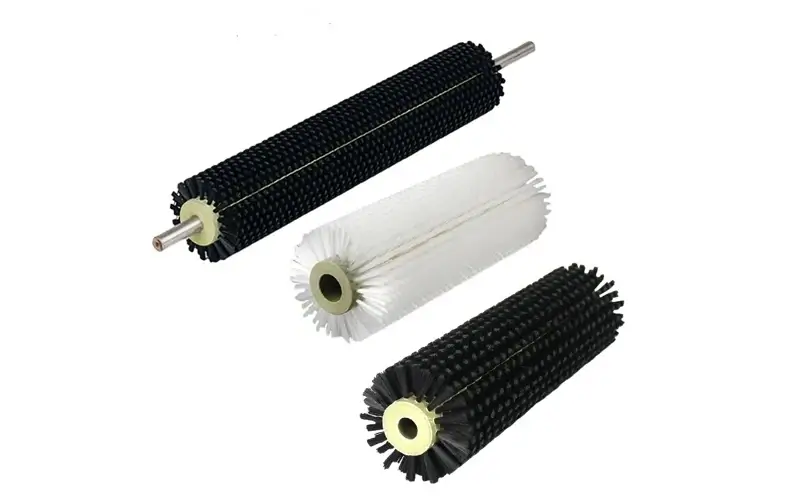
A cylinder rotary brush used for conveyor cleaning often employs a spiral-wound construction. Filaments are anchored into metal channel strips and wound helically around the core. This design eliminates gaps in bristle coverage and distributes contact pressure evenly, which prevents the streaking patterns that can occur with segmented brush designs.
Why Custom Sizing Matters for Different Conveyor Types
Full Belt-Width Coverage: Avoiding Undersized and Oversized Brushes
Standard-sized brushes rarely match a conveyor system’s exact requirements because belt widths, operating speeds, and material characteristics vary widely between facilities. A custom-sized brush ensures full belt-width coverage, correct bristle penetration depth, and shaft dimensions that integrate directly with existing mounting hardware without retrofit modifications.
Conveyor belts range from narrow 12-inch lines in packaging operations to 96-inch-wide belts in mining and aggregate handling. An undersized brush leaves uncleaned edges where material accumulates and eventually migrates back toward the center. An oversized brush wastes bristle material and may interfere with adjacent equipment or structural supports. Custom manufacturing produces brushes that match the belt width within millimeter tolerances.
Core and Overall Diameter: Matching the Mounting Envelope and Surface Speed
Core diameter and overall brush diameter also need to match the conveyor’s geometry. The brush must fit within the available space on the return side of the belt, often in tight clearance areas near pulleys and tensioners. A brush that is too large will not mount properly. A brush that is too small will not apply enough bristle tip speed to dislodge stubborn material. Custom specification accounts for the available mounting envelope and calculates the diameter needed to achieve effective surface speed at the bristle tips.
Shaft Design and Mounting Compatibility: Integrating with Existing Hardware
Shaft design is another factor that varies between conveyor models. Some systems use keyed shafts, others use tapered bushings, and still others require through-bore mounting for direct motor coupling. A custom cylinder brush can be built with shaft ends and bore dimensions that match existing pillow block bearings and drive couplings, eliminating the need for adapter plates or shaft modifications during installation.
.
Material Options for Conveyor Cylinder Brushes
Nylon Cylinder Brushes: The General-Purpose Standard for Conveyor Cleaning
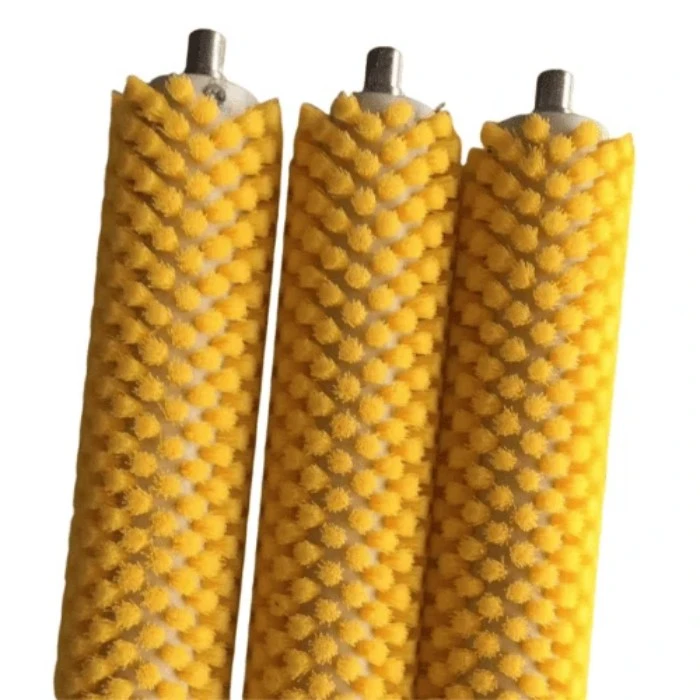
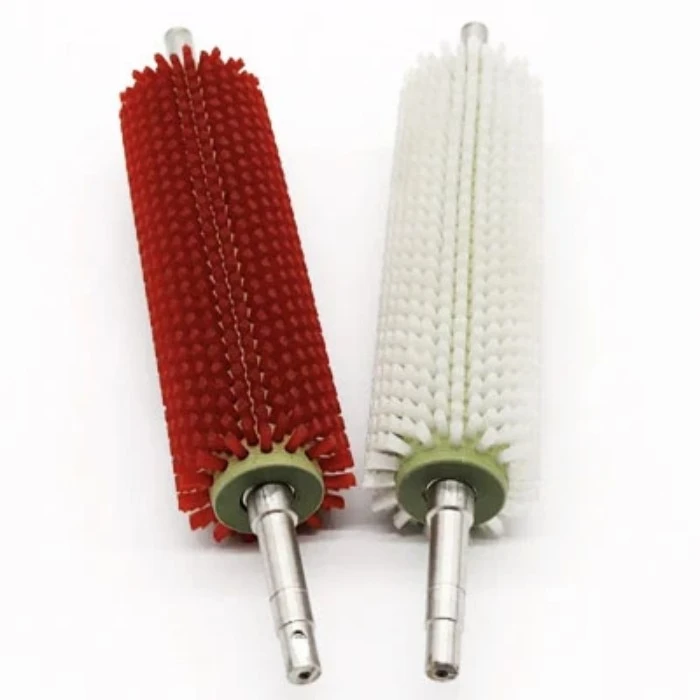
Conveyor cylinder brushes are manufactured with filaments including nylon, polypropylene, abrasive nylon, steel wire, brass wire, and natural fibers. Nylon cylinder brushes for cleaning are the most common choice for general-purpose conveyor maintenance because nylon resists moisture, maintains stiffness across a wide temperature range, and does not scratch steel belt surfaces.
Nylon filaments come in multiple diameters and trim lengths. Thicker filaments, in the range of 0.020 to 0.040 inches, provide aggressive cleaning action for removing compacted material from heavy-duty belts. Finer filaments, around 0.012 to 0.020 inches, are suited for food-grade conveyors where gentle cleaning prevents belt surface abrasion. The filament density, measured in filaments per square inch of brush surface, also affects cleaning aggressiveness and brush life.
Abrasive Nylon: Cutting Action for Hardened and Bonded Residue
Abrasive nylon incorporates silicon carbide or aluminum oxide grit directly into the filament material. This type of conveyor cylinder brush handles material that has hardened or bonded to the belt surface, such as cured adhesives, dried food residue, or compacted minerals. The abrasive particles expose fresh cutting edges as the filament wears, maintaining cleaning performance throughout the brush life.
Steel and Brass Wire Brushes: Heavy-Duty and Spark-Free Options
Steel wire brushes are used on mining and heavy industrial conveyors where belt covers are thick enough to withstand wire contact. Carbon steel wire removes rust scale and hardened deposits. Stainless steel wire is used in wet or corrosive environments where carbon steel would degrade quickly. Brass wire is chosen when spark-free operation is required, such as in environments with combustible dust.
The table below summarizes filament selection by application type:
How to Specify the Right Conveyor Cleaning Brush for Your Operation
Start with the Belt: Width, Profile, and Cleaning Surface
Specifying a conveyor cleaning brush requires defining the belt width, belt speed, available mounting space, material being conveyed, and operating environment. Providing these five parameters to a brush manufacturer allows them to calculate the optimal diameter, filament type, density, and core construction for reliable long-term performance.
Start with the belt dimensions. Measure the exact belt width and identify whether the belt has any crowns, cleats, or sidewalls that affect the usable cleaning surface. The brush face width should match the flat portion of the belt. For chevron or cleated belts, the brush must be positioned to clean the flat sections between or behind the profile features.
Determine Belt Speed and Brush Rotation Requirements
Next, determine the belt speed and the desired brush rotational speed. Most conveyor cleaning brushes are driven by the belt itself through friction contact, which means the brush surface speed equals or slightly exceeds the belt speed. For applications where friction drive is insufficient to remove stubborn material, a motorized brush with independent speed control may be needed. The brush core and bearing assembly must be rated for the expected RPM.
Match Bristle Material and Density to the Conveyed Material
The material being conveyed determines the bristle material and density. Dry, powdery materials like cement or flour need dense, fine filaments to capture fine particles. Sticky materials like clay or wet grain need stiffer filaments with wider spacing to prevent material packing between bristle rows. Abrasive materials like sand or crushed rock call for wear-resistant filaments and may require a larger brush diameter to extend service life.
Consider Operating Environment: Washdown, Heat, and UV Exposure
Operating environment conditions influence core material and filament choice. Washdown environments in food plants need stainless steel cores and moisture-resistant filaments. High-temperature applications near kilns or dryers require filaments rated for the expected ambient temperature. Outdoor installations need UV-stabilized materials and corrosion-resistant hardware. The mounting hardware, including bearings, shaft seals, and adjustment mechanisms, must also be specified for the environment.
Define the Mounting Configuration for Drop-In Installation
Finally, define the mounting configuration. Note the shaft diameter, keyway dimensions, bearing center distances, and available clearance around the mounting position. If the brush needs to fit an existing tensioning system or brush holder, provide the holder dimensions and adjustment range. This information lets the manufacturer build a brush that drops into place without field modifications.
Industries That Depend on Custom Conveyor Cleaning Brushes
Mining, food processing, bulk material handling, recycling, and manufacturing are the five industries that use custom conveyor cleaning brushes most heavily. Each industry presents distinct material handling challenges that off-the-shelf brushes cannot reliably address across all conveyor configurations.
Mining operations run some of the widest and fastest conveyor belts in the world, often moving thousands of tons of ore per hour. Coal dust, mineral fines, and wet slurry accumulate on belt surfaces and spill along the return path if not removed. Custom conveyor cleaning applications in mining require brushes built for 24-hour continuous operation, with abrasion-resistant filaments and cores designed to handle belt speeds exceeding 1,000 feet per minute.
Sanitary Standards and Material Requirements for Food Processing Conveyor Brushes
Food processing presents a different set of requirements. Conveyors carrying raw dough, meat trimmings, or sticky confectionery ingredients need brushes that clean effectively while meeting sanitary standards. Nylon filaments are preferred because they resist bacterial growth and withstand frequent washdown cycles. Brush cores for food applications are typically stainless steel, and all components must tolerate cleaning chemicals and hot water sanitation.
Brush Specification Variability in Bulk Material Handling Applications
Bulk material handling covers a wide range of materials, including grains, fertilizers, wood chips, and recycled aggregates. These materials vary in particle size, moisture content, and abrasiveness, so brush specifications change from one handling line to the next. Facilities that process multiple materials on shared conveyors often need brushes that handle the most demanding material on that line.
Durability and Metal-Detectable Features for Recycling Facility Conveyor Brushes
Recycling facilities deal with unpredictable material streams that can include everything from shredded paper to metal fragments. Conveyor cleaning brushes in these environments must resist impact damage from stray material pieces while still providing thorough cleaning. Metal-detectable filament options are sometimes specified so that any bristle fragments that break off can be captured by downstream detection equipment.
Manufacturing operations, particularly those in automotive, aerospace, and building products, use conveyors to move parts through production stages. Metal chips, cutting fluid, and process dust accumulate on belts and can mark finished surfaces or jam guide rails. A nylon cylinder brush for cleaning in these settings typically runs at moderate speeds and prioritizes consistent contact pressure to remove debris without slowing production.
Matching Brush Design to Conveyor Performance Goals
Conveyor cleaning is not just about removing visible debris. It affects belt tracking, energy consumption, and bearing life across the entire conveyor system. Material buildup on return rollers creates uneven diameters that cause the belt to drift sideways. This drift accelerates edge wear and can trigger misalignment sensors that stop production. A properly specified cleaning brush keeps rollers clean and the belt centered.
Energy costs also connect to belt cleanliness. Material that sticks to the belt adds weight that the drive motor must pull on every revolution. On long overland conveyors in mining or aggregate operations, this added weight translates to measurable increases in power draw. Clean belts require less energy to move, which reduces operating cost per ton of material conveyed.
Bearing life on return rollers benefits from consistent cleaning as well. When material builds up on a roller surface, it creates high spots that hammer the bearing with each revolution. This impact loading shortens bearing life and increases unplanned maintenance. A cleaning brush that removes material before it reaches the return rollers eliminates this failure mode.
These downstream effects mean that brush selection should be part of the conveyor’s overall design review, not an afterthought addressed after commissioning. Plants that retrofit cleaning brushes onto existing conveyors often find that improved belt cleanliness resolves multiple maintenance issues simultaneously.
Conclusion
A conveyor cleaning brush looks simple, but the difference between a brush that works and one that does not comes down to specification detail. Belt width, speed, material type, and environment each drive decisions about filament material, brush diameter, density, and core construction. Custom sizing addresses these variables directly. It produces a brush that fits the available space, applies correct pressure across the full belt width, and holds up to the operating conditions.
For maintenance teams and plant engineers evaluating brush options, the most productive first step is documenting the conveyor’s operating parameters and sharing them with a brush manufacturer that offers custom engineering. The upfront time spent on specification pays back through longer brush life, fewer belt-related stoppages, and lower total maintenance cost.
Frequently Asked Questions
How often should a conveyor cleaning brush be replaced?
Brush replacement timing depends on filament wear rate, which varies with the material being conveyed and hours of operation. A nylon brush on a food conveyor carrying dry product may last 6 to 12 months. A steel wire brush on a mining conveyor processing abrasive ore might need replacement every 2 to 3 months. Monitoring bristle length and contact pressure provides the most reliable indication. When the bristles have worn to half their original length or when cleaning effectiveness visibly declines, replacement is due.
Can one brush handle multiple materials on the same conveyor?
It is possible if the materials have similar properties, but switching between drastically different materials, such as dry powder and wet sludge, on the same conveyor typically requires different brush specifications. The brush that cleans dry powder well may clog with wet material, and the brush that handles wet material may be too aggressive for dry product. Some facilities keep two brush assemblies on quick-change mounts and swap them when the conveyed material changes.
What is the difference between a driven brush and a friction-driven brush?
A friction-driven brush rotates by contact with the moving belt, so its speed is proportional to the belt speed. This works for light to moderate cleaning where the belt provides enough traction. A motor-driven brush runs independently at a set RPM, which allows higher brush surface speeds and more aggressive cleaning. Motor drives are used when the belt surface alone cannot generate enough friction to spin the brush, or when the material requires higher brush tip speeds than the belt speed can provide.