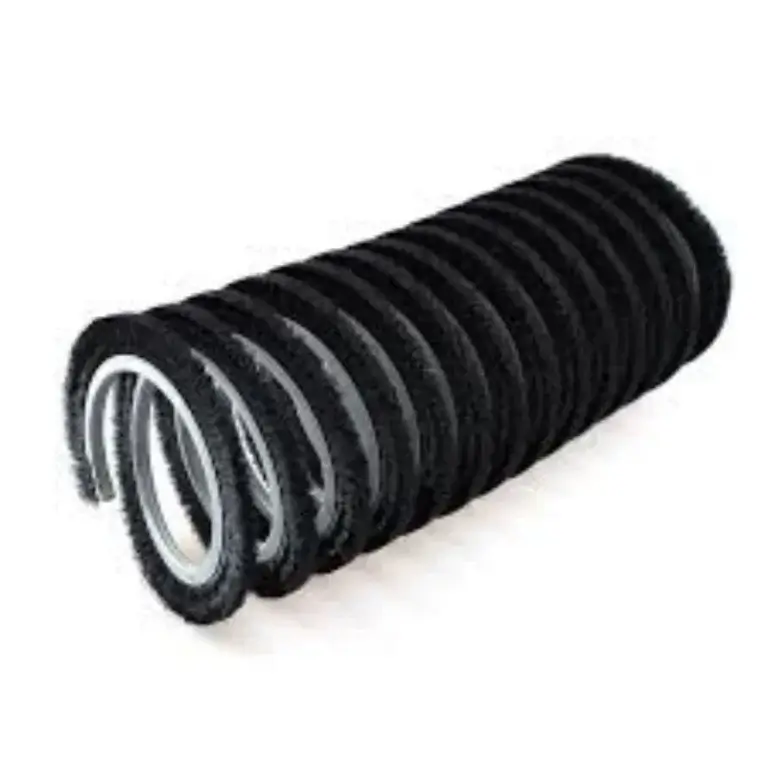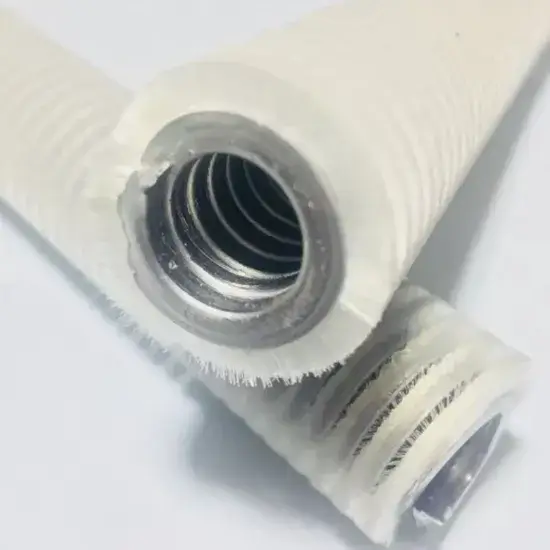
In pharmaceutical manufacturing, capsule polishing represents the final quality control checkpoint before products reach packaging and, ultimately, patients. After filling and sealing, capsules carry residual powder from the fill material, dust from the production environment, and in some cases, a fine electrostatic charge that makes particles cling stubbornly to capsule surfaces. The capsule polishing brush sits at the center of this process, mechanically dislodging contaminants while capsules tumble through a polishing chamber. What many production managers overlook is that a single specification of that brush determines whether the polishing stage adds value or creates new defects: bristle density.
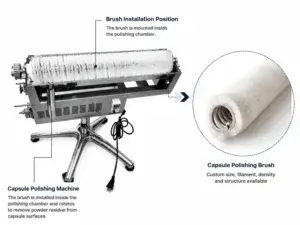
Bristle density, measured in filaments per square centimeter, controls how many individual nylon bristles contact each capsule during its transit through the polishing zone. This specification shapes cleaning effectiveness, capsule surface safety, brush lifespan, and ultimately, the rejection rate at downstream visual inspection. A brush with too few filaments leaves dust behind; a brush with too many filaments scratches capsules and wears out prematurely. Getting bristle density right means matching the brush to the capsule formulation, production speed, and cleanliness targets of a specific line. There is no universal correct number, but there is a correct number for each application.
Capsule polishing brush bristle density directly affects polish quality by determining the number of cleaning contacts per capsule transit, the force distribution across capsule surfaces, and the debris clearance pathway between filament bundles. A density of 75 to 90 filaments per square centimeter balances cleaning power and surface safety for most gelatin and HPMC capsule applications, while low-density brushes below 65 filaments per square centimeter suit softgel formulations and high-density brushes above 100 filaments per square centimeter target enteric-coated capsules with stubborn residues.
Production lines vary widely in capsule formulations, throughput speeds, and environmental conditions. A polishing station processing 120,000 hard gelatin capsules per hour in a dry, dust-prone facility faces fundamentally different demands than a line polishing 50,000 softgel capsules per hour in a humidity-controlled clean room. Bristle density must be treated as an active process parameter, adjusted and monitored like fill weight or sealing temperature, rather than a fixed specification ordered once and forgotten. The following sections examine how bristle density interacts with cleaning mechanics, surface safety, brush longevity, and selection methodology.
What Bristle Density Means in a Capsule Polishing Brush
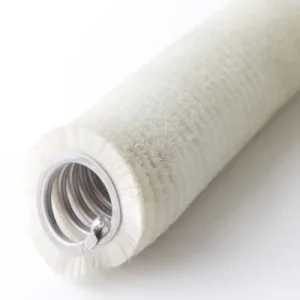
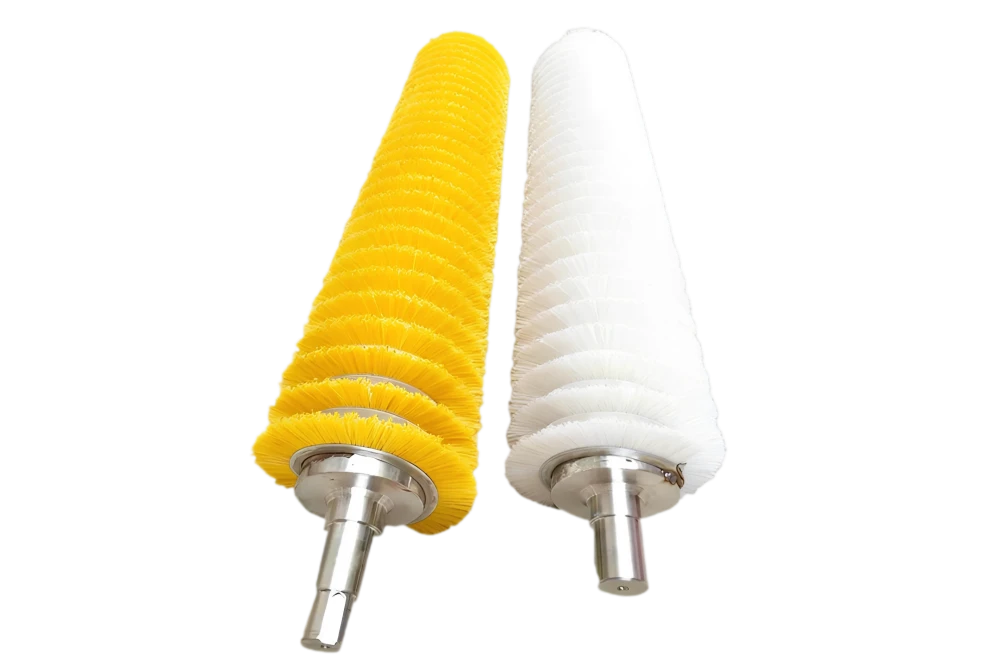
Bristle density in a capsule polishing brush refers to the number of individual nylon filaments packed into a square centimeter of the brush surface, a parameter controlled during manufacturing by the helical winding pitch of the filament coil and the filament diameter. Typical pharmaceutical polishing brushes range from 60 to 120 filaments per square centimeter, with each filament acting as an independent cleaning element that flexes to accommodate capsule geometry.
Bristle density is not the same as brush stiffness, though the two are related. A brush with fine 0.15 mm filaments packed at 100 filaments per square centimeter may feel softer to the touch than a brush with coarse 0.40 mm filaments at 70 filaments per square centimeter. The interaction between filament diameter and packing density determines how the brush transfers mechanical energy to the capsule surface. A nylon cylinder brush with a dense helical winding distributes cleaning force across many fine contact points, while a sparser winding with thicker filaments delivers concentrated force through fewer, stiffer contacts.
Manufacturing method also influences how bristle density behaves in operation. A wound cylinder brush uses a continuous wire core with filaments wound in a tight spiral pattern. The pitch of this spiral, measured in millimeters between successive filament wraps, sets the baseline bristle density before the brush is even installed. A pitch of 3 mm produces roughly twice the filament concentration of a 6 mm pitch for the same filament gauge. Brush suppliers typically express this as filament count per unit area rather than pitch alone, giving production teams a standardized metric for comparison.
A tufted cylinder brush, by contrast, arranges filament bundles in discrete tufts drilled into a solid core. Each tuft contains a cluster of filaments with a defined fill weight. The spacing between tufts and the fill weight per tuft together determine overall bristle density. Tufted brushes allow for localized density variation: the center section of a brush might carry higher tuft density for the primary polishing zone while the entry and exit sections use lighter tufting to reduce capsule impact at the transition points.
How Bristle Density Governs Dust Removal Efficiency
Bristle density controls dust removal efficiency through two competing mechanisms: contact frequency and debris clearance. Higher density increases the number of filament tips that sweep across each capsule surface, removing more particles per transit, but simultaneously narrows the gaps between filament bundles, restricting the airflow that carries dislodged dust away from the brush. The best bristle density and polishing performance balance these opposing effects for a given dust load and particle profile.
The Contact Frequency vs. Debris Clearance Trade-Off
When a capsule enters the polishing zone, it tumbles against the rotating brush. In a medium-density brush with 80 filaments per square centimeter, each square centimeter of capsule surface contacts roughly 8 to 12 filament tips during a single rotation, depending on filament trim length and brush diameter. Over a polishing chamber transit of three seconds at a line speed of 80,000 capsules per hour, a given capsule surface area may experience 40 to 60 individual filament sweeps. At high density, this number can reach 80 to 100 contacts per transit. For capsules carrying tenacious, statically charged dust, this additional contact frequency translates directly into higher cleanliness scores at the quality inspection station.
The trade-off occurs in dust evacuation. As filament packing tightens, the cross-sectional open area between filament bundles shrinks. A brush with 110 filaments per square centimeter may have less than 25 percent open area for airflow, compared to 40 to 50 percent at 70 filaments per square centimeter. The polishing machine vacuum system pulls dust-laden air through this open area. When the pathway is restricted, dislodged dust re-circulates within the brush rather than exiting the system. This recirculation can re-deposit particles onto capsules, offsetting the cleaning gains from higher contact frequency.
Why Particle Size Changes the Density Equation
Particle size plays into this trade-off. Fine powder particles below 10 microns, common in many oral solid dosage formulations, tend to embed within the filament matrix and resist vacuum extraction. Dense bristle packing traps these fines, requiring more frequent brush cleaning to prevent accumulation that eventually transfers residue back onto capsules. Coarser particles above 50 microns clear more easily through even restricted filament spacing, making high-density brushes a more viable choice for formulations that produce larger, less adherent dust particles.
The Role of Static Charge in Dust Removal
Static charge complicates the dust removal equation. Many fill powders develop a triboelectric charge during the encapsulation process, causing particles to adhere electrostatically to capsule surfaces with forces exceeding the mechanical dislodging capability of a single filament sweep. Static dust removal for capsules requires not just mechanical brushing but also conductive filament properties that dissipate charge. Anti-static nylon filaments, which incorporate conductive carbon or metallic compounds, allow accumulated charge to bleed away through the brush core to ground. When bristle density is high, more anti-static filaments contact each capsule, improving charge dissipation and reducing the mechanical work required for dust removal.
The interaction between bristle density, vacuum flow rate, and static dissipation determines whether a polishing station achieves 95 percent or 99.5 percent particle removal. For manufacturers pursuing zero-defect quality targets, this difference matters.
Bristle Density and Its Effect on Capsule Surface Quality
Excessive bristle density damages capsule surfaces by concentrating mechanical stress and trapping heat at the filament-capsule interface. Capsules processed with a brush density above 100 filaments per square centimeter show a measurable increase in surface micro-scratches, particularly on thin-shell gelatin capsules with plasticizer levels above 30 percent. The relationship between bristle density and surface quality follows a curve where cleaning improvement flattens above a threshold density while surface damage rises sharply.
Why Gelatin Capsules Are Most at Risk
Gelatin capsules present the greatest surface sensitivity challenge. The gelatin shell, typically 0.1 to 0.15 mm thick for size 0 capsules, relies on a plasticizer such as glycerin or sorbitol to maintain flexibility. At plasticizer levels above 30 percent, the shell becomes softer and more susceptible to mechanical marking. A filament tip from a dense brush, constrained by neighboring filaments and unable to deflect freely, strikes the capsule surface with nearly its full stiffness. Repeated impacts from thousands of such constrained filaments create a dulling or hazing effect on the capsule surface that optical inspection systems flag as a cosmetic defect.
HPMC Capsules: Higher Density Tolerance Without Quality Loss
HPMC capsules, with inherently higher mechanical strength and lower moisture sensitivity, tolerate higher bristle densities. Testing across multiple HPMC formulations shows that these capsules withstand brush densities up to 110 filaments per square centimeter without statistically significant increases in surface marking, provided filament diameter stays at or below 0.25 mm. This tolerance opens the door to using higher-density brushes for HPMC lines that need maximum throughput without sacrificing visual quality.
The Hidden Threat of Frictional Heat
Heat generation at the filament-capsule interface represents an underappreciated surface damage mechanism. Dense bristle packing generates more frictional heat because filaments rub against each other as well as against capsules. Nylon has a glass transition temperature between 50 and 80 degrees Celsius. When local interface temperatures approach this range, nylon filaments soften and lose their elastic recovery. Softened filaments deform against capsule surfaces rather than springing back, increasing contact area and dwell time. This creates a feedback loop where heat-induced softening leads to more friction, which generates more heat, ultimately producing visible surface burnishing on capsules.
Density Guidelines by Capsule Formulation
The surface quality impact of bristle density manifests differently across capsule formulations:
- Gelatin capsules with high plasticizer content: Density above 80 filaments per square centimeter increases surface hazing risk. Limit to 65-75 filaments per square centimeter.
- Standard gelatin capsules: Density up to 90 filaments per square centimeter is safe for most formulations. Test at pilot scale before full deployment.
- HPMC capsules: Density up to 110 filaments per square centimeter with fine filaments (0.25 mm or below) does not produce measurable surface quality degradation.
- Enteric-coated capsules: Coating layer absorbs contact stress. Density up to 120 filaments per square centimeter is acceptable, though coating thickness uniformity should be verified at the upper end.
Manufacturers who send capsules through downstream optical sorting should monitor rejection rates after any bristle density change. A sudden increase in surface-related rejects following a brush specification change points to density incompatibility and warrants a return to the previous specification or a reduction in filament diameter to soften individual contact points.
Selecting the Right Bristle Density for Your Production Environment
Bristle density selection starts with four inputs: capsule shell material and thickness, hourly production throughput, target cleanliness level measured by gravimetric dust weight reduction, and the particle size distribution of the fill powder residue. These four variables determine whether a line needs low-density gentle cleaning, medium-density balanced cleaning, or high-density aggressive cleaning. No supplier catalog page can answer this question; it must be answered through pilot testing with the actual capsules and powder from the production line.
Production throughput is the first variable to lock down because it sets the contact time constraint. A polishing chamber provides a fixed residence time for capsules, determined by chamber length divided by linear transport speed. At 60,000 capsules per hour, a typical polishing chamber gives each capsule three to four seconds of brush contact. At 120,000 capsules per hour, contact time drops to 1.5 to 2 seconds. To achieve the same number of filament sweeps per capsule at double the speed, the bristle density must increase proportionally. A line running at 120,000 capsules per hour needs roughly 30 to 40 percent higher bristle density than the same line running at 60,000 capsules per hour to maintain equivalent cleaning.
The table below maps typical production scenarios to bristle density starting points:
Glass fabrication plants produce enormous volumes of fine silica dust during cutting, scoring, and edge grinding. Each linear meter of processed glass sheds microscopic particles that settle on sheet surfaces, infiltrate machinery bearings, and hang suspended in factory air. If left unmanaged, this dust creates three problems at once: quality defects from particles trapped between stacked glass panels, accelerated equipment wear from abrasive contamination, and respiratory hazards for operators working near edging lines.
The dust particle size distribution after edge grinding skews heavily toward the sub-10-micron range. Particles this small adhere to glass surfaces through electrostatic attraction and van der Waals forces. They do not simply fall off when sheets are tilted or tapped. Removing them requires mechanical agitation at the glass surface combined with controlled airflow or fluid flushing. A blower alone redistributes dust without capturing it. A static scraper leaves behind the finest fraction and risks scratching the polished edge.
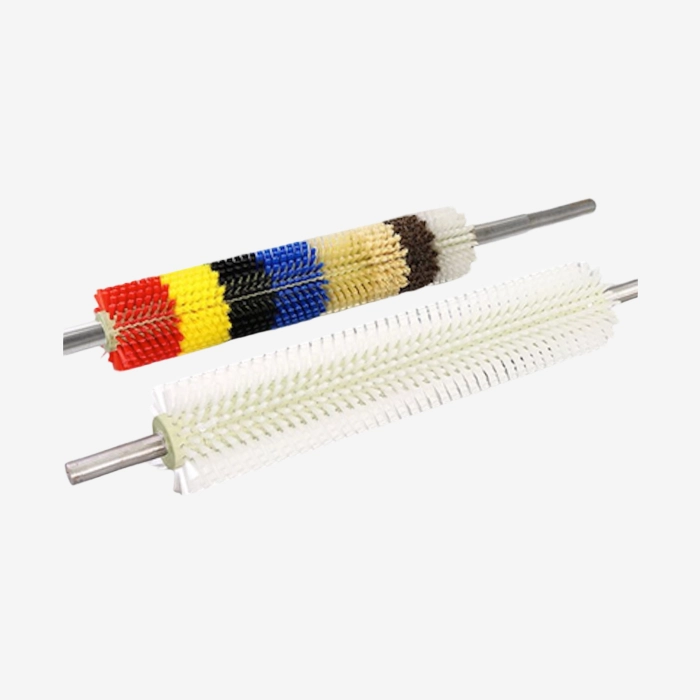
Industrial nylon roller brushes remove glass dust after cutting and edging by rotating thousands of independently flexible filaments against the glass surface at controlled contact pressure and surface speed. Each filament tip flicks adhered particles loose through mechanical scrubbing action while the brush rotation generates airflow that directs loosened dust toward extraction hoods or wash-down drainage. Nylon filaments do not scratch glass, absorb minimal water in wet processing environments, and recover their shape after millions of flex cycles, making them the default cleaning element in automated glass washing and dedusting machines.
The working principle sounds straightforward, but the engineering behind effective dust removal goes deeper than mounting a spinning brush above a conveyor. Filament material selection, brush diameter, rotational speed, contact depth, and bristle density all interact to determine whether a glass sheet emerges clean or carries a thin film of residue into the next processing stage. Understanding these parameters helps production engineers specify the right brush configuration for their line speed and glass type.
The dust problem also varies by glass product. Flat architectural glass generates relatively uniform particulate distribution across wide surfaces. Automotive glass with curved profiles and printed edges traps dust in contours that linear brushes miss. Thin display glass demands gentler brushing to avoid flexing the substrate. Each scenario calls for different brush characteristics, though the core mechanism remains the same: nylon filaments sweeping glass clean.
Why Is Glass Dust So Difficult to Remove After Edging
Small Size and Strong Adhesive Forces
Glass dust particles are small, electrostatically charged, and mechanically adherent. They range from sub-micron fines to coarse 50-micron chips, with the majority falling between 1 and 10 microns. At this scale, adhesive forces including van der Waals attraction and electrostatic bonding exceed gravitational pull, meaning dust stays on the surface unless an external force actively dislodges it.
The physics of particle adhesion on glass has been studied extensively in semiconductor wafer cleaning research, and the same principles apply to architectural and automotive glass processing. A 5-micron silica particle experiences van der Waals forces roughly 100 to 1,000 times stronger than its own weight. Tilting a glass panel at 90 degrees removes nothing from this size fraction. The particles remain attached until something mechanically disturbs the bond.
Angular Particle Shapes Increase Adhesion
Glass edging introduces an additional complication. The grinding wheel does not produce clean, uniform spheres. Edge grinding fractures glass along conchoidal patterns, generating angular, sharp-edged particles. These irregular shapes increase the contact area between particle and substrate compared to a perfect sphere, further strengthening the adhesive bond. Angular particles also interlock with each other on the glass surface, forming multi-layer dust deposits that a single pass of low-pressure air or a soft wiper cannot break apart.
Electrostatic Charge Keeps Dust Attached
Electrostatic charge builds during grinding as well. Glass is an electrical insulator with surface resistivity in the 10^12 to 10^15 ohm per square range. Friction during grinding generates triboelectric charge on both the glass surface and the dust particles. Opposing charges cause particles to cling. Even after the glass leaves the edging station, residual charge keeps dust attached for minutes to hours depending on ambient humidity. In dry factory conditions below 30% relative humidity, electrostatic adhesion dominates, and manual wipe-downs become the only fallback.
Health and Regulatory Pressures
The health dimension adds regulatory pressure. Respirable crystalline silica, classified as a Group 1 carcinogen by the International Agency for Research on Cancer, forms a significant fraction of glass edging dust when quartz-containing raw materials are processed. Regulatory limits in many jurisdictions cap respirable silica exposure at 0.05 mg per cubic meter averaged over an 8-hour shift. Effective dust capture at the point of generation, including brush-based removal systems integrated with local exhaust ventilation, is the engineering control that most standards specify.
What Makes Nylon the Right Filament Material for Glass Dust Removal
Key Properties of Nylon for Glass Processing
Nylon filaments combine scratch-free glass contact, high elastic recovery, low water absorption in PA612 grades, and chemical resistance to cleaning agents. These properties let a nylon roller brush maintain consistent contact pressure across its entire working width through millions of rotation cycles in both wet and dry glass processing environments.
PA66 vs. PA612: Understanding the Difference
Nylon is not one material but a family of polyamides with distinct properties tailored to different operating conditions. The two grades most commonly specified for glass industry brush rollers are PA66 and PA612. Understanding the difference matters because choosing the wrong grade for a wet glass washing line leads to premature filament softening, dimensional swelling, and lost cleaning performance.
PA66 offers high stiffness and excellent abrasion resistance at a moderate price point. Its tensile strength sits around 80 MPa dry, with flexural modulus near 2.8 GPa. These mechanical properties translate to bristles that hold their shape under sustained contact pressure and resist wear from continuous rubbing against glass edges. PA66 absorbs approximately 2.5% moisture at saturation in 50% relative humidity, which is acceptable for dry dedusting stations but becomes a problem in wet washing tunnels where filaments spend hours submerged or continuously wetted.
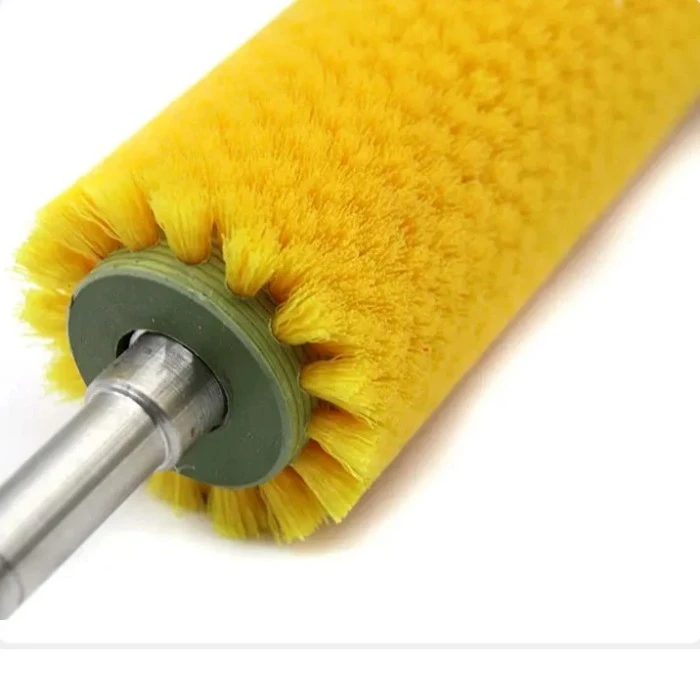
PA612 absorbs only 0.6% water at saturation. This low moisture uptake means a nylon cylinder brush built with PA612 filaments maintains its stiffness and diameter within tight tolerances even after months of continuous wet operation. The dimensional stability of PA612 prevents the softening that causes wet PA66 brushes to flatten against the glass surface and lose their flicking action. For glass washing machines where brush rollers sit partially submerged in water tanks or receive constant spray, PA612 is the standard recommendation.
Chemical Resistance of Nylon Grades
Both nylon grades resist the mildly alkaline detergents and rinse aids used in glass washing lines. Neither degrades significantly in pH ranges from 4 to 10, covering the full spectrum of industrial glass cleaning chemistry. This chemical inertness means a single brush set lasts through daily wash-down cycles without filament embrittlement or surface pitting.
Filament Diameter: Balancing Density and Scrubbing Force
Beyond material chemistry, nylon filament diameters for glass dust removal typically range from 0.08 mm to 0.30 mm. Finer filaments in the 0.08 to 0.15 mm range produce denser bristle packing and more contact points per square centimeter, which improves fine dust pickup but reduces the scrubbing force per filament tip. Thicker filaments above 0.20 mm deliver more mechanical energy to dislodge stubborn edge-grinding debris but leave larger gaps between bristles where the smallest particles can pass through. Many glass lines settle on 0.15 to 0.20 mm as a compromise that catches both fine dust and larger chips.
PA66 vs. PA612: Key Properties Comparison
The following table compares the key properties of PA66 and PA612 in the context of glass processing:
These are starting points, not final specifications. Each production line should validate cleaning effectiveness at three density levels bracketing the recommended range. A gravimetric measurement protocol provides quantitative data: weigh sample capsules before polishing, process them through the polishing station, weigh again, and calculate weight loss as a percentage. A target of 99 percent or higher weight reduction from polishing indicates effective density selection. If performance falls short at the recommended density, move up one tier and retest.
Filament material matters alongside density. Standard nylon 6/12 filaments with antistatic treatment improve dust removal in low-humidity environments where static charge is most problematic. For lines processing capsules with lipid-based fill formulations, abrasive nylon filaments impregnated with silicon carbide provide the mechanical action needed to cut through waxy residues without requiring extreme bristle density. The combination of material selection and density specification gives production teams two independent levers for tuning polishing performance.
Preserving Bristle Density Through Maintenance and Monitoring
Bristle density degrades predictably during normal brush operation. Filaments break at the root from cyclic fatigue, filaments take a permanent set that reduces their sweep angle, and trapped powder particles compact between filament bundles, reducing effective density by restricting filament movement. A brush that starts at 85 filaments per square centimeter may fall below 65 effective filaments per square centimeter within 300 operating hours if not maintained. Scheduled cleaning, humidity-controlled storage, and brush rotation preserve density and extend service life.
Compressed Air Cleaning: The First Line of Defense
Compressed air cleaning is the most impactful maintenance action for preserving bristle density. At the end of each production shift, a 15-second purge with filtered compressed air at 3 to 4 bar pressure blows trapped powder from between filament bundles. Powder that remains in the brush overnight can absorb moisture from ambient air, forming a hardened cake that locks filaments together. Once filaments are immobilized by compacted residue, they cannot flex independently during the next production run, reducing effective bristle density regardless of the physical filament count. For lines running three shifts, a mid-shift air purge adds valuable protection.
Humidity Control: Stabilizing Filament Properties
Humidity control matters for nylon filament properties. Nylon is hygroscopic. At relative humidity above 65 percent, nylon filaments absorb moisture and swell by 2 to 4 percent in diameter. Swollen filaments crowd each other, artificially increasing effective bristle density and stiffness beyond the designed specification. This humidity-induced stiffening increases surface stress on capsules and accelerates filament fatigue. At relative humidity below 30 percent, filaments dry out and become brittle. Brittle filaments fracture at the base under normal bending loads, causing permanent density loss. Storing spare brushes in sealed packaging with desiccant packs and maintaining polishing area humidity between 40 and 55 percent stabilizes filament properties.
Brush Rotation and Recovery Time
Brush rotation extends density preservation by giving filaments recovery time. Nylon exhibits viscoelastic creep: under sustained bending load, filaments gradually take a permanent set, reducing their spring-back angle against capsule surfaces. By alternating between two identical brush assemblies on a weekly rotation schedule, each brush receives seven days of recovery time. This rest period allows the nylon polymer chains to relax, partially recovering the original filament shape. Facilities using rotation report 20 to 30 percent longer brush service life compared to continuous single-brush operation.
Inspection Frequency and the Brush Log
Inspection frequency should match production criticality:
- Daily: Visual check for obvious filament loss, matting, or uneven wear. Run a hand over the brush surface to feel for stiff, immobilized sections.
- Weekly: Measure filament trim length at three points along the brush. A variation of more than 1 mm indicates uneven wear from shaft misalignment or bearing wear.
- Monthly: Count filaments in a defined sample area using a magnifier or microscope camera. Compare to the original specification. Replace the brush when filament count drops below 75 percent of original density.
A brush log tracking installation date, operating hours, capsule count processed, and gravimetric cleaning efficiency at each inspection point builds a data set that predicts replacement timing. Reactive replacement after quality rejects spikes costs more in rejected product and line downtime than scheduled replacement based on documented wear rates. A well-maintained medium-density brush in a properly calibrated polishing machine processes 350 to 450 hours before requiring replacement. High-density brushes wear faster, typically reaching end of life at 200 to 300 hours. Low-density brushes on softgel lines often exceed 500 hours.
Frequently Asked Questions
These three questions address common concerns that production engineers and procurement teams raise when specifying capsule polishing brush bristle density for pharmaceutical manufacturing lines.
Q1: How does filament diameter interact with bristle density to determine cleaning performance?
Filament diameter and bristle density are independent variables that multiply together to determine total cleaning aggressiveness. A brush with 0.15 mm filaments at 100 per square centimeter delivers very different performance from a brush with 0.40 mm filaments at 100 per square centimeter, even though the density number is identical. Thinner filaments at high density create a soft, high-contact-count cleaning surface suitable for delicate gelatin capsules. Thicker filaments at moderate density create a firm, lower-contact-count surface for heavy residue removal. The product of filament cross-sectional area and density approximates the total contact stiffness the brush applies to capsules.
Q2: What cleaning validation methods can production teams use to verify that their bristle density selection is correct?
Several methods exist beyond visual inspection. Gravimetric analysis weighs capsule samples before and after polishing to calculate percent dust removal. A target above 99 percent is typical for pharmaceutical applications. Swab testing of polished capsules with a clean white cloth identifies residual dust not visible to the naked eye. For quantitative surface cleanliness verification, some facilities use optical particle counters that scan capsule surfaces and count particles above a size threshold. A correctly specified bristle density should produce fewer than 10 particles above 50 microns per capsule surface. If particle counts exceed this threshold, consider increasing density or reducing filament diameter to add contact points without adding surface pressure.
Q3: Does bristle density affect the compatibility of a capsule polishing brush with automated washing systems?
Yes. High-density brushes resist penetration by cleaning solutions during automated wash cycles. Water jets and spray balls in clean-in-place systems cannot fully penetrate tightly packed filament bundles, leaving residual cleaning agent or powder residue trapped deep within the brush. This trapped material can leach out during subsequent production runs, creating cross-contamination risk between batches. Brushes destined for automated washing should be specified at the lower end of their effective density range, typically 70 to 85 filaments per square centimeter, to allow solution penetration. After washing, extended drying at 40 to 50 degrees Celsius in forced-air dryers removes moisture from the filament bundle interior before the brush returns to service.