
Pharmaceutical tablet manufacturing operates under some of the strictest quality control standards in any industry. After compression, tablets exit the press carrying a fine layer of uncompressed powder on their surface. This residual dust is not a cosmetic issue. It interferes with coating adhesion, skews weight checks during QC sampling, and generates airborne particles that can cross-contaminate other production areas. Tablet dedusting is therefore a mandatory step, not an optional one, in any solid-dose manufacturing line regulated by FDA 21 CFR Part 211 or EU GMP Annex 1.
The equipment used to remove this dust must strike a difficult balance. It needs to apply enough mechanical action to dislodge fine particles, yet remain gentle enough to avoid scuffing tablet coatings, eroding embossed logos, or chipping edges. At the same time, every component that contacts the product must resist chemical degradation from cleaning agents, withstand repeated sterilization cycles, and generate no particulate shedding of its own.
Nylon cylindrical brushes are the preferred tool for pharmaceutical tablet dedusting because their filament properties uniquely satisfy all three demands: effective dust removal, surface-safe contact, and full regulatory compliance. Among nylon grades, PA612 delivers the lowest moisture absorption, best filament recovery, and strongest resistance to cleaning chemicals, making it the material of choice in GMP-regulated production environments.
Selecting a dedusting brush for pharma use goes beyond picking a standard catalog item. Filament material, construction method, trim length, core type, and rotational speed all interact to determine cleaning efficacy and product safety. A brush that performs well on a dry food conveyor may shed filaments or deform within weeks when exposed to the alcohol-based sanitizers common in pharma cleanrooms. This article walks through the technical factors that matter when specifying a nylon cylinder brush for tablet dedusting, from material science to maintenance planning, so that production engineers and procurement teams can make decisions backed by data rather than guesswork.
What Is Tablet Dedusting and Why Does Brush Selection Matter
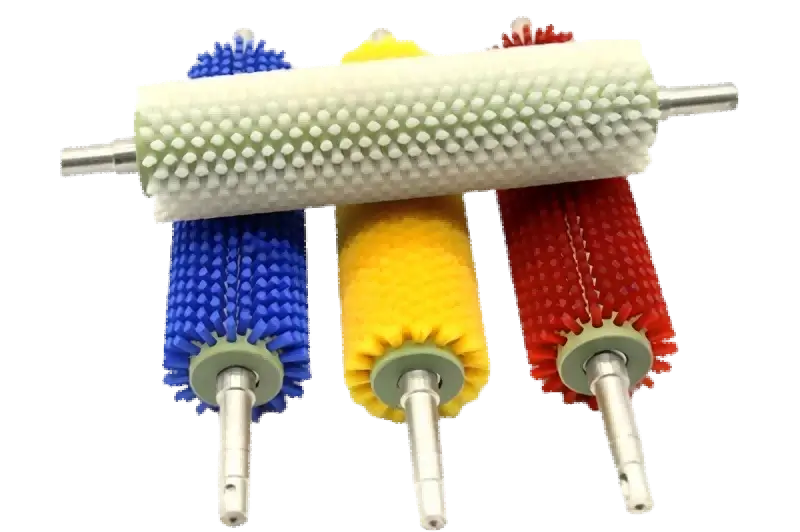
Tablet dedusting is the process of removing loose surface powder from freshly compressed tablets before they proceed to coating, metal detection, or packaging. The brush element inside a dedusting machine makes physical contact with each tablet, using controlled friction to lift off dust that is then evacuated by a vacuum system.
How Tablet Dedusting Works in a Continuous Production Line
In a typical tablet press line, tablets drop from the compression turret onto a vibrating or rotating channel that feeds them through a dedusting unit. Inside the unit, one or more rotating cylindrical brushes sweep against the passing tablets. The mechanical action of the bristle tips loosens adhered powder. A connected dust extraction system pulls the airborne particles away through HEPA filtration, leaving clean tablets to exit the unit. The entire process runs continuously at production speeds that can exceed 5,000 tablets per minute.
Why Brush Selection Is Critical to Product Quality
The brush is the only component that physically touches the product in this sequence. If the filament is too stiff, it scratches the tablet surface. If it is too soft, it fails to remove compacted dust from crevices around scored lines or embossed characters. If the filament material absorbs moisture from cleaning solutions, it swells, loses stiffness, and eventually sheds bristles into the product stream. Any one of these failures triggers a deviation report and, in the worst case, a batch rejection. Understanding how nylon cylinder brushes work and how their construction affects performance is the starting point for making a correct specification.
Three Root Causes of Dedusting Brush Failures in Pharma
Dedusting brush failures in pharma environments tend to trace back to three root causes: material-chemical incompatibility, incorrect filament diameter for the tablet hardness being processed, and core corrosion under repeated washdown. Addressing these in the specification phase eliminates the majority of field failures.
What Makes Nylon the Preferred Filament for Pharma Dedusting Brushes?
Nylon outperforms natural fibers, polypropylene, and abrasive-filled synthetics in pharmaceutical dedusting because it combines chemical inertness, predictable stiffness retention, and negligible moisture uptake with full FDA and EU food-contact compliance availability.
Why Natural Fibers and Polypropylene Fall Short in Pharma Environments
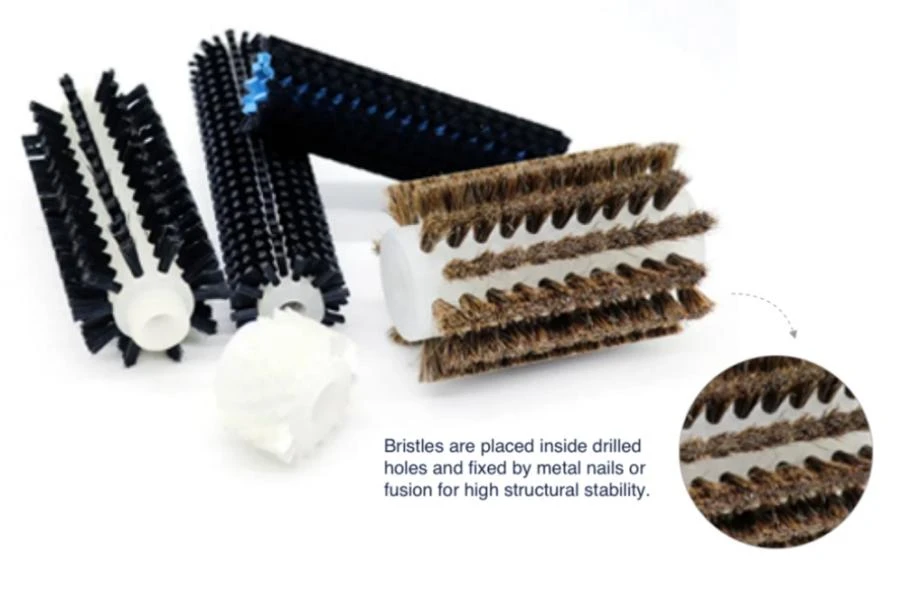
Natural fibers like horsehair or tampico were once common in industrial brushes, but they absorb moisture unpredictably, degrade under chemical cleaning, and shed organic debris. Polypropylene resists moisture but has poor stiffness retention. Its filaments permanently deform after sustained mechanical load, creating dead spots on the brush face that leave dust behind. Abrasive nylon filaments contain embedded grit particles that can erode tablet coatings, making them unsuitable for any application where surface integrity matters.
Nylon Grades Compared: Why PA612 Leads in Pharmaceutical Dedusting
Nylon, by contrast, is a synthetic polyamide whose mechanical properties can be engineered by selecting the right grade. The table below compares the nylon filament grades most relevant to pharmaceutical dedusting:
How PA612 Delivers Consistent Performance Across Production Shifts
The numbers explain the preference for PA612. A filament that absorbs only 0.6% moisture does not swell after CIP (clean-in-place) cycles. Its stiffness stays within specification across shifts, ensuring consistent dust removal from the first tablet to the last. For production engineers, this consistency means fewer parameter adjustments and less unplanned downtime.
How Do Brush Construction Methods Affect Dedusting Reliability
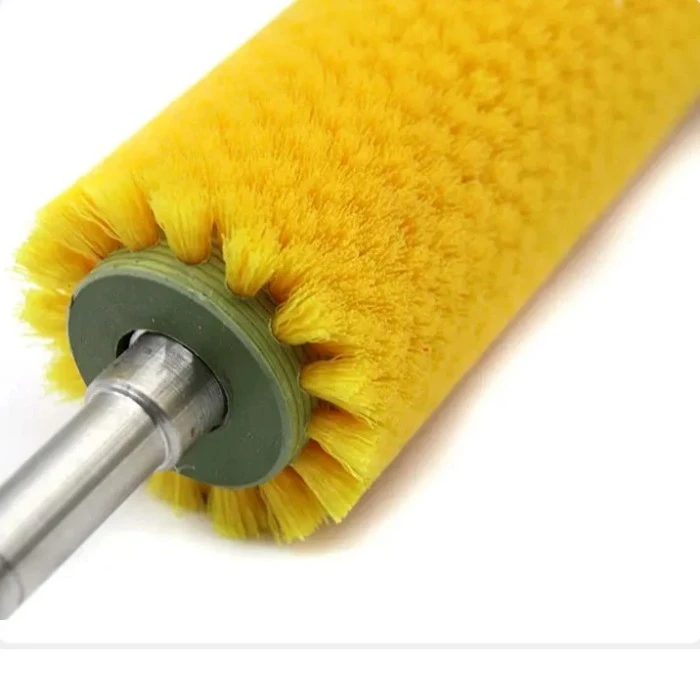
The construction method determines how securely filaments are anchored to the brush core. Staple-set (tufted) construction provides the highest filament retention in pharma dedusting applications because each tuft is mechanically locked by a stainless steel staple rather than bonded with adhesive that can degrade under chemical exposure.
Staple-Set vs Wound Construction: Two Approaches Compared
Two construction types dominate pharmaceutical brush manufacturing. In staple-set (also called tufted) construction, individual tufts of filament are inserted into pre-drilled holes in the core and secured by metal staples driven across the base of each tuft. This creates a positive mechanical lock. In wound construction, a continuous filament is fed into a spiral channel machined around the core and held in place by friction and a retaining wire.
Why Staple-Set Construction Prevails in Pharma Environments
The difference matters in pharma settings. Staple-set brushes, such as those produced as a tufted cylinder brush, resist filament pullout under chemical exposure because the staple does not degrade when exposed to ethanol, isopropyl alcohol, or hydrogen peroxide-based sanitizers. Wound brushes rely partly on filament tension for retention. Over repeated washdown cycles, differential thermal expansion between the filament and the core can loosen that tension, gradually increasing the risk of filament loss.
The Contamination Risk That Justifies the Premium for Staple-Set Design
The risk is not theoretical. A loose filament that ends up in a tablet batch creates a contamination event. In GMP environments, every contamination incident requires a root cause investigation, potentially halting production for hours or days. The modest premium for staple-set construction is therefore a form of insurance against a far more expensive failure mode. When specifying custom nylon cylinder brushes for pharma lines, requesting staple-set construction and 316L stainless steel staples should be the default specification.
What Specifications Control Dedusting Performance
The three parameters that most directly control how a nylon cylindrical brush performs in tablet dedusting are filament diameter, trim length, and rotational surface speed. Getting any one of them wrong leads to either inadequate dust removal or tablet surface damage.
Filament diameter is the primary driver of stiffness. The table below maps filament diameter ranges to their typical dedusting roles:
Trim length, the exposed filament length from the core surface to the bristle tip, controls the contact pressure distribution. Short trim (under 20 mm) concentrates force at the tips, producing aggressive scrubbing suitable for dislodging compacted dust from scored tablet surfaces. Long trim (over 30 mm) allows filaments to flex, creating a softer wiping action that suits coated tablets. Most pharma dedusting applications use trim lengths between 18 and 28 mm, with the exact value tuned to the tablet shape and hardness.
Rotational surface speed, measured in surface feet per minute (SFPM) or meters per second, is calculated from the brush outer diameter and the shaft RPM. A typical dedusting brush runs at 200 to 600 RPM with an outer diameter of 100 to 150 mm, producing surface speeds between 1.0 and 4.7 m/s. Running below this range leaves dust on the tablets. Running above it generates frictional heat that can soften tablet coatings and accelerate filament wear. The correct speed is always a function of both the brush specification and the tablet characteristics, not a fixed number that transfers from one product to another.
Why Is PA612 the Material of Choice for Direct-Contact Pharma Brushes
PA612 nylon has become the default filament specification for pharmaceutical tablet dedusting brushes because its combination of 0.6% moisture absorption, high flexural recovery, and resistance to common cleanroom sanitizers eliminates the failure modes that affect other nylon grades.
The technical advantage of PA612 over PA6 and PA66 is measurable. In a wet pharma environment where brushes undergo daily alcohol-based sanitization, PA6 filaments can absorb enough moisture within a single shift to lose 15 to 20 percent of their original stiffness. Operators compensate by lowering the brush position, which increases contact pressure and accelerates wear. Within weeks, the brush profile develops uneven wear, creating gaps where dust passes through untreated.
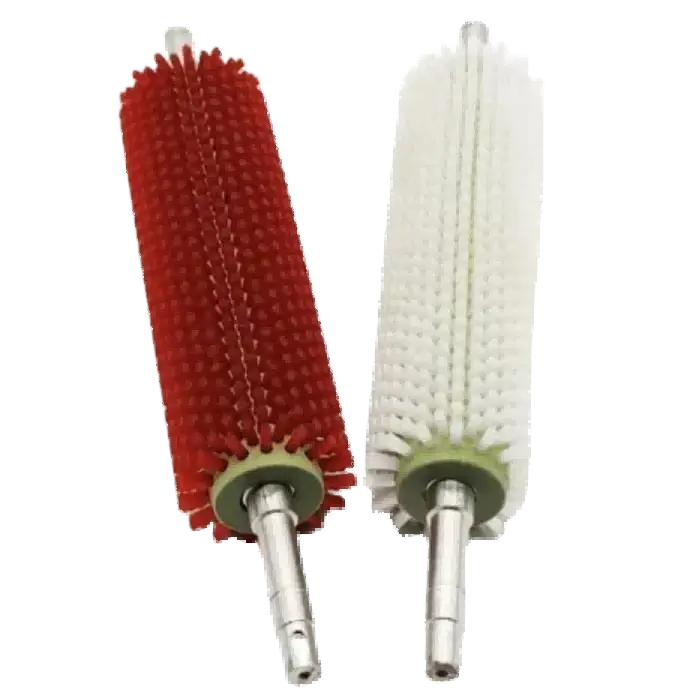
A PA612 nylon roller brush sidesteps this entire cycle. Moisture absorption at 0.6 percent means stiffness stays within a narrow band throughout the shift and across the service life of the brush. Flexural recovery – the ability of a bent filament to spring back to its original position – is the highest among standard nylon grades. This matters because filaments in a rotating dedusting brush cycle through compression and release thousands of times per minute. Low recovery leads to permanent bristle set, where filaments stay bent after the load is removed, creating dead zones on the brush face.
Chemical resistance data further supports the PA612 choice. The table below summarizes compatibility with common pharma cleaning agents:
The data shows why production lines that have switched from PA6 to PA612 dedusting brushes report longer service intervals and fewer cleaning-related deviations. The material simply handles the chemical environment of a pharma cleanroom with less degradation.
How Should Pharma Dedusting Brushes Be Maintained and Validated
Pharmaceutical dedusting brushes require documented maintenance schedules tied to measurable wear thresholds. Replacing a brush when filament length has decreased by 10 to 15 percent, rather than waiting for visible performance degradation, prevents quality deviations and keeps the process in a validated state.
Pharma maintenance is fundamentally different from industrial maintenance. In a general industrial setting, a brush is replaced when it stops working. In a GMP environment, the brush must be replaced before its performance drifts outside the validated operating window. This requires establishing objective wear limits and documenting every inspection.
A practical monitoring protocol includes three elements. First, measure the brush outer diameter at three points along its length (left, center, right) at a fixed interval, typically weekly or biweekly, using calibrated calipers. Record the data. Second, inspect filaments under magnification for tip splitting, which indicates fatigue and precedes shedding. Third, correlate wear data with product quality metrics such as visual inspection reject rates and coating thickness variability. When either the diameter has decreased by more than 15 percent from the as-new measurement, or tip splitting is observed on more than 5 percent of filaments in the tablet contact zone, the brush is due for replacement.
Proper nylon cylinder brush selection for replacement cycles should also account for the lead time on custom-manufactured units. Keeping one spare brush on hand per dedusting station eliminates the risk of a production stoppage while waiting for a replacement to ship.
What Is the Total Cost of Ownership for Pharma Dedusting Brushes
The purchase price of a nylon dedusting brush represents a small fraction of its total cost of ownership. The dominant cost drivers are production downtime during unscheduled brush replacements, batch rejection due to contamination events, and the engineering time spent on deviation investigations.
Consider a production line running 5,000 tablets per minute across two eight-hour shifts. If a low-cost brush made from PA6 filament loses effective stiffness halfway through its expected service life and requires an unplanned changeover, the downtime alone – assuming a one-hour stop for cleaning, brush swap, and line restart – costs roughly 300,000 tablets in lost output. The cost of the replacement brush is negligible compared to that loss.
The table below compares estimated annual costs for three dedusting brush strategies on a single medium-speed tablet line: