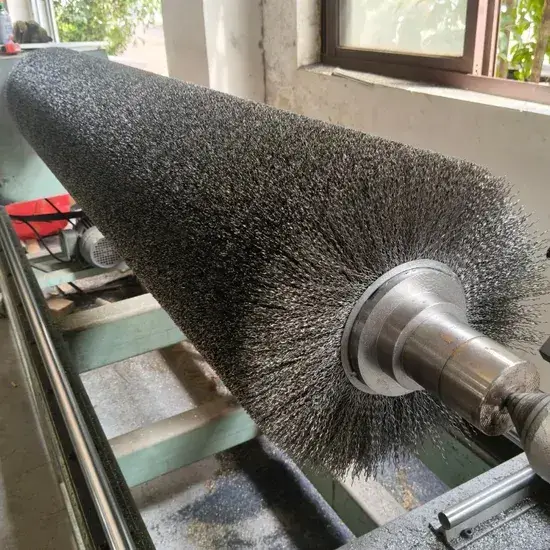
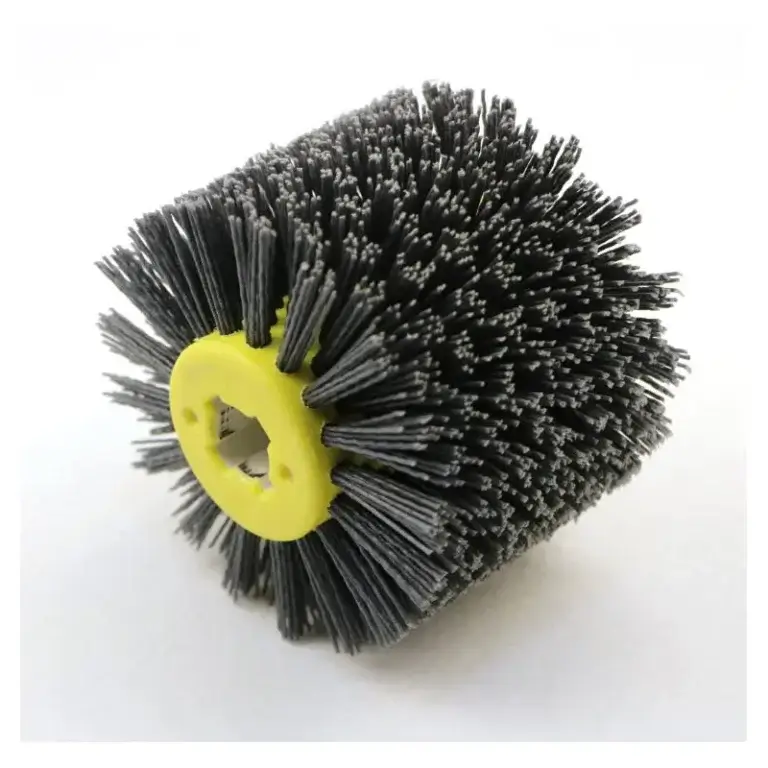
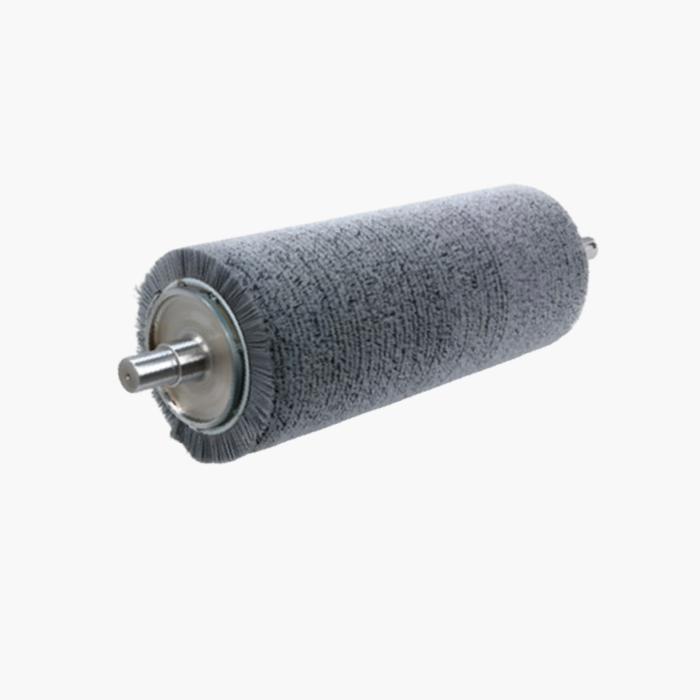
Metal surface treatment sits between fabrication and whatever comes next, whether welding, coating, or assembly. Each later step depends on the state of the surface. A coating needs a rough, clean substrate, a weld needs metal free of oil and oxide, and a finished part needs safe edges.
A cylinder wire brush handles descaling, rust and coating removal, weld preparation and cleaning, deburring, edge blending and surface roughening. It suits any job where the work passes the brush rather than the reverse, because a rotating cylinder keeps thousands of wire tips in contact across the full width at once.
Which tasks a given brush can take on depends on the wire, the mounting, and the drive.
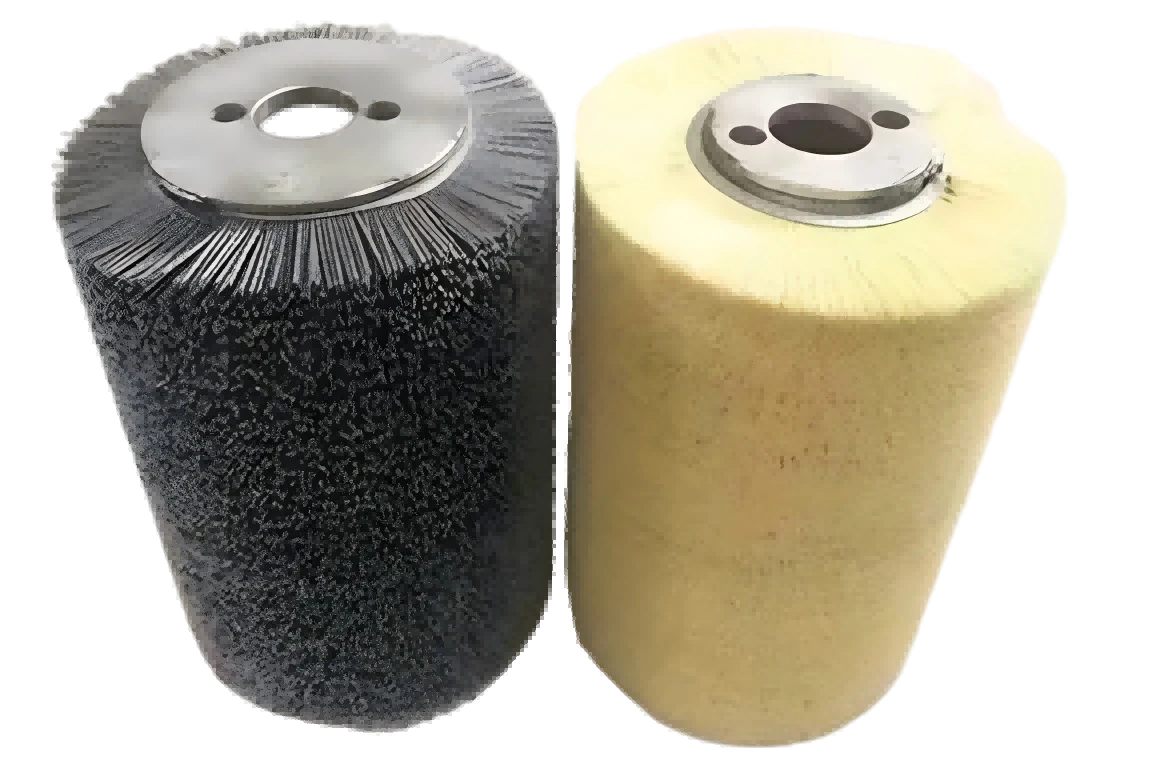
What a Cylinder Wire Brush Does in Metal Surface Treatment
The brush removes material by impact rather than by cutting. Each wire tip strikes the surface, breaks the bond holding scale, rust, or coating, and throws the debris clear, so the same tool strips oxide without gouging the metal underneath.
That impact action defines both the reach and the limit of a cylinder wire brush. It works on brittle contamination that fractures under repeated strikes and follows surfaces a rigid tool cannot, such as a weld toe or a rolled profile.
Descaling, Rust Removal and Coating Stripping
Hot rolled steel leaves the mill under a layer of mill scale that is brittle and tightly bonded. A descaling brush running against the direction of travel breaks that layer away in a pass, and the same action lifts loose rust and flaking paint. Wire brushing is a recognised preparation method with defined cleanliness grades that a coating specification can call out.
Weld Preparation and Post-Weld Cleaning
Before welding, the joint faces and a band of 25 to 50 mm either side must be free of oil, oxide and moisture, which would otherwise become porosity. After welding, the same brush removes slag, spatter and heat tint, and a narrow face width lets the operator work the weld toe without polishing the surrounding plate.
Deburring, Edge Blending and Surface Roughening
Sheared and punched edges carry fine burrs and a work-hardened lip. Brushing rounds those edges enough to make handling safe without removing the dimensional edge the part needs, and it avoids the dishing a grinding wheel leaves on thin sheet. The same pass produces the directional pattern of a satin finish.
| Task | What the brush removes | Typical configuration |
| Descaling and rust removal | Mill scale, loose rust, flaking paint | Knotted or coarse crimped, 0.3 to 0.5 mm |
| Weld preparation and cleaning | Oil, oxide, slag, spatter, heat tint | Narrow face, crimped or knot |
| Deburring and edge blending | Fine burrs, sharp edges, work-hardened lip | Crimped, 0.2 to 0.3 mm |
| Surface roughening | Gloss on a smooth surface | Crimped, medium wire, light contact |
Matching Wire Material, Knot Style and Diameter to the Job
Match the wire material to the workpiece first, then the construction, then the diameter. Carbon steel for ferrous work, stainless steel wherever a ferrous brush would contaminate the surface, brass where sparks are unwelcome, and the finest wire that will still do the job.
Values outside these ranges usually mean the application deserves a trial rather than a catalogue selection.
| Parameter | What it controls | Typical starting range |
| Wire material | Contamination risk, corrosion resistance, hardness | Carbon steel for steel, stainless for stainless, and aluminium |
| Knot style | Flexibility against impact | Crimped for light to medium, knotted for heavy scale |
| Wire diameter | Cutting aggression against fatigue life | 0.2 to 0.5 mm |
| Trim and density | Conformity against contact pressure and life | Short and dense for production work |
| Face width | Coverage per pass and weld access | Narrow for welds, wide for strip |
| Brush diameter | Tip speed and reach | Matched to the machine |
| Speed | Tip velocity and impact energy | Set against the marked maximum |
Wire Material and Cross-Contamination
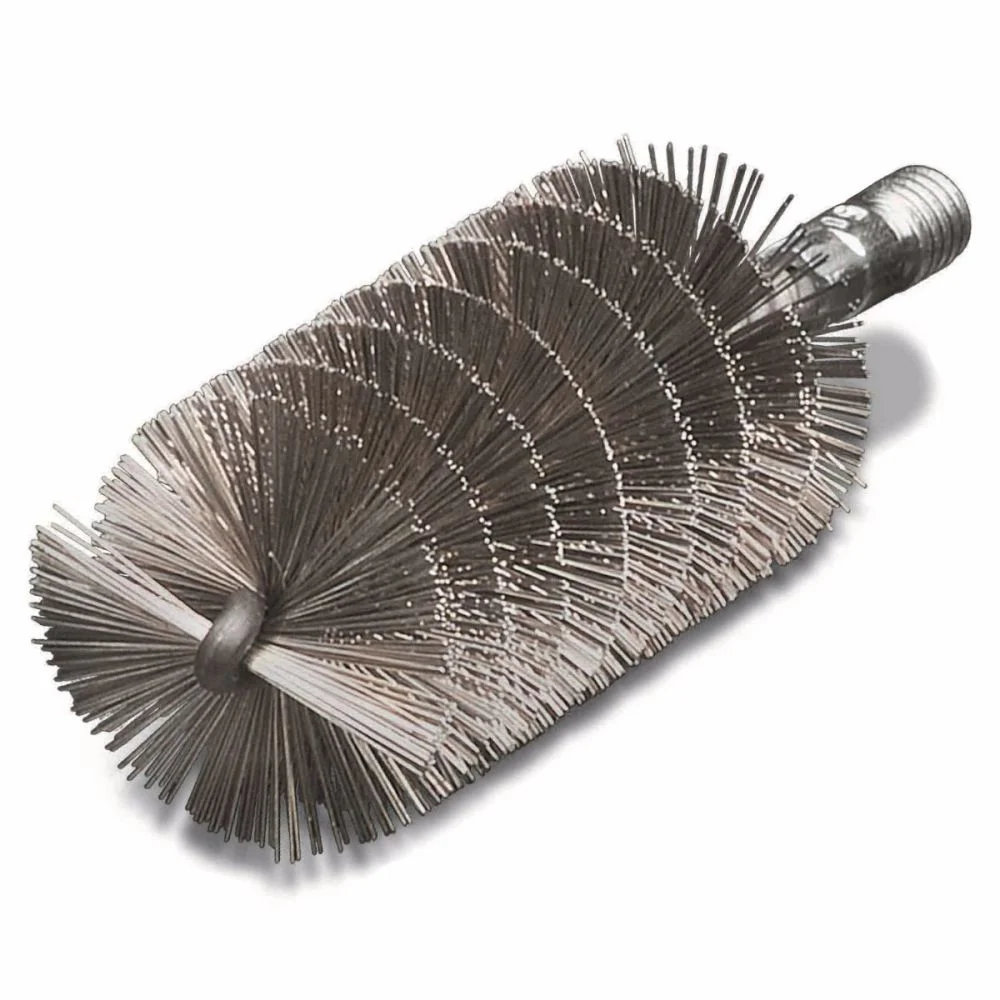
Carbon steel is the economical default for ordinary steel, cast iron, and heavy scale. It is wrong for stainless and aluminium, because carbon steel bristles shed particles that embed in the surface and then rust, so a plain steel wire coil brush can leave a workpiece speckled brown within days and ruin the corrosion resistance it was specified for. A stainless steel wire coil brush is the correct choice there instead.
Crimped Versus Knotted Construction
Construction decides how the wire meets the surface. Crimped filaments are waved along their length, so they flex on contact and spread the load across the tip. A crimped wire brush suits light to medium work and irregular profiles, and its wire reaches into recesses instead of riding over them. Knotted wire is twisted into tight bundles that behave like small hammers, so a knotted wire brush breaks heavy scale and weld slag far faster, at the cost of a rougher finish.
Wire Diameter, Trim Length and Fill Density
Diameter sets the trade-off between aggression and life. A 0.3 mm wire flexes and resists fatigue, making it the general-purpose choice for cleaning and deburring. A 0.5 mm wire cuts harder and lasts longer on heavy scale but breaks sooner when over-flexed. Short trim with high fill density gives a firmer face and longer life at the cost of conformity.
Where Cylinder Geometry Beats a Wheel or Cup Brush
A cylinder brush wins wherever the workpiece moves past the tool rather than the tool across the workpiece. Continuous strip, coil, tube and conveyorised parts present a surface to a rotating cylinder that stays in contact across its full width, which a cup or wheel brush reaches only in overlapping passes.
The cylinder cleaning brush form also survives conditions hand-held brushes do not, since it can be enclosed under a hood and driven at a fixed speed for long runs.
Continuous Strip, Coil and Conveyorised Lines
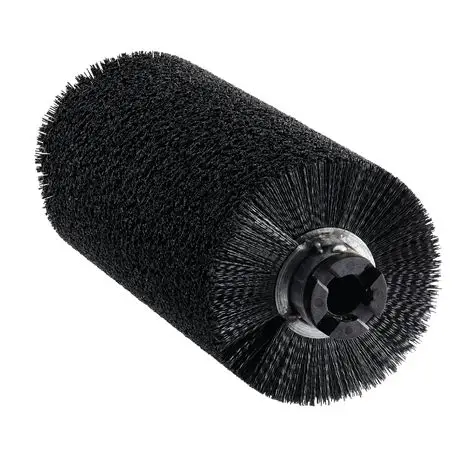
In strip and coil processing, pairs of wire brush roller assemblies run above and below the moving strip, rotating against the direction of travel to break the oxide layer off both faces at once. The removed scale is flushed away by a closed circulation cooling water system. Because the work is continuous, brush condition is tracked against throughput rather than calendar time.
Tubes, Bores and Recessed Surfaces
A long, small-diameter cylinder reaches inside tube and bore walls that a wheel cannot enter, and it works from a driven shaft rather than a hand-held tool, which makes internal cleaning repeatable. For blind holes and fillets, a small end brush is still better, because the cylinder needs clearance at both ends of its travel.
Setting Speed, Contact and Direction on the Machine
Set the drive and balance first, then the speed, then the contact. A cylinder brush has to match the machine envelope, be dynamically balanced above roughly 500 rpm, and run at a light contact that lets the tips cut rather than at heavy pressure.
Most complaints about a brush that cleans unevenly, wears early, or throws wire trace back to these settings.

Drive, Mounting and Dynamic Balance
A cylinder brush can be welded or clipped to a shaft, supplied on a throwaway core, or built on a heavier refillable core. The refillable option costs more at the start and less over the machine’s life, because the shaft and journals are reused. Above roughly 500 rpm, balancing becomes a requirement, since an unbalanced roller transfers vibration into the bearings and the finish.
Speed, Contact Pressure and Feed Direction
Speed and diameter together set tip velocity, which is what does the work, so a large roller reaches a given tip speed at a lower shaft speed than a small one. Contact should stay light, because pressing harder folds the filaments over, reduces the cutting action, adds heat, and shortens brush life, and it is the main cause of filament breakage. Where the machine allows, run the brush against the feed direction so the relative speed at the contact point is the sum of the two, and rotate it so debris is thrown away from the operator.
Safety, Wear and Maintenance in Production
The governing safety rule for any power-driven wire brush is that the machine’s no-load speed must never exceed the brush’s marked maximum safe free speed. Beyond that, keep guards in place, wear eye and face protection, and inspect the brush before every shift.
Wire filaments break in normal service and leave the brush with enough force to travel a long way, which is why the marking is a limit rather than a suggestion.
Maximum Safe Free Speed and Guarding
Maximum safe free speed is the highest speed at which a brush may be run with no load, and it is marked on the brush or its packaging. The requirement that machine speed never exceed it is written into ANSI B165.1, the safety standard for power-driven brushing tools. If the tool’s no-load speed is higher, the brush does not go on that tool, and eye protection alone is not enough for anyone standing in line with a running brush.
Reading Wear and Deciding When to Replace
Wear shows up first as a shorter wire length, then as rounded tips that polish rather than cut, then as a face packed with the material it should be removing. Track it against operating hours or throughput, since a brush that looks intact can be past its cutting life. A refillable core reuses the shaft and journals, which usually makes refilling cheaper than a new roller.
Symptom, Cause and Correction
| Symptom | Likely cause | Correction |
| Surface still carries scale or rust | Wire worn below working length, or contact too light | Replace the brush, then increase contact before speed |
| Base metal scored or dished | Wire too coarse for the workpiece | Move to a finer wire or a crimped construction |
Filaments breaking or wire thrown. Pressure too high, speed above the rating, wire fatigued. Reduce pressure, verify the rating, replace the brush. Heat discolouration on thin sheet. Excess contact pressure or the wrong wire material. Lighten contact and use brass or coated wire. Vibration that grows during a shift. Loss of balance from uneven wear or a loose brush. Rebalance and re-tighten, then check shaft and bearings. Brush face packed with material. Soft coating or oil loading, or rotation direction wrong. Clean the face, reverse rotation, remove coating in stages.
FAQ
Q1: Can a wire brush damage the base metal?
Yes, if the wire is too coarse or the pressure too high. Wire brushing removes contamination by impact, so a coarse or knotted brush on a soft or thin workpiece will peen the surface, round sharp edges, and can score aluminium. Use the finest wire that does the job and let the tips cut.
Q2: How long does a cylinder wire brush last, and can it be refilled?
Life depends on wire grade, contact pressure, and the abrasiveness of the work, so it is tracked in operating hours or tonnes rather than weeks. Many cylindrical brushes run on a refillable core, where the shaft and journals are reused and only the wire section is replaced.
Q3: Can wire brushing replace abrasive blasting before painting?
No. Power tool cleaning with a wire brush reaches roughly the St 3 grade, which leaves no defined surface profile, while near-white metal blast cleaning leaves a measurable anchor profile that a high-build coating needs to key into. Brushing suits weld preparation and spot repair, but a specification calling for blast cleanliness needs blasting or an equivalent method.