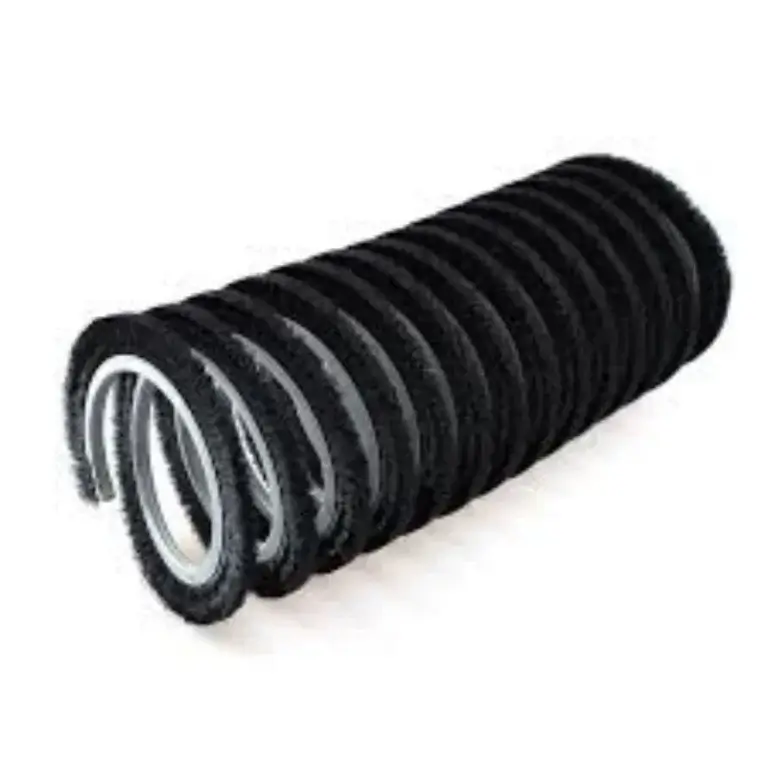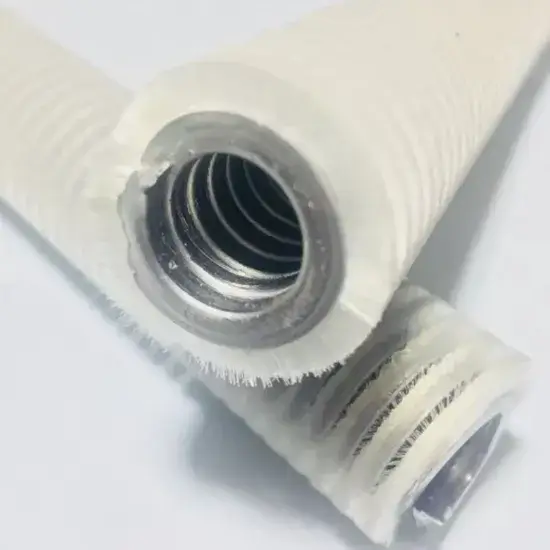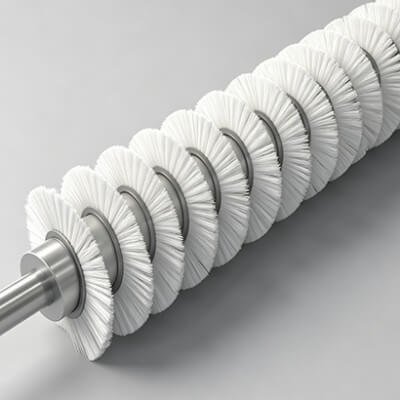
In pharmaceutical and nutraceutical manufacturing, achieving a flawless capsule finish is not merely a cosmetic goal. It directly impacts product perception, packaging efficiency, and downstream manufacturing consistency. Among the many variables influencing capsule surface quality, bristle density stands as one of the most critical yet often overlooked parameters in the design and selection of a capsule polishing brush. Operators and procurement teams frequently focus on bristle material or brush dimensions, while the density of bristles packed into the brush core determines how evenly force is distributed across each capsule shell passing through the polishing station.
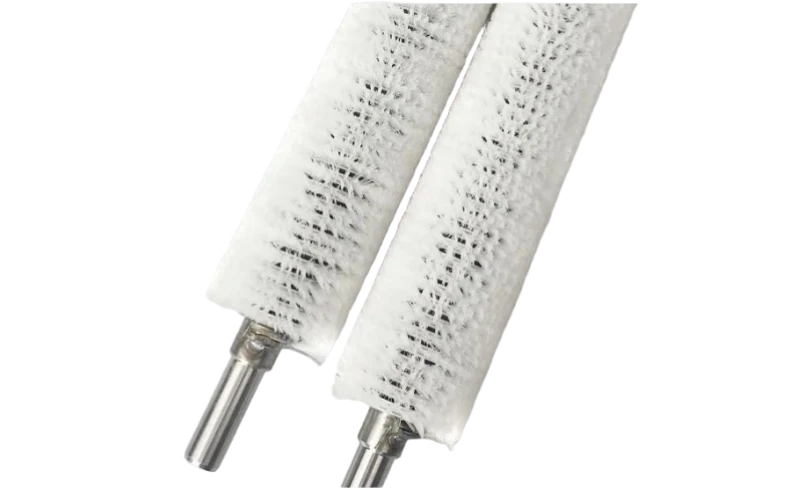
Bristle density is the single most decisive factor in determining how effectively a capsule polishing brush removes surface dust, powder residue, and static-attached debris without damaging the capsule shell. Higher bristle density delivers more contact points per capsule, increasing cleaning power, while lower density allows flexible adaptation to irregular capsule geometries. The optimal density depends on capsule shell hardness, production speed, and the specific type of coil brush used in the polishing machine.
Understanding this relationship becomes essential when sourcing replacement brushes or designing a new polishing line. Whether you are specifying a nylon coil brush for cleaning applications, evaluating a nylon outside coil brush for your tumble polisher, or selecting an inside coil brush for cleaning the interior surfaces of your capsule polishing equipment, bristle density must be matched to your specific production requirements. This article provides a technical framework for evaluating bristle density and its downstream effects on cleaning performance, brush longevity, and overall equipment effectiveness.
Understanding Bristle Density in Capsule Polishing Brushes
What Bristle Density Means in Capsule Polishing Brushes
Bristle density refers to the number of individual filament strands packed per unit area along the brush surface, typically measured in filaments per square centimeter or tufts per linear inch. In a capsule polishing brush, this density determines the contact surface area available for mechanical interaction with each capsule during the polishing cycle.
How Nylon Coil Brushes Are Constructed and Why Density Matters
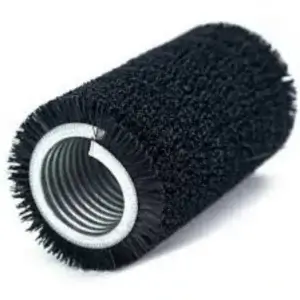
A capsule polishing brush is typically constructed by winding nylon filaments around a central wire core in a helix pattern. The pitch of this helix and the thickness of each filament bundle collectively define the bristle density. A nylon coil brush for cleaning applications in capsule polishers uses food-grade or pharmaceutical-grade nylon filaments, typically PA6, PA66, or PA612, each offering distinct mechanical properties. The choice of bristle density directly affects how the brush interacts with the capsule surface at both macroscopic and microscopic levels.
Macroscopic and Microscopic Effects of Bristle Density
At a macroscopic level, higher bristle density means more filaments pressing against each capsule as it tumbles through the polishing chamber. This creates more friction and generates greater shear force against surface contaminants. At a microscopic level, individual filaments behave like flexible cantilevers. Dense packing reduces the free space between adjacent filaments, increasing the stiffness of the overall brush surface without necessarily increasing the stiffness of each filament. This phenomenon, known as collective stiffening, allows a nylon outside coil brush to apply uniform pressure across capsules of varying sizes without requiring brittle or overly rigid filaments.
Typical Bristle Density Ranges for Standard Production Lines
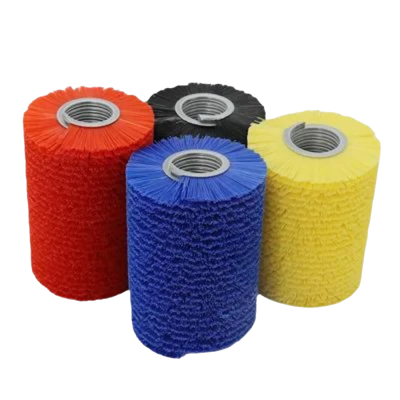
Manufacturers specify bristle density alongside other parameters such as filament diameter, brush outer diameter, and overall length. A standard capsule polishing brush used in medium-speed production lines typically ranges from 60 to 120 filaments per square centimeter of brush surface, though specialty applications may require densities outside this range. Understanding this baseline helps operators make informed comparisons when evaluating replacement brushes from different suppliers.
How Bristle Density Affects Cleaning Efficiency
The Bell-Shaped Relationship Between Density and Cleaning Performance
Cleaning efficiency improves proportionally with bristle density up to an inflection point, after which excessive density begins to trap debris rather than eject it, reducing net cleaning performance. The optimal density window depends on capsule shell composition, production throughput, and the physical properties of the dust and powder residues being removed.
How Brush Rotation and Filament Contact Remove Surface Dust
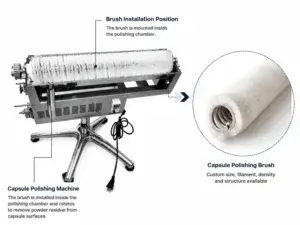
In a typical capsule polishing operation, the brush rotates at speeds between 200 and 600 RPM. Capsules enter the polishing chamber and are agitated by the rotating brush surface. Bristles contact the capsule shell, dislodging surface dust through mechanical impact and shear. An inside coil brush for cleaning applications, which rotates around the capsule stream, relies on filament density to create sufficient contact pressure without crushing or scratching the capsule shell.
Optimal Density Range for Gelatine and HPMC Capsules
The relationship between bristle density and cleaning efficiency follows a bell-shaped curve. At low density levels (below 40 filaments per square centimeter), individual bristles are spaced too far apart. Capsules pass through gaps without sufficient contact, leaving significant residual dust. As density rises, more filaments engage with each capsule surface, improving dust removal. The sweet spot for most gelatine and HPMC capsule formulations falls between 80 and 100 filaments per square centimeter, where cleaning efficiency typically reaches 95 percent or higher.
Why Excessive Density Traps Debris and Generates Heat
Beyond this optimal range, diminishing returns set in. At very high densities (above 130 filaments per square centimeter), bristles become so tightly packed that they cannot flex independently. The brush surface behaves more like a solid wall than a flexible cleaning tool. Dust particles dislodged from capsules become trapped between filaments rather than being thrown clear by centrifugal force. This recontamination effect offsets the gains from increased contact area. Additionally, densely packed bristles generate more heat through friction, which may soften gelatine capsule shells and create surface tackiness.
Particle Size, Static Charge, and Production Speed Considerations
Particle size and adhesive properties also interact with bristle density. Fine dust particles below 10 microns are more easily trapped in high-density brushes, while larger particles above 50 microns are effectively ejected regardless of density. When cleaning capsules carrying electrostatic charges, moderate bristle density combined with conductive or anti-static filament materials delivers superior results compared to density alone.
Production speed introduces another variable. At higher throughput rates (above 100,000 capsules per hour), capsules spend less time in the polishing chamber. Higher bristle density compensates for shorter residence time by increasing cleaning intensity per revolution. Manufacturers running high-speed lines typically select brushes at the upper end of the optimal density range, while slower lines can achieve acceptable results with lower density brushes that generate less friction and heat.
Comparing Performance: Low-Density vs. High-Density Brushes
How Low-Density and High-Density Brushes Differ in Performance Priorities
Low-density brushes (under 60 filaments per square centimeter) prioritize gentleness and flexibility over cleaning power, while high-density brushes (over 100 filaments per square centimeter) maximize cleaning intensity at the cost of increased friction, heat generation, and potential capsule surface marking. The choice between them must be guided by capsule shell characteristics and production priorities.
Side-by-Side Performance Comparison Across Key Parameters
Understanding these trade-offs requires a side-by-side comparison across multiple performance dimensions.
Low-Density Brushes for Soft Gelatine and Thin-Shell Capsules
A nylon outside coil brush with low bristle density works well for polishing soft gelatine capsules or capsules with thin shells that are prone to surface scuffing. The wide spacing between bristle bundles allows each filament to deflect more freely, reducing point pressure on the capsule surface. However, this configuration requires longer polishing cycles or multiple passes to achieve acceptable cleanliness levels.
Medium-Density Brushes for General-Purpose Capsule Polishing
Medium-density brushes represent the most common specification for general-purpose capsule polishing. A nylon coil brush for cleaning set to 75 to 90 filaments per square centimeter balances cleaning power and capsule safety across most production scenarios. This density range accommodates variations in capsule hardness, batch-to-batch inconsistencies, and fluctuations in line speed without requiring constant parameter adjustment.
High-Density Brushes for Enteric-Coated and High-Cleanliness Applications
High-density brushes are reserved for applications requiring exceptional clean-room standards or processing capsules with tough enteric coatings that resist standard cleaning. In these cases, the aggressive cleaning action of an inside coil brush for cleaning with high filament density ensures that even stubborn coating residues are removed before packaging. Operators must monitor
capsule appearance closely, as high density can produce visible surface marking on softer capsule formulations.
The Impact of Bristle Density on Brush Lifespan and Wear
How Higher Bristle Density Accelerates Brush Wear
Higher bristle density accelerates wear on both the filaments and the capsule polishing brush core, reducing service life by 30 to 50 percent compared to medium-density equivalents under identical operating conditions. The primary wear mechanisms are filament fatigue, core deformation, and heat-induced crystallinity changes in the nylon material.
Filament Fatigue and Micro-Cracks at the Bristle Root
When a capsule polishing brush operates at high bristle density, each filament experiences greater lateral force from adjacent filaments. This confinement restricts the natural bending motion of the nylon bristles, concentrating stress at the filament base near the wire core. Over time, this concentrated stress causes micro-cracks in the nylon, particularly in PA6 and PA66 materials, which are susceptible to fatigue under cyclic loading. Filaments begin to break off at the root, reducing effective bristle density and degrading cleaning performance.
Heat Buildup and Permanent Deformation of Nylon Filaments
Heat buildup accelerates this process. As previously noted, high-density brushes generate more frictional heat. Nylon filaments have a glass transition temperature between 50 and 80 degrees Celsius, depending on the specific polymer grade. Continuous operation above this temperature range causes the filaments to soften, lose their elastic recovery, and permanently deform. A brush that initially had 110 filaments per square centimeter may degrade to an effective density of 70 filaments per square centimeter within 200 hours of continuous use, at which point replacement becomes necessary.
Wire Core Deformation and Uneven Bristle Distribution
The wire core of a nylon coil brush for cleaning applications also suffers under high-density configurations. The increased torsional load from densely packed filaments can cause the central wire to stretch or kink over time, particularly in brushes with a smaller core diameter. A deformed core creates uneven bristle distribution around the brush circumference, leading to inconsistent polishing results and premature capsule rejection.
Additional Wear from Restricted Airflow and Trapped Abrasive Particles
An inside coil brush for cleaning applications used in machines with aggressive dust extraction systems faces additional wear. High bristle density restricts airflow through the brush, reducing the system’s ability to carry away dislodged dust. Abrasive particles become trapped between filaments and accelerate filament wear through micro-abrasion. This mechanism is especially pronounced when processing capsules that generate significant amounts of fine powder from fill material leakage.
Replacement Intervals by Density Level
Operators should track brush replacement intervals and correlate them with bristle density specifications. A well-maintained medium-density brush in a properly calibrated machine typically delivers 350 to 450 hours of effective service before cleaning performance drops below acceptable thresholds. High-density brushes may require replacement after 200 to 300 hours, while low-density brushes can often run 500 hours or more when processing soft capsules that generate minimal dust.
Selecting the Optimal Bristle Density for Your Capsule Polishing Application
Four Variables That Determine Optimal Bristle Density
The optimal bristle density for a capsule polishing brush is determined by four variables: capsule shell hardness, production throughput, acceptable capsule surface quality, and the physical characteristics of the dust and powder residues encountered in your specific manufacturing environment. No single density value works across all applications.
Matching Density to Capsule Shell Hardness
Begin by evaluating the capsule shell. Gelatine capsules, especially those with plasticizer levels above 30 percent, are more susceptible to surface damage from aggressive brushing. A lower bristle density, between 60 and 75 filaments per square centimeter, is recommended for these formulations. HPMC capsules, which have higher mechanical strength and lower moisture sensitivity, can tolerate medium- to high-density brushes in the 80 to 110 filaments per square centimeter range. Enteric-coated capsules typically require the highest density brushes, as the coating is designed to resist chemical dissolution and similarly resists mechanical cleaning.
Adjusting Density for Production Throughput
Production throughput sets the second constraint. For lines running below 60,000 capsules per hour, a nylon outside coil brush with moderate density provides sufficient cleaning contact time. As throughput rises toward 120,000 capsules per hour or more, bristle density must increase to compensate for reduced residence time. At these speeds, a nylon coil brush for cleaning should be specified at 90 to 110 filaments per square centimeter to maintain consistent output quality.
Balancing Surface Quality Requirements and Cleanliness
Surface quality requirements also guide density selection. If your downstream packaging line includes optical inspection systems that detect micro-scratches, or if your capsules are destined for high-visibility consumer packaging, use a brush density no higher than 80 filaments per square centimeter. This limits the probability of visible surface marking while still achieving acceptable cleanliness. For bulk pharmaceutical packaging where visual appearance is less critical, higher-density brushes can be used to maximize throughput.
Accounting for Dust Load and Particle Profile
The fourth variable is the dust load and particle profile. Manufacturing environments with high airborne dust levels or capsules prone to powder leakage benefit from medium-density brushes paired with high-efficiency dust extraction. In these scenarios, an inside coil brush for cleaning applications with anti-static nylon filaments reduces electrostatic attraction between capsules and bristles, further improving cleaning results without requiring maximum density.
Specifying and Testing Replacement Brushes
When specifying replacement brushes, request from your supplier the exact bristle density expressed in filaments per square centimeter, not just generic descriptors such as soft, medium, or hard. Test the selected brush on a pilot scale before deploying across the full production line. Measure cleaning efficiency using a standardized gravimetric method, weighing capsule samples before and after polishing to quantify actual dust removal.
Best Practices for Maintaining Bristle Density Over Time
Three Core Maintenance Practices That Preserve Bristle Density
Proper maintenance extends the effective service life of any capsule polishing brush by preserving bristle density and filament elasticity. The three most impactful practices are routine debris removal, controlled storage humidity, and scheduled rotation between paired brush sets.
Routine Compressed Air Cleaning to Remove Trapped Dust
Compressed air cleaning at regular intervals removes trapped dust from between bristle bundles. For a nylon coil brush for cleaning operating on a daily production schedule, a 15-second purge with filtered compressed air at 3 to 4 bar pressure at the end of each shift prevents particle accumulation from compacting bristles and reducing effective density. For brushes operating in high-dust environments, additional cleaning midway through the shift is recommended.
Humidity Control for Nylon Filament Stability
Humidity control directly affects nylon filament properties. Nylon absorbs moisture from the air, and changes in moisture content alter filament stiffness and diameter. At relative humidity above 65 percent, nylon filaments can swell by 2 to 4 percent, crowding adjacent filaments and effectively increasing bristle density beyond its designed specification. This artificial density increase reduces filament flexibility and raises surface stress on capsules. Conversely, humidity below 30 percent dries the filaments, making them brittle and prone to fracture. Store replacement brushes in sealed packaging at 40 to 55 percent relative humidity.
Rotating Paired Brush Sets to Extend Lifespan
Rotation between paired brush sets allows each brush to rest and recover between use cycles. Nylon filaments exhibit viscoelastic creep under sustained load. Continuous rotation causes the filaments to take a set, reducing their ability to spring back against capsule surfaces. By alternating between two identical nylon outside coil brush assemblies on a weekly basis, each brush receives recovery time that preserves bristle density and extends overall lifespan by 20 to 30 percent.
Weekly Inspection for Uneven Wear and Mechanical Issues
Inspect brushes weekly for signs of uneven wear. An inside coil brush for cleaning that shows patchy filament loss on one side indicates a misaligned brush shaft or worn bearings. Address these mechanical issues promptly, as continued operation with a damaged brush causes the remaining intact bristles to carry a disproportionate load, accelerating further density loss.
Replacement Thresholds and Data-Driven Scheduling
Replace brushes when bristle density drops below 75 percent of the original specification. At this point, cleaning efficiency typically falls below 80 percent, and continued use wastes energy and risks capsule quality variability. Maintain a log of replacement dates, operating hours, and measured cleaning efficiency to build a data-driven replacement schedule tailored to your specific production conditions.
Properly specified and maintained, the capsule polishing brush remains one of the most cost-effective quality assurance components in your production line. Understanding and controlling bristle density transforms it from a passive consumable part into an active parameter that can be optimized for cleanliness, yield, and operational efficiency. Whether you are sourcing a nylon coil brush for cleaning standard capsules or specifying a specialized inside coil brush for cleaning coated capsule products, make bristle density the first specification you evaluate.
FAQ
Q1: How do I know when to replace my capsule polishing brush?
Watch for powder residue on capsules, bristle flattening or breakage, abnormal vibration or noise, and recommended hours (350–450 for medium density). Keep a replacement log and use data, not feel.
Q 2: Can I use one brush for different capsule types and sizes?
Not recommended. Soft gelatine needs low-density soft brushes; enteric-coated capsules need high-density brushes. Mixing can scratch soft capsules or under-clean hard ones. Use multiple density sets or a compatible medium-density spec, and re-validate after switching.
Q 3: What cleaning agents can I use with a nylon capsule polishing brush?
Use filtered compressed air for routine dry cleaning. For wet cleaning, use neutral cleaners or manufacturer-recommended solutions, then dry thoroughly. Avoid strong acids, bases, chlorine solvents, alcohol, and acetone unless the supplier confirms compatibility.
Q 4: Does heat affect bristle density during operation?
Yes. Nylon softens and deforms above its 50–80°C glass transition temperature, reducing effective density. Friction, machine heat, ambient temperature, and continuous runtime all compound the effect. Monitor temperature, avoid overload, and shorten replacement cycles in hot environments.
Q 5: How should I store spare brushes?
Store sealed at 40%–55% relative humidity, away from sunlight and heat. High humidity swells filaments; low humidity makes them brittle. Avoid pressure or bending. Let brushes acclimate before use if taken from storage.