
Nylon Tufted Cylinder Brush: The Complete Guide to Conveyor Belt Cleaning
Conveyor systems move millions of tons of material every day across mining sites, textile mills, food processing plants, and packaging facilities. A single underperforming belt can generate hundreds of kilograms of spillage per shift. The cost adds up fast: extra cleanup labor, premature roller failure, belt mistracking, and product contamination. Production managers know this cycle well because they live with it.
The problem usually traces back to carryback, the layer of material that sticks to the belt surface after the discharge point and falls off along the return run. Primary scrapers handle the bulk of it. But fine dust, sticky residue, and embedded particles slip past even the best scraper blades. A nylon tufted cylinder brush mounted after the primary cleaner catches what the scraper misses and keeps the return side of the belt clean.
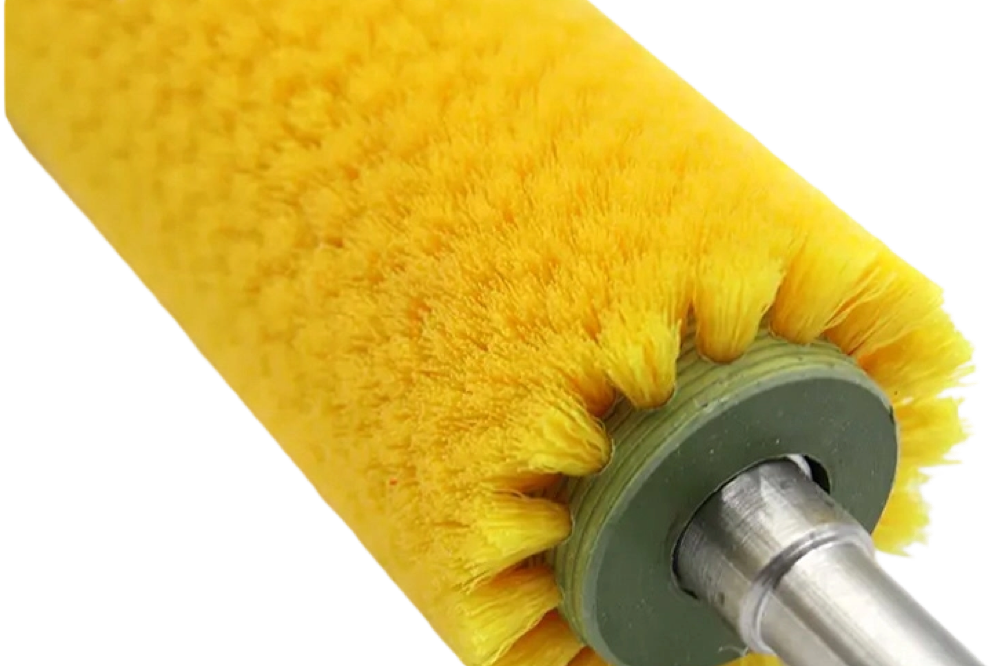
A nylon tufted cylinder brush is a rotating industrial brush with densely packed nylon filaments arranged around a central core. Mounted under the return run of a conveyor belt, it spins against the belt direction at controlled speeds to dislodge fine particles and sticky residue that primary scrapers leave behind. The tufted construction, where filaments are packed into drilled holes rather than wound in a spiral, provides a dense cleaning face with consistent contact pressure across the full belt width.
The tufted design matters more than most operators realize. Spiral-wound brushes work fine for light dusting, but they leave thin uncleaned gaps between the wire channels. Tufted construction packs filaments into a continuous face with no gaps, so every millimeter of belt surface gets direct contact. For applications where even a thin film of residue causes problems, like food processing or textile finishing, that gap-free coverage makes a measurable difference in product quality.
This article covers how nylon tufted cylinder brushes work, where they fit in industrial production lines, what nylon brings to the table compared to other filament materials, and how to specify a brush that cleans effectively without eating through belts or bearings. If carryback has been a recurring headache on your lines, the following sections address the questions that maintenance teams ask most often.
What Is a Nylon Tufted Cylinder Brush
A nylon tufted cylinder brush is a cylindrical industrial cleaning tool built by inserting dense clusters of nylon filaments into a rigid core, usually steel or aluminum, and driven by an electric motor to rotate against a conveyor belt surface. The tufting process locks each filament bundle into a drilled hole, creating a brush face that is denser and more durable than wound or strip-brush alternatives.
The construction starts with a hollow or solid core turned to the required diameter. Holes are drilled into the core in a predetermined pattern. Each hole receives a bundle of nylon filaments, typically held in place by a metal staple or anchor at the base of the hole. The filament bundles protrude outward from the core surface, forming a brush face that can range from 50 mm to over 300 mm in outer diameter depending on the belt width and cleaning load.
Three things make tufted construction the right choice for conveyor cleaning. First, filament density: a tufted brush packs 30 to 60 filament bundles per square inch of core surface, versus 15 to 25 for a spiral-wound brush of the same diameter. Second, replacement: when a tufted brush wears down, the core can be re-tufted with fresh filaments, cutting long-term cost by roughly 40% compared to buying a new brush each time. Third, uniform pressure: because tufted filaments stand perpendicular to the core surface instead of leaning in a spiral, contact pressure across the belt face stays even without low-pressure dead zones.
Conveyor belt cleaning brushes using tufted nylon construction appear most often on belts between 500 mm and 2,400 mm wide handling dry to slightly moist materials. The brush mounts on adjustable brackets under the return run, usually 300 to 500 mm behind the head pulley, and spins at 200 to 400 RPM with a tip speed of 3 to 5 meters per second. A 1.1 to 3 kW motor drives the brush through a gearbox or belt drive, depending on belt width and filament density.
How Does a Cylindrical Conveyor Brush Improve Belt Cleaning
A cylindrical conveyor brush improves belt cleaning by adding a rotating mechanical action that primary scrapers cannot provide. While a scraper blade drags across the belt surface in a fixed position, a rotating brush sweeps across each point on the belt multiple times per second, dislodging particles from surface irregularities, mechanical splices, and worn belt grooves that a static blade simply skips over.
The cleaning mechanism combines three physical effects. First, the filament tips strike the belt surface at an angle opposite to belt travel, mechanically breaking the adhesion between carryback particles and the belt. Second, the centrifugal force from the brush rotation flings dislodged particles away from the brush and belt, preventing re-entrainment. Third, the sweeping action of the filament tips reaches into belt imperfections that scrapers bridge over, including fastener recesses, splice gaps, and wear grooves.
Laboratory wear measurements on aggregate conveyor systems show that a dual-stage setup combining a primary polyurethane scraper with a secondary cylindrical conveyor brush reduces residual carryback by 70 to 85% compared to a scraper alone. The brush handles the fraction that matters most: the fine dust that works its way into roller bearings and the sticky film that builds up on return idlers. These are the particles that cause the expensive problems, even though they make up a small share of total carryback mass.
Speed matching is the most overlooked variable. A brush that spins at the wrong RPM relative to belt speed either undercleans or overcleans. Under a belt moving at 2.5 meters per second, a brush running at 400 RPM with a 200 mm diameter produces a tip speed of roughly 4.2 meters per second. The 1.7 m/s differential between brush tip speed and belt speed provides enough relative motion to clean without excessive filament wear. Running the brush faster increases cleaning but shortens filament life; running slower extends filament life but leaves residue behind. The sweet spot sits between a 1.5 and 2.5 m/s differential for most dry bulk applications.
Key Applications Across Industries
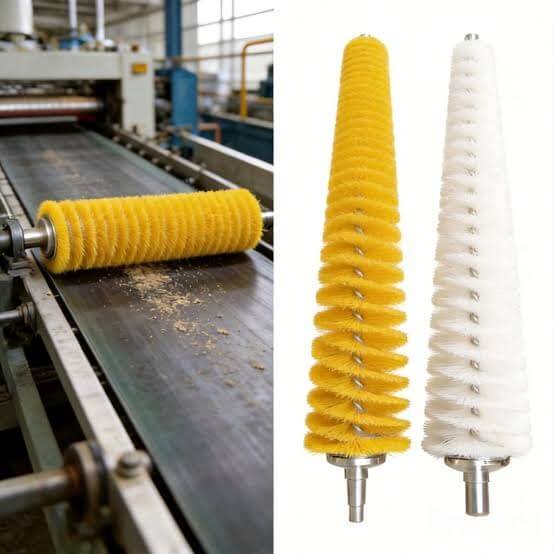
Nylon tufted cylinder brushes appear in nearly every industry that runs conveyor belts, but they are especially common in textile processing, food production, aggregate handling, and packaging lines, where carryback directly threatens product quality or equipment reliability.
Textile Processing
In textile mills, conveyor belts carry raw fibers, yarns, and finished fabrics through multiple processing stages. Lint, dust, and loose fibers accumulate on belt surfaces continuously. A textile processing brush keeps these belts clean enough to prevent fiber contamination between batches. Nylon filaments are preferred here because they resist abrasion without scratching or snagging the belt surface, which matters when processing delicate natural fibers like cotton and wool. Mills running synthetic fibers at high speed report that a tufted nylon brush mounted after the carding stage cuts belt-related fiber contamination by over 60%.
Aggregate and Mining
Stone, sand, and ore handling expose conveyor brushes to conditions that destroy generic cleaning tools in weeks. Sharp particles embed in soft filaments, water and mud accelerate corrosion, and belt speeds above 3 meters per second test every component on the brush assembly. Nylon stands up to these conditions better than most polymers. Its moisture absorption sits at roughly 4.5% at saturation, which is higher than polypropylene but still low enough to avoid swelling and dimensional change that would throw off brush-to-belt contact. Abrasive-grade nylon filaments containing silicon carbide or aluminum oxide additives extend brush life on aggregate belts by 30 to 50% compared to standard nylon.
Food Processing
Food-grade nylon tufted brushes clean conveyor belts carrying everything from raw produce to baked goods. The requirements are stricter here: filaments must meet FDA compliance for food contact, the core and bearings must withstand frequent washdowns, and filament retention must be secure enough that no loose bristles end up in the product. Nylon filaments in white or blue color coding help with visual inspection for contamination. A food plant running a 24-hour snack production line might replace tufted brush filaments every 800 to 1,200 operating hours, depending on belt speed and product abrasiveness.
Packaging and Logistics
Distribution centers and packaging lines run hundreds of conveyors handling cardboard boxes, plastic totes, and shrink-wrapped pallets. Dust from cardboard and plastic film clings to belt surfaces and transfers to packages. A small-diameter tufted cylinder brush mounted under return rollers keeps belts clean enough to prevent dust transfer without slowing line speed. These brushes run at the low end of the power scale, often 0.75 to 1.1 kW, and filament life exceeds 3,000 hours because the abrasion from cardboard dust is negligible compared to mineral dust.
Polypropylene wins on moisture resistance and initial cost. In a wet environment where the brush sits in constant contact with water, polypropylene will not swell or soften appreciably. But on a dry aggregate belt running at 2.5 meters per second, polypropylene filaments wear down roughly twice as fast as nylon because the softer polymer cannot withstand the same level of abrasive friction without rapid material loss.
Polyester offers higher temperature tolerance and better chemical resistance than nylon in some environments, but it is stiffer. With a flexural modulus nearly 25% higher than nylon, polyester filaments deflect less under load, which sounds like an advantage but translates to harsher contact with the belt surface. This stiffness can accelerate belt cover wear on older or thinner belts. For most general-purpose conveyor cleaning, nylon hits the practical middle ground between cleaning effectiveness and belt preservation.
Filament diameter also changes behavior. A 0.6 mm nylon filament on a standard rubber belt provides a good balance of cleaning aggression and belt life. Moving to 0.8 mm or 1.0 mm diameter increases cleaning force for sticky or compacted materials but draws more motor current and increases belt surface wear. The general rule: start with 0.6 mm and increase diameter only if cleaning performance is inadequate at the baseline specification.
Sizing and Customization Considerations
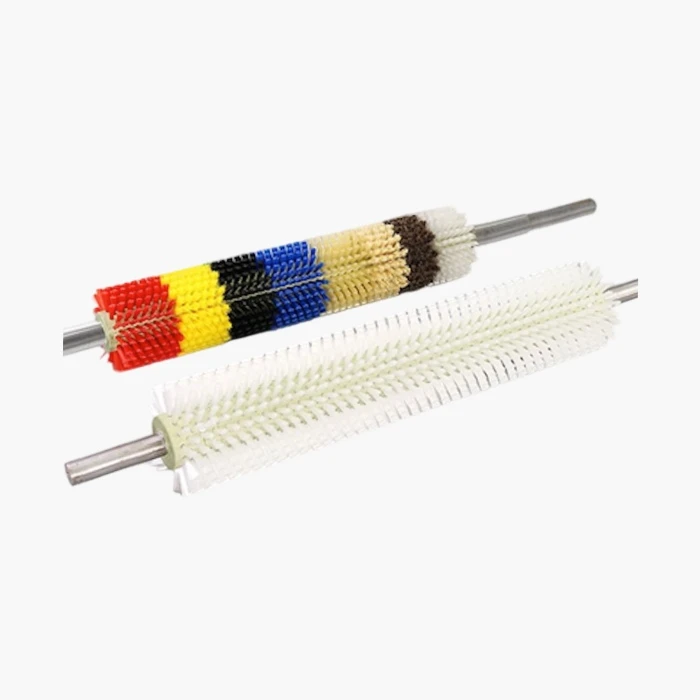
A properly sized cylindrical conveyor brush matches the belt width, available mounting clearance, motor RPM, and material characteristics of the specific conveyor. Off-the-shelf brushes that are close but not exact typically underperform because even small mismatches in diameter, filament density, or core length create uneven cleaning patterns.
Core length is the most straightforward variable but also the one most likely to be ordered wrong. The brush core needs to span the full belt width plus an additional 25 to 50 mm on each side to account for belt wander. On a 1,200 mm belt, a 1,250 to 1,300 mm core length provides enough margin. Ordering a core that matches the belt width exactly leaves the edges uncleaned whenever the belt drifts.
Brush diameter shapes both cleaning performance and motor power requirements. A larger diameter provides more filament surface area and a longer filament path for each point on the belt, which improves cleaning at a given RPM. But larger diameters also increase the moment of inertia, requiring more motor torque to start and maintain speed. Common diameters for belt-mounted brushes range from 150 mm to 350 mm, with 200 mm and 250 mm covering most general-purpose applications on belts up to 1,500 mm wide. Custom sizing for conveyors becomes necessary when mounting space is tight, such as inside enclosed conveyor galleries or under low-clearance transfer points where a standard diameter brush will not fit.
Mounting clearance is a separate constraint from brush diameter. The brush assembly needs room to sit under the return run with enough vertical adjustment range to set filament contact depth. The standard rule allows 100 mm of vertical clearance above the brush for adjustment and 150 mm of horizontal clearance from the nearest structure for motor and drive access. Conveyors installed in tight spaces sometimes need a smaller-diameter brush running at higher RPM to compensate for the reduced filament contact area, which shifts the motor specification accordingly.
Shaft and bearing selection follows belt width. Up to 1,200 mm, a solid shaft with standard pillow block bearings works reliably. Between 1,200 and 2,000 mm, a segmented core with a center support bearing prevents deflection that would cause the brush to press harder in the middle and lighter at the edges. Above 2,000 mm, segmented construction is required; a single-piece core of that length will deflect enough under its own weight plus belt contact load to create a cleaned strip down the middle of the belt with residue remaining at both edges.
Installation and Maintenance Best Practices
A nylon tufted cylinder brush needs minimal ongoing maintenance when installed correctly. Weekly inspection of filament wear, bearing temperature, and drive belt tension catches most problems before they affect cleaning performance. Filaments should be replaced when they have worn down to 50% of their original length or when visible residue streaks appear on the return belt surface.
Positioning the brush is the first and most important decision. Mount it under the return run within 500 mm of the head pulley, where carryback is still loosely adhered and easy to remove. Moving the brush farther downstream lets material compact under the pressure of return rollers, hardening it and accelerating filament wear. The brush height should be set so filament tips compress by 5 to 10 mm against the belt surface when the brush is not spinning. A simple paper test confirms the setting: slide a sheet of paper between the brush and a stopped belt. If it pulls through with light resistance, the contact pressure is in the right range.
Drive system maintenance follows standard industrial practice. Gearbox oil should be checked monthly. Drive belts or chains need inspection for tension and wear on the same schedule. Bearing temperature at the pillow blocks is the best early warning signal for trouble. A bearing running 20°C above ambient under steady load is working normally. A bearing climbing past 40°C above ambient usually signals misalignment or lubricant breakdown. Most brush failures trace back to bearing seizure rather than filament wear. When a bearing locks, the brush stops rotating and the belt quickly wears a flat spot into the stationary filaments, requiring a full brush replacement.
Filament wear follows a predictable pattern. In the first 100 to 200 operating hours, new filaments bed in as tips mushroom slightly against the belt surface. Cleaning peaks during this period. From 200 to roughly 1,000 hours, wear is steady and linear, with filament length dropping by about 0.05 mm per operating hour. Between 1,000 and 1,500 hours, filaments reach 50 to 60% of original length and cleaning begins to decline. Beyond 1,500 hours on a standard dry aggregate belt, residue streaks appear, and replacement is due. Uneven wear across the brush face, with deeper wear at the center or edges, points to a mounting or alignment issue that should be fixed before a new brush goes in.
The cost of running a brush past its service life is higher than the cost of replacement. Worn filaments clean poorly, letting carryback accumulate on return rollers and inside the conveyor structure. A single seized return roller from abrasive contamination costs more to replace than a set of brush filaments. Maintenance teams that track brush hours and replace filaments on a schedule rather than waiting for visible failure report 20 to 30% lower annual conveyor maintenance costs.
Conclusion
A nylon tufted cylinder brush is not a complicated piece of equipment. It is a rotating cylinder with nylon filaments that sweeps the underside of a conveyor belt. But the gap between a brush that just spins and one that cleans effectively for thousands of hours comes down to the details: filament material and diameter matched to the material being conveyed, a core construction that spans the belt width without deflection, a drive system sized to deliver the right tip speed for the belt speed, and a mounting setup that maintains consistent contact pressure as the belt moves.
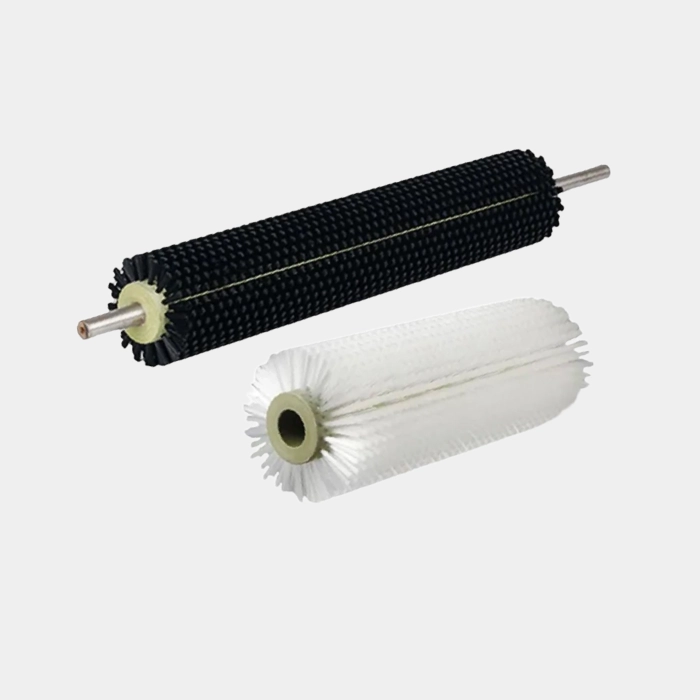
The return on getting these details right shows up in lower spillage cleanup labor, extended roller and belt life, and fewer unplanned stops. A brush specified for the application will run reliably for a year or more between filament changes. A generic brush ordered by approximate dimensions will frustrate the maintenance team within weeks. For production lines where carryback has been an ongoing problem, switching to a properly specified tufted nylon brush is one of the lowest-cost, highest-impact maintenance upgrades available.
FAQ
Can a nylon tufted cylinder brush clean a wet or sticky belt?
Yes, but performance depends on water content. Standard nylon absorbs about 2.5% moisture over 24 hours, which causes slight softening but does not destroy the filament. For belts carrying consistently wet material, polypropylene filaments may hold up better because they absorb virtually no water. The trade-off is faster mechanical wear. A hybrid approach uses polypropylene for wet sections and nylon for dry sections on the same production line.
How do I know when to replace the brush filaments instead of the entire brush?
Three indicators: filament length drops below 50% of original, visible residue streaks appear on the return belt, or motor current draw drops significantly because the filaments no longer make firm contact. A tufted brush core can be re-tufted with fresh filaments two to three times before the core itself needs replacement. This re-tufting process costs about 60% of a new brush and returns the brush to full performance.
What is the difference between a tufted cylinder brush and a spiral-wound cylinder brush for conveyor cleaning?
Tufted brushes pack filaments into individual drilled holes across the core surface, creating a dense, gap-free cleaning face. Spiral-wound brushes wrap a continuous strip of filaments around the core in a helical pattern, which leaves small uncleaned gaps between the winding channels. For conveyor cleaning, tufted construction provides more uniform belt contact and higher filament density. Spiral-wound brushes work better for light polishing and dusting applications where full-surface contact is less critical.