
Cylindrical Brush Speed and Wear: Optimizing RPM for Maximum Service Life
The Hidden Cost of Running Brushes Beyond Their Effective Wear Range
Industrial cylindrical cleaning brushes operate in some of the harshest environments in manufacturing. From conveyor belt cleaning lines to food processing and metal deburring stations, these brushes spin at speeds that can range from under 100 RPM to well over 3,000 RPM. The problem is that most maintenance teams only replace a brush when cleaning quality drops, long after the bristles have already worn past their effective range. By then, the damage to product quality and production efficiency has already happened.
The relationship between rotation speed and brush wear is not linear. A brush running at 1,200 RPM does not wear twice as fast as one at 600 RPM. It wears faster, sometimes three or four times faster, because the physics of wear changes with speed. Higher RPM generates more heat, increases bristle fatigue rates, and amplifies the impact force each time a bristle strikes the surface. Understanding where that threshold lies for your specific brush type is the key to extending service life without sacrificing cleaning performance.
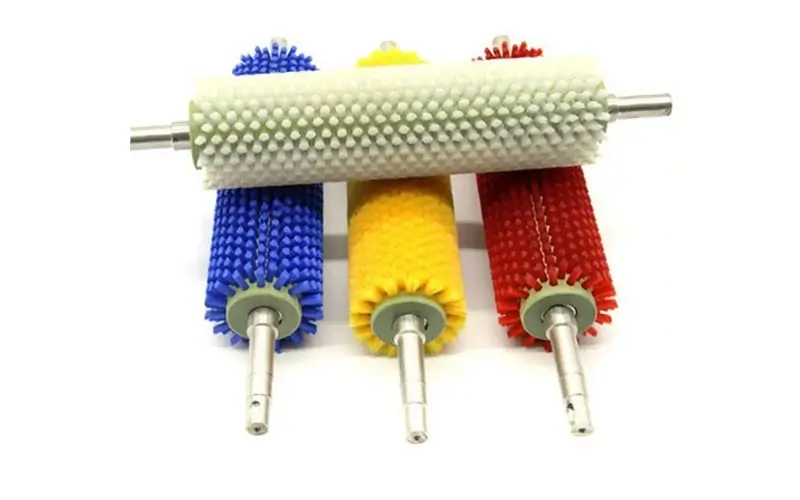
Tip Speed (SFM) Matters More Than Shaft RPM Alone
The most important factor in cylindrical brush wear is tip speed — measured in surface feet per minute (SFM) — not shaft RPM alone. Keeping tip speed between 1,500 and 3,000 SFM balances cleaning effectiveness with bristle longevity for most industrial nylon and polypropylene brushes. Operating above 4,000 SFM accelerates wear exponentially by generating frictional heat that softens thermoplastic filaments and breaks down bristle structure from the inside.
How Brush Diameter Changes the Speed-Wear Equation
What makes this tricky is that the same tip speed can come from very different shaft RPM depending on brush diameter. A 4-inch brush spinning at 2,000 RPM and a 10-inch brush at 800 RPM can produce roughly the same tip speed. But the wear pattern on each will be different because the bristle engagement angle and contact pressure per filament also change with diameter. This article breaks down the mechanics behind speed-related wear, the data you need to track, and how to match RPM to your specific brush material and application.
How Rotation Speed Drives Bristle Wear at the Mechanical Level
The Three Wear Modes: Abrasive, Cyclic Fatigue, and Thermal Degradation
Bristle wear from rotation speed is a combination of abrasive friction, cyclic fatigue, and thermal degradation, each triggered at different speed thresholds. The dominant wear mode shifts from abrasive to thermal once tip speed exceeds approximately 3,500 SFM for nylon filaments.
Abrasive Wear and Cyclic Fatigue at Low-to-Moderate Speeds
At low to moderate speeds (under 2,500 SFM), wear is primarily abrasive. Each bristle tip scrapes against the surface, removing debris but also losing microscopic amounts of material with every pass. This is normal wear. It is predictable and can be modeled linearly. A brush in this range typically loses about 1-2% of its effective bristle length per 100 hours of continuous operation, depending on the abrasiveness of the material being cleaned.
As speed crosses into the moderate-high range (2,500-3,500 SFM), cyclic fatigue becomes a factor. Bristles flex and recover hundreds of times per minute. At 300 RPM, a bristle flexes 18,000 times per hour. At 1,200 RPM, that number jumps to 72,000 flex cycles per hour. Each flex cycle creates micro-stresses at the base of the bristle where it enters the brush core. Over thousands of hours, these micro-stresses accumulate and cause bristle breakage at the root, a failure mode that looks completely different from abrasive tip wear. The construction quality of the cylinder rotary brush directly influences how well it resists this type of fatigue-driven bristle loss.
Thermal Degradation Above 3,500 SFM: The Point of No Return
Above 3,500 SFM, thermal degradation becomes the dominant wear driver. Friction between bristles and the cleaned surface generates heat faster than the brush can dissipate it. For nylon (PA6 and PA6.6), the material softens above 80 degrees Celsius. Prolonged operation at high speed can push bristle tips well past this point, causing the nylon to plasticize, lose elastic recovery, and permanently deform. Once a nylon bristle loses its recovery, it stops cleaning effectively and starts dragging. That sets off a rapid acceleration of wear measured in hours, not days.
Wear Rate by Speed Range
The Difference Between Shaft RPM and Tip Speed
Shaft RPM alone tells you almost nothing about brush wear. What matters is tip speed — the actual velocity at which bristle tips travel across the surface. The formula is simple: SFM = (RPM x brush diameter in inches x pi) / 12.
Two brushes with the same shaft RPM but different diameters produce completely different tip speeds. A 6-inch diameter brush at 1,000 RPM produces a tip speed of approximately 1,570 SFM. An 8-inch brush at the same RPM produces roughly 2,094 SFM, 33% faster, with proportionally higher wear despite identical RPM. This is why comparing RPM between different brush sizes is misleading.
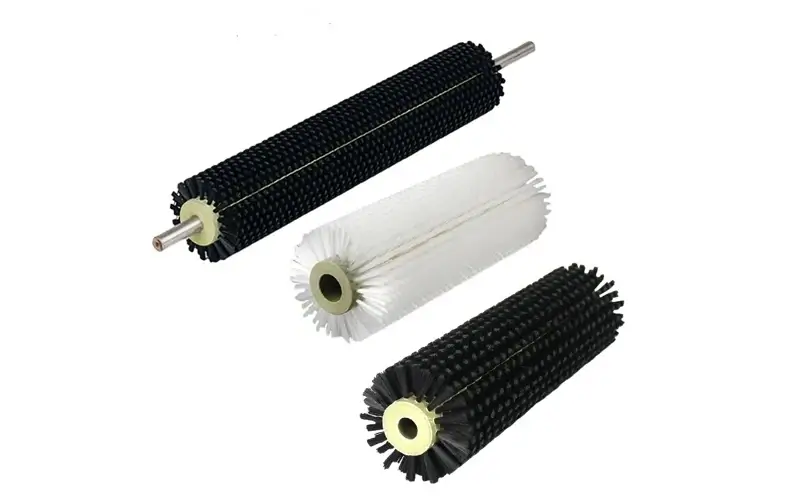
The practical consequence for maintenance planning is straightforward. If you replace a 6-inch brush with an 8-inch brush and keep the same shaft RPM, the wear rate increases significantly because the bristle tips are moving faster. Conversely, if you want the same wear profile, you must reduce RPM when increasing diameter.
Matching RPM to Brush Diameter
These values assume standard nylon filaments. For polypropylene, reduce the max RPM by about 20% due to lower heat tolerance. For steel wire, the max RPM can be 30-40% higher, but the limiting factor becomes core balance and vibration, not the bristle itself.
How Bristle Material Changes the Speed-Wear Relationship
Nylon vs. Polypropylene vs. Steel Wire: Speed Tolerance and Failure Modes
Nylon, polypropylene, and steel wire each respond differently to speed. Nylon offers the best balance of wear resistance and cleaning performance across a wide speed range, but its heat sensitivity makes it vulnerable above 3,500 SFM. Polypropylene wears faster at any speed but handles wet environments better. Steel wire resists abrasive wear but fatigues at the root under high cyclic loads.
For most industrial cleaning applications, the nylon cylinder brush sets the performance benchmark. Its tensile strength, elastic recovery, and moderate heat tolerance make it effective across a broad RPM range without the rapid failure modes that plague softer or more rigid alternatives.
Nylon PA6.6: The Preferred Choice for Continuous High-Speed Operation
Nylon (PA6 and PA6.6) is the most common material for industrial cylindrical cleaning brushes, and for good reason. It has high tensile strength, good elastic recovery, and moderate heat resistance. Nylon PA6.6 performs better than PA6 at elevated temperatures, making it the preferred choice for brushes that run continuously above 2,500 SFM. The key limitation is melt temperature, and once nylon exceeds 120 degrees Celsius intermittently, bristle tips begin to soften and take a permanent set.
Polypropylene for Wet Environments and Steel Wire for Extreme Speeds
Polypropylene (PP) is the second most common synthetic filament. It is softer than nylon, has lower tensile strength, and wears faster at equivalent tip speeds. However, PP is chemically resistant and absorbs almost no moisture, making it the go-to material for wet environments like food washing lines and vegetable processing. In these applications, PP brushes typically run at lower tip speeds (under 2,000 SFM) because higher speeds generate enough heat to soften the material in wet conditions.
Steel wire brushes occupy a different category. They can handle much higher tip speeds, up to 5,500 SFM in some applications, because metal does not soften with frictional heat the way thermoplastics do. The failure mode for steel wire is different: cyclic fatigue at the anchor point. Wire bristles work harden over time and eventually snap at the bend point where they exit the brush core. Steel wire also generates more heat transfer to the core and bearings, so the drive system must be rated accordingly.
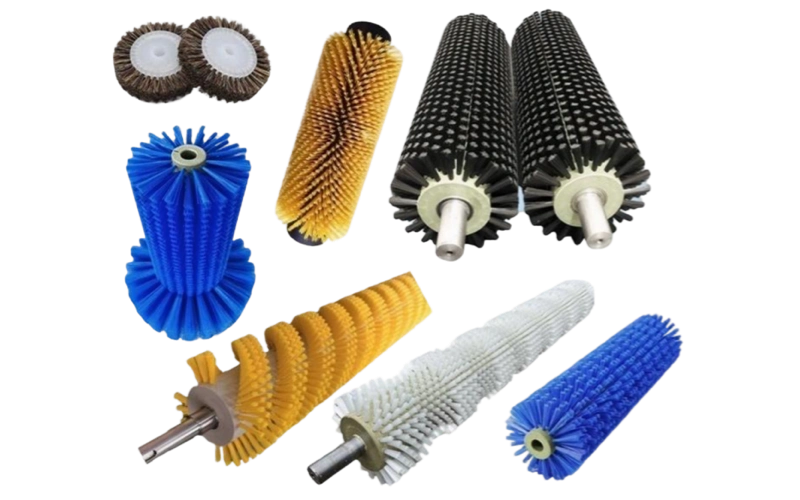
Filament Material Comparison at Equivalent Tip Speed
Practical Guidelines for Extending Brush Life
The most effective way to extend cylindrical brush life is to operate at the lowest tip speed that still delivers acceptable cleaning results. For most industrial applications, this means targeting 1,800 to 2,500 SFM and verifying cleaning performance before making upward adjustments.
Start with the low end of the speed range and increase in increments of 200-300 SFM until cleaning quality meets your standards. Document the minimum speed that works and lock that as your operating set point. Many operations run brushes faster than necessary because “that is how it has always been done.” The process of evaluating brush speed as part of a broader maintenance review is covered in detail in our guide on how to select a cylinder cleaning brush, which covers the full range of selection factors beyond just speed. In practice, a brush running at 2,200 SFM often cleans just as effectively as one at 3,200 SFM for common debris types like dust, loose particles, and light residue. The difference is a brush that lasts 2,000 hours versus one that needs replacement at 600 hours.
Additional Measures to Reduce Speed-Related Wear
Prioritize Contact Pressure Adjustment Before Speed Changes
Adjust contact pressure before adjusting speed. Heavy pressure combined with high speed produces the worst wear rates. A brush forced hard against the surface at high RPM generates friction heat from both the contact force and the sliding velocity. Backing off the pressure by 10-15% can cut wear by 30-40% without a noticeable drop in cleaning results.
Monitoring Bristle Temperature and Reversing Rotation Direction
Monitor bristle temperature during operation. If the bristles feel warm to the touch immediately after shutdown, they are running at the upper end of safe temperature. If they feel hot enough that you cannot keep your hand on them, the brush is overheating and wear will accelerate rapidly. Infrared temperature guns pointed at the brush surface during operation give accurate readings, and anything above 70 degrees Celsius for nylon warrants a speed reduction.
Schedule brush rotation direction changes when applicable. Running a brush in the same direction at high speed for extended periods creates directional bristle set: the filaments lean in the direction of rotation and clean less effectively. Reversing the rotation periodically (where the drive system allows) evens out the directional wear and can extend usable life by 15-25%.
Match Bristle Diameter to the Cleaning Task for Better Heat Dissipation
Match bristle diameter to the cleaning task. Thicker bristles (0.3-0.5 mm) resist heat buildup better than thin bristles (0.15-0.2 mm) at equivalent RPM because they have more material mass to absorb and dissipate frictional heat. For high-speed applications, use the thickest bristle that can still reach into the crevices or surface features that need cleaning.
When Higher Speed Is Actually the Right Choice
When Higher Speed Is Justified: Sticky Debris, Grooved Surfaces, and High Line Speeds
Higher rotation speed is justified in three scenarios: when dealing with sticky or adhesive debris that requires impact force to dislodge, when cleaning textured or grooved surfaces where bristles must penetrate recesses quickly, and when line speed requires faster brush pass frequency to keep up with production throughput.
Sticky Debris and Grooved Belts: Speed Requirements for Difficult Surfaces
Sticky materials like dough residue, adhesive labels, or wet pulp do not respond well to gentle brushing. They require sufficient bristle impact energy to shear the bond between the debris and the belt surface. In these cases, running at 3,000-3,500 SFM may be necessary, but only with heat-resistant nylon (PA6.6) and a correspondingly shorter replacement interval built into the maintenance schedule.
For grooved or cleated conveyor belts, the brush needs enough speed to force bristles into channels before the belt moves past the brush zone. If tip speed is too low, bristles ride over the grooves and leave debris packed into the recesses. The correct speed depends on belt speed and groove depth, but a good starting point is 2.5 to 3 times the belt surface speed.
Matching Speed to Throughput: The Role of Brush Diameter and Customization
When line speed increases, brush tip speed must increase proportionally to maintain the same number of bristle passes per unit area of belt. This is a mathematical necessity, not a choice. In these cases, the solution is often to increase brush diameter (to get higher tip speed at lower RPM) rather than increasing RPM alone, since larger diameters keep bearing loads and vibration more manageable. For applications that run consistently outside the optimal speed envelope, OEM brush customization can tailor the filament material, density, and core design to the specific operating speed range, improving wear resistance where standard brushes fail prematurely.
Summary
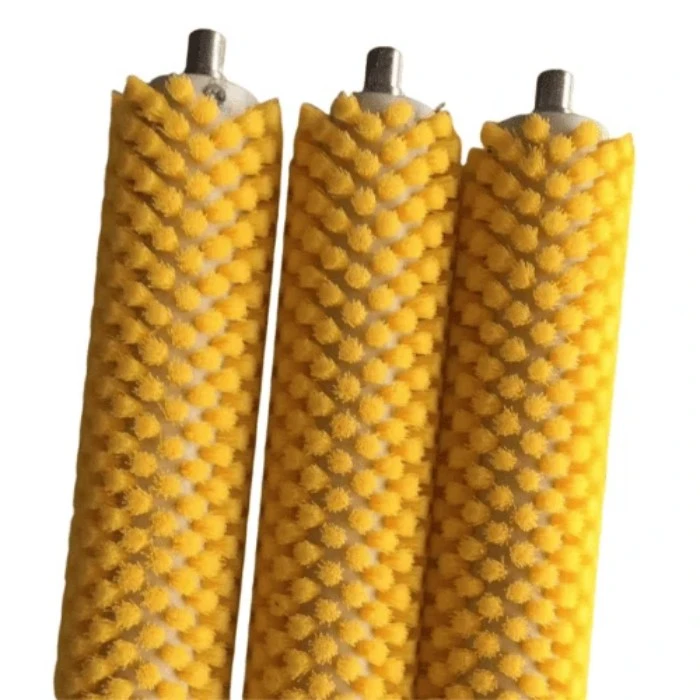
Rotation speed directly determines how fast cylindrical cleaning brushes wear, but the relationship depends on tip speed, not shaft RPM. Keeping tip speed between 1,500 and 3,000 SFM gives the best balance of cleaning performance and brush life for most nylon and polypropylene brushes. Above 3,500 SFM, thermal degradation sets in and wear accelerates exponentially. The specific thresholds shift based on bristle material, brush diameter, and application type.
To maximize brush life, start at the lowest speed that delivers acceptable cleaning, monitor bristle temperature regularly, and adjust contact pressure before increasing RPM. Match filament material to your operating conditions: PA6.6 nylon for high-speed dry applications, polypropylene for wet environments, and steel wire for heavy-duty scraping. And when higher speed is unavoidable, plan for shorter replacement intervals and use the largest brush diameter your system can accommodate.
Frequently Asked Questions
Can I run a cylindrical brush at a lower RPM than recommended?
Yes, and it often extends brush life significantly. The minimum RPM should be high enough that bristles deflect adequately to reach the surface and dislodge debris. If the brush leaves visible uncleaned patches at low speed, increase RPM in 100-200 increments until coverage is uniform. Most applications can run 20-30% below the manufacturer maximum without losing cleaning performance.
How do I know when a brush needs replacement due to speed-related wear?
The most reliable indicator is bristle height. When bristles have worn to 50-60% of their original length, replace the brush. Other signs include bristles that have taken a permanent bend at the tip (thermal set), visible melting or glazing on bristle ends, and patterns of bristle loss at the base rather than at the tip. Track brush hours and compare actual service life to the expected life for your operating speed.
Does reversing brush direction reduce wear from high-speed rotation?
Reversing direction does not reduce the total wear rate, but it distributes wear more evenly across the bristle surface, preventing directional set and extending usable life. The benefit is most pronounced in brushes that run above 2,500 SFM for extended periods. If your drive system can reverse direction, alternate every 200-300 operating hours. If it cannot, accept that directional set will occur and plan replacement accordingly.