Why Automotive Manufacturing Needs Custom Cylinder Brushes
Automotive manufacturing lives on tight tolerances. A burr left on a transmission gear after machining, a layer of oxide on a brake caliper before coating, or uneven surface roughness on an engine block can cascade into warranty claims, assembly line stoppages, or parts rejected at inspection. Cylinder brushes handle these surface finishing tasks across dozens of automotive production stages, but only when the brush fits the part geometry, the material, and the line speed.
The challenge is that most automotive parts are not flat or uniform. They have splines, bores, chamfers, threads, and compound curves. A standard catalog brush rarely matches those contours well enough to produce consistent results at production speeds. That is where custom cylinder brushes come in. Engineering the filament type, density, trim length, and core construction around a specific part transforms a generic cleaning tool into a process-controlled finishing station.
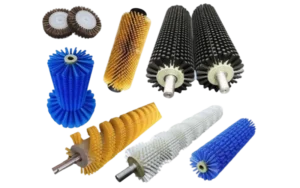
Custom cylinder brushes give automotive manufacturers exact control over filament material, density, outer diameter, and core construction to match specific part geometries and process requirements. The right combination of these four variables produces consistent deburring, cleaning, or surface finishing results that off-the-shelf brushes cannot deliver on complex automotive components.
This article walks through the types of cylinder brushes used in automotive production and the materials that determine how aggressively they cut or how gently they polish. It covers the design parameters that affect performance and service life, from filament diameter to rotational speed. If you are specifying brushes for a new production line or trying to fix an existing brush that wears out too fast or leaves inconsistent finishes, the sections below break down what matters and what does not.
What Are Cylinder Brushes and Why Are They Used in Automotive Manufacturing
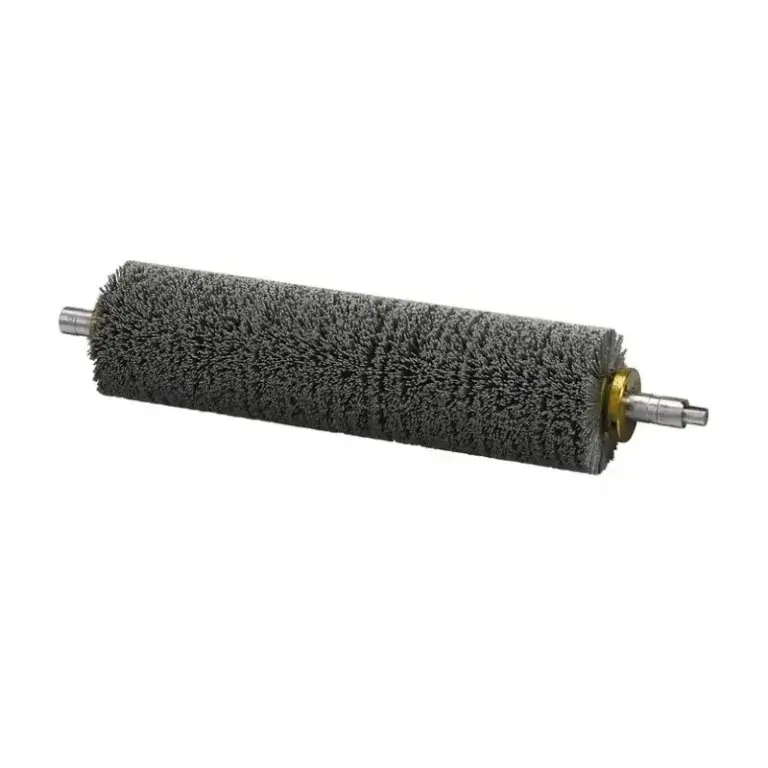
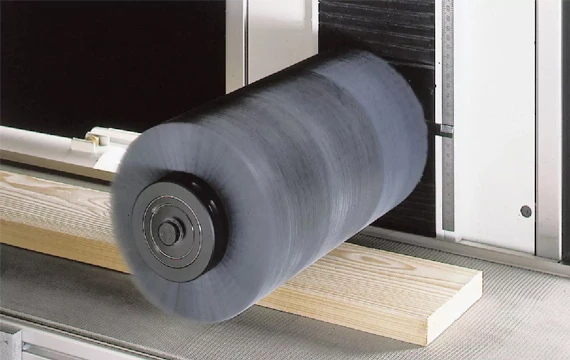
A cylinder brush is a rotating tool with bristles arranged around a cylindrical core. In automotive manufacturing, these brushes remove burrs from machined parts, clean surfaces before coating or assembly, polish bearing journals, and break sharp edges on stamped or cast components. They run in automated cells, CNC machines, robotic arms, and dedicated brush stations, typically at speeds of 800 to 3,600 RPM depending on diameter and filament type.
Automotive production lines use cylinder brushes because no other tool combines conformability with controlled cutting action the way a brush does. A grinding wheel removes material fast but leaves directional scratch patterns and risks gouging the part surface. A media blasting system works on external surfaces but cannot reach internal bores or blind holes. A cylinder brush, by contrast, conforms to the part surface because each filament flexes independently. This lets the brush reach into splines, threads, and cross-holes while maintaining uniform contact pressure.
The brush category spans a wide range of styles. A cylinder rotary brush uses a spiral-wound construction where filament is crimped into a metal channel and wound helically around a core, creating a continuous bristle face. This design handles heavy deburring on cast iron engine blocks and stamped steel brackets. For lighter cleaning and polishing on aluminum or coated surfaces, nylon cylinder brushes with abrasive-impregnated filaments work without scratching the substrate. Manufacturers also use tufted cylinder brush designs where individual filament bundles are inserted into pre-drilled holes in the core. Tufted brushes hold more compound and work well on contoured surfaces such as camshaft lobes and crankshaft journals.
Key Cylinder Brush Types for Automotive Applications
The three main categories for automotive parts finishing are abrasive nylon cylinder brushes for deburring and edge rounding, natural or synthetic fiber brushes for cleaning and polishing, and wire cylinder brushes for heavy material removal and rust stripping. Each type targets a different stage in the part production workflow.
Abrasive Nylon Cylinder Brushes
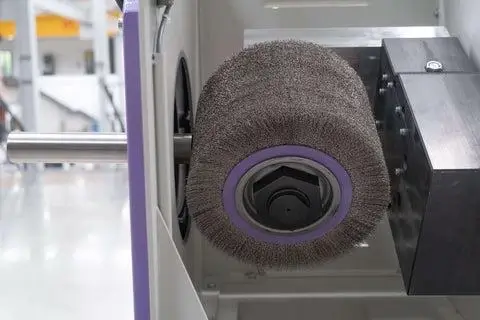
Abrasive nylon filaments carry silicon carbide, aluminum oxide, or ceramic grit bonded into each strand. As the filament wears, fresh abrasive is exposed, so the brush maintains consistent cutting action through its service life. These brushes handle edge rounding on gears before heat treatment, deburring after CNC machining, and surface texturing before coating.
Typical filament diameters range from 0.018 to 0.060 inches. Thinner filaments produce finer finishes on precision surfaces. Thicker filaments last longer and cut faster on heavy burrs. Grit choices follow the application:
Fiber and Natural Bristle Brushes
For cleaning parts before assembly or removing light oxidation without dimensional change, fiber brushes made from nylon, polypropylene, Tampico, or horsehair are the common choice. These filaments carry no abrasive grit, so they clean without cutting the base material. Automotive applications include pre-assembly cleaning of bearing bores, removal of light dust and chips from machined aluminum housings, and polishing of decorative trim surfaces.
Conveyor belt cleaning in assembly plants also relies on cylinder brushes, where segmented brush cores with central support bearings maintain even contact pressure across wide belt widths. The same filament density and core engineering principles apply whether the brush cleans a moving belt or a rotating part.
Wire Cylinder Brushes
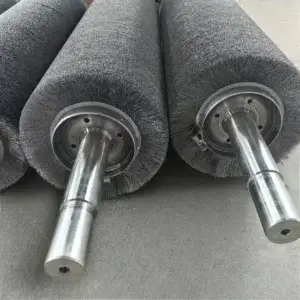
Wire brushes use carbon steel, stainless steel, or brass filaments for aggressive cleaning tasks. In automotive production, they strip rust from castings before machining, remove heavy scale after heat treatment, and clean weld spatter from fabricated assemblies. Wire filament diameter and crimp pattern control how aggressively the brush cuts. Straight wire is the most aggressive. Crimped wire produces a lighter, more uniform finish. Knot wire handles extreme material removal on heavily scaled steel parts.
The table below compares the three types based on key selection factors:
Design Parameters That Control Cylinder Brush Performance
Four design parameters determine how a cylinder brush performs: outer diameter, filament trim length, filament density (fill density), and rotational speed. Changing any one of these changes the brush’s cutting action, its service life, and the surface finish it produces. These four variables interact, so a change to one usually requires adjusting at least one other to maintain consistent results.
Outer Diameter and Trim Length
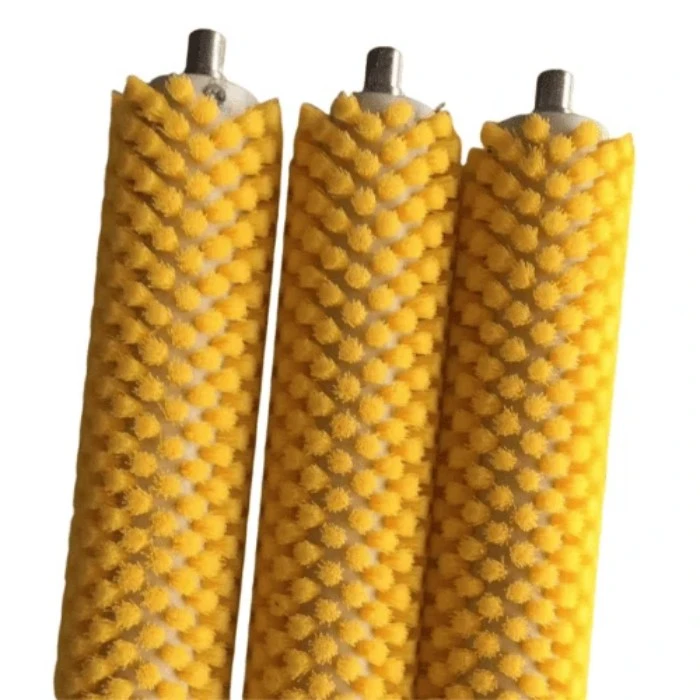
The relationship between brush outer diameter (OD) and part geometry sets the contact area. A brush OD that is too small relative to the part diameter results in a narrow contact patch and uneven wear. A brush OD that is too big wastes filament material and can make it hard to get to tight part features. For internal bores, the brush OD is typically 10 to 15 percent larger than the bore diameter. For external surfaces, the brush OD is matched to the minimum curvature of the part so all surfaces see uniform bristle contact.
Trim length is the radial distance from the core surface to the brush OD. Longer trim produces a more compliant brush that conforms better to contoured surfaces but generates less cutting force at the filament tip. Shorter trim produces a stiffer brush with higher tip pressure, suitable for heavy deburring on flat or gently curved surfaces. Trim length and filament diameter together control the brush stiffness: a thick filament with short trim cuts aggressively, and a thin filament with long trim polishes gently.
Filament Density
Fill density is the number of filaments per unit area on the brush face. It is often specified as a percentage of the theoretical maximum density or as filaments per inch along the core length. Higher density produces more contact points per revolution, which improves surface finish uniformity and extends brush life by distributing wear across more filaments. The tradeoff is that higher density increases the brush’s resistance to conforming around small part features.
The following table shows typical density ranges and their effects:
Rotational Speed
Rotational speed (RPM) and brush diameter together determine the surface speed at the filament tip. Surface speed, measured in surface feet per minute (SFPM), is what actually governs cutting action. Filament materials have recommended SFPM ranges. Running too slow reduces cutting efficiency. Running too quickly overheats the filament and shortens brush life. For nylon brushes, the optimal speed is 1,200 to 3,600 SFPM. Wire brushes run up to 6,500 SFPM in certain applications.
The formula for calculating surface speed is SFPM = (Brush OD in inches × π × RPM) ÷ 12. A 6-inch diameter brush running at 1,800 RPM produces 2,827 SFPM. That same brush at 3,600 RPM produces 5,655 SFPM, which may be too rapid for nylon filaments if sustained contact generates heat faster than the brush can dissipate it.
Core Construction
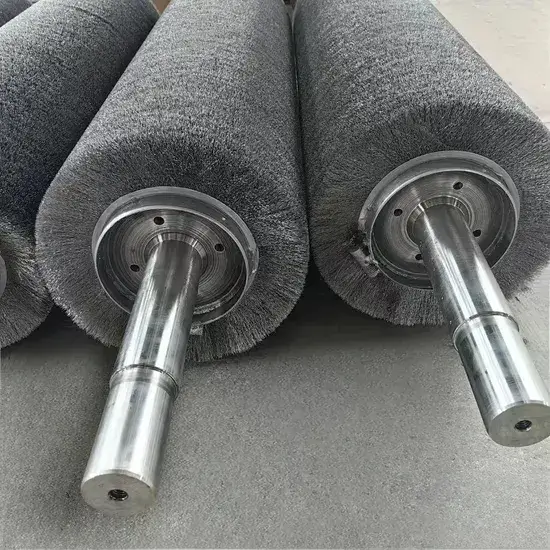
The brush core is the structural foundation. Steel cores handle the torque and radial loads of aggressive deburring. Plastic or composite cores work for lighter cleaning applications where weight matters, such as robotic end-of-arm tooling where every pound affects cycle time and motor sizing. For wide brushes on long shafts, custom sizing for conveyors and similar wide-format applications often calls for segmented cores with intermediate support bearings to control shaft deflection and maintain uniform filament pressure.
How to Select a Custom Cylinder Brush for Your Automotive Application
Start with the part material and the target result. Define whether you need material removal (deburring, edge breaking) or surface cleaning (dust removal, pre-coat prep). Measure the part geometry at every point the brush must contact, including internal bores, undercuts, and sharp radii. Then specify filament type, OD, trim length, and density around those measurements. A brush specified this way is a custom brush. A brush bought from a catalog and adapted to the part is a compromise that costs more in rework, rejects, and brush replacements than the upfront engineering cost of going custom.
The selection process follows a logical sequence. Missing a step at the front end of the process is what causes most brush performance problems on production lines. A brush that wears out in 40 hours instead of 200 is almost always the result of a specification mismatch, not a manufacturing defect. The filament material is wrong for the part material. The OD is too small relative to the part bore, so only a narrow strip of filaments does all the work. The RPM is too high for the filament type, causing heat degradation. Or the density is too low, so a small number of filaments carry the full load and wear out fast.
The checklist below covers the minimum information needed to specify a custom cylinder brush for an automotive application:
- Part material and hardness (aluminum, cast iron, hardened steel, plastic)
- Target result (burr removal, surface cleaning, edge radius, surface roughness target)
- Part geometry at all brush contact zones (minimum bore diameter, maximum curvature radius)
- Available space around the part (clearance for brush OD plus fixture clearance)
- Machine interface (shaft diameter, keyway, mounting method, drive type)
- Cycle time constraint (how many seconds the brush has to complete the operation)
- Coolant or dry operation (affects filament heat buildup and material choice)
- Target brush life (in hours or number of parts between changeovers)
A specification that answers all eight points gives the brush manufacturer what they need to engineer a brush that matches the process, rather than forcing the process to adapt to a brush. The difference shows up in first-pass yield rates and brush consumption costs.
Common Problems and How Custom Cylinder Brushes Solve Them
The three most common complaints about cylinder brushes in automotive production are inconsistent surface finish across the part, short brush life, and filament breakage contaminating the part or the machine. Each of these problems has a root cause in brush design, not in the brush material itself. A custom cylinder brush addresses the root cause instead of treating the symptom.
Inconsistent Surface Finish
When a brush leaves a shiny stripe down the center of a part but does not touch the edges, the problem is almost always a mismatch between brush OD and part geometry. The brush OD is too small relative to the part curvature, so only the middle filaments make contact. The fix is a larger OD or a different core profile that matches the part contour. A spiral-wound brush with filaments in a continuous helical pattern also helps because there are no gaps in the bristle face, so every point on the part sees uniform filament density as it passes through the brush.
Short Brush Life
If a brush wears out in a fraction of the expected service hours, the usual suspects are excessive RPM, insufficient density, or the wrong filament material for the part hardness. Running the RPM calculation against the filament material’s SFPM rating often reveals the mismatch. Increasing density spreads the wear across more filaments and extends life proportionally. Switching to a filament with coarser grit or thicker diameter can also help, but only up to the point where finish requirements allow. If the part surface finish specification is 32 Ra and the coarser filament produces 50 Ra, then density and RPM adjustments are the only knobs to turn.
Filament Breakage
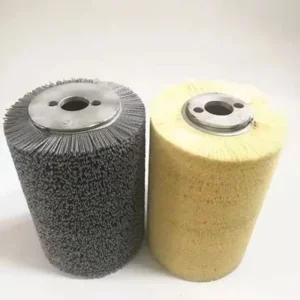
Filaments snap when the bending stress at the filament root exceeds the material’s fatigue limit. Short trim length, high RPM, and sharp part edges all increase bending stress. The solution sequence is to increase trim length to reduce bending stress, reduce RPM to lower cycle stress, and specify a filament with higher flex fatigue resistance. Nylon filaments, particularly grade 6.12, have favorable flex fatigue properties. For applications with unavoidable sharp edges, a filament with a crimped or wavy profile reduces the stress concentration at the contact point because the curved filament tip slides over the edge instead of catching on it.
The table below maps common symptoms to their most likely design causes: