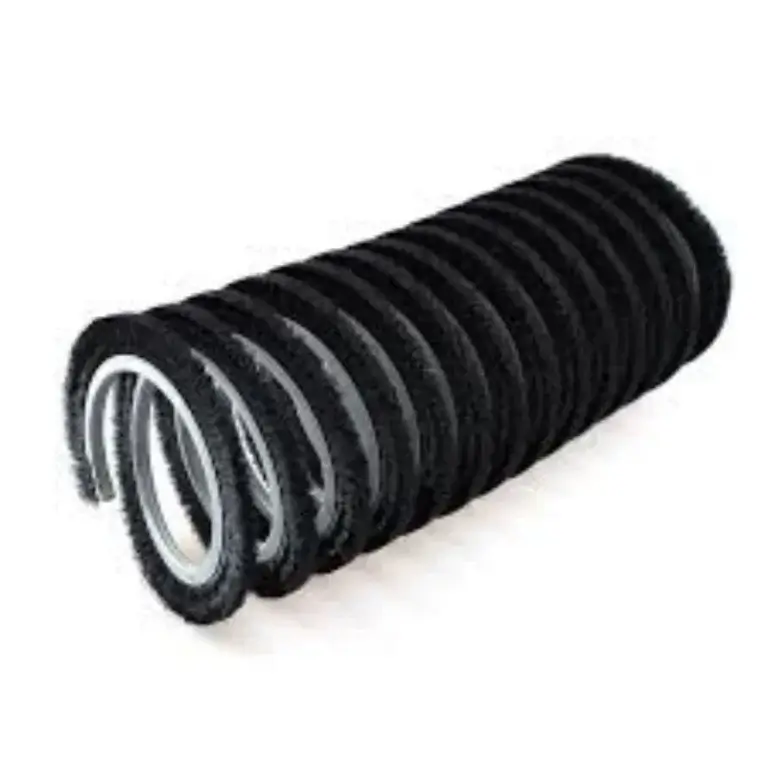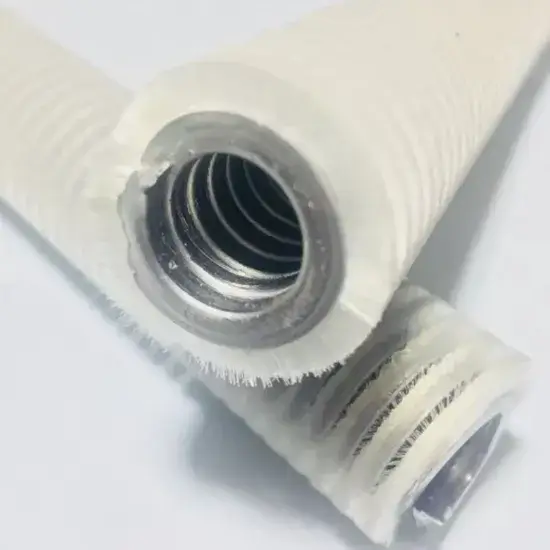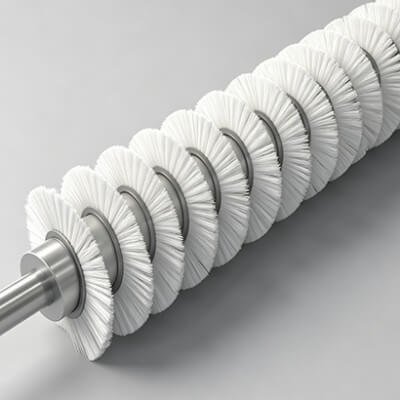
Capsule polishing is one of the last mechanical processes a filled capsule goes through before it reaches a patient. After the filling station deposits powder, pellets, or granules into the shell body and the cap is joined, a thin layer of dust settles on the exterior surface. This dust comes from fill powder that escaped the dosing mechanism, shell fragments from the joining operation, or airborne particulates inside the encapsulation suite. A capsule polishing machine brush spins against the tumbling capsules inside a vacuum-assisted chamber, sweeping this residue away so that every capsule leaving the line is clean enough for optical inspection, printing, and packaging.
The geometry of the brush, the density of the filament packing, the vacuum flow rate, and the filament material all matter. But no variable produces more immediate and visible impact on polish quality than bristle stiffness. A brush that is too soft leaves dust behind and raises rejection rates at the inspection station. A brush that is too stiff micro-scratches the gelatin or HPMC shell, dulling the surface sheen and creating cosmetic defects that are just as likely to trigger a reject. Getting stiffness right means hitting the narrow window where every filament tip has enough backbone to dislodge adhered particles but enough compliance to deflect before it can mark the capsule surface.
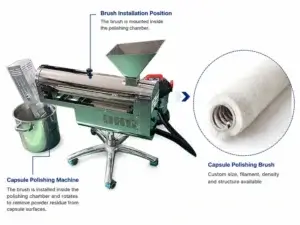
The right bristle stiffness for a capsule polishing machine brush is determined by three interacting factors: the capsule shell material and thickness, the adhesion characteristics of the fill powder residue, and the production line speed. There is no universal stiffness value. A brush that polishes hard HPMC capsules at 60,000 per hour without damage may leave visible hazing on soft gelatin capsules at the same speed. The correct specification always starts with the capsule itself and works outward to filament diameter, trim length, and nylon grade.
Production engineers who treat brush stiffness as a fixed specification rather than a line-specific variable often find themselves chasing quality problems they cannot isolate. A line that ran with zero surface defects for six months suddenly sees a 3 percent rejection spike after a capsule shell supplier changes plasticizer concentration by two percentage points. The brush did not change. The capsule did, and the stiffness that was acceptable last month is now 15 percent too aggressive. This article walks through what controls bristle stiffness in a capsule polishing machine brush, how to match stiffness to different capsule types, and how to validate stiffness before committing a brush specification to full production.
The interplay between stiffness, density, and material is what makes brush selection feel more like process engineering than procurement. A nylon cylinder brush wound at high density with 0.20 mm filaments behaves very differently from the same brush wound at lower density with 0.35 mm filaments, even though both use the same nylon grade. Understanding these relationships lets production teams specify brushes that deliver consistent polish quality across entire batch runs without the trial-and-error cycle that burns production hours and capsule inventory.
What Controls Bristle Stiffness in a Capsule Polishing Brush
Bristle stiffness in a capsule polishing brush is controlled by four parameters: filament diameter, filament trim length, the elastic modulus of the nylon grade, and the packing density determined by the coil pitch or tufting pattern. Filament diameter has the largest single-variable effect. Doubling the filament diameter from 0.15 mm to 0.30 mm increases bending stiffness by a factor of 16, because bending stiffness scales with the fourth power of diameter.
Filament Diameter: The Most Powerful Stiffness Variable
Filament diameter is the stiffness control that most process engineers adjust first, and for good reason. A filament 0.15 mm in diameter bends under less than 5 grams of tip force, deflecting at the lightest contact with a soft gelatin shell. A filament 0.40 mm in diameter requires roughly 50 times more force to produce the same deflection. For comparison, the force needed to visibly scratch a standard gelatin capsule shell with 28 percent glycerin plasticizer is around 8 to 12 grams applied at a single point. This means a 0.40 mm filament at full stiffness can mark a capsule before it deflects, while a 0.15 mm filament deflects at forces well below the marking threshold.
Filament Trim Length: Leverage and Deflection
Filament trim length matters almost as much because longer filaments have greater leverage to bend. A 25 mm filament deflects more than twice as far under the same tip load as a 15 mm filament of the same diameter. Production engineers who need gentler cleaning without reducing diameter can specify longer trim lengths to achieve the same net stiffness reduction. This approach has the advantage of preserving filament tip count, since diameter remains unchanged and cleaning coverage does not decrease.
Nylon Grade and the Humidity Factor
The nylon grade sets the baseline elastic modulus. Nylon 6 has a dry flexural modulus around 2.8 GPa. Nylon 6.10 has a lower modulus around 2.0 GPa in dry conditions and absorbs less than half the moisture of Nylon 6. Nylon 6.12 sits around 1.8 GPa. These differences mean a 0.25 mm Nylon 6 filament feels 30 to 40 percent stiffer than a 0.25 mm Nylon 6.12 filament at the same trim length. In the humid environment of a pharmaceutical production suite running at 45 to 55 percent relative humidity, nylon absorbs moisture from the air, which plasticizes the polymer and reduces stiffness further. Nylon 6 can lose 15 to 25 percent of its dry stiffness at equilibrium with 50 percent RH, while Nylon 6.12 loses only 5 to 10 percent. This humidity-driven stiffness shift catches some production teams off guard when capsules that polished perfectly during a dry winter validation run show increased dust carryover during the humid summer months.
Why Packing Density Makes the Brush Stiffer Than It Looks
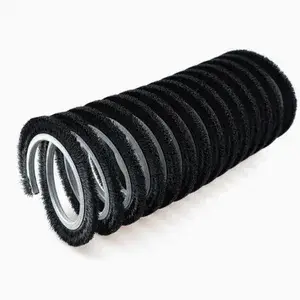
Packing density interacts with stiffness because filaments in a densely packed brush constrain each other. In a cylinder rotary brush with tightly wound spiral construction, neighboring filaments limit how far any individual filament can deflect laterally. A filament that would deflect 3 mm under a given load when isolated may deflect only 1.5 mm when packed at 90 filaments per square centimeter. The result is that the brush behaves as if its filaments are stiffer than their individual mechanical properties would predict. Accounting for this packing effect during specification prevents the common problem of specifying filament diameter based on single-filament data and ending up with a brush that is 20 to 30 percent stiffer in actual operation.
Matching Bristle Stiffness to Shell Material
Different capsule shell materials require different stiffness ranges. Soft gelatin capsules with plasticizer content above 25 percent need filament diameters of 0.15 to 0.20 mm with trim lengths above 20 mm to avoid surface marking. Hard gelatin capsules tolerate 0.20 to 0.30 mm. HPMC capsules handle up to 0.35 mm without cosmetic damage, and enteric-coated capsules can accept 0.40 mm filaments because the coating layer absorbs and distributes contact stress.
Gelatin Capsules: The Sensitivity Baseline
Gelatin capsules are the most stiffness-sensitive because their mechanical properties vary with plasticizer content, moisture level, and manufacturing method. A soft gelatin capsule with glycerin above 30 percent has a surface hardness low enough that a 0.25 mm nylon filament at 15 mm trim length can produce visible hazing after 3 to 4 seconds of continuous contact inside the polishing chamber. The hazing appears as a uniform dullness rather than discrete scratches, but optical inspection systems with surface gloss measurement flag it as a reject just the same.
Hard gelatin capsules, produced using the dip-molding process with plasticizer levels typically between 18 and 25 percent, have greater surface hardness and tolerate higher stiffness. A filament diameter of 0.25 mm with a 15 to 18 mm trim length works for most hard gelatin capsule lines running at up to 80,000 capsules per hour. Above 100,000 per hour, the reduced contact time per capsule means stiffness can increase slightly without risking damage, because the cumulative number of impacts any single point on the capsule surface receives drops by nearly half.
The complication is that gelatin capsule hardness varies between suppliers and even between batches from the same supplier. A production line that processes capsules from two qualified suppliers may see different polish quality outcomes from the same brush because one supplier’s shells are 15 percent harder than the other’s. The only reliable approach is to test brushes against actual capsule samples from each qualified supplier at production speed before finalizing the stiffness specification.
HPMC Capsules: Higher Tolerance
HPMC capsules have higher intrinsic surface hardness and lower moisture sensitivity than gelatin. They tolerate filament diameters up to 0.35 mm without statistically significant surface marking in controlled tests, even at trim lengths as short as 12 mm. This tolerance opens the door to using stiffer brushes on HPMC lines that need to remove tenacious powder residues, such as those from cohesive direct-compression blends or certain lipid-based fill formulations.
The caveat with HPMC is that while surface marking is less likely, the capsules are more brittle at low humidity. Below 30 percent RH, HPMC capsules can develop micro-cracks under repeated filament impact, especially near the cap-to-body joint where stress concentrates. Stiffness specifications for HPMC lines operating below 35 percent RH should drop filament diameter by one step (for example, from 0.30 mm to 0.25 mm) and increase trim length by 20 to 30 percent to reduce impact force.
Enteric-Coated Capsules
Enteric-coated capsules present an easier stiffness problem because the coating layer, typically 50 to 100 microns of methacrylic acid copolymer or cellulose acetate phthalate, absorbs and distributes localized contact stress. Filament diameters up to 0.40 mm are acceptable for most enteric-coated products. The coating layer can develop micro-cracks if stiffness is too high, but the threshold is well above what is needed for effective dust removal. Most enteric coating formulations tolerate the same stiffness range used for standard HPMC capsules.
How Filament Diameter and Trim Length Interact
Filament diameter and trim length together set the effective stiffness of any capsule polishing brush, and they can be traded off against each other. A brush with 0.30 mm filaments at 25 mm trim length has roughly the same effective stiffness as one with 0.22 mm filaments at 12 mm trim length. This trade-off gives production engineers two paths to the same stiffness target.
The table below compares effective stiffness across common diameter and length combinations, normalized against a baseline of 0.25 mm diameter at 18 mm trim length.
The practical implication of this trade-off is that production engineers should never specify filament diameter in isolation. A procurement specification that reads “0.25 mm nylon filaments” without specifying trim length is incomplete. A brush wound with 0.25 mm filaments at 12 mm trim length is nearly twice as stiff as the same brush at 22 mm trim length, and the difference is enough to turn an acceptable polish into a surface quality problem.
Choosing between the two paths to the same stiffness target depends on secondary considerations. The larger-diameter, longer-trim option provides more filament material, which means longer wear life because each filament has more material to lose before replacement is needed. The smaller-diameter, shorter-trim option packs more filament tips per unit area, which increases cleaning coverage and can improve dust removal for fine-particle powders. For lines where brush replacement cost is the dominant concern, the larger-diameter path is usually better. For lines where cleaning thoroughness is the priority, the smaller-diameter path wins.
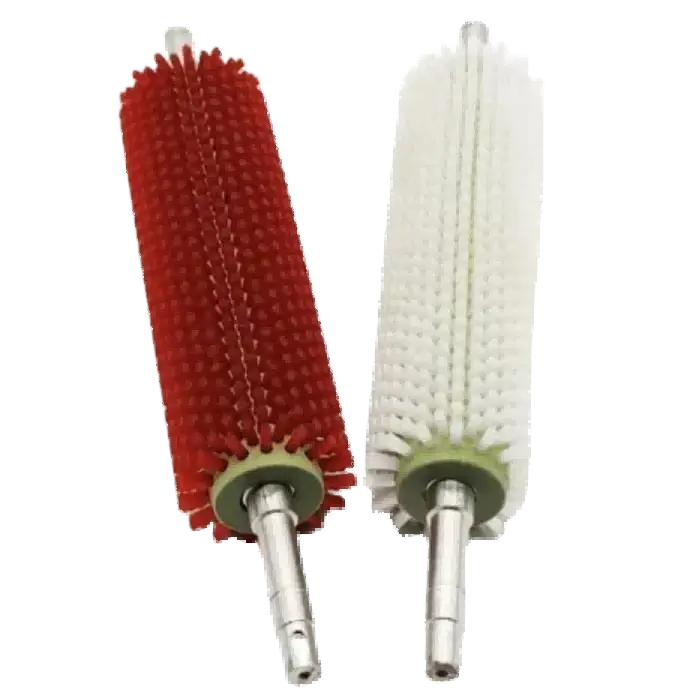
A tufted cylinder brush adds another dimension to the stiffness trade-off because filaments are grouped into discrete tufts rather than distributed continuously. The space between tufts allows individual filaments to deflect more freely than in a continuous spiral-wound brush. This means a tufted brush with 0.30 mm filaments can behave more gently than a continuous-wound brush with the same filament diameter, because each filament has room to bend without being constrained by its neighbors.
Nylon Grade Selection and Stiffness Stability
Nylon 6.12 and Nylon 6.10 provide the best stiffness stability in pharmaceutical environments because their low moisture absorption minimizes stiffness drift between dry and humid conditions. Nylon 6 is the most cost-effective option but requires wider stiffness safety margins to account for humidity-driven softening.
Moisture Absorption and Its Effect on Stiffness
Nylon absorbs moisture from ambient air, and absorbed moisture acts as an internal plasticizer that reduces the elastic modulus. The amount of moisture absorbed at equilibrium depends on the nylon grade and the relative humidity of the production environment. The stiffness reduction from dry to 50 percent RH equilibrium is approximately:
- Nylon 6: 20 to 25 percent stiffness loss
- Nylon 6.6: 15 to 20 percent stiffness loss
- Nylon 6.10: 8 to 12 percent stiffness loss
- Nylon 6.12: 5 to 8 percent stiffness loss
The Dry-Start Problem and How to Mitigate It
A brush specified for a stiffness target based on Nylon 6 at 50 percent RH equilibrium will be 20 to 25 percent stiffer when first installed dry. If the specification was already near the upper limit of what the capsule shells can tolerate, those first few hours of operation before moisture equilibrium is reached can produce a wave of surface defects. Production teams that use Nylon 6 brushes can mitigate this by pre-conditioning brushes in the production environment for 24 to 48 hours before installation, or by lowering the filament diameter by one step to build in a humidity safety margin.
The Cost-Benefit Case for Premium Nylon Grades
Nylon 6.10 and 6.12 cost more per kilogram than Nylon 6, but the price difference narrows when the cost of reduced rejects and fewer brush changes enters the calculation. A pharmaceutical line producing 100,000 capsules per hour with a batch value of $0.05 per capsule loses $150 per hour at a 3 percent reject rate from surface defects. Over a 16-hour shift, that is $2,400 in lost product, which pays for the premium on humidity-stable nylon many times over.
Testing and Validating Stiffness Before Production
Stiffness validation requires running production-representative capsules through a test polishing station at line speed and measuring both cleanliness (gravimetric dust weight reduction) and surface quality (optical gloss measurement or visual defect count) across a range of filament diameter and trim length combinations. A pilot test that uses only one stiffness level cannot reveal whether the specification is near the center of the acceptable window or close to one edge.
The Four-Step Stiffness Validation Protocol
A rigorous stiffness validation protocol follows four steps:
- Run three brush configurations at the target line speed: the estimated optimal stiffness, one step softer (one diameter smaller or 25 percent longer trim), and one step stiffer (one diameter larger or 25 percent shorter trim).
- Measure dust removal efficiency as the percentage weight reduction of a known dust load applied to test capsules. A cleanliness target of 98 percent weight reduction is typical for visual inspection standards.
- Measure surface quality using an optical gloss meter on 100 capsules from each configuration, comparing to a control group of unpolished capsules. A gloss reduction greater than 5 percent indicates surface modification that warrants investigation.
- Run a sustained test of at least 50,000 capsules with the selected configuration and monitor rejection rates at the downstream inspection station. Early-cycle wear can change effective stiffness within the first 10,000 to 20,000 capsules as filament tips develop their working shape.
Why Bristle Density Must Be Validated Alongside Stiffness
The relationship between bristle density and stiffness makes density a variable that should be tested alongside stiffness. An increase in bristle density makes a brush behave stiffer because of the filament constraint effect described earlier. When changing density, the stiffness specification should be re-validated rather than assumed to carry over. A brush that produces zero rejects at 80 filaments per square centimeter may produce a 1.5 percent reject rate at 110 filaments per square centimeter, even with the same filament diameter and trim length, because the packing effect raises effective stiffness at the capsule contact point.
Keeping Stiffness Consistent Over the Brush Service Life
Capsule polishing brushes lose effective stiffness as filament tips wear and trim length shortens, but they can also gain stiffness temporarily as powder residue builds up between filaments and constrains deflection. A brush maintenance program that includes regular inspection, cleaning, and re-trimming keeps stiffness within the validated window over the full service life.
The Wear Pattern: Why Center Filaments Wear Faster
The wear pattern on a capsule polishing brush is rarely uniform. Filaments in the center of the brush, where capsule contact is most frequent, wear faster than filaments near the edges. Over a service life of 5 million to 10 million capsules, center-zone filaments can lose 2 to 4 mm of trim length while edge filaments lose less than 1 mm. This differential wear creates a stiffness gradient across the brush width, with the center becoming stiffer relative to the edges. Capsules that tumble through the center of the brush experience higher effective stiffness than capsules that stay near the edges, producing inconsistent polish quality across the batch.
Scheduled Re-Trimming: Restoring Uniform Stiffness
Scheduled re-trimming restores uniform trim length and consistent stiffness across the entire brush width. Mounting the brush in a trimming fixture and removing 1 to 3 mm of material from the filament tips creates a fresh, uniform contact surface. A single re-trim extends brush life by 30 to 50 percent over a use-then-replace cycle, and the cost of the trimming operation is typically less than 20 percent of the cost of a new brush.
Powder Accumulation and Static Charge: Hidden Stiffness Drivers
Powder accumulation between filaments has the opposite effect on stiffness. Compacted residue fills the spaces that filaments need to deflect, effectively shortening the free trim length. A brush that has accumulated residue in 30 percent of its inter-filament space will behave as if its filaments are 20 to 30 percent stiffer. This is why a brush that produced zero surface rejects for three shifts suddenly generates rejects on the fourth shift, even though nothing about the capsules or the line speed changed. Cleaning the brush removes the residue, restores the inter-filament clearance, and returns effective stiffness to the original specification. For lines running sticky or cohesive fill powders, cleaning every 100,000 to 200,000 capsules is a practical interval that prevents residue-driven stiffness drift.
Static charge buildup also affects perceived stiffness because electrostatically adhered dust requires more mechanical force to dislodge. When operators respond to increased dust carryover by requesting a stiffer brush, they may be solving the wrong problem. The right fix is often improved static dissipation through anti-static nylon filaments combined with ionizing air supplementation, rather than increased bristle stiffness that risks surface damage.
Bringing Stiffness Selection Into a Controlled Process
Stiffness selection for a capsule polishing machine brush is engineering, not guesswork. It starts with the capsule shell material and thickness, considers fill powder characteristics, adjusts for line speed and contact time, and accounts for the production environment, including humidity range. The stiffness specification that results is a point on a multi-dimensional map that also includes filament diameter, trim length, nylon grade, packing density, and brush construction type.
A Systematic Approach to Stiffness Selection
Bristle stiffness directly controls the balance between polish thoroughness and surface preservation. A systematic approach to stiffness selection that treats capsule type as the primary input, uses overlapping diameter and trim length adjustments to hit the stiffness target, and validates the result at production speed with actual product capsules eliminates the trial-and-error cycle and produces repeatable polish quality across batches, shifts, and seasons.
Documenting Stiffness as a Function of Capsule Type and Line Speed
Production engineers who document stiffness specifications by capsule type and line speed, rather than as a single fixed brush part number, build a knowledge base that pays off every time a new product is introduced or an existing product changes capsule suppliers. The data from one validation exercise informs the next, and over time the acceptable stiffness window for each capsule category becomes a known quantity rather than a discovery exercise.
Quick-Change Systems and Multi-Capsule Lines
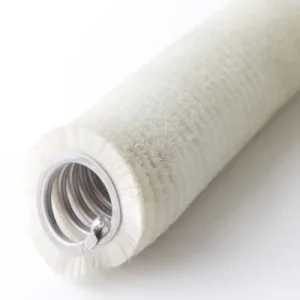
For lines that process multiple capsule types, quick-change brush mounting systems let operators swap brushes optimized for each shell material in minutes rather than hours. A line that runs gelatin capsules in the morning and HPMC capsules in the afternoon can use a 0.20 mm brush for the gelatin run and switch to a 0.30 mm brush for the HPMC run. The cost of carrying two brush specifications is small relative to the cost of running the wrong stiffness and losing product to surface rejects.
The same principles that govern stiffness selection in capsule polishing apply to other pharmaceutical brush applications where surface preservation and cleaning effectiveness compete. The combination of controlled bristle density, correct stiffness, and humidity-stable nylon grades produces the consistent polish quality that pharmaceutical manufacturers depend on for every capsule that reaches a patient.
Frequently Asked Questions
Q1: How does filament cross-section shape affect effective stiffness?
Round filaments are the standard in capsule polishing brushes, but trilobal and cruciform cross-sections are available. A trilobal filament of the same nominal diameter as a round filament deflects more easily because the cross-section moment of inertia is lower. Trilobal filaments provide roughly 15 to 20 percent lower effective stiffness at the same diameter, which can be useful when the ideal filament diameter falls between two standard round filament sizes. The trade-off is that trilobal filaments have less material volume and may wear faster in abrasive powder environments.
Q2: Can brush rotational speed compensate for lower bristle stiffness?
Increasing brush RPM increases the number of filament sweeps per capsule transit and the impact velocity of each sweep. This can partially compensate for lower stiffness because a faster-moving soft filament dislodges particles that a slower-moving soft filament cannot. However, the relationship has limits. At very high RPM, centrifugal force straightens filaments and reduces their ability to deflect around capsule contours, effectively making the brush behave stiffer. Above 1,200 to 1,500 RPM on a typical 100 mm diameter brush, the centrifugal stiffening effect becomes significant and should be accounted for in stiffness calculations.
Q3: What is the minimum filament diameter that still provides useful cleaning in high-speed capsule polishing?
For lines running above 100,000 capsules per hour, filament diameters below 0.15 mm provide diminishing returns because the filaments deflect so easily that they slide over adhered particles rather than dislodging them. The practical minimum for high-speed pharmaceutical lines is 0.15 mm, and even at this diameter the trim length should be kept under 20 mm to maintain enough tip stiffness for effective dust removal. For lines running below 60,000 capsules per hour, 0.12 mm filaments can work for very soft gelatin capsules, but the wear life is short because there is so little material in each filament.