Industrial wire rope rarely fails because it was overloaded on the day it broke. It fails because of what accumulated on and inside it over thousands of operating hours: mill scale and surface rust, hardened lubricant that stopped migrating, coating residue, and fine abrasive grit driven into the strand valleys by sheave pressure. Teams in ports, mines, steel plants, and offshore installations know the frustration that follows, because a rope can look serviceable from the outside while its internal wires have been grinding against each other for months. Descaling closes that gap, and the tool that makes descaling practical on a working rope is a properly specified wire rope cleaning brush.
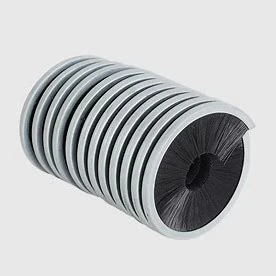
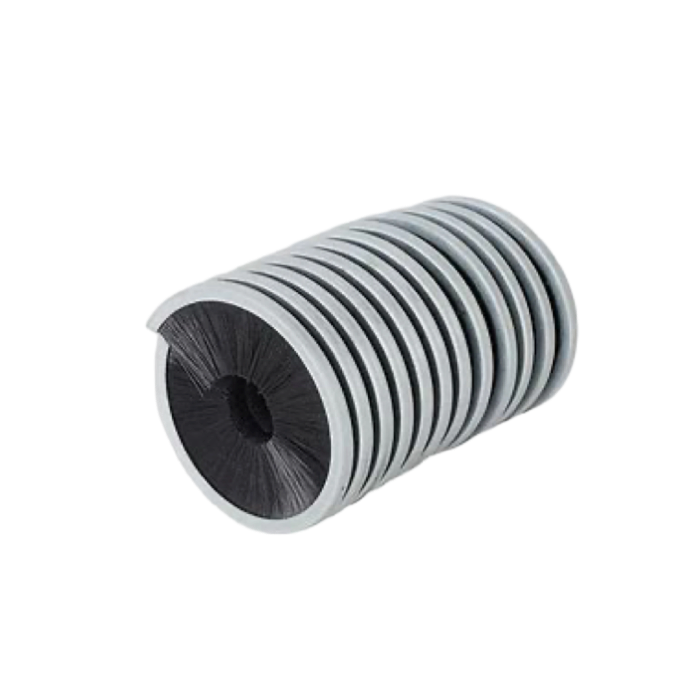
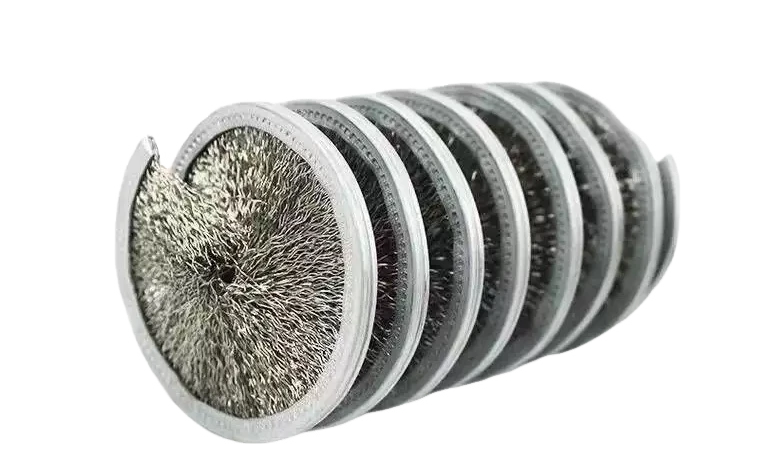
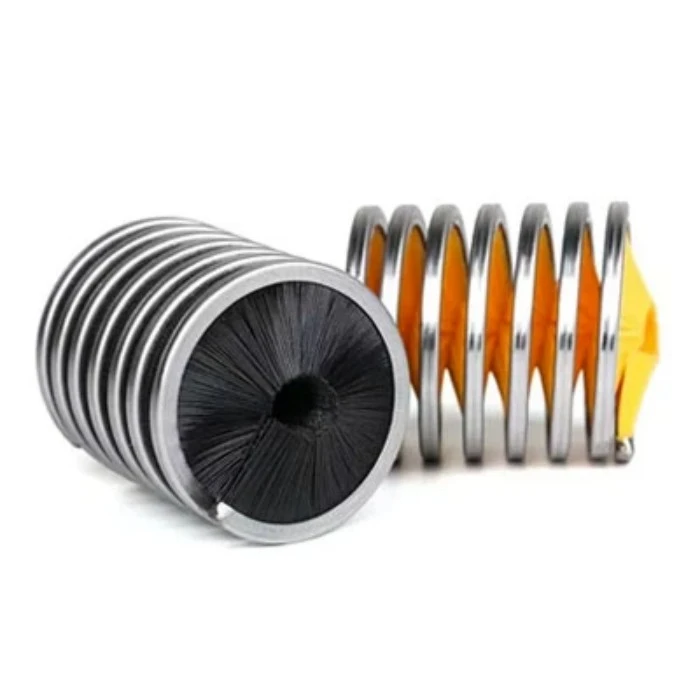
A wire rope cleaning brush is a heavy-duty descaling tool built as an inward-coiling spiral brush, with stiff filaments facing a central bore through which the rope passes, giving full circumference contact that reaches the strand valleys rather than only the outer crowns. With steel, stainless, or brass filaments, it removes mill scale, rust, hardened grease, and coating residue aggressively enough for industrial duty, while nylon and polypropylene variants handle protective cleaning on galvanised, coated, or synthetic ropes.
This article covers how the tool works, which filament material suits which job, the specifications that determine fit, how to select and deploy it, the descaling workflow, where heavy-duty descaling matters most, and how to keep both rope and brush in working condition.
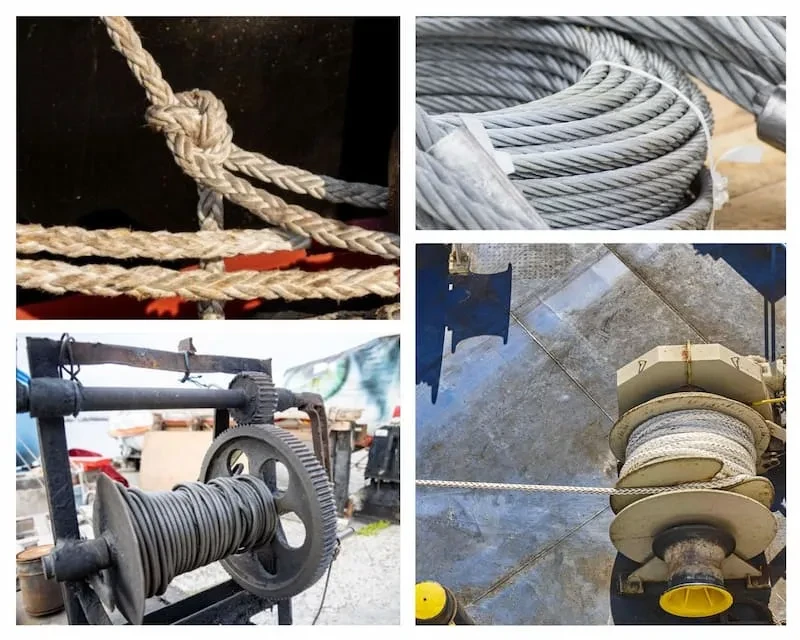
What Makes a Wire Rope Cleaning Brush a Heavy-duty Descaling Tool?
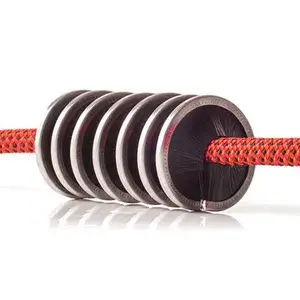
It is a strip brush wound into a spring-like helical coil, with filaments pointing inward toward a hollow bore matched to the rope diameter. As the rope is drawn through the bore, or the brush is slid and rotated along the rope, filaments penetrate the gaps between strands and shear away scale, rust, and dried residue.
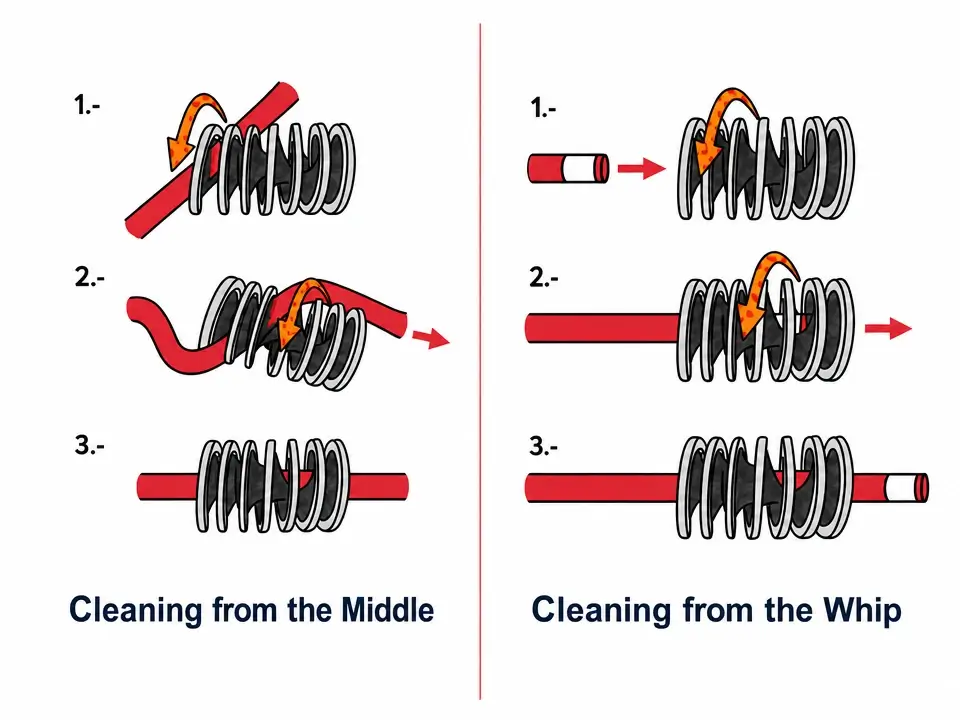
The difference from a conventional hand brush comes down to geometry, not bristle stiffness. A flat brush presents a straight line of filaments to a cylindrical object, so contact is limited to a narrow band on one side, and access to the valleys between outer strands remains intermittent. A coil brush presents filaments around the full circumference at once, and because the coil is open along its length, filaments work slightly into the crevices as the lay rotates through the bore. The spring form also solves the problem of cleaning in place: because the coil tolerates trimming, stretching, or compression within a limited range and adapts to slight diameter variation, the spiral wire brush can be used at a sheave entry, at a drum, or along an accessible free length without removing the rope from the machine.
What Descaling Actually Removes
Four categories of contamination fall under the term descaling, and they do not respond equally to the same tool. Mill scale and surface rust are hard, brittle oxide layers that need stiff steel or stainless filaments to fracture and lift. Hardened, dried lubricant is grease that has lost its lighter fractions and turned tacky or tar-like; it no longer migrates into the core, and it traps grit underneath. Coating and carrier residue leaves films that block the strand valleys the way dried grease does. Embedded grit, mineral dust, and metallic debris are the most damaging category, because fine particles forced into crevices by sheave contact act as a lapping compound against the wires. Each has a dual character: it abrades the wires it touches, and it holds moisture against them, so a contaminated rope corrodes from the inside while wearing from the inside.
Why Full Circumference Contact Matters
Partial cleaning is close to useless because contamination migrates rather than disappears. If only the crowns of the outer strands are cleaned, material in the valleys remains in place, and normal operation gradually redistributes it back across the surface just cleaned. Freshly exposed clean steel next to packed contamination also creates a corrosion cell, since the clean area has no protective film while the contaminated area keeps holding moisture against adjacent wires. Full circumference contact breaks that cycle by removing the reservoir rather than relocating it, which is why a mismatched bore undermines the whole exercise.
Brush Bristle Materials and What Each One Descales Best
Filament material sets both how aggressively the brush cuts contamination and how much risk it poses to the rope. Carbon or stainless steel filaments remove the most material and suit heavy scale on plain steel ropes; brass offers moderate aggression with non-sparking behaviour, and nylon or polypropylene is reserved for coated, galvanised, or synthetic ropes where preserving the surface film matters more than aggressive removal.
The trade-off is simple: the material that lifts hardened scale fastest is also the one most capable of scuffing a zinc coating or a stainless finish, and over-brushing with stiff steel converts a protected surface into bright, unprotected steel that then corrodes faster than the surrounding rope.
Steel, Brass, and Nylon Filaments
Carbon steel filaments are the workhorse for heavy-duty descaling on plain carbon steel rope, cutting mill scale, heavy rust, and hardened dried lubricant, and they suit mining hoists, construction cranes, and general heavy lifting where the rope surface is uncoated. Stainless steel filaments are the choice when the brush must survive the environment as well as clean it, since marine, offshore, chemical, and wash-down areas expose a brush to chloride and moisture that would rust a carbon coil quickly. Where the rope itself is galvanised or stainless, steel filaments must be used with restraint: lighter contact pressure, shorter dwell at any one point, and immediate relubrication so freshly exposed steel is protected before corrosion starts.
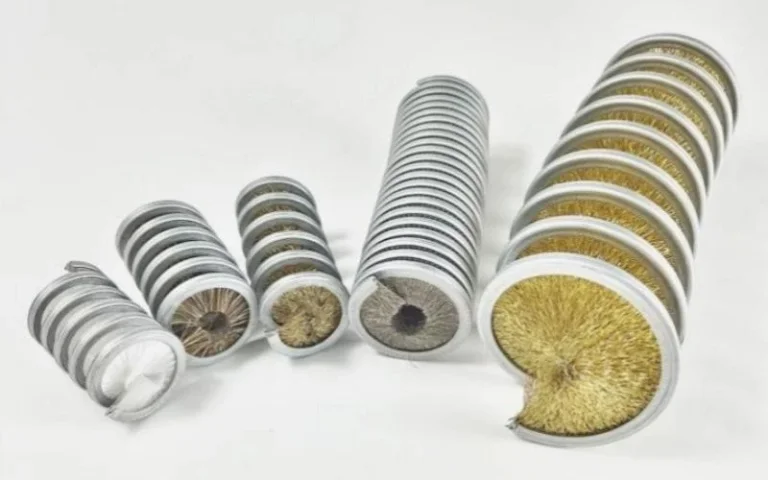
Brass and copper-coated filaments sit in the middle of the aggression range. They clean effectively without cutting deeply into the rope surface, and their distinctive property is non-sparking behaviour, which makes them the specified choice wherever explosive or flammable atmospheres exist. The limitation is equally clear: brass will not fracture heavy mill scale as efficiently as steel. Nylon and polypropylene filaments are the protective option, cleaning without scuffing galvanised coatings or rope surface treatments and avoiding any risk of stray metal filaments contaminating the work area. That last point makes nylon wire brushes the standard choice in food processing, pharmaceutical, and clean-room environments. The boundary must be stated plainly: nylon will not remove hardened mill scale or tar-like dried lubricant, and used on a heavily scaled rope it simply burnishes contamination into a smoother layer.
| Filament Material | Aggression | Risk to Rope Surface | Heat Tolerance | Typical Duty |
| Carbon steel | High | Can scuff galvanised or stainless | High | Heavy scale on plain steel rope; mining, construction |
| Galvanised steel | High | Can scuff soft or coated surfaces | High | Heavy descaling in humid or wet conditions |
| Stainless steel | High | Can scuff soft or coated surfaces | High | Marine, offshore, chemical, hot process |
| Brass or copper-coated | Medium | Low to moderate | Moderate | Non-sparking duty; surface-sensitive work |
| Nylon or polypropylene | Low | Very low | Low | Coated or synthetic rope; food and clean-room areas |
Specifications That Determine Fit and Performance
Five specifications govern whether a brush will actually descale a given rope: inner diameter, outer diameter, filament wire diameter, overall length, and coil pitch. Inner diameter matters most, because it decides whether filaments reach the strand valleys or merely ride the crowns, while the other four control cleaning intensity, tool life, and how the brush can be mounted.
Ordering by nominal rope diameter alone is a common and costly mistake, because rope diameter carries a manufacturing tolerance, so a brush sized to the exact nominal figure may be tight on a rope at the upper end of its band while leaving filaments barely touching a rope that measures at nominal.
| Specification | What It Controls | Selection Guidance | Common Mistake |
| Inner diameter | Whether filaments reach the valleys | Match to measured rope diameter, not the nominal figure | Sizing too large, so filaments skim the crowns |
| Outer diameter | Bulk, clearance, filament depth | Set by required filament protrusion and space at the cleaning point | Too small an outer diameter on a large rope, cutting working depth |
| Filament wire diameter | Aggression and tool stiffness | Thicker filaments for heavy scale, thinner for finer surfaces | Thick filaments on coated rope scuff the protective layer |
| Overall length | Rope cleaned per pass and mounting | Longer coils for in-line cleaning, shorter for spot work | Under-sizing length, forcing repeated passes |
| Coil pitch | Filament contacts per metre and drag | Tighter pitch for thorough cleaning, wider for lower resistance | Judging the tool by outer diameter while ignoring pitch |
Matching Inner Diameter to Rope Diameter
The guiding rule is that all outer strand crowns must make firm, complete contact with the filaments while the brush can still be moved along the rope without excessive force. Get that right, and the filaments deflect slightly as they pass each strand, which is what generates scraping action in the valleys. Rope construction affects fit as well, because a 6×19 class rope presents fewer, thicker outer wires than a 6×36 class rope of the same diameter, so the surface geometry differs even when the measured diameter matches. Lay direction and the resulting helix angle matter too, since the coil must follow the twist without binding. Many coil brushes tolerate trimming, stretching, or compression within a limited range, letting one tool cover a small band of diameters, but that should be treated as a tolerance band rather than a range, since a brush working well outside its intended diameter either loses valley contact or becomes stiff enough to be unsafe to handle.
Filament Wire Diameter, Coil Pitch, and Length
Filament wire diameter is the second most consequential specification. Thicker filaments are stiffer, resist deflection better under load, and remove heavier deposits, while thinner filaments conform more closely to surface detail but deflect away from hard, thick contamination. Heavy-duty descaling on large ropes trends toward thicker steel filaments, and precision work on fine or coated rope leans toward thinner filaments and softer materials. Coil pitch sets how many filament contacts occur per unit length of rope travel: a tighter pitch presents more scraping edges per pass, but increases drag, while a wider pitch reduces resistance and suits powered systems where the rope moves at speed. Overall length should match the cleaning method, with short coils for manual spot work and confined areas near terminations, and long coils for continuous draw-through cleaning.
How to Choose the Right Wire Rope Cleaning Brush
Selection follows four steps in a fixed order: measure the rope and record its construction, choose the filament material, decide how the brush will be deployed, then confirm environmental and standard requirements with the supplier. The order matters because each step narrows the field, and following it prevents the common error of choosing a brush by appearance or material preference before the rope geometry is known.
- Measure the rope and note its construction. Record the actual diameter at several points rather than the data sheet figure, and note construction class, core type, and lay direction. The chosen wire rope cleaner must fit the measured diameter and follow the lay.
- Choose the filament material. Match aggression to contamination and rope finish. Heavy scale on plain steel points to steel or stainless; coated, galvanised, or synthetic ropes point to nylon or polypropylene; explosive atmospheres point to brass.
- Decide the deployment method. Determine whether the brush will be used by hand, mounted at a fixed point the rope passes through, or integrated into a powered descaling unit. This fixes coil length, pitch, and end fittings.
- Confirm environment and standard requirements. Account for temperature, chemical exposure, salt spray, and any standards the site must satisfy. Temperature alone eliminates materials, since nylon has a far lower working limit than steel.
Manual, Stationary, and Powered Descaling Setups
| Setup | Capacity | Suitable Rope Diameter | Relative Cost | Practical Notes |
| Manual slide-along and rotate | Low | Small to moderate | Lowest | Flexible and precise; labour-intensive; for short lengths and spot work |
| Fixed brush station at a travel point | Moderate to high | Moderate to large | Low to moderate | Cleans continuously as the rope pays in or out; needs mounting and guarding |
| Powered rotary descaling unit | High | Moderate to large | Highest | Best for high-cycle fleets; needs clearance, guarding, and trained operators |
Manual work is adequate for low-cycle equipment, short accessible lengths, and cleaning close to terminations where a powered unit cannot reach. As diameter and duty cycle rise, a fixed station where the rope enters or leaves a drum becomes attractive, because the rope effectively cleans itself each time it travels. Powered units offer the highest throughput and are common in ports, mines, and heavy lifting fleets, but they require proper guarding and operators trained not to hold rope against the filaments in one position. Where a rope has both heavy scale and a sensitive finish, a staged arrangement works well: an aggressive steel coil first, followed by a plain wire round brush to sweep loosened debris without further scuffing.
A worn brush does not fail visibly; it simply stops clearing the valleys while still looking serviceable. A practical rule is to examine the brush at intervals based on usage, checking after every fifty cleaning operations as a reasonable baseline, and replacing it once roughly thirty per cent of filament length is gone. A useful diagnostic from the rope side is to watch how much force is needed to move the brush: when the same brush on the same rope suddenly becomes much easier to push, filament length has been lost, and the valleys are no longer being contacted.
The Descaling and Maintenance Workflow
Descaling is a preparatory step with a fixed position in the sequence: clean, dry, inspect, then lubricate. Cleaning removes abrasive contamination and opens the strand valleys, drying eliminates the moisture and solvent residue that would otherwise be sealed inside, inspection uses the now-visible surface to assess condition, and lubrication restores the protective film across the full cross-section.
The order is non-negotiable because each step depends on the one before it. Lubricant applied to a contaminated rope cannot reach the core and instead traps grit against the wires; lubricant applied to a wet rope seals moisture inside, and inspection performed on freshly greased rope is largely worthless because a smooth film hides the defects that matter most.
Step by Step Descaling Procedure
- Isolate and secure the equipment. Lock out the drive, release tension where the procedure allows, and confirm the rope cannot move. Never descale a live moving rope unless the station is purpose-built and guarded.
- Put on personal protective equipment. Gloves against broken wires and metal filaments, and eye protection against flying scale.
- Perform a preliminary inspection. Traverse the full length for deformation, broken wires, corrosion bloom, and damage near terminations. If the rope already meets removal criteria, cleaning is pointless.
- Work in sections along the lay. Draw the brush in the direction of strand twist, rotate slightly between passes so filaments reach crowns and valleys, and avoid lingering in one place.
- Use a compatible solvent where deposits are hardened. Dried lubricant may need solvent applied and allowed to dwell rather than more pressure on the filaments. Confirm it will not attack the rope’s remaining lubricant film.
- Remove loosened debris. Wipe or blow off dislodged material so it does not resettle into valleys just cleared.
- Dry the rope completely. Allow full evaporation of solvent and water; in moderate conditions this commonly takes twenty to forty minutes, longer when cold or humid.
- Inspect the clean surface. This is the highest-value inspection the rope will receive, and findings should be recorded rather than noted mentally.
- Relubricate with a compatible product. Match lubricant type to the application and work it into the valleys rather than coating only the surface.
- Record the cycle. Note date, rope section, findings, and lubricant used so deterioration trends become visible across intervals.
Why Descaling Must Precede Lubrication
Three mechanisms explain why the sequence matters. Penetration is blocked because fresh lubricant reaches the core through the gaps between outer strands, and where those gaps are packed with scale and hardened residue, lubricant stays on the surface as a cosmetic coating while the core runs dry. An abrasive paste is created because old lubricant holds grit, metal particles shed from fatigue wear, and moisture, and fresh lubricant over the top seals all of it against the wires. And defects are concealed, because a lubricated rope is harder to examine than a clean one, so broken wires and early pitting can hide under an even film.
Standards frameworks reinforce the discipline. In the United States, wire rope slings must be inspected before each use and removed from service immediately when defective, as set out in the applicable provisions of 29 CFR 1910.184, and equivalent provisions in crane and lifting standards follow the same logic. Rope structure and the internal wear mechanisms that make descaling necessary are described in general reference material on wire rope construction, while nominal diameter and manufacturing tolerance are specified in international standards such as ISO 2408.
Descaling as the Best Inspection Window
Because descaling strips away the material that hides defects, it is the best opportunity to assess rope condition. On the clean surface, check for broken wires within a lay length, broken wires near terminations, diameter reduction measured crown to crown and compared with the original figure, corrosion state, deformation such as kinks or birdcaging, and heat damage. Pitting, internal corrosion, and structural deformation are normally treated as immediate grounds for removal from service rather than conditions to monitor. A sander wire brush applies comparable discipline in a different context, being designed for surface preparation and finishing work on flat or contoured surfaces rather than for cleaning rope that remains in load-bearing service, and the distinction matters when specifying abrasives and brushes for a workshop.
Where Heavy-duty Rope Descaling Matters Most
Priority is set by two factors acting together: how fast contamination accumulates, and how severe a rope failure would be. Operations exposed to salt, mineral dust, process chemicals, or heavy cyclic loading sit at the top of the list, while protected indoor installations with low cycling sit at the bottom, though even there descaling remains the prerequisite for meaningful inspection.
| Environment | Contamination Mechanism | Suggested Discipline | Why It Ranks Here |
| Marine and offshore | Salt spray, chloride corrosion, lubricant wash-off | Frequent descaling with stainless or brass filaments; fresh-water rinse; documented examination | Corrosion advances rapidly, and internal damage is hard to detect |
| Mining, quarrying, earthmoving | Abrasive dust, mud, impact loading | Descaling after each dust or slurry exposure; monthly documented examination | Grit acts as a lapping compound and accelerates wear sharply |
| Steel plants and foundries | Scale, heat, airborne particulates | Descaling with heat-tolerant filaments; inspection keyed to thermal exposure | High temperature degrades lubricant and filaments alike |
| Ports and shipyards | Salt air, cargo dust, high duty cycles | Regular descaling with stainless filaments at drum or sheave entry | High cycle counts compound contamination effects quickly |
| Elevators and fixed hoisting | Low external contamination, internal fatigue | Descaling and inspection at each lubrication service | Contamination is light, but the inspection window is essential |
| Food processing and clean lines | Product residue, wash-down chemicals | Descaling with nylon filaments; no metal shedding permitted | Residue is aggressive, and filament shedding is a quality risk |
Maintenance Practices That Protect the Investment
Descaling produces compounding returns only when it is part of a documented cycle rather than an occasional reaction, and the brush itself needs care, since filaments left caked with residue or that rust between uses lose effectiveness and can transfer contamination back onto a rope just cleaned.
The economics are straightforward. Descaling costs maintenance labour and modest tool replacement, while the events it defers, namely rope replacement and unplanned downtime, are among the largest single maintenance costs in heavy lifting. Between uses, clear filaments of residue, dry the inside-coil-brush tool before storage, avoid crushing or distorting the coil, track usage against the replacement threshold, and store tools separately by filament material to prevent cross-contamination in clean environments. Rope care between descaling cycles is equally tied to handling: spool rope onto a reel rather than coiling it loosely, keep reels elevated and clear of the floor in a cool, dry, ventilated area, avoid dragging rope across rough surfaces, and keep suspended rope under appropriate tension so slack loops cannot tighten into permanent kinks. Match lubricant type to the application, using penetrating lubricants where the core must be protected, coating lubricants where exterior moisture is the threat, and combination products where both apply, and descale and examine rope that has sat idle before it takes load again.
FAQ
Q1: How do I know whether to clean or retire a wire rope?
Descaling is worthwhile only if the rope is still fit for service. If it shows broken wires exceeding the applicable limit for its construction and duty class, a measurable diameter reduction, pitting or internal corrosion, or structural deformation such as kinking or birdcaging, it should be removed from service rather than cleaned. Descaling is what makes those conditions visible, so the answer usually emerges during the cleaning pass itself. When in doubt, the decision belongs with a competent person, and the rope stays out of service until that decision is made.
Q2: Do I need a powered descaling machine, or can I clean by hand?
Manual descaling is entirely adequate for low-cycle equipment, short accessible lengths, and work near terminations where a machine cannot reach. A powered rotary unit becomes worthwhile when rope diameter is large, when several ropes need regular descaling, or when the rope travels long distances and can be cleaned continuously at a fixed station as it pays in and out. The deciding factor is usually throughput and labour hours at each interval rather than cleaning quality, since both approaches can achieve full contact. Powered units also introduce guarding and training requirements that manual work does not.
Q3: Is descaling necessary for low-cycle indoor elevator ropes?
Yes, though for a different reason than heavy industrial duty. Indoor elevator ropes accumulate little external contamination, so descaling is not primarily about removing scale. It is about creating a clean surface, which is the only reliable basis for inspection, and elevator ropes are subject to statutory examination at defined intervals. Removing the lubricant film and light residue allows strand condition, diameter, and termination integrity to be assessed properly. Descaling in this context is best scheduled immediately before each examination or lubrication service rather than on a separate calendar.