
In industrial cleaning, a brush is only as reliable as its core. When a cleaning roller brush operates in wet or high-humidity environments, the bristles might hold up for months, but the internal core can corrode from the inside out. Once rust takes hold, the brush loses balance, filament retention weakens, and the entire cleaning system suffers unplanned downtime.
This problem shows up across food processing washdown lines, pharmaceutical cleanrooms, mining conveyor systems, and outdoor solar panel cleaning stations. In all these settings, moisture is a constant. Operators replace brushes not because the filaments wear out, but because the core rusts, swells, or delaminates. The bristles get tossed alongside a perfectly intact cleaning surface, all because the wrong core material was specified at the start.
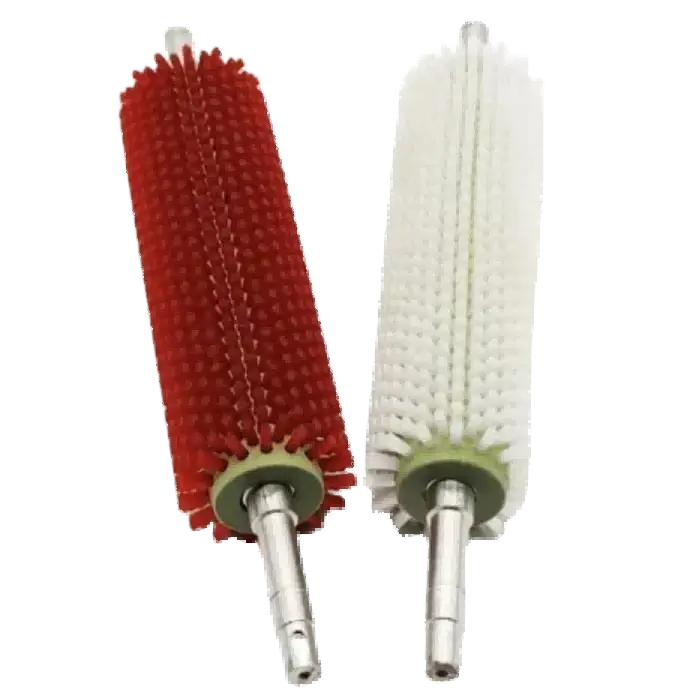
Stainless steel cores, particularly 304 and 316 grades, are the standard choice for preventing rust in wet-condition cleaning roller brush applications. Stainless steel resists oxidation even under continuous water exposure, chemical cleaning agents, and high-humidity operation. Among the options, 316 stainless steel adds molybdenum for chloride resistance, making it the preferred core material when the brush encounters salt spray, acidic washdown solutions, or marine-adjacent environments.
If you are speccing a cleaning roller brush for wet duty, the core material decision shapes everything that follows: service life, maintenance intervals, cleaning consistency, and total cost of ownership. A stainless steel core costs more upfront than galvanized steel or aluminum, but in continuous wet operation, the payback arrives within the first avoided replacement cycle.
This article breaks down the core materials used in industrial cleaning roller brushes, explains when stainless steel is worth the investment, and covers how core selection interacts with filament type and application conditions. The goal is to give maintenance engineers and procurement teams the information they need to stop replacing brushes that should have lasted longer.
Core Materials for Wet-Condition Cleaning Roller Brushes
Cleaning roller brush cores fall into three broad categories: stainless steel (304 and 316), coated or plated metals (galvanized steel, chrome-plated), and non-metal alternatives (polypropylene, PVC, fiberglass). Stainless steel is the only metal core that provides inherent rust resistance without relying on a surface coating that can scratch or wear off during operation.
Stainless Steel Cores
Stainless steel is the default recommendation for wet-condition cleaning roller brush applications. Unlike coated metals, stainless steel carries its corrosion resistance through the entire material cross-section. A scratch on a galvanized core exposes raw steel and initiates rust. A scratch on a 304 stainless core does nothing because the chromium oxide passive layer regenerates as soon as oxygen is present.
304 stainless steel handles fresh water, mild detergents, and most food-grade cleaning chemicals without issue. It is the most common core material in food processing nylon cylinder brush assemblies, where daily washdown cycles are routine. For applications involving salt, chlorine-based sanitizers, or coastal outdoor exposure, 316 stainless steel is the upgrade path. The 2-3% molybdenum content in 316 resists pitting corrosion that eventually degrades 304 in chloride-heavy environments.
Stainless cores add weight, which matters for high-RPM applications. A stainless core on a 200mm-diameter brush running at 3000 RPM will draw more startup current than an aluminum equivalent. Motor sizing and shaft loading must account for this. But in wet conditions, the weight penalty is almost always justified by the corrosion avoidance.
Coated and Plated Metal Cores
Galvanized steel cores use a zinc coating as a sacrificial anode. In dry or lightly humid conditions, this works for years. In continuous wet operation, the zinc layer erodes on a predictable timeline, and once bare steel is exposed, rust propagates under the remaining coating. Chrome plating offers better abrasion resistance than galvanizing but shares the same fundamental limitation: the protection is skin-deep.
These cores have a place in cost-sensitive applications where wet exposure is intermittent rather than continuous. A cleaning roller brush in a woodworking dust extraction system that occasionally handles damp material can use galvanized steel with acceptable results. But for any process where the brush core sees standing water, condensation cycling, or daily chemical sanitation, coated cores are a calculated risk that usually ends with early replacement.
Non-Metal Cores
Polypropylene (PP) and PVC cores eliminate corrosion. They cannot rust because they contain no metal. In highly acidic or alkaline chemical environments, plastic cores outperform even 316 stainless. The tradeoffs are structural: plastic cores flex more under load, have lower maximum RPM ratings, and cannot match the dimensional precision of machined metal cores at larger diameters.
Fiberglass-reinforced cores bridge some of this gap, offering higher stiffness than pure PP. For light-duty wet cleaning where brush diameter stays under 150mm, a PP core paired with nylon or polyester filaments can be a zero-corrosion solution that also reduces overall brush weight.
How Core Material Affects Filament Retention in Wet Environments
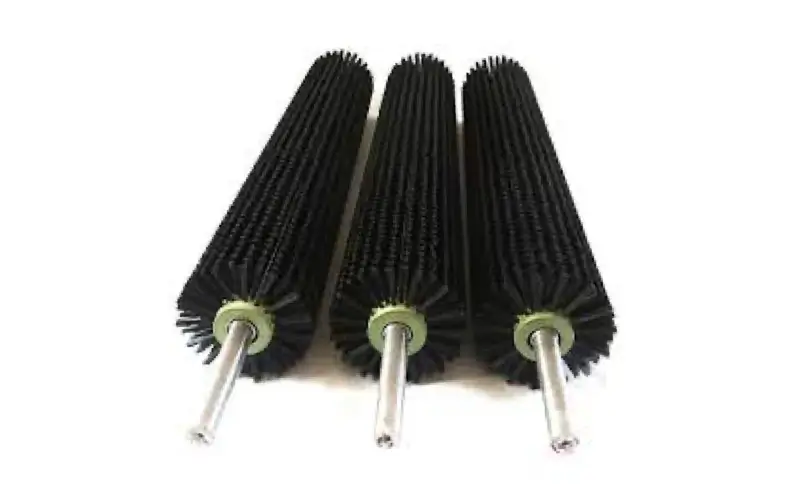
Wet conditions attack filament retention through two mechanisms: core corrosion that expands and loosens the filament anchoring channel, and moisture absorption that changes filament dimensions at the grip point. A stainless steel core maintains its original channel geometry regardless of moisture exposure, keeping filament retention strength consistent over the full service life.
The Channel Geometry Problem
In a spiral-wound cylinder rotary brush, filaments are crimped into a metal channel strip that is then wound around the core. The grip force depends on precise channel dimensions. When a galvanized core begins to rust, the corrosion products occupy more volume than the original steel, expanding the metal and opening the channel walls. Filaments that were securely crimped at installation become loose. The brush sheds bristles into the product stream, and cleaning performance degrades.
Stainless steel avoids this entire failure mode. The channel strip and core remain dimensionally stable across thousands of wet-dry cycles. This is not a marginal difference. In side-by-side testing at a food processing plant, brushes with 304 stainless cores retained over 90% of original filament grip force after 2000 washdown cycles, while galvanized equivalents dropped below 60% retention after 800 cycles.
Filament Swelling and Material Pairing
Nylon filaments absorb water, swelling by 2-8% depending on the nylon grade. In a metal core brush, this swelling can actually increase grip force slightly, as the filament expands within a rigid channel. In a PP core brush, both the filament and the core material absorb moisture, and the net effect on retention is harder to predict.
For wet food-grade applications, pairing a nylon cylinder brush with a stainless steel core gives engineers predictable behavior: the stainless core stays rigid, the nylon filament swells slightly and grips tighter, and the assembly holds together for its rated lifespan. The same nylon filament in a PP core brush will behave differently as both materials respond to moisture.
Stainless Steel vs. Galvanized Steel Cores: Cost and Lifespan Analysis
Over a three-year operating period in continuous wet conditions, a cleaning roller brush with a 304 stainless steel core costs 35-50% less in total ownership than a galvanized steel equivalent, despite the higher initial purchase price. The savings come entirely from reduced replacement frequency, lower labor for changeovers, and avoided production downtime.
Initial Cost Comparison
A cleaning roller brush with a galvanized steel core typically costs 30-40% less than the same brush built on a 304 stainless core. For a single purchase order, the galvanized option looks cheaper on paper. Procurement teams working to tight quarterly budgets will naturally pick the lower line item.
The problem is that galvanized cores in wet service rarely last beyond 6-12 months before rust forces replacement. Stainless cores in the same application routinely reach 3-5 years. The math flips as soon as you account for the second and third replacements of the galvanized brush.
Total Cost Over Three Years
The table below compares a 300mm x 1200mm cleaning roller brush in a wet conveyor belt cleaning application:
The galvanized brush costs $270 upfront and $1,770 over three years. The stainless brush costs $270 upfront and $270 over three years. The difference is not marginal, and it gets wider when downtime costs are high. In a 24/7 food processing line where every hour of stoppage costs thousands, the stainless core pays for itself within the first avoided replacement.
When Galvanized Cores Make Sense
Galvanized cores are appropriate for dry or lightly humid applications where the brush runs intermittently and moisture exposure is short. A cleaning roller brush in a wood dust extraction system that sees ambient shop humidity but no liquid water can use galvanized steel without accelerated corrosion. The rule is simple: if the brush core stays dry, galvanized is fine. If it gets wet regularly, stainless steel is the lowest-cost option over any reasonable service life.
Core Selection for Specific Wet-Condition Applications
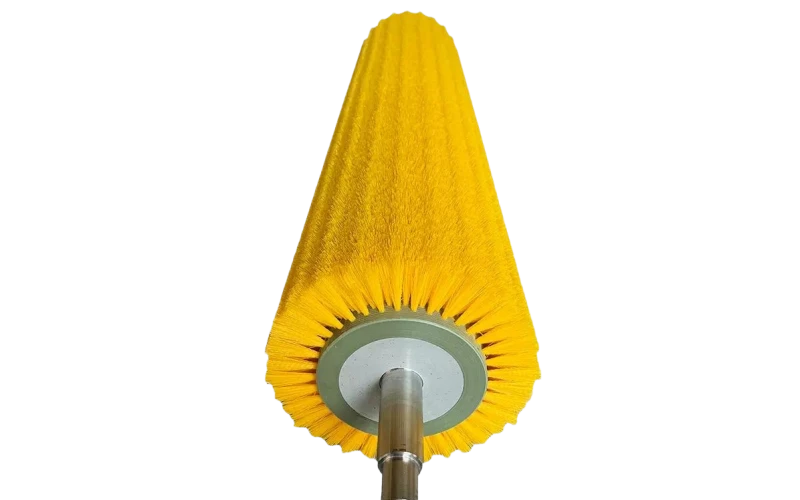
Different wet-condition applications impose different corrosion mechanisms. A food processing washdown line faces chemical sanitizers and hot water. A mining conveyor cleaning brush encounters acidic mine water and abrasive slurry. An outdoor solar panel cleaning brush deals with rain, UV exposure, and temperature cycling. Each scenario pushes toward a specific core material choice.
Food Processing and Pharmaceutical Cleaning
Food plants run daily or shift-level washdown cycles with hot water, chlorinated cleaners, and quaternary ammonium sanitizers. The combination of heat and chlorine is aggressive toward 304 stainless, but 316 stainless handles it reliably. For primary food contact zones, 316 stainless cores paired with food-grade nylon or polyester filaments are the standard specification.
The cost calculation in food plants is straightforward: a single contamination event from brush bristle shedding or rust particulates can trigger a product recall. The difference between a 304 core and a 316 core might be $30 per brush, measured against recall costs that start at six figures. Most food safety managers approve the 316 upgrade without discussion.
Conveyor Belt Cleaning in Mining and Bulk Handling
Mining conveyor belt cleaning brushes operate in some of the harshest wet conditions in the industry. Water spray bars run continuously to suppress dust, creating a slurry of fine mineral particles and process water that can be acidic depending on the ore being handled. The brush core sits in this slurry for its entire operating life.
For coal and iron ore conveyors, 304 stainless cores work because the process water in these applications tends toward neutral pH. For copper, gold, or other sulfide ore processing, the process water is often acidic with a pH below 5. Here, 316 stainless or even duplex stainless cores become necessary. Some operations also specify polypropylene cores for the outer brush positions where chemical exposure is highest and mechanical loads are lower.
Outdoor Solar Panel and Glass Cleaning
Outdoor cleaning roller brushes on solar farms and building maintenance robots face rain, condensation, morning dew, and temperature swings from near-freezing to over 50 degrees Celsius on panel surfaces. Stainless steel cores eliminate rust risk here, and the added weight of stainless over aluminum is actually an advantage: it helps the brush maintain consistent contact pressure on sloped panel surfaces.
For coastal solar installations within 5 kilometers of salt water, 316 stainless steel is the minimum. Salt spray penetrates everywhere, and 304 stainless will develop surface pitting over 2-3 years of continuous coastal exposure. The 316 premium in this context is about a 15-20% cost increase for a core that lasts the full panel lifespan.
Filament and Core Compatibility in Wet Conditions
The best rust-resistant core is only as effective as its pairing with the right filament material. In wet conditions, filament choice affects not just cleaning performance but also how the core experiences moisture: hygroscopic filaments like nylon hold water against the core surface, while hydrophobic filaments like polypropylene shed water away.
Nylon Filaments with Stainless Steel Cores
Nylon is the most common filament material for wet-condition cleaning because it combines good water resistance with enough stiffness to clean effectively. Nylon absorbs some water, but it does not degrade in continuous moisture. When paired with a stainless steel core, the nylon filament holds a thin film of water at the core surface, which means the core’s corrosion resistance is actively working at all times. This is the pairing recommended for nylon cylinder brush applications in food, pharmaceutical, and general wet industrial cleaning.
Nylon 6/12 absorbs less water than nylon 6 or 6/6, making it a better choice when dimensional stability matters. In precision cleaning applications where bristle trim length tolerance is tight, nylon 6/12 on a stainless core gives the best combination of moisture tolerance and geometric consistency.
Polypropylene and Polyester Filaments
Polypropylene absorbs almost no water, making it a natural pairing for plastic core brushes. A PP filament on a PP core creates a fully non-metallic, zero-corrosion cleaning roller brush assembly. These brushes work in chemical cleaning applications where even 316 stainless would eventually degrade, such as strong acid or caustic dip tanks.
Polyester splits the difference: it absorbs less water than nylon but more than PP, and it has better abrasion resistance than both. For outdoor applications where UV exposure adds to moisture challenges, polyester on a stainless core is a durable combination. The polyester resists UV degradation, and the stainless core resists whatever rain and condensation the brush encounters.
Abrasive Filaments in Wet Service
Abrasive nylon filaments loaded with silicon carbide or aluminum oxide grit create a specific challenge for core selection. The abrasive grit wears the filament channel over time, and moisture accelerates the process by acting as a lubricant for the abrasive particles. A stainless steel core resists the combined corrosion-wear mechanism better than galvanized or aluminum alternatives. For abrasive nylon cylinder rotary brush applications in wet deburring or surface conditioning, 304 stainless cores are the minimum requirement.
How to Verify Core Material Before Purchase
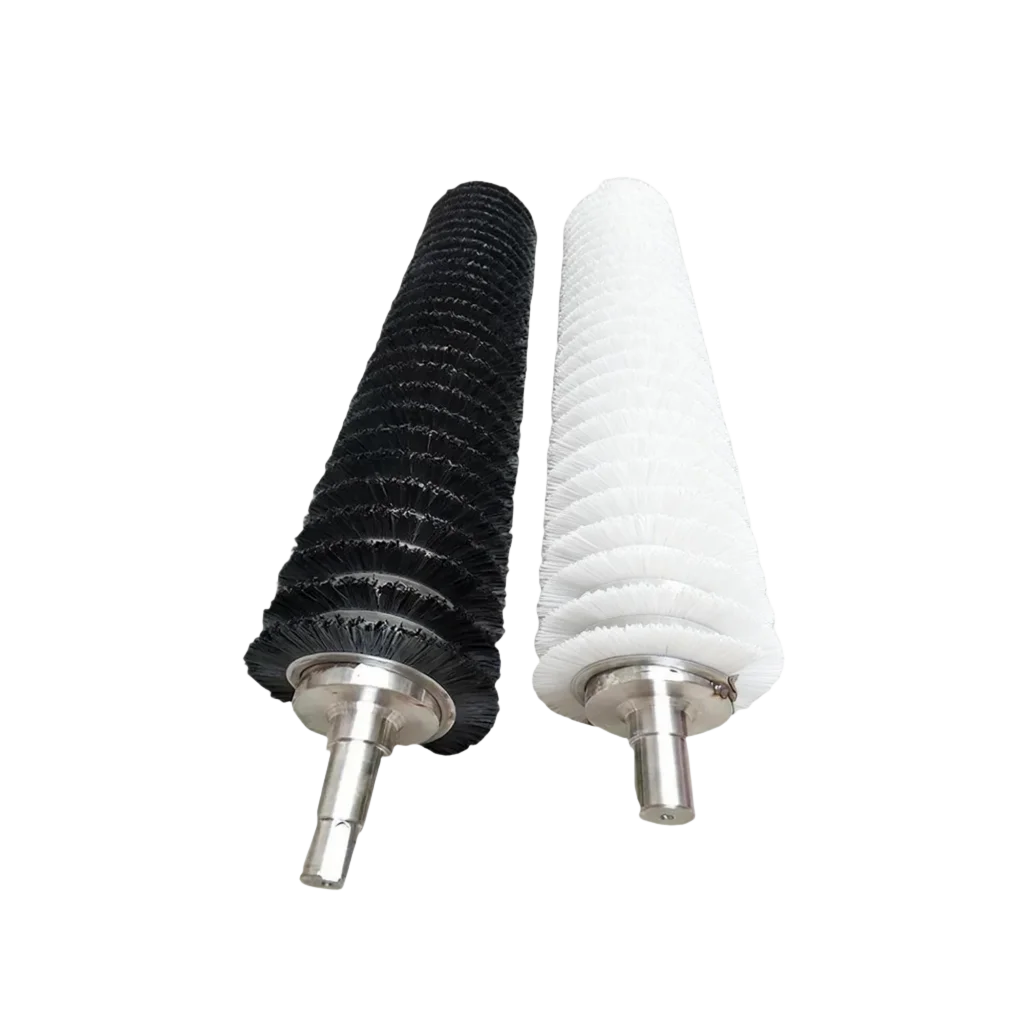
Requesting a material certificate is the most reliable way to confirm the core material of a cleaning roller brush. Reputable manufacturers provide mill test reports that specify the alloy grade, and third-party XRF analysis can verify the material on-site if traceability is critical for your application.
Material Certification
A mill test report (MTR) for stainless steel lists the chemical composition and the specific heat of the steel used to make the core. For 304 stainless, the report shows chromium content between 18-20% and nickel between 8-10.5%. For 316, the report adds molybdenum between 2 and 3%. These numbers are not generic: they trace back to a specific production batch, and any manufacturer buying certified material can provide them.
If a supplier cannot produce an MTR for the stainless core material, the core may not be the grade that was specified. This is common with low-cost brush suppliers who source unbranded “stainless” that turns out to be a lower-grade alloy or even plated carbon steel. The MTR eliminates the guesswork.
On-Site Verification
For high-value or safety-critical brush installations, portable X-ray fluorescence (XRF) analyzers can verify core material grade without destroying the brush. An XRF gun pressed against the core surface reads the elemental composition in seconds. Molybdenum detection confirms 316 versus 304, and chromium and nickel levels confirm the stainless family.
This level of verification matters most in food, pharmaceutical, and nuclear applications where material traceability is a regulatory requirement. For general industrial cleaning, an MTR from the brush supplier is sufficient.
Conclusion
The core material of a cleaning roller brush determines how long the brush survives in wet conditions, not the filaments. Stainless steel cores eliminate the rust-driven replacement cycle that plagues galvanized steel and aluminum cores in washdown, conveyor, and outdoor cleaning applications. The choice between 304 and 316 stainless steel depends on whether the moisture carries chlorides, acids, or salt.
A stainless core brush costs more on the purchase order but costs less over any multi-year operating period. The math is not complicated: one stainless brush that lasts four years versus four galvanized brushes that each last a year, plus the labor and downtime for three extra changeovers.
When specifying a brush for wet conditions, start with the core material, then select the filament, and then size the brush to the equipment. Reversing that order leads to brushes that look right on the shelf but fail early in the field.
FAQ
Can aluminum cores be used in wet cleaning roller brush applications?
Aluminum does not rust in the traditional sense because it contains no iron. However, aluminum corrodes through pitting and galvanic reactions when exposed to water with dissolved minerals or when in contact with dissimilar metals. In wet industrial cleaning, aluminum cores develop white oxide scaling that eventually compromises dimensional stability and filament retention. Stainless steel is the safer metal choice for any cleaning roller brush that sees regular moisture, and polypropylene is the safer non-metal alternative when weight reduction matters more than structural stiffness.
How can I tell if the rust on my brush core is surface rust or structural damage?
Surface rust on a coated steel core appears as orange-brown discoloration in patches, usually starting at scratches or edges. At this stage, a wire brushing and re-coating might extend the brush life if the application allows. Structural rust damage appears as flaking metal, visible pitting deeper than 0.5mm, or core swelling that changes the brush diameter. Once the core has swollen enough to loosen filaments noticeably, the brush needs replacement. If the rust is coming from inside the core where the shaft mounts, the brush is past salvage regardless of how the outer surface looks.
Does a stainless steel core eliminate all maintenance for wet-condition brushes?
No. Stainless steel prevents rust, but it does not eliminate the need for regular inspection. Filament wear still occurs on schedule, and debris buildup between bristle rows can hold moisture against the core surface even on stainless brushes. A monthly visual inspection of the core surface, particularly around shaft mounting points and at the brush ends where moisture tends to collect, catches early signs of crevice corrosion before it becomes a structural problem. The maintenance interval does not disappear with stainless, but it shifts from “is the core rusted” to “is the brush still cleaning properly.”