Most surface damage on soft metal is not caused by neglect. It is caused by a tool that was one step too hard for the material underneath it. A cleaning operation that works perfectly on a steel weldment can leave permanent tracks across an aluminium casting, and the operator rarely notices until the part is inspected under proper lighting. Choosing between a steel brush and a softer alternative is therefore not a matter of preference. It is a material-hardness decision with a very small margin for error.
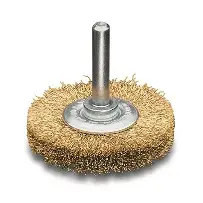
A round brass wire brush is the right tool when you need to clean, finish, or deburr a soft metal or a spark-sensitive area without cutting into the substrate, and when the surface is raw, cast, or satin rather than mirror-polished. It is a stem-mounted circular brush, commonly called a wire round brush, that fits a drill, die grinder, or flexible shaft. It becomes the wrong tool the moment you need to remove heavy rust, mill scale, or weld spatter, because brass wire is deliberately too soft to cut that material efficiently.
This guide sets out the cases where brass is genuinely the only sensible choice, the cases where it quietly ruins the part, and the parameters that decide which brass brush to specify.
What a Round Brass Wire Brush Actually Is
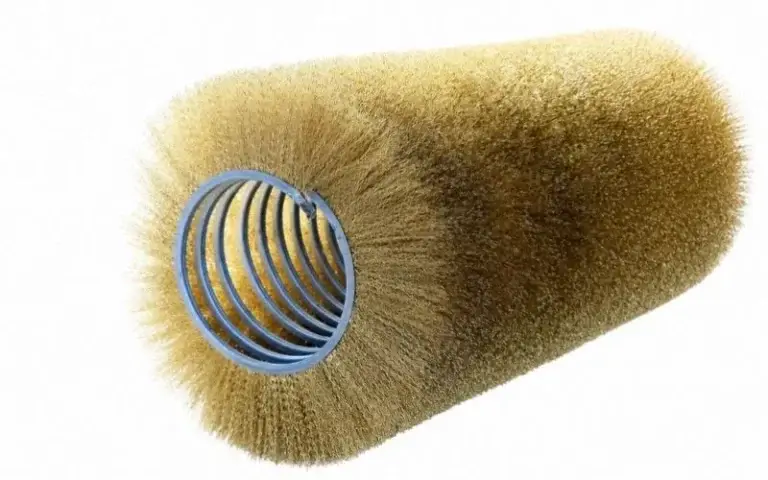
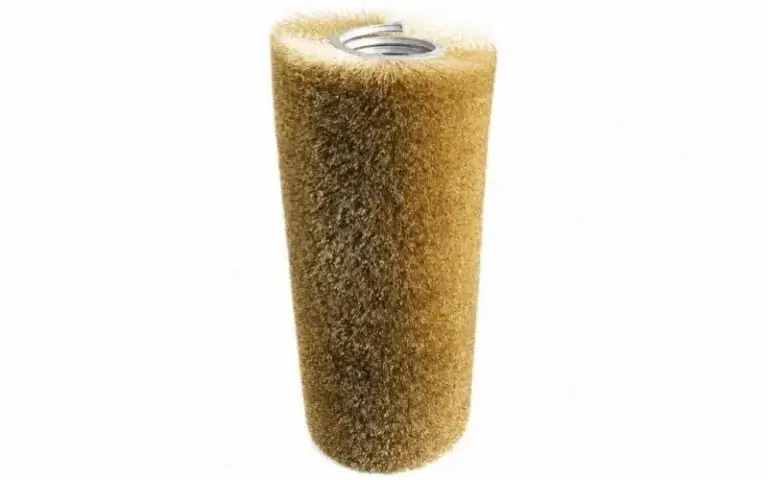
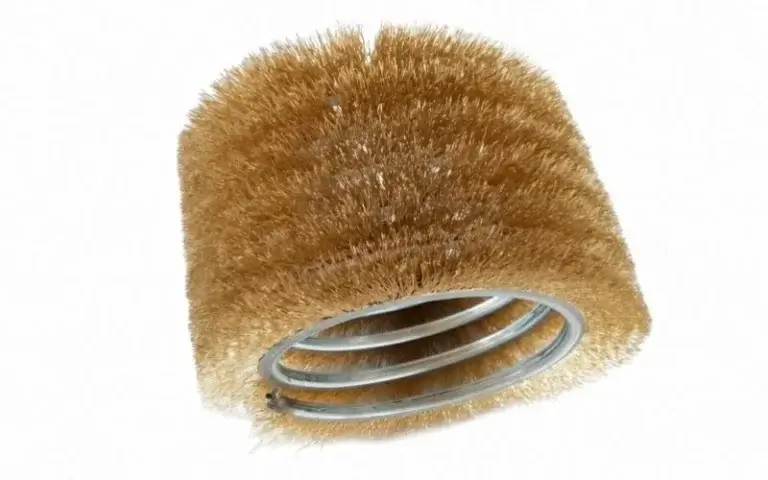
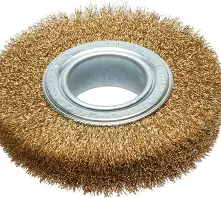
A round brass wire brush is a stem-mounted circular brush in which brass wire is held in a circular hub, and the free ends extend outward around the full circumference of the wheel. It differs from a cup brush, an end brush, and a standard wire wheel mainly in how the wire contacts the work: a wire round brush presents wire tips radially and is fed against the surface from the side, which makes it well suited to internal diameters, narrow slots, grooves, and contoured profiles that a flat wheel cannot reach.
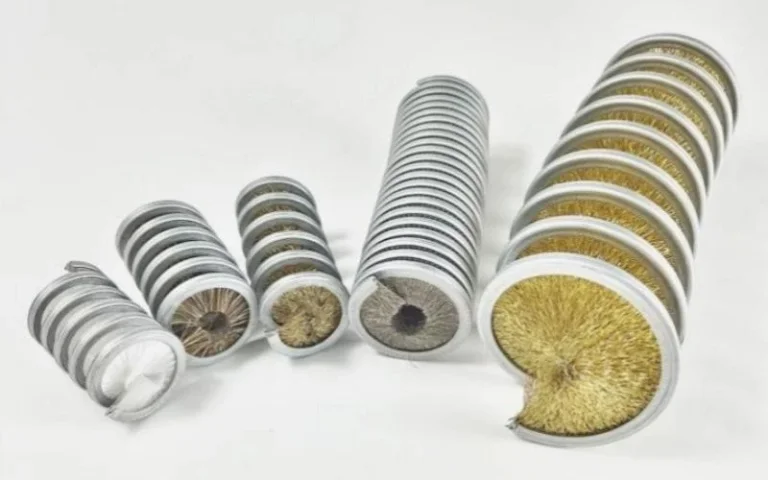
The shape is only half the specification. The wire itself is set in one of two ways. Crimped wire is waved along its length before being cut and set, which gives a dense, compliant face that conforms to irregular geometry and produces a softer, more controllable action. Knotted or twisted wire is gathered into bundles that are twisted tight, leaving a stiff, aggressive face that removes more material but leaves a coarser pattern. For soft-metal work, the crimped construction is almost always the correct starting point.
| Format | Contact direction | Best suited to | Typical brass use |
| Round brush (stem-mounted) | Radial, approached from the side | Internal diameters, grooves, slots, contours | Deburring bores, cleaning threads, finishing cast profiles |
| Wheel brush | Radial, approached from the face | Flat open surfaces, wide areas | Light scale removal, blending on soft metals |
| Cup brush | Axial, flat face on the work | Large flat areas, corners | Rust and paint removal, largely carbon steel work |
| End brush | Axial, tip-on | Recesses, tight corners, drilled holes | Spot cleaning, hole deburring |
| Tube or twisted-in-wire brush | Radial, pushed through | Pipe, tubing, long bores | Internal cleaning of soft-metal tubing |
The stem diameter, trim length, and wire density together determine how much force the brush will apply at a given speed. A long trim length gives a gentler, more flexible action but wears faster and deflects under pressure. A short trim length with high density is stiffer and cuts more aggressively, which is usually the opposite of what a soft-metal application needs. The practical rule is to use the shortest trim that still reaches the geometry, and to compensate for a short trim by lowering the feed pressure rather than raising the speed. This is also why a wire round brush is rarely interchangeable between jobs: a brush sized for a 20 mm bore will not perform the same way in a 60 mm bore, even at identical speed and pressure.
The Situations Where Brass Is the Only Sensible Choice
Brass is the only sensible choice in three broad situations: where a spark could ignite a flammable atmosphere, where ferrous contamination would damage the part or the process, and where the workpiece is a soft metal that a harder wire would visibly scratch. In each of these cases, a brass round brush is not merely a preference; it is the option that keeps the operation safe or the part acceptable.
The first situation is hazardous-area work. In refineries, petrochemical plants, grain handling, flour mills, mining, and any environment with a potentially explosive atmosphere, a brush that can produce a spark is a hazard in its own right. Brass and other copper-based alloys are used for non-sparking tooling precisely because they do not generate the hot, high-energy sparks that steel does when it strikes a hard surface. Brass also carries a useful secondary property in these environments: with roughly 28% of the conductivity of copper on the International Annealed Copper Standard, a brass brush can help dissipate static charge rather than allowing it to accumulate on an isolated part.
The second situation is contamination control. Carbon steel wire leaves embedded ferrous particles on the surface of whatever it touches. On aluminium, copper and stainless steel, those particles become localised corrosion sites, producing the speckled rust bloom that appears days after a part was supposedly cleaned. Brass wire does not introduce this problem in the same way, which is why it is standard for electrical contacts, instrument components, switchgear and any assembly where stray iron is unacceptable. Brass is also effectively non-magnetic, so it can be used near magnetic sensors and delicate mechanisms without attracting debris.
| Property | Carbon steel wire | Stainless steel wire | Brass wire |
| Approximate Mohs hardness | 6.0–6.5 | 5.5–6.5 | 3.5–4.0 |
| Spark risk on hard contact | High | Moderate | Negligible |
| Magnetic | Yes | Slightly | No |
| Ferrous contamination risk | High | Moderate | None |
| Corrosion resistance of the wire | Poor | Good | Moderate |
| Suitable for soft metals | No | Limited | Yes, with care |
One caveat is worth stating plainly, because it is the most common misunderstanding in this area. The wire being non-sparking does not make the whole brush non-sparking. The hub, the stem, the retaining rings, and the crimp are still steel in most standard constructions, and those components are what actually strike a workpiece if the brush is misused or run at excessive pressure. For genuinely classified hazardous areas, the entire tool assembly needs to be assessed, not just the bristle material.
Hardness Matching Is the Real Decision Variable
The decision between brass and any other wire is governed by relative hardness. Brass wire sits at roughly 3.5 to 4.0 on the Mohs scale of mineral hardness, which places it above pure aluminium at 2.5 to 3.0 and pure copper at 3.0 but below mild steel at 4.0 to 4.5 and stainless steel at 5.5 to 6.5. The critical consequence is that brass is harder than aluminium and copper, so it can still mark them. What brass does is move the operation from cutting to light abrasion, which is a much smaller and more controllable effect.
| Material being cleaned | Approximate Mohs hardness | Brass wire suitable? | Notes |
| Pure aluminium | 2.5–3.0 | Yes, with care | Raw cast surfaces tolerate it; polished surfaces do not |
| Copper | 3.0 | Yes, with care | Light pressure only; watch for smearing |
| Brass workpiece | 3.0–4.0 | Marginal | Matching hardness risks galling and smearing |
| Aluminium alloys (heat treated) | 3.0–4.0 | Marginal to none | Higher-strength alloys mark more easily |
| Mild steel | 4.0–4.5 | For light work only | Too soft for scale or rust removal |
| Stainless steel | 5.5–6.5 | Not recommended | Cleanability is fine; contamination control is the problem |
Two material-specific effects matter more than the hardness number alone. The first is galling, or smearing, which happens when two surfaces of similar hardness rub together and material transfers rather than being cut away. A brass brush on a brass workpiece is the classic example: instead of cleaning the surface, the brush can drag metal across it and leave a smeared, dull finish. The second is work hardening on aluminium, where repeated light abrasion hardens the surface layer and makes subsequent finishing less predictable.
There is also a practical threshold that separates acceptable from unacceptable soft-metal work, and it is not the alloy but the finish. Raw cast aluminium, extruded profiles, sand-cast parts and satin-finished components will generally accept a brass brush and improve. Mirror-polished aluminium, anodised surfaces, plated parts and high-gloss decorative faces will not, because any abrasion of a reflective surface is immediately visible as a change in clarity. If the part has to stay mirror-bright, brass is the wrong family of tool regardless of how lightly it is used.
Where a Brass Brush Is the Wrong Tool
A brass round brush is the wrong tool for heavy rust, mill scale, weld spatter, thick paint and coatings on steel, for stainless steel where cleanliness specifications apply, for food, pharmaceutical and cleanroom environments, and for any surface that has to remain mirror-polished. In all of these cases, the brush either cannot do the job at all or introduces a contamination risk that outweighs the benefit of using a softer wire.
On heavy corrosion, the limitation is fundamental rather than a matter of technique. Brass wire is too soft to fracture mill scale, which is composed largely of wüstite, magnetite and haematite and is harder than the rust around it. Attempting the job anyway does not produce a clean surface; it polishes the top of the scale and leaves the underlying corrosion in place, which is a worse outcome than not starting, because the surface now looks prepared while failing a proper adhesion test.
Stainless steel needs separate consideration. Brass wire will not damage the substrate, but the brush carries copper and zinc, and on stainless work the metallurgical concern is not iron contamination but the introduction of foreign elements into a surface that may later be passivated or welded. Where a specification governs the finish, the appropriate tool is a stainless brush dedicated to stainless work, used exclusively for that purpose. The same logic applies to food handling, pharmaceutical equipment, and cleanrooms, where copper and zinc are not acceptable residues.
Temperature is the other hard limit. Brass wire is generally rated for continuous operation at temperatures up to roughly 300 °F, or 180 °C, at the wire itself. Above that, the alloy softens, the wire deforms under load, and the brush loses its geometry quickly. High-temperature work belongs to a different wire material.
| Wrong application | What goes wrong | Correct alternative |
| Heavy rust or mill scale on steel | Scale is polished, not removed | Abrasive wheel, needle gun, or abrasive blasting |
| Weld spatter removal | Brass deforms against the spatter | Chipping hammer, grinding wheel |
| Stainless steel with a finish spec | Copper and zinc contamination | Dedicated stainless brush |
| Food, pharma, cleanroom surfaces | Metallic residue in a controlled area | Food-grade or nylon abrasive brush |
| Mirror-polished aluminium | Visible loss of reflectivity | Non-abrasive polishing pad |
| Continuous service above 300 °F | Wire softening and deformation | Heat-resistant wire material |
| Brass or high-strength alloy workpiece | Galling and smearing | Nylon abrasive or soft polishing brush |
Specifying the Brush: Wire Diameter, Trim, Density and Speed
Wire diameter is the primary control on how aggressively a brass brush acts. For cleaning and polishing soft metals, brass wire in the 0.08 to 0.20 mm range is the standard band; for light deburring and heavier oxidation, 0.20 to 0.65 mm is used. Within end brushes, 0.10 to 0.15 mm wire is used for fine polishing and 0.20 to 0.30 mm for heavier oxide removal. Thicker wire cuts faster and leaves a coarser pattern; thinner wire gives a finer, more forgiving finish at the cost of longer working time.
Trim length and density then modulate that baseline. A brush with a long trim and moderate density will flex under load and follow contours, which is exactly what internal bores and irregular castings require. A brush with a short trim and high density is stiff and will cut a fixed path, which is useful on flat work but unforgiving on curved geometry. For a wire round brush used inside a bore, trim length also sets the effective working diameter, so it is chosen to match the bore rather than the finish.
Two operational parameters complete the specification. The first is the maximum safe free speed, published by the manufacturer for each brush and which must always be equal to or higher than the no-load speed of the tool it is mounted on. Running a brush above its rated speed is a shedding hazard: wire can be thrown at speed, and the brush can fail structurally. The second is balance. Above roughly 350 to 500 RPM, dynamic balancing becomes relevant, and an unbalanced brush will vibrate, chatter, and produce an uneven finish pattern that no amount of technique will correct.
Speed also interacts with finish quality in a way that surprises most operators. Because brass wire still abrades, running it fast generates heat and increases the depth of the mark it leaves. Keeping spindle speed in the region of 4,500 to 6,000 RPM and below, using light pressure and letting the wire tips do the work, produces the satin finish brass is known for. Running the same brush fast and hard produces something closer to a scratch pattern, which is the opposite of the intended result.
Technique That Keeps the Surface Scratch-Free
Scratch-free brass brushing comes down to four habits: keep the speed low, keep the pressure light and the contact angle shallow, use a fresh or evenly worn brush, and clean thoroughly between different metals. Brass wire creates a light, even abrasion when the tips glide across the surface, and a damage pattern when the wire is pressed flat and dragged.
The contact angle is the parameter most often ignored. Holding the brush at a shallow angle of roughly 5 to 15 degrees to the work presents the wire tips to the surface and lets them flick across it, which cleans efficiently without gouging. Pressing the brush flat, so that the wire is bent against the surface, converts the brush into a stiff scraper and is the single fastest way to mark a soft metal. Pressure should be just enough to keep the tips in contact; if the wire is visibly deflecting at the root, the pressure is too high.
Brush condition deserves attention too. A new brass brush has sharp, square-cut wire ends that cut more aggressively than the same brush after an hour of use, so a new brush should be trialled on scrap material before it touches a finished part. Once the tips round over, the brush becomes gentler and more predictable, but it also stops cleaning effectively and starts polishing the surface instead, which is the point at which it should be replaced for cleaning work.
Finally, keep brass brushes separate from steel tools. A brass brush that has been used on carbon steel, or that has been stored loose in a drawer with steel brushes, can transfer ferrous particles onto soft metal and produce the after-rust bloom that the brass wire was chosen to avoid. Dedicate each brass brush to one material family and one purpose, and clean the workpiece after brushing to remove loose debris before any coating or assembly step.
| Common mistake | Visible result | Correction |
| Brush pressed flat against the work | Grooves and a directional scratch pattern | Hold at 5 to 15 degrees, light pressure |
| Spindle speed too high | Localised heat, deeper marks | Reduce to roughly 4,500 to 6,000 RPM or lower |
| Brand-new brush on a finished part | Sharp, uneven scratch marks | Break in on scrap material first |
| Brass brush used previously on carbon steel | Rust bloom days after cleaning | Dedicate brushes to one material family |
| Brush worn past the point of effective cleaning | Surface polished but still contaminated | Replace the brush |
| Brush run above its rated speed | Wire shedding, uneven finish | Match brush rating to tool no-load speed |
FAQ
Q1: Is a brass wire brush non-sparking?
The brass wire itself is considered non-sparking because copper-based alloys do not produce the hot, high-energy sparks that steel generates on hard contact. However, the hub, stem, retaining rings, and crimp of a standard round brush are usually steel, and those parts can spark if they strike the workpiece. In a classified hazardous area, assess the entire tool assembly rather than the bristle material alone, and confirm the tool is approved for the zone.
Q2: Can I use a round brass wire brush on aluminium?
It depends on the finish, not only the alloy. Raw cast, extruded, and satin-finished aluminium generally tolerates a brass brush well and can be cleaned or given a light satin finish with one. Mirror-polished, anodised, or plated aluminium should not be brushed with brass, because brass wire is harder than pure aluminium and any abrasion of a reflective surface shows immediately. Use light pressure and low speed, and test on scrap before working a visible face.
Q3: Do I need a different brush for stainless steel?
Yes. Brass will not damage a stainless surface, but it introduces copper and zinc into a material that may later be passivated or welded, and that contamination is unacceptable where a finish specification applies. Stainless steel work should use a stainless wire brush dedicated exclusively to stainless, stored separately, and never used on carbon steel, so that no ferrous or foreign particles are carried back onto the part.