
A good Potato Peeling Brush does more than just ensure that the surface is clean; it directly influences the yield of peeled product and the uniformity of the product, as well as any unplanned downtime on an industrial washing line. However, many processors still replace worn brushes with the cheapest available option and suffer a failure that recurs within weeks.
The ideal replacement brush should have three main features: a SUS304 stainless steel shaft with thick walls, bristle materials that are suitable for each processing stage, and high-density bristle planting. This is why each of these standards is so important and what happens when any one of them is not met.
Next, let’s look at three production problems caused by low-quality replacement brushes. Once we understand the problems, we can move on to the solutions.
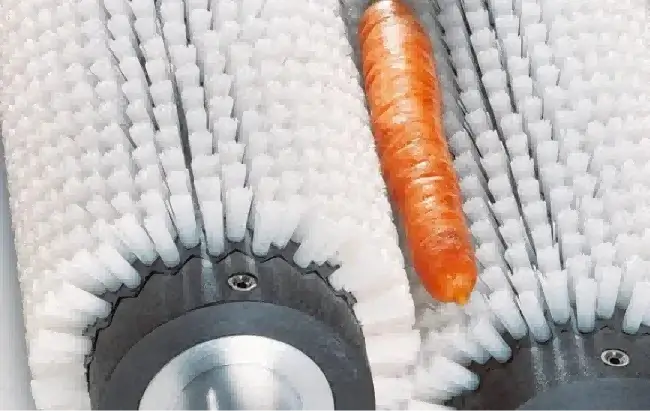
3 Issues from Low-Quality Replacement Brushes
Real-world failures on high-throughput potato lines make it easier to understand the solutions.
Thin/Carbon Steel Shafts Corrode Fast in Wash Water
Potato washing creates a large amount of wastewater with heavy sand particle loads, starch, and high concentrations of microorganisms. A basic carbon steel shaft will start corroding from the interior outward within a few months under these conditions. When the internal corrosion reaches the surface, the anchor wires cannot hold the bristle tufts together any longer, and the whole brush falls apart in the middle of a shift.
Low-Rigidity Shafts Bend Under Heavy Loads
Industrial potato peeling machines handle several tons per hour on a routine basis. Downward pressure and frictional drag from this volume place enormous stress on each roller. A slight midpoint sag can develop gradually in a thin-wall or low-grade shaft after weeks of continuous operation.
That small deflection creates a non-uniform pressure profile, where both ends press too hard while the center barely contacts the potatoes. The result is predictable: excessive peeling and product damage at the ends; the potatoes in the middle still carry soil residues. Such a single defect can seriously damage finished-product yield across an entire shift. For more details on controlling material loss, see the guide on how to reduce loss during potato peeling.
Improper Bristles Lead to Uneven Peeling
If a processor uses the same bristle type for both the washing stage and the peeling stage, then neither stage will perform well. Soft bristles cannot remove skin efficiently; overly hard ones in the wash zone gouge clean potatoes. Teamed with low-density planting, this brush leaves visible stripe marks and an inconsistent peel depth—another quality issue that bulk buyers immediately reject.
Standard 1: Thick-Wall SUS304 Anti-Rust Rigid Shaft
Thick-Wall 304 Shafts for Potato Washing
The shaft forms the core of each roller of the Vegetable Cleaning Brush and, therefore, must bear all mechanical as well as chemical stresses at the same time. SUS304 stainless steel is resistant to chloride-rich wash water, acidic starch residue, and abrasive sand— the three drivers for corrosion in every potato line. A thick wall section also removes the possibility of internal pitting, which is a risk that thin-wall tubes cannot eliminate.
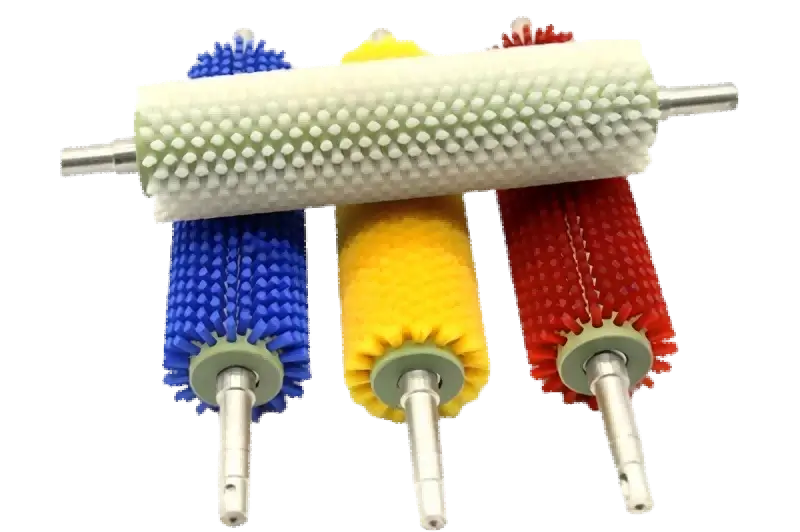
Rigid Shafts Prevent Bending & Even Peeling Force
A well-designed thick-wall shaft will not change its straightness along the full roller length, even when subjected to multi-ton throughput. Uniform rigidity ensures that the contact pressure of the bristles is the same from one end to another; hence, every potato receives the same intensity of peeling. Such consistency forms the basis for high yield and low loss at scale.
Thin/Carbon Steel Shafts Have Higher Long-Term Costs
A cheaper shaft may cut the purchase price by 15–20%, but here’s what really hurts:
- Unscheduled downtime for emergency brush replacement
- Increased potato waste from uneven peeling
- Shorter brush lifespan, needing more frequent orders
Over a 12-month cycle, total expenditure on cheap shafts often doubles the cost of a single premium SUS304 roller.
Standard 2: Stage-Matched Bristle Materials
Mud Wash: Medium-Hard PA612 Crimped Nylon
The first wash must take away soil, sand, and surface dirt without harming the skin beneath. It is a Nylon Cylinder Brush which has crimped PA612 filaments that give it the right balance: not so stiff to dislodge heavy mud, and not so flexible to miss the irregular contour of the potato. This PA612 also has better moisture resistance and longer fatigue life in comparison with standard PA6.
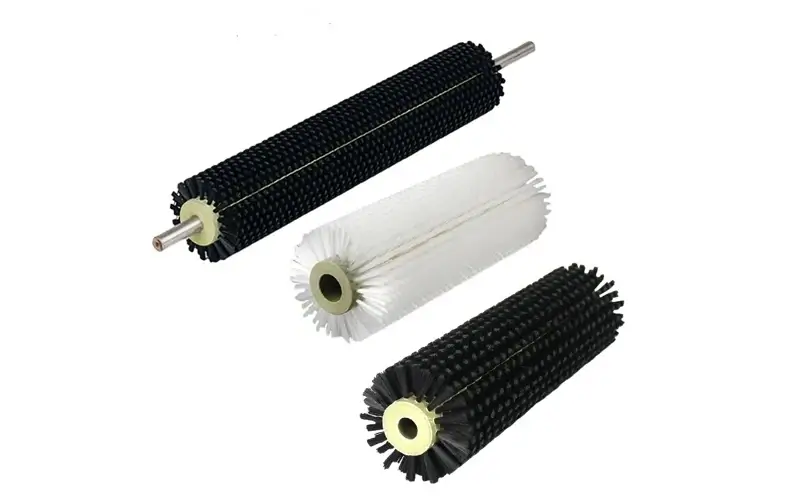
Heavy Peeling: 0.8–1.2mm Abrasive Bristles
The peeling station needs aggressive material removal. It should be done with abrasive-grit filaments, which are bristles in diameters of 0.8–1.2 mm and are capable of cutting power to strip skin at high roller speed. The large diameter also makes it rigid enough so that the filament will not fold under load.
Avoid Mixed Bristle Mistakes
Using peeling-grade abrasive bristles in the wash zone scratches already-clean potatoes, while setting soft nylon in the peeling zone forces operators to increase roller speed or processing time — both of which raise energy costs and cut into throughput. Each stage needs a different brush specification. For more on picking the right brush across different vegetable lines, check out the guide to selecting a durable Vegetable Cleaning Brush.
Standard 3: Dense Bristles for Even Peeling
Key Advantages of High-Density Planting
Dense bristle rows keep multiple filament tips in contact with the potato surface all the time. This distributes peeling force, preventing deep gouging while producing a smooth, market-ready finish. High-density planting also extends brush service life because each individual filament carries less load.
Defects of Sparse Planting
Rollers that are thinly planted will show strip marks as well as leave an inconsistent thickness of peel; they will also wear out faster since fewer filaments share the total workload. In operations with high volume, these defects will directly translate to higher product rejection rates.
Potato Peeling Brush Spec Comparison
| Parameter | Premium Specification | Budget Specification |
| Material of Shaft | Thick-wall stainless steel of SUS304 | Steel, carbon thin wall |
| Corrosion Resistance | Excellent—resistant to sand, acid, and chloride | Poor—rusts internally in months |
| Shaft Rigidity | High—no deflection at mid-span | Low deflection is measurable under load |
| Wash-Stage Bristle | Crimped PA612 nylon, medium hardness | PA6 nylon, general softness |
| Peel-Stage Bristle | 0.8–1.2 mm abrasive grit of silicon carbide | 0.5 mm smooth plain nylon |
| Bristle Density | Planting of bristles at high density | Planting standard/sparse |
| Peeling Uniformity | End-to-end uniformity | Heavy at ends, light at center |
| Service Life | 10–14 months | 3–5 months |
FAQ
What’s the replacement cycle on an industrial potato peeling brush?
A good Potato Peeling Brush, with a SUS304 shaft and abrasive bristles, should normally go for 10-14 months under typical daily throughputs of several tons before being replaced.
Can one brush roller be used for both washing and peeling?
No, because different functions require different types of bristles: the washing process needs bristles of medium hardness made of nylon, while abrasive grit filaments are needed for the peeling process. Besides, dual-purpose bristles will reduce both efficiency and quality.
What bristle diameter should be used for heavy peeling?
A bristle diameter of 0.8 mm to 1.2 mm with silicon-carbide abrasive filaments will give the required stiffness and sharpness for high-speed industrial peeling.