Modern finishing lines are judged by what the customer feels and sees in the finished cloth, yet the machines that create that surface are often the least understood part of the plant. A stenter, a brushing unit, or a shearing line may run at steady speed for months, and then suddenly produce a batch with faint stripes, uneven nap, or embedded lint that only becomes visible after dyeing. Finishing engineers know the pattern: the fault is rarely in the drive or the tension control, but in a consumable component that wore gradually and stopped behaving as the process assumed. The textile processing brush sits exactly in that category, delivering contact that no rigid roller can replicate, and declining in effectiveness so slowly that the decline goes unnoticed until the cloth itself reports it.
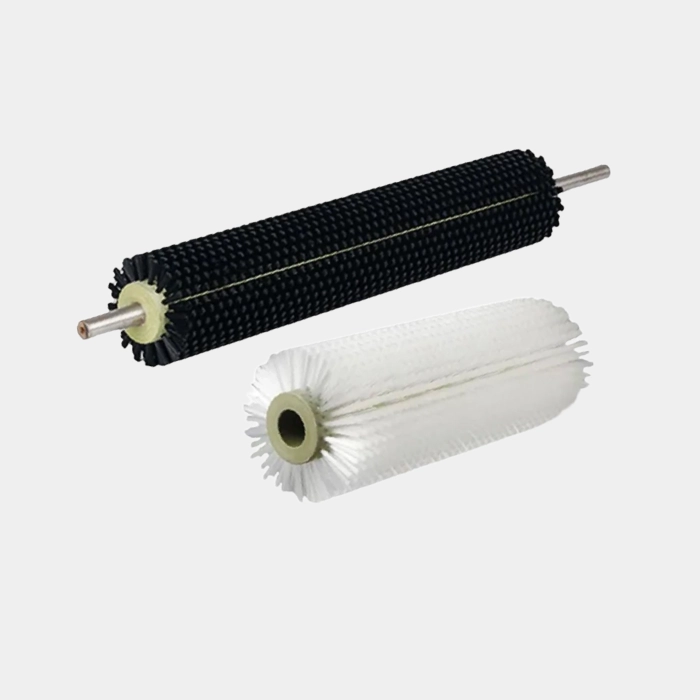
A textile processing brush is a cylindrical brush roller, also called a brush roll, mounted on a shaft and driven to rotate against a moving fabric web at line speed. It performs four distinct jobs on a finishing line: removing lint, dust, and loose fibre from the fabric surface; opening, separating, and guiding the web so it stays flat and correctly tensioned; lifting and aligning existing surface fibres for a controlled nap or hand feel; and conditioning the surface ahead of or behind shearing, coating, printing, or laminating. Because the contact is flexible rather than rigid, it removes contamination and reorients fibre without crushing the weave or marking the face of the cloth, which is why the same basic component appears at so many points on the line with completely different filament specifications at each position.
This article explains what a finishing brush actually contributes, how its role changes from stage to stage, how the two main cylinder constructions differ in performance and failure mode, how filament material is matched to fabric and process, how to specify a brush correctly, which quality defects point back to the brush, and how to keep brushes productive across their working life.
What Does a Textile Processing Brush Do on a Finishing Line?
It provides controlled, flexible contact between a rotating brush face and a moving fabric web. Unlike a rubber-covered roller that applies a nip or a traction surface, the brush contacts the cloth through thousands of individual filaments that deflect under load, so contact pressure stays low and localised rather than flat and compressive. That property is what allows one component family to perform lint removal, web opening, fibre alignment, and surface conditioning without damaging delicate constructions such as knits, microfibre, or nonwovens.
The distinction between flexible and rigid contact explains why brushes are specified at all. A rubber roller is selected when the process needs a nip, support, traction, or a continuous transfer surface. A brush is selected when the line needs cleaning, wiping, non-rigid guidance, or a contact edge that yields instead of marking. When a wound cylinder brush is specified for a wide, high-speed finishing line, it is usually because that flexibility has to be delivered uniformly across the full working width, which places specific demands on construction and balance that will be covered later.
Contact Tasks, Not Just Cleaning
- Lint, dust, and loose-fibre removal. Brushes lift loose fibre, thread ends, and airborne particulate from the fabric face before the next operation, preventing those contaminants from being pressed into the cloth by a downstream nip or printed over by a decorating roller.
- Web opening, spreading, and layer separation. On lines feeding stacked or folded material, a brush face can separate layers and open the web so it enters the next stage flat rather than creased or double-fed.
- Alignment, guidance, and tension assistance. Brush contact helps hold the web in position and maintain consistent tracking through washing, drying, coating, and printing stages without the slip that can occur with a smooth surface.
- Surface conditioning and hand feel. Brushing lifts surface fibres to create or restore a controlled nap, improves the handle of the cloth, and equalises surface appearance across the width.
Which Finishing Stage Is the Brush Working In?
The same physical component behaves completely differently depending on which finishing process it serves, so brush selection must begin with the process rather than with the brush. Napping lifts fibres from the yarn body to create a long directional pile, sueding abrades surface fibres to create a short non-directional nap, brushing aligns and lifts existing loose fibres without creating new ones, and shearing cuts raised pile to a uniform height. Each process imposes different demands on filament stiffness, contact pressure, and rotation direction.
The most common specification error in finishing plants is treating these processes as interchangeable because they all involve a roller touching cloth. They are not. A brush intended to align existing fibre works at low contact pressure and moderate stiffness; a napping roller works through hooked wire clothing that engages yarns and pulls fibre free; a sueding roller works by controlled abrasion that cuts fibre ends. Using the wrong type produces either no visible effect or permanent fabric damage. All four processes sit within the broader family of mechanical and chemical treatments collectively described as textile finishing, and understanding where brushing fits within that sequence is what allows the right station to be specified.
Napping, Sueding, and Brushing Compared
| Process | Mechanism | Pile Length Produced | Directionality | Typical Fibre | Typical Fabric |
| Napping (raising) | Fine wire pins engage yarns and pull fibre ends upward | 1 to 5 mm or more | Strong lay direction | Staple fibre: wool, cotton, acrylic, polyester staple | Flannel, fleece, velour, blanket |
| Sueding | Abrasive surface cuts and roughens surface fibres | 0.1 to 0.5 mm | Largely non-directional | Microfibre, filament polyester, nylon | Peach-skin wovens, stretch wovens, fine knits |
| Brushing | Brush filaments align and lift existing loose fibres | Variable, no new fibre created | Controllable | Any fibre with loose surface ends | Velvet, terry, napped fabric after raising |
| Shearing | Mechanical cutting of raised pile to uniform height | Not applicable, pile levelled | Follows existing pile direction | Any raised fabric | Flannel, velour, blanket, carpet |
The practical consequence is that brushing is a preparation and correction step rather than a pile-creating one. It is the process that makes the other three work reliably, because a web that enters a napping or shearing unit with lint, tangled fibre, or uneven moisture will produce inconsistent results no matter how the downstream machine is set.
Brushing Before and After Shearing
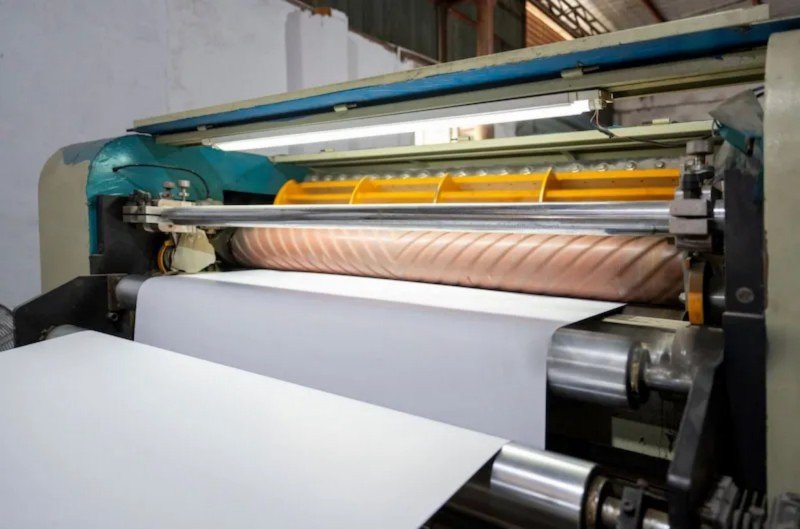
Shearing lines almost always pair the cutting head with brushes on both sides, and the two positions do opposite jobs. Ahead of the shearing head, brushes stand the surface fuzz up and clear away loose debris so the cutter meets a consistent pile height and cuts cleanly rather than dragging or tearing. Behind the shearing head, brushes sweep away the cut fibre and clippings, lay the nap in a uniform direction, and restore a smooth, even appearance to the face.
Moisture control supports this. Many brushing units incorporate a steam box that softens the fibre before the brush contacts it, since fibre that has absorbed steam is more pliable and easier to brush without damage, and the roller is then run in the direction opposite to fabric travel to produce the desired lift. An extraction fan positioned at the brush generally removes the released thread, dust, and floating fibre from the line rather than letting it resettle on the cloth, which is an important detail in plants where airborne lint is already a housekeeping problem.
Wound or Tufted? Choosing the Right Cylinder Construction
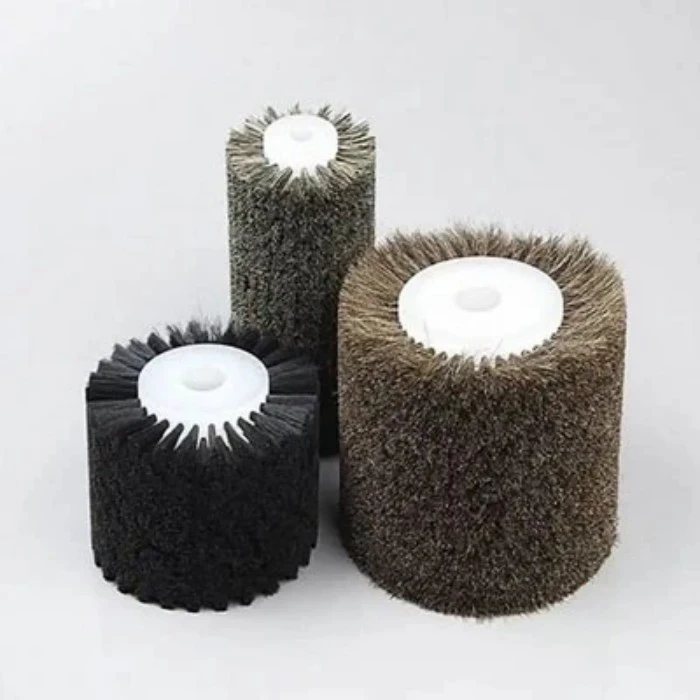
Cylinder brushes are built in three ways: spiral-wound, tufted, and molded. Wound construction feeds a continuous strip brush into a helical channel on the core and achieves the highest filament density with even force distribution, making it the preferred choice for high-RPM and wide-web textile duty. A tufted cylinder brush staples or anchors individual filament bundles into drilled holes, giving flexible tuft patterns and easy replacement of worn sections, and it suits general dry-service duty where density and speed demands are moderate. The two differ most in their failure modes: wound brushes fail at the strip ends or the weld, while tufted brushes fail when staples corrode and shed tufts into the product stream.
Construction selection is therefore a question of matching the working-face requirement to the operating condition. Density and balance matter most where the brush runs fast against a wide web; replacement economics and pattern flexibility matter most where the brush runs at moderate speed in a dry environment and individual worn sections can be renewed. Getting this wrong produces either vibration and uneven contact at speed, or unexpected contamination shedding into product.
Spiral-Wound Construction
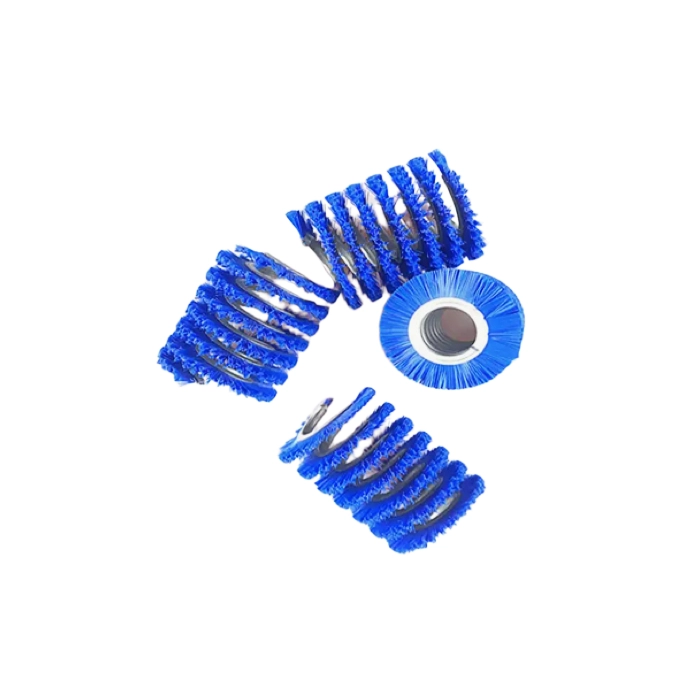
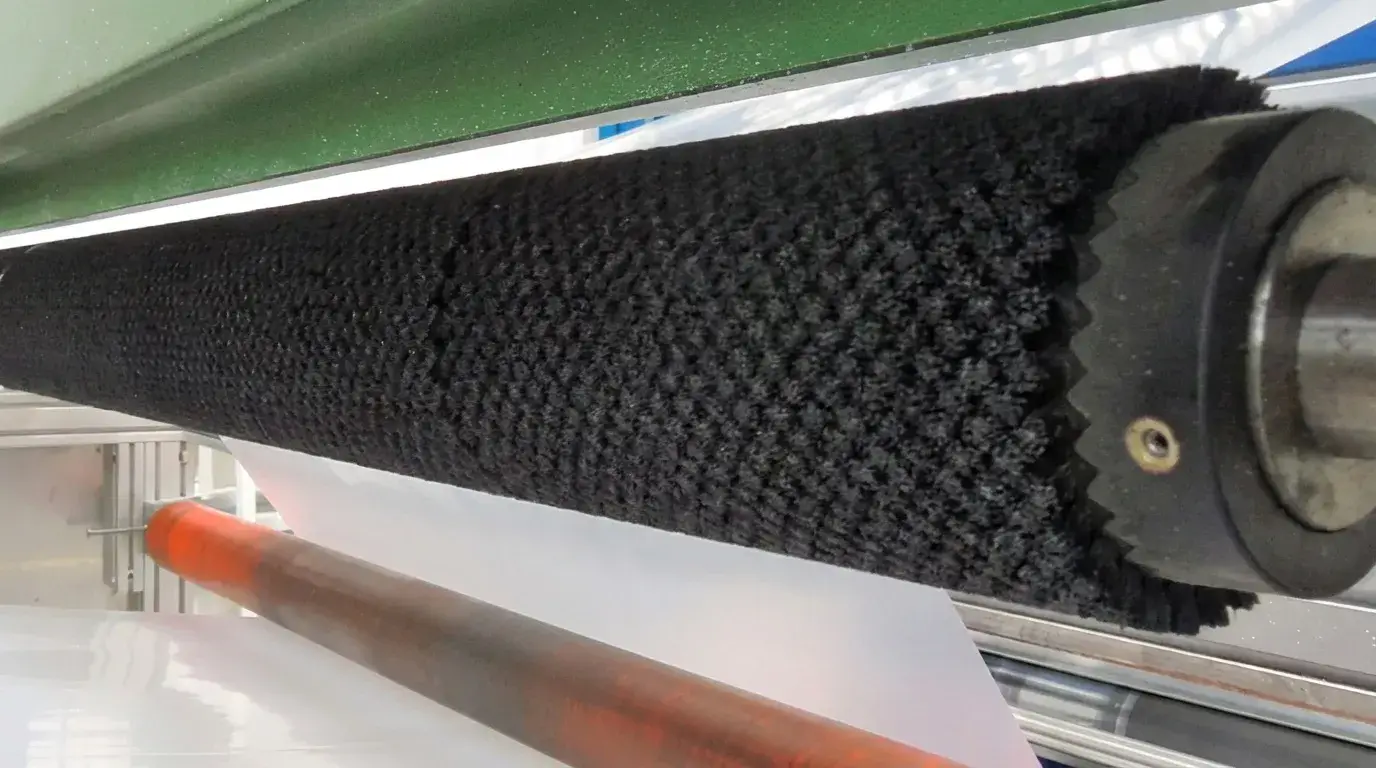
Wound construction, also called helical or spring brush construction, feeds a continuous strip brush into a spiral channel machined into the core surface, with the strip welded or mechanically locked at both ends. Nylon spiral brush adopts this manufacturing method. Because the filament is continuous rather than assembled from discrete bundles, wound brushes reach the highest filament density of the three methods and distribute cleaning force evenly across the brush face. In textile duty, the decisive advantage is vibration control: a wound brush presents filaments to the fabric continuously, whereas individual tufts contact the cloth at slightly different moments, which at high RPM can set up the vibration that shows up as visible patterning on the face of the cloth.
Wound brushes also accept flexible specification of diameter and pitch during the winding process, and where the coil is supplied as a replaceable sleeve, the core and shaft can be reused, reducing long-term cost. The main structural limitation is the strip backing itself: it is less rigid under extreme side-to-side loading than a solid-core brush, and the pitch gap that gives the construction its good debris clearance can, if set too wide for the application, produce slightly uneven cleaning action across the working face.
Tufted Construction
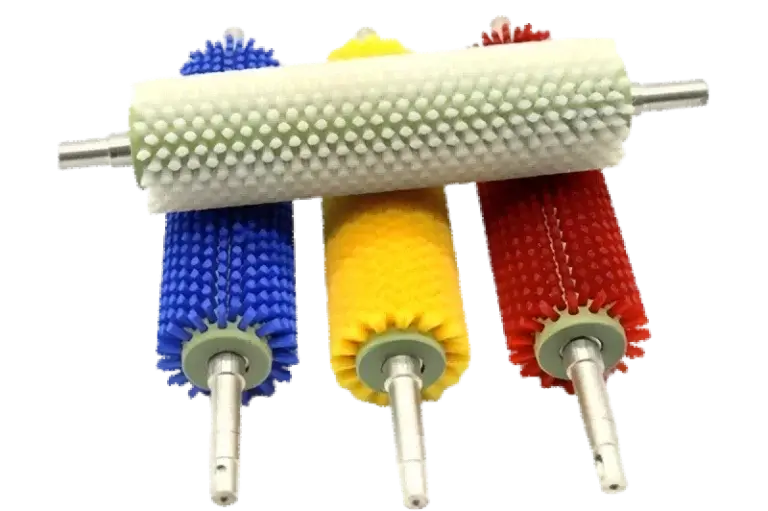
Tufted construction drives stainless steel staples or anchors through filament bundles into pre-drilled holes in a metal or plastic core. The staple mechanically locks each tuft, similar in principle to a staple set into timber. This produces consistent filament density and, in designs where tufts are individually accessible, allows a worn section to be replaced without scrapping the whole roller. Tuft-hole position also gives direct control over the surface pattern: straight rows produce uniform contact across the face, staggered rows improve coverage by reducing open gaps, chevron patterns direct material toward the centre or the sides, and helical tuft rows give progressive contact along the working face.
The characteristic failure mode is worth understanding before specifying tufted brushes for wet processes. A staple that corrodes loses its grip, and once grip is lost, the tufts begin shedding into the product stream. In a wet finishing stage, or in a plant with high humidity and aggressive chemistry, that shedding is a quality and contamination risk that a wound construction does not carry in the same way.
Construction Comparison and Failure Modes
| Construction | Maximum Filament Density | Typical Failure Mode | Best Suited To |
| Wound (helical) | Very high | Weld fatigue at strip ends | High RPM, wide webs, textile finishing |
| Tufted (staple-set) | High | Staple corrosion, tuft pullout | General industrial, dry environments |
| Molded (fusion) | Medium to high | Core cracking under impact | Washdown, hygiene-critical, food processing |
Molded construction, in which filament ends are fused directly into a plastic or composite core during injection molding, eliminates the mechanical fastener entirely and is why it dominates hygiene-critical applications. Its limitation is diameter, because mold tooling cost scales with volume and makes large rollers uneconomic. All three methods belong to the general family of industrial brushes, in which filament material, tuft or coil geometry, and core construction are selected independently to suit the workpiece and process duty.
One further point applies specifically to finishing lines running wide fabric. For working widths beyond roughly 1,200 mm, a solid steel shaft spanning the full face deflects under its own weight plus the radial load of brush contact, so the centre of the brush presses harder while the edges contact more lightly. The visible symptom is a clean band down the middle of the web with residue or uneven nap remaining toward the selvages. Segmented core construction with a central support bearing distributes load evenly across the full width and is essential for wide finishing lines.
Matching Filament Material to Fabric and Process
Filament material determines contact stiffness, surface risk, and service life, and it must be matched to the fabric’s sensitivity, the moisture and chemistry present at that stage, the operating temperature, and the target contact result. Synthetic filaments cover most finishing duty for their durability and chemical resistance, natural filaments remain in use where soft polishing or liquid retention is required, and abrasive filaments are specified only where the process intends to modify the surface rather than clean it.
A brush that is too stiff will mark a sensitive web, and a brush that is too soft will fail to remove the lint or residue that affects the next operation. Neither failure announces itself immediately, which is why material selection should be made against a stated fabric sensitivity and process target rather than on the basis of previous practice at the plant.
Synthetic Filaments
Nylon, or polyamide, is the general-purpose choice for washing, wiping, conveying, and direct product contact. It offers good abrasion resistance, reasonable chemical tolerance, and availability in very fine filaments, which allows soft contact on sensitive surfaces where coarser filaments would leave visible marks. Polypropylene is preferred for wet cleaning and chemical-exposure applications because of its low moisture absorption, making it the practical default for fabric washing and wet finishing stages where dimensional stability matters.
Natural and Specialty Filaments
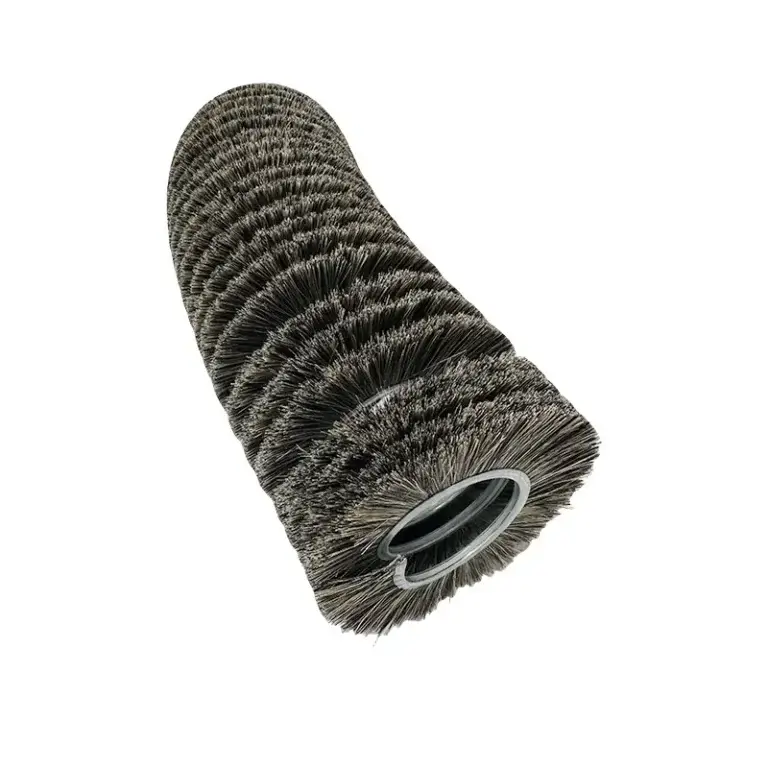
Tampico, horsehair, and hog bristle remain in use where their specific properties justify the cost. Natural filaments tend to be softer, hold liquids well, and produce a gentler polishing action, which suits fine finishing passes, waxing, dust removal, and antistatic surface cleaning on delicate fabric. Abrasive filaments, in which silicon carbide or aluminium oxide grit is embedded in a nylon carrier, are the correct choice where the process intends controlled surface modification, such as sueding or preparing a surface for bonding, and should not be used on a cleaning station where they will progressively abrade the cloth. Conductive filaments and grounding-compatible cores address static accumulation, which manifests as dust attraction and web misalignment rather than as an obvious mechanical fault.
Material Selection Table
| Filament Material | Contact Stiffness | Moisture Suitability | Temperature Tolerance | Typical Duty |
| Nylon (polyamide) | Moderate, available in very fine | Good, but absorbs some moisture | Moderate | General cleaning, wiping, product contact on sensitive fabric |
| Polypropylene | Moderate | Excellent, low absorption | Moderate | Wet cleaning, washing, chemical-exposure stages |
| Tampico, horsehair, bristle | Low to moderate | Very good liquid retention | Low | Fine polishing, dust removal, antistatic cleaning |
| Abrasive nylon | High, surface-removing | Good | Moderate | Sueding, surface preparation, controlled abrasion |
| Conductive filament | As per base material | As per base material | As per base material | Static control on dry webs |
How to Specify a Textile Processing Brush for Your Line
Specification follows four steps: identify the process the brush serves, match the filament and construction to that process and to the fabric, define the physical dimensions from the actual machine, and confirm speed, environment, and mounting requirements. Of these, the dimensioning step is where most specification failures originate, because a brush built to catalogue dimensions rather than to measurements taken from the machine will frequently fail to mount or will not cover the working width correctly.
The order matters because each step constrains the next. Process determines filament stiffness. Fabric sensitivity determines material. Machine geometry determines diameter, face length, and shaft fit. Operating conditions determine balance requirements and construction choice. Where the brush rotates on a driven shaft, guarding and machine-safety provisions apply as they would to any rotating component, and the guidance on machine-related injuries and safeguarding published by the National Institute for Occupational Safety and Health is the appropriate reference point for that assessment.
- Identify the process. Determine whether the brush is being specified for lint removal, web spreading, layer separation, fibre alignment, or surface finishing. Each task demands a different filament stiffness and contact behaviour, and the same line may need several different specifications at different stations.
- Match filament and construction to the application. Natural or fine synthetic filaments suit delicate fabrics and finishing passes; nylon and polypropylene handle heavier textiles; abrasive filament is reserved for processes that intend to modify the surface. Construction choice follows from speed and working width.
- Define dimensions from the actual machine. Measure the working width, the shaft or bearing seat diameter, and the available mounting space. The brush must cover the full material width with a slight overlap at both sides. Take shaft measurements with a caliper at the bearing seat itself rather than relying on the nominal figure, since a worn seat is a common cause of mounting failure.
- Confirm speed and environment. Provide line speed and operating RPM so the brush can be balanced and rated for the duty, and disclose temperature, moisture, chemical exposure, and any hygiene requirements so core and filament materials can be matched.
Working Width, Diameter, and Bristle Length
Working width is the first dimensional constraint, since the brush face must match the fabric width with a small margin at each selvage so that no part of the web passes unbrushed. Diameter then follows from the available installation envelope and the required surface speed at the specified line speed, and bristle length is set by the required contact depth and deflection. Short bristles generally indicate a stiff, precision cleaning or polishing action, while longer bristles indicate more aggressive coverage or fibre handling. Because these three interact, specifying any one of them in isolation tends to produce a brush that either over-contacts or under-contacts the cloth.
Line Speed, Balance, and Mounting
Dynamic balance becomes increasingly important as rotational speed rises. An unbalanced brush running against a wide web produces vibration that shows up as periodic patterning on the fabric, and at high RPM the effect is both a quality problem and a bearing life problem. Providing the actual operating speed at the specification stage allows the manufacturer to balance the assembly for the correct condition rather than for a nominal one.
Mounting should be decided at the same time, because it affects construction choice. Where bearings, drives, or surrounding machine parts make full roller removal difficult, split-core or two-piece designs install around an existing shaft and reduce changeover time substantially. For long working faces, segmented or modular sections simplify both installation and the replacement of worn subsections.
Quality Defects and Troubleshooting
Striping, marking, and uneven surface effects on the fabric almost always trace back to the brush rather than to the machine. The three most common causes are pitch set too wide for the application, which leaves periodic lighter contact lines; filament that has hardened, splayed, or become loaded with residue, which scratches or drags; and contact pressure or penetration depth set beyond what the fabric and process require.
The diagnostic value of this is considerable, because it means a repeat surface defect can be resolved by examining the brush rather than by adjusting the machine. Operators often respond to visible striping by changing line speed or tension, which changes the defect’s appearance without removing its cause.
Striping, Marking, and Uneven Surface
Periodic striping across the width usually indicates a wound brush operating with a pitch too wide for the application, so that cleaning action is concentrated at the coil lines and lighter in the gaps between. The remedy is a tighter pitch or a change of construction rather than a pressure increase, which would only deepen the lines. Random scratching or marking generally indicates worn or hardened filament, contamination trapped in the brush face, or a filament specification that is too stiff for the fabric. Uneven effects that are stronger at the centre than at the edges indicate shaft deflection on a wide face and point to segmented core construction or a central support bearing, as discussed earlier.
Lint Build-Up and Release
Debris clearance is a design property, not an accident. Open-wound and spaced constructions allow dirt, fibre, and liquid to fall through the gaps between coils, which is why they resist clogging on heavily contaminated lines. A densely wound or zero-pitch construction cleans more uniformly but offers the fibre no path of escape, so on a line generating high lint volumes it can load up and begin pressing contamination back onto the cloth. Where the process runs wet, the interaction between moisture and retained fibre is the main mechanism by which a brush that performed well on commissioning begins to produce defects, and scheduled extraction or cleaning becomes part of normal operation rather than an exception.
Keeping Finishing Brushes Productive
Finishing brushes are consumables, and their performance declines gradually rather than failing outright, so effective management depends on scheduled inspection and replacement rather than on responding to visible defects. A brush that has lost a significant proportion of its filament length no longer contacts the fabric as the process assumes, even though it continues to rotate and appears serviceable from a distance.
The economics favour this discipline. Finishing brushes are modest in cost relative to the value of the fabric passing through the line, and a single rejected batch caused by a worn brush will outweigh the cost of several replacement brushes. Tracking brush condition against running hours or production volume, rather than against calendar time alone, produces a replacement interval that reflects actual duty.
Replacement Indicators and Intervals
Several observable conditions justify replacement independent of hours run: a measurable reduction in filament length or visible flattening of filament tips; splaying or matting of filaments so they no longer present a defined contact edge; filament that has hardened, glazed, or become permanently loaded with residue; corrosion of staples or strip backing in a tufted or wound brush, respectively; and any sign of tuft shedding or strip end deterioration. The most reliable practical indicator remains the one operators can check quickly, which is whether the brush still lifts lint from a test section of fabric as effectively as it did when new.
Cleaning and Storage Between Runs
Brushes should be cleared of accumulated fibre and residue at the end of a run, since material left packed between filaments hardens and reduces working depth on the next start-up. Where the process is wet or chemically aggressive, cores should be inspected for corrosion and brushes stored dry rather than left in situ in a damp environment. Spare brushes should be stored so that filaments are not compressed or deformed, and stock rotation should follow the same discipline as the operating brushes so that an aged spare is not introduced into the line in place of a fresh one. Recording which brush position each replacement went into also reveals whether one station is consuming brushes faster than the others, which normally points to a contact pressure or alignment issue rather than to the brush itself.
FAQ
Q1: How often should finishing brushes be replaced?
There is no universal interval, because filament wear depends on contact pressure, line speed, fabric abrasiveness, and contamination level at each station. Plants that track brush condition against running hours or production metres rather than calendar time generally find that one or two stations consume brushes noticeably faster than the rest, and setting intervals per station rather than per line avoids both premature replacement and late replacement. The practical starting point is to record filament length and lint-lifting performance at commissioning, then inspect at regular intervals until the degradation curve for that station is known.
Q2: Can one brush handle both wet and dry finishing stages?
Rarely, and attempting it usually produces a compromise that suits neither. Wet stages demand a core and filament that resist moisture and chemistry, and polypropylene is commonly specified for its low moisture absorption. Dry stages generate static and airborne lint, which may call for conductive filaments or an open construction that releases debris. A brush specified for dry duty and then used in a wet stage risks staple corrosion, filament swelling, and shedding into the product stream, so the two duties are normally kept separate.
Q3: Are natural bristles still used in modern finishing lines?
Yes, though the role has narrowed to specific tasks where their properties are difficult to replicate. Tampico, horsehair, and bristle remain in use for fine polishing passes, dust removal, waxing, and antistatic surface cleaning, where softness and liquid retention matter more than durability or abrasion resistance. On high-speed production duty, synthetic filaments have largely displaced them because they offer more consistent filament diameter, better chemical resistance, and a longer working life, and modern finishing lines generally reserve natural fills for the final delicate passes rather than for high-load cleaning stations.