
Why Bristle Material Selection Determines Conveyor Brush Performance
Every food packaging facility runs on a simple rule: if the line stops, money walks out the door. Conveyor belts move thousands of packaged units per shift, and anything that gums up that motion becomes a direct cost. Spilled powders, sticky syrups, bread crumbs, meat particles, oil films—these residues build up fast and threaten both throughput and hygiene scores. A well-specified conveyor cylinder brush keeps the belt surface clean without damaging it, but the brush only works as well as the bristle material inside it. Pick the wrong filament and the brush sheds into product, absorbs water and goes limp mid-shift, or melts during the daily hot-water sanitation cycle.
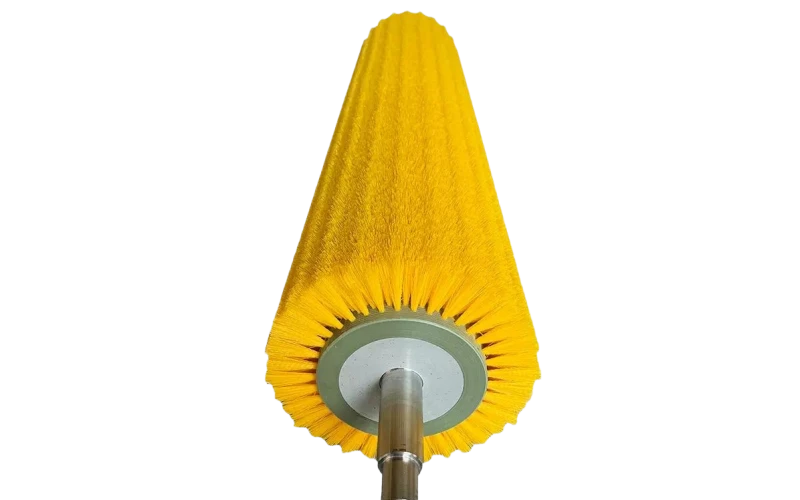
Food packaging sits at an uncomfortable intersection of requirements. The brush has to survive continuous wet exposure, periodic blasts of 80°C to 95°C water, caustic cleaning chemicals at 2% to 5% concentration, and acidic sanitizers, all without losing stiffness, shedding filaments, or leaching anything into the production environment. At the same time, the bristle must have enough mechanical energy to dislodge food residue from belt surfaces that may be smooth, textured, grooved, or cleated. These conditions rule out entire categories of filament materials immediately. Natural fibers like Tampico or horsehair absorb water, harbor bacteria, and disintegrate under chemical washdown. Low-cost commodity plastics soften well below the required temperature range. The decision narrows fast.
Why PA612 Nylon Is the Benchmark for Wet Washdown Environments
Nylon PA612 is the best bristle material for conveyor cylinder brushes in food packaging lines. It combines FDA 21 CFR 177.1500 food-contact compliance, low moisture absorption of roughly 3%, and the ability to retain over 85% of its dry stiffness when wet, even after repeated exposure to hot water at 80°C to 95°C and cleaning chemicals including sodium hydroxide solutions and peracetic acid sanitizers. For wet, high-temperature washdown environments common in meat, dairy, bakery, and produce packaging, no other single filament material matches this balance of regulatory compliance, wet mechanical performance, and chemical endurance.
Why “Best” Depends on Your Line Conditions
The catch is that “best” depends on the specific conditions on your line. A dry cereal packaging room and a wet poultry washdown station place different demands on a brush. Nylon comes in several grades, and two of them, PA66 and PA612, dominate industrial brush specifications for food applications. Polypropylene and polyester filaments also have roles to play in certain lower-temperature or chemically aggressive setups. Understanding where each material wins and where it fails is what separates a brush that lasts 2,000 hours from one that needs replacement at 600 hours. The rest of this article walks through the material properties, trade-offs, and design choices that determine real-world performance in food packaging environments.
Why Nylon Dominates Food-Grade Conveyor Brush Applications
Nylon’s Balanced Property Profile Outperforms Other Synthetics
Nylon dominates because it delivers the best combination of abrasion resistance, elastic recovery, temperature tolerance, and food-safety compliance among synthetic filaments at a practical cost. Nylon bristles withstand continuous flexing at high RPM without taking a permanent set, resist temperatures up to 110°C in dry operation, and, in the PA612 grade, maintain sufficient wet stiffness to clean effectively through full sanitation cycles.
PA66 vs. PA612: The Moisture Absorption Difference That Matters
Nylon belongs to the polyamide family, and the number after “PA” tells you the chemical structure. PA66 (nylon 6.6) uses a six-carbon diamine and a six-carbon diacid. PA612 (nylon 6.12) uses a six-carbon diamine and a twelve-carbon diacid. That longer carbon chain in PA612 carries less polarity per unit length, which directly reduces the material’s affinity for water molecules. The practical result: PA612 picks up around 3% moisture at saturation while PA66 absorbs about 9%. In a dry state, the two grades have similar stiffness. Once water enters the picture, PA66 loses roughly half its bending resistance. PA612 holds onto most of its mechanical properties.
Why Wet Stiffness Determines Cleaning Effectiveness
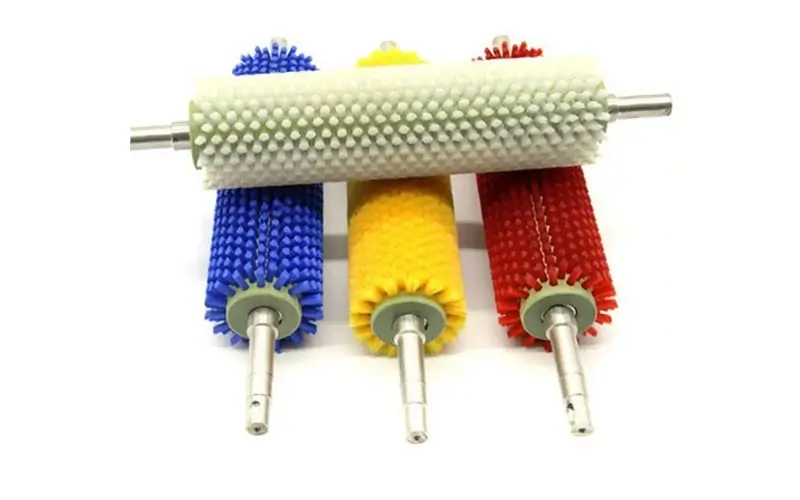
For a nylon cylinder brush running on a food packaging conveyor, this wet-stiffness difference is the single most important material property. A brush that goes soft mid-shift stops cleaning. Debris accumulates on the belt, carryback increases, and the sanitation team finds residue at the end of the day that should have been swept off hours earlier. PA612 brush filaments avoid this failure mode by design. Their lower moisture absorption also means less dimensional swelling when wet, so the brush maintains a more consistent contact pressure against the belt surface across its full face width.
Elastic Recovery: The Hidden Factor in Long-Term Performance
The elastic recovery of nylon gives it another practical advantage in conveyor cleaning. Cylinder brushes rotate at speeds that can range from 50 to over 300 RPM depending on diameter and line speed. Each bristle hits the belt, deflects, and snaps back thousands of times per minute. Nylon filaments recover over 90% of their original shape after each deflection cycle. Polypropylene, by comparison, recovers about 75%. Over weeks of continuous operation, that difference in recovery translates into bristles that either stand up and keep cleaning or lay over permanently and stop contacting the belt.
PA612 vs. PA66: Which Nylon Grade Survives Washdown Conditions
Moisture Absorption and Stiffness Loss in PA66
PA612 is the right choice for any conveyor brush that sees regular wet cleaning, chemical sanitization, or continuous exposure to food liquids. PA66 works well in dry packaging environments, cereal lines, dry snack packing, and powder filling rooms, but loses too much stiffness when wet to be reliable under washdown conditions. The cost difference between the two grades, typically 15% to 30% on the filament alone, pays for itself within the first avoided replacement cycle on a wet line.
The stiffness loss in PA66 follows a predictable pattern. When a PA66 brush first contacts water or high-humidity air, the filament absorbs moisture over the first few hours of exposure. Stiffness drops along a curve that flattens out after the material reaches equilibrium at roughly 9% moisture content. At that point, the filament has lost about half its bending resistance. It will not lose more, but it will not recover dry stiffness until the brush is removed, dried completely, and reconditioned, a step that no production line schedules into its sanitation program. For a line that runs two shifts and wet-cleans between them, the brush spends its entire working life in the softened state.
Field Signal: The “Monday Morning” Softening Effect
One practical signal that a PA66 brush is operating in the wrong environment: bristles that look and feel normal during inspection after a weekend shutdown but turn soft and ineffective within two hours of Monday startup. Maintenance teams sometimes blame the brush manufacturer when the real problem is a PA66 filament absorbing process moisture that PA612 would have shrugged off. Switching grades solves the issue without any change to the brush dimensions, core material, or mounting setup.
Wet-Heat Performance: PA612 Outperforms PA66 Under Sanitation Temperatures
The temperature side of the equation matters too. Food packaging sanitation protocols often specify hot water at 80°C or above for pathogen control. PA612 holds its mechanical properties through these cycles without permanent thermal damage. PA66 actually has a higher melting point, around 255°C versus 215°C for PA612, and a higher heat deflection temperature in dry air. But wet heat is the real-world condition, and PA612’s dimensional stability under combined heat and moisture gives it the practical edge. A PA612 filament at 85°C in water keeps more of its designed stiffness than a PA66 filament at the same temperature because the PA66 is simultaneously fighting thermal softening and plasticization from absorbed water.
Cost-per-Hour Advantage: Fewer Replacements, Lower Total Cost
The economic case for PA612 on wet lines is straightforward. A PA66 brush that loses cleaning effectiveness after 400 hours because of moisture-induced softening needs replacement three times as often as a PA612 brush that runs 1,200 hours before reaching the same wear limit. Even at a 30% higher unit cost, the PA612 brush delivers a lower cost per operating hour. The math gets better when you factor in the labor to change brushes, the production downtime during changeover, and the quality risk from running a partially effective brush during the hours before replacement.
When Polypropylene or Polyester Makes More Sense
Polypropylene: The Acid-Resistant, Low-Cost Alternative
Polypropylene works better than nylon in two specific food packaging scenarios: continuous immersion in aggressive acidic solutions at temperatures below 70°C, and applications where the lowest possible unit cost matters more than maximum brush life. Polyester (PBT) outperforms both nylon and polypropylene when the cleaning protocol involves chlorinated sanitizers at concentrations above 200 ppm or autoclave sterilization above 121°C.
Polypropylene’s Strengths: Zero Water Absorption and Chemical Resistance
Polypropylene’s defining characteristic is near-zero water absorption, 0.03% or lower depending on the grade. It does not swell, soften, or change dimension when wet. It also resists most acids, alkalis, and organic solvents that would attack nylon over time. These properties make polypropylene brushes a logical choice for conveyor belt cleaning brush applications in beverage filling lines, dairy processing, and any packaging environment where the brush runs under a constant spray of cleaning solution rather than facing periodic washdown cycles.
Polypropylene’s Limits: Temperature and Elastic Recovery
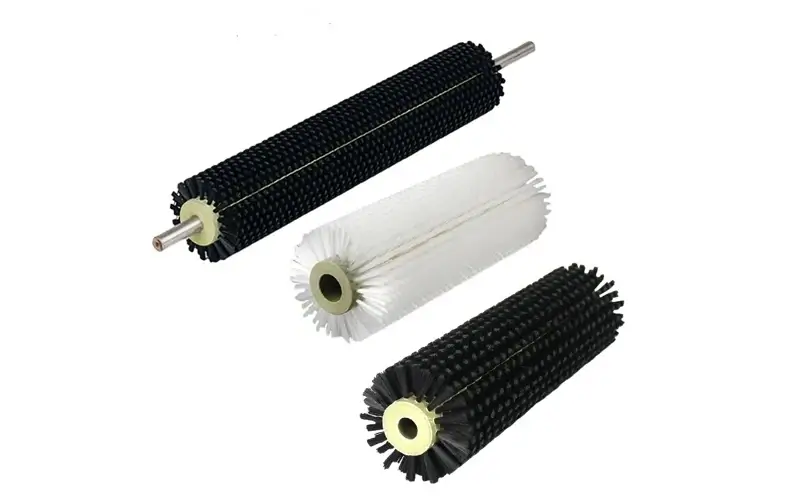
The limitation is temperature. Standard polypropylene softens around 60°C and loses structural integrity above 80°C. If the sanitation protocol specifies 85°C water, a polypropylene brush will deform within weeks. Heat-stabilized grades push the upper limit to around 100°C but at a higher cost that erodes polypropylene’s price advantage. Another weakness: polypropylene’s lower elastic recovery means bristles take a permanent set faster than nylon bristles under the same mechanical load. For high-RPM cylinder brush applications where each bristle cycles thousands of times per minute, nylon’s 90% recovery versus polypropylene’s 75% recovery translates directly into longer effective brush life.
Polyester (PBT): High-Temperature and Chlorine-Resistant Performance
Polyester, specifically polybutylene terephthalate (PBT), fills the gap at the high end of the temperature and chemical resistance spectrum. PBT bristles hold stiffness up to 121°C, resist degradation from chlorinated sanitizers that would embrittle nylon over time, and maintain excellent dimensional stability in wet conditions. Bakeries, ready-meal facilities, and any packaging line that runs products above 100°C or sterilizes equipment with steam benefit from PBT’s thermal headroom. The trade-off is brittleness: PBT filaments snap more readily than nylon under repeated flexing, especially in smaller diameters below 0.3 mm. PBT also costs more than standard nylon grades, and fewer brush manufacturers stock PBT cylinder brushes as catalog items, which can lead to longer lead times.
The following table maps material choice to the dominant environmental condition on the line:
Brush Design Features That Keep a Cylinder Brush Food-Grade Throughout Its Service Life
A food-grade conveyor cylinder brush needs five design features beyond the filament material itself: a stainless steel core (304 or 316 grade), sealed end caps with no exposed threads, a bristle anchoring method that eliminates loose-filament shedding, a core surface free of crevices and weld pits, and a mounting system that allows tool-free removal for sanitation access. Without all five, the brush becomes a contamination source regardless of how good the filament is.
The core material choice comes down to corrosion resistance under chemical attack. Carbon steel cores rust within weeks in a washdown environment. The rust flakes off onto the belt, and the core loses structural integrity. Stainless steel, specifically 304 for general food contact and 316 for high-chloride or high-acid environments, eliminates this failure mode. The core should be seamless or continuously welded with the weld bead ground smooth. Any pit, crevice, or rough surface on the core body collects food residue and provides a niche where bacteria survive sanitation.
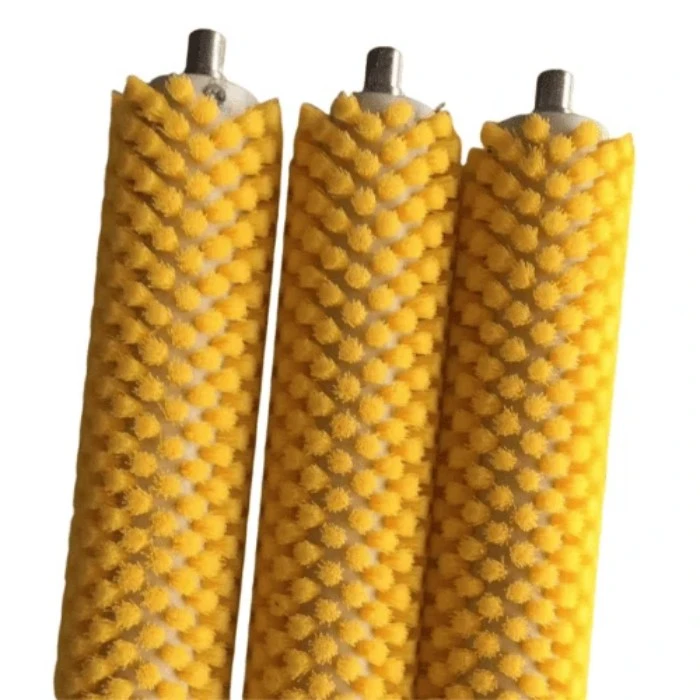
Tufted cylinder brushes use individually set bristle tufts anchored into pre-drilled holes in the core. This construction method has a distinct food-safety advantage: each tuft is mechanically independent. If a tuft fails, it detaches as a visible cluster rather than shedding individual filaments gradually over weeks of operation. The gradual-shedding mode is more dangerous in food packaging because it goes undetected until a consumer finds a filament in the product. Tufted construction also allows higher bristle density in specific zones of the brush face, useful for lines where residue patterns are concentrated on one section of the belt width.
The mounting system affects food safety indirectly but materially. A brush that takes three technicians and 20 minutes to remove will not get pulled for the weekly deep clean the maintenance schedule calls for. It will run until performance visibly degrades, by which point the trapped residue has already become a microbiological problem. Quick-release mounts, whether keyed shaft ends with spring-loaded retention or split-hub clamps with captive fasteners, shorten the removal time to under two minutes and make scheduled sanitation practical instead of aspirational. The brush gets cleaned because it is easy to clean.
Operating parameters also interact with brush longevity in ways that food safety managers should track. Running a brush at excessive speed generates frictional heat at the bristle tips. Above roughly 70°C at the tip surface, nylon begins to soften locally, and the combination of heat and mechanical load accelerates wear. The relationship between rotation speed and brush wear is non-linear; doubling the RPM more than doubles the wear rate because of the thermal component. Keeping tip speed in the 1,500 to 2,500 surface-feet-per-minute range for nylon brushes and monitoring bristle temperature with an infrared gun during operation are two simple practices that add hundreds of hours to brush life and reduce the risk of heat-damaged filaments breaking off into product.
Summary
The bristle material inside a conveyor cylinder brush determines whether the brush cleans the belt or becomes another problem the sanitation team has to solve. For most food packaging lines, nylon PA612 is the answer. Its low moisture absorption keeps bristles stiff through hot-water washdown cycles that would turn PA66 into a wet noodle. Its FDA compliance satisfies regulatory requirements without special documentation or variance requests. And its 90% elastic recovery means the brush keeps working through millions of deflection cycles without taking a permanent set.
PA66 still makes sense on dry packaging lines where moisture never enters the equation. Polypropylene has a role in cold, chemically aggressive environments where its acid resistance and zero water absorption justify its lower temperature ceiling. Polyester PBT handles the end of the spectrum: steam, chlorinated sanitizers, and autoclave temperatures, where other materials fail outright. But across the broad middle of food packaging operations, where wet belts, hot water, caustic cleaners, and acidic sanitizers all appear in the same 24-hour cycle, PA612 is the filament that holds up.
The material choice works as part of a system. A PA612 brush on a rusty carbon steel core with trapped-particle bristle packing and a bolt-on mount that nobody wants to touch during sanitation is still a problem. The filament is the starting point. The core material, bristle anchoring method, density, trim length, mounting design, and operating speed all contribute to whether the brush performs as a cleaning tool or becomes a contamination vector. Get the material right first, then verify that the rest of the design supports it.
Frequently Asked Questions
Can a single brush use multiple filament materials for different sections of a conveyor belt?
Yes. Some cylinder brushes combine nylon bristles in the center section with polypropylene bristles at the edges. This approach makes sense when the belt carries different residues across its width, for example, a packaging line where product contact occurs in the center while edge sections only see a clean belt surface. The edge sections can use a less expensive filament, and the center section gets the higher-performance material where it matters. The core must support two different bristle anchoring patterns, which adds manufacturing complexity and cost, but the material savings on wide brushes often justify the setup.
How do metal-detectable bristles work in conveyor cylinder brushes, and are they worth specifying?
Metal-detectable bristles incorporate a metallic additive, typically iron powder or stainless steel particles, into the nylon or polypropylene base polymer during extrusion. The additive concentration is high enough that a standard food-industry metal detector will trigger if a bristle fragment enters the product stream. The filament still has to meet food-contact regulations, so the additive must be food-grade, and the total loading must stay below thresholds that would affect the filament’s mechanical properties. Metal-detectable brushes add 20% to 40% to the unit cost. They are worth the premium on lines where even a single filament fragment would trigger a recall; infant formula, medical nutrition products, and allergen-free lines are the clearest cases. For commodity dry goods packaging where the contamination risk from a single bristle fragment is lower, standard FDA-compliant filaments without metal additives are generally sufficient.
What is the expected service life difference between a nylon PA612 brush and an abrasive nylon brush on the same food packaging conveyor?
Abrasive nylon brushes contain silicon carbide or aluminum oxide grit embedded in the filament during manufacturing. The grit makes the bristle tips act like fine sandpaper, which cuts through baked-on residues more aggressively than standard nylon. Service life is shorter, typically 30% to 50% shorter, because the abrasive particles accelerate wear on the bristle tips themselves. An abrasive nylon brush might run 600 to 800 hours on a line where a standard PA612 brush runs 1,200 hours. The trade-off is cleaning speed: abrasive nylon removes stubborn residue faster and at lower contact pressure, which can protect delicate belt surfaces from the higher pressure that a standard brush would need for the same cleaning result. Abrasive nylon is a specialty tool for lines with persistent baked-on or polymerized residue that standard nylon cannot remove at any practical operating pressure.