
Root vegetables arrive at processing plants covered in soil, clay, and organic debris that no water spray alone can remove. Potatoes, carrots, beets, sweet potatoes, and radishes all have irregular surfaces with eyes, crevices, and rough skins where dirt embeds deeply. A line that processes 5 to 20 tons per hour cannot rely on manual scrubbing or passive soaking. The brush is the mechanical heart of the wash line and the single largest factor in whether produce leaves the line truly clean or merely wet.
Food safety standards have tightened across the supply chain. Retail buyers and regulators now expect documented cleaning protocols and verifiable contamination control. A round vegetable brush that sheds bristles, deforms under load, or fails to maintain consistent contact pressure puts the entire operation at risk. Replacing brushes every few weeks also drives up operating costs in ways that erode margins over time.
A round vegetable brush is a cylindrical brush assembly that rotates against root vegetables on a conveyor or roller bed, using mechanical friction from food-grade bristles to remove soil, pesticide residues, and surface contaminants. The right brush matches bristle material and density to the produce type, operates at the correct RPM for the line speed, and maintains its geometry through thousands of hours of wet, high-friction use. Buyers who understand brush specifications rather than treating brushes as generic consumables get cleaner produce, fewer replacements, and fewer contamination incidents.
The difference between a brush that works and one that fails is in the details: bristle material composition, filament diameter, tufting pattern, core construction, and shaft design. Each of these variables shifts the cleaning result for a specific root crop. A potato line running at 10 tons per hour needs a very different round vegetable brush than a carrot line processing delicate skin-on product at 3 tons per hour. This guide walks through the specifications that matter, the trade-offs between brush types, and the maintenance practices that determine how long a brush delivers consistent results.
What Is a Round Vegetable Brush
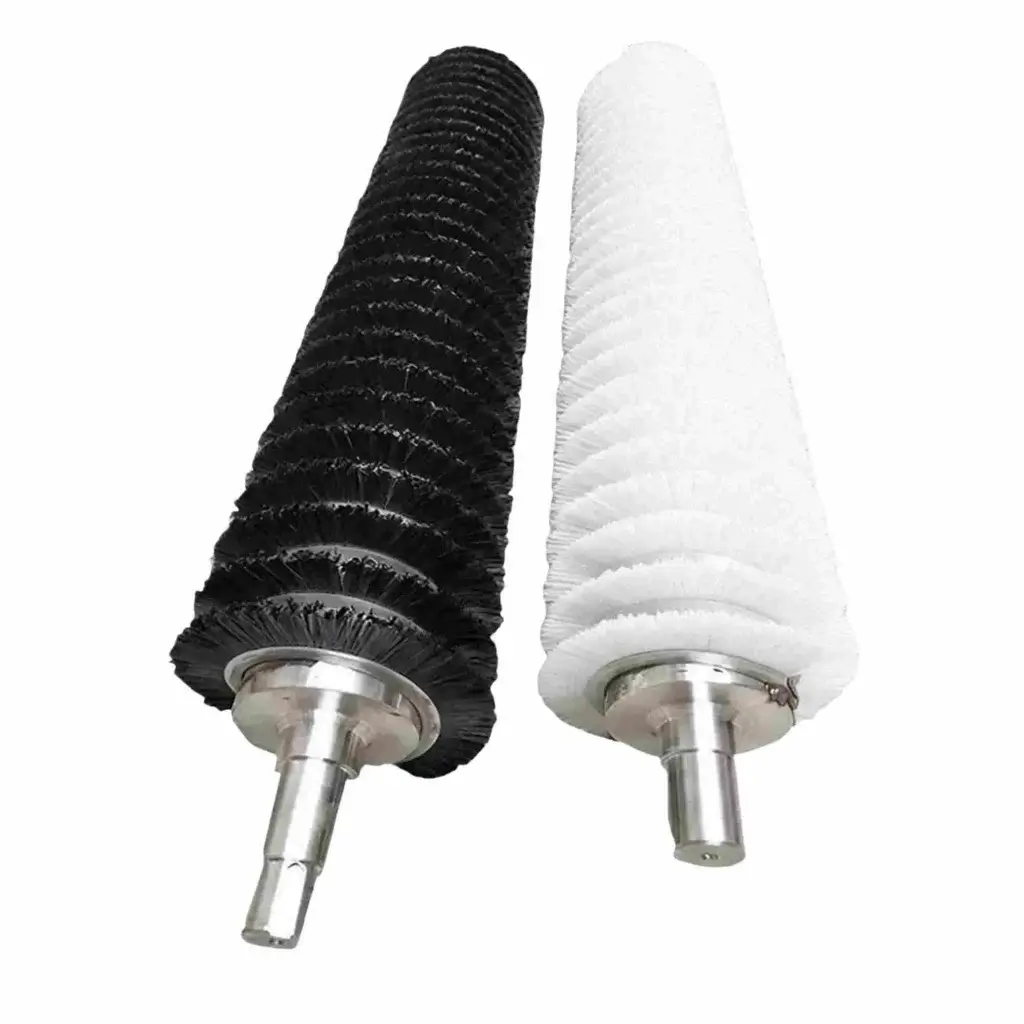
A round vegetable brush is a rotating cylindrical brush mounted in a produce washing machine, built with food-grade bristles anchored to a central core or shaft. It uses mechanical brushing action combined with water spray to clean root vegetables as they pass over or between multiple brush rollers.
The round vegetable brush gets its name from its cylindrical geometry. Most wash lines use a brush bed configuration where multiple brush rollers sit side by side in a slight U-shaped or flat arrangement. Produce moves forward by the rotation of the brushes themselves or by an overhead conveyor while water jets spray from above. The rotating bristles scrub every surface that contacts them. Because root vegetables tumble and rotate as they move across the brush bed, a well-designed setup achieves near-complete surface coverage.
The brush core can be a solid polypropylene (PP) cylinder, a hollow metal tube, or a fabricated shaft with end fittings. Bristles are attached either by tufting (punching bundles of filaments into pre-drilled holes in the core and securing them with anchor wires) or by spiral winding (crimping filaments into a metal channel strip and helically wrapping the strip around the core). Each construction method produces different bristle density, pressure distribution, and durability characteristics. A cylinder rotary brush with spiral-wound construction gives uniform contact pressure across the full brush face, which matters for produce that requires consistent scrubbing force without gaps. The choice between tufted and wound construction depends on the target produce and the operating speed of the line.
Key Specifications That Determine Brush Performance
Three specifications drive round vegetable brush performance on a root crop line: bristle material and filament diameter, brush outer diameter and length, and rotational speed relative to line speed. Getting any of these wrong produces either incomplete cleaning or produce damage.
Bristle Material and Filament Diameter
Bristle material is the single most important variable. For root vegetables, food-grade nylon 6 or nylon 612 is the standard choice. Nylon resists water absorption, does not support bacterial growth, and maintains its stiffness through extended wet-dry cycles. Filament diameter ranges from 0.2 mm for fine cleaning of delicate-skinned carrots to 0.8 mm or more for aggressive scrubbing of muddy potatoes. Thicker filaments apply more force per bristle tip but cover less surface area per rotation. Thinner filaments conform better to irregular surfaces but wear faster on abrasive soil.
Abrasive-filled nylon filaments embed silicon carbide or aluminum oxide particles in the nylon matrix. These bristles remove stubborn clay and thin outer skins from beets and potatoes without the metal contamination risk of wire brushes. The trade-off is higher cost per brush and slightly faster wear on the brush core due to the abrasive action transferring some vibration back into the anchor points.
Brush Diameter and Length
Outer diameter (OD) determines how much bristle contacts the product at any moment. Common ODs for root vegetable lines range from 100 mm to 200 mm. A larger OD provides more bristle surface area per rotation and requires fewer RPM to achieve the same surface speed at the bristle tip. A 150 mm OD brush rotating at 250 RPM generates a bristle tip speed of roughly 2 meters per second. This is fast enough for effective scrubbing without “batting” smaller vegetables off the line.
Brush length must match the conveyor width. Standard food processing brush rollers run from 500 mm up to 2,000 mm or more. Longer brushes need larger shaft diameters to prevent flexing in the middle, which creates uneven pressure across the produce bed. A brush that bows in the center cleans aggressively at the edges and barely touches produce in the middle. Shaft diameter of 25 mm to 40 mm is typical for brushes under 1,200 mm in length; longer brushes benefit from 50 mm shafts or intermediate support bearings.
Rotational Speed
RPM selection involves a balance. Too slow and debris settles back into the bristles between rotations. Too fast and the brush may cause friction burns on produce skin or eject lighter vegetables from the line. Root vegetable lines typically run brushes at 150 to 400 RPM depending on produce weight and skin toughness. Potatoes tolerate 300 to 400 RPM. Carrots and radishes do better at 150 to 250 RPM. The key is matching bristle tip speed to the conveyor line speed so that produce experiences consistent scrubbing time rather than being rushed through or held back.
The following table summarizes typical round vegetable brush specifications by root crop type:
For operations that wash multiple crop types, a medium-hardness nylon round vegetable brush with 0.5 mm filaments and 150 mm OD covers the widest range without excessive changeover. Lines dedicated to a single crop benefit from tuning specifications tightly to that crop.
Tufted vs. Wound: Which Brush Construction Works Best for Root Vegetables
Tufted cylinder brushes offer higher bristle density and better dirt-penetration ability for heavy soil, while wound cylinder rotary brushes provide more uniform surface contact and longer wear life for lighter cleaning. Root vegetable lines with heavy clay soil typically perform better with tufted construction.
A tufted cylinder brush anchors bristle bundles into a solid PP or nylon core using stainless steel anchor wires. Each tuft hole holds 20 to 50 individual filaments bundled tightly together. The tufts stand proud from the core surface, creating a bristle face that has high points (the tuft tips) and low points (the spaces between tufts). This geometry works well for root vegetables because the tuft tips dig into crevices and eyes where soil hides, while water flows through the spaces between tufts to carry debris away. Tufted brushes also tolerate heavier soil loads because debris has room to move out of the bristle zone rather than packing into a dense bristle mat.
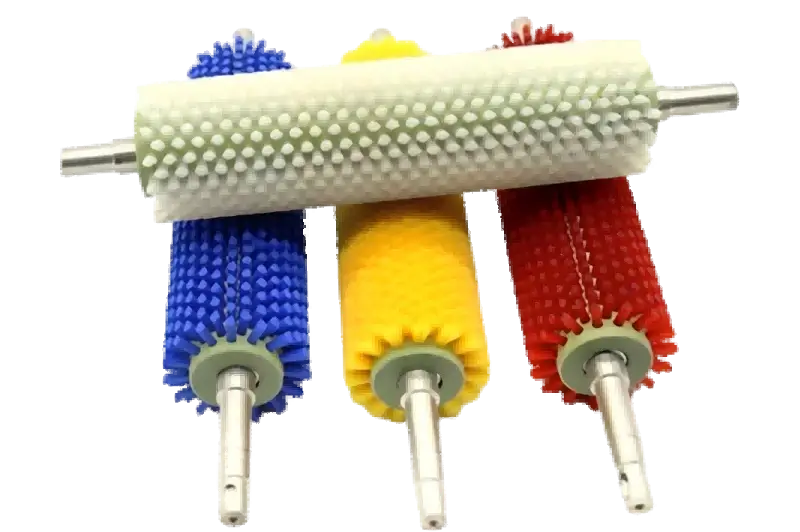
Wound brushes wind a continuous strip of filament around the core in a helical pattern. The resulting bristle surface is more uniform, with fewer gaps. This gives a smoother cleaning action with less risk of skin damage on thin-skinned produce. Wound construction also holds bristles more securely at high RPM because each filament is mechanically crimped into a metal channel rather than relying on anchor wire friction in a drilled hole. For lines that run at 350 RPM or above, wound brushes hold up longer before bristle loss becomes a problem.
The trade-off is density. A tufted brush with 40 tufts per square decimeter puts more bristle tips in contact with the produce than a wound brush of similar OD. This matters for root vegetables with deep eyes or irregular shapes. The tufts reach where a uniform wound surface skims over. For potatoes coming out of heavy clay soil, tufted construction paired with abrasive nylon filaments delivers the most thorough clean in a single pass.
Cost also differs. Tufted brushes are less expensive to manufacture because the tufting process runs faster than precision spiral winding. A typical 150 mm OD by 1,000 mm long tufted PP core brush costs 20 to 30 percent less than a comparable wound brush. However, tufted brushes may need replacement sooner in high-RPM applications where centripetal force works bristles loose from anchor points. The lower initial cost can be offset by more frequent changeovers. Plants should calculate total cost over a 12-month operating period rather than comparing unit prices.
Bristle Material Options for Food Processing Lines
Food-grade nylon 6 and nylon 612 are the dominant bristle materials for root vegetable brushes. Polypropylene serves wet wash-down lines where chemical exposure is a concern. Abrasive nylon handles heavy soil and light peeling. Natural fibers work for delicate finish polishing but degrade faster in continuous wet use.
Nylon 6 is the workhorse. It has high tensile strength, good abrasion resistance, and a working temperature range from -40°C to 120°C. It absorbs 1.5 to 2.5 percent moisture by weight in wet environments, which causes slight softening over the first 24 hours of immersion. Brush manufacturers compensate by using slightly stiffer filaments than the target operating hardness. After the initial moisture equalization, nylon 6 stabilizes and holds consistent cleaning performance.
Nylon 612 absorbs less than half the moisture of nylon 6 and resists dimensional change better in continuously wet lines. This makes it the better choice for carrot and radish lines where consistent bristle stiffness matters for gentle cleaning. The downside is a 15 to 25 percent cost premium over nylon 6.
Polypropylene (PP) bristles absorb essentially zero water and resist most cleaning chemicals and sanitizers used in food plants. PP is the standard choice for brush sections that sit in chemical wash tanks or operate under continuous sanitizer spray. However, PP has lower abrasion resistance than nylon and wears faster in high-friction root vegetable applications. A vegetable cleaning brush built with PP tufted bristles works well for leafy greens and soft-skinned produce but delivers shorter service life on potato and beet lines compared to nylon.
Abrasive nylon embeds grit particles throughout the filament cross-section. As the bristle wears, fresh abrasive particles are exposed to the surface, maintaining cutting action through the life of the filament. For root vegetables arriving with dried clay or thin outer skins that processors want removed, abrasive nylon cuts cleaning time per piece. The trade-off is that abrasive nylon costs roughly twice as much as standard nylon and generates slightly more heat at the bristle tip during high-RPM operation, which can affect very thin-skinned produce.
The table below compares the four most common bristle materials for root vegetable brushes:
Maintenance Practices That Extend Brush Life
A round vegetable brush loses effective cleaning power when bristle length drops by about 20 percent from its original trim. Daily rinse-down after each shift, weekly inspection for hooked or matted bristles, and monthly shaft bearing checks keep brushes performing at specification and extend replacement intervals from weeks to months.
The most common maintenance failure is letting organic debris accumulate at the bristle base. Starches and sugars from damaged produce seep into the tuft holes and harden. This glues bristles together, reduces their independent flex, and creates a surface where bacteria colonize. A daily high-pressure rinse while the brush rotates at low speed clears this debris before it sets. Using sanitizing solution in the rinse water adds a layer of bacterial control.
Bristle hooking is the second major wear pattern. Over hundreds of hours, bristle tips develop a bent shape that curves in the direction of rotation. A hooked bristle no longer flicks debris away with each rotation. It drags across the produce surface and can trap fine soil particles against the skin. Once more than 15 to 20 percent of bristles show visible hooking, the brush should be replaced even if overall bristle length still appears adequate. No cleaning line produces acceptable results on hooked brushes regardless of how much water pressure is applied.
Shaft bearings deserve more attention than they typically receive. A brush that runs with worn bearings develops eccentric rotation. The wobble creates alternating high-pressure and low-pressure zones along the brush length. Produce passing through the high-pressure zone gets over-scrubbed, while produce in the low-pressure zone leaves dirty. Checking bearing play monthly and replacing bearings showing more than 0.5 mm of radial movement prevents this uneven wear pattern. For guidance on evaluating brush condition and planning replacement cycles, see durable vegetable cleaning brush.
Replacement timing is a cost calculation, not just a visual inspection. A brush that costs $300 and lasts 8 weeks costs $37.50 per week. The same brush replaced at 6 weeks because of declining performance costs $50 per week, a 33 percent increase. Plants with documented replacement schedules based on actual wear data rather than guesswork consistently run lower brush costs per ton of produce processed. Understanding that choosing vegetable cleaning brushes with the right specifications from the start makes these replacement calculations more predictable. A brush matched to the crop and operating conditions follows a predictable wear curve. A mismatched brush fails unpredictably, sometimes catastrophically, with bristle shedding that forces an immediate line stoppage.
The bristle color choice, while seemingly cosmetic, serves a practical purpose. Bright blue bristles are the industry standard for food processing because no common vegetable is naturally blue. If a blue bristle snaps off and lands in the product stream, optical sorters or manual inspectors spot it immediately. White, black, and natural bristle colors blend with produce and potato skins, making contamination detection harder. This is one of those details that costs nothing to get right at the procurement stage and prevents expensive recalls.
What Buyers Should Ask Before Ordering
Buyers should confirm bristle material certification, core and shaft material for the operating environment, and the manufacturer’s ability to produce custom diameters and trim lengths matched to existing line equipment. Off-the-shelf brushes rarely fit optimally.
Start with material documentation. Any supplier claiming food-grade bristles should provide third-party test reports showing compliance with FDA 21 CFR or EU Regulation 10/2011 for food contact materials. A general statement of “food grade” without a test report number and issuing laboratory is not sufficient for audit purposes. The same applies to stainless steel components. Shafts, end fittings, and anchor wires in wet processing environments need to be 304 or 316 stainless steel. Galvanized steel corrodes quickly in the acidic conditions created by vegetable starches breaking down in water.
Core material choice depends on the wet environment. Solid PP cores eliminate the corrosion risk and are lighter than metal cores, reducing bearing load. However, PP cores have lower dimensional stability at temperatures above 80°C and can soften if exposed to steam cleaning. Metal cores with PP sleeves combine the structural rigidity of steel with the corrosion resistance and chemical inertness of PP at the surface. For lines that sanitize with hot water or steam, metal core construction with appropriate sealing at the ends is the more reliable choice.
Custom diameter and trim matter more than most first-time buyers realize. A brush roller that is 5 mm too large in OD may not fit into the existing brush bed arrangement. One that is 5 mm too small leaves a gap where produce can jam or pass through uncleaned. Working with a manufacturer that produces the brush to exact specifications rather than shipping the nearest stock size avoids expensive modifications to the line. The guide on what vegetable cleaning brushes are explains the mechanical principles that make precision dimensions important for industrial-grade cleaning results.
Lead time is a procurement variable that affects inventory strategy. Standard brushes from domestic manufacturers ship in 5 to 10 business days. Custom brushes with non-standard diameters, special filament blends, or unusual trim lengths can take 3 to 6 weeks. Plants with a single brush configuration and no backup inventory risk a line stoppage if a brush fails unexpectedly. Keeping at least one full set of replacement brushes on the shelf and reordering when the last spare set goes into service is the standard practice for lines running 16 to 24 hours per day.
FAQ
What is the typical service life of a round vegetable brush in a root crop processing line?
Service life depends on crop type, soil conditions, and operating hours. A nylon round vegetable brush processing washed potatoes for 12 hours daily on a line with pre-soak typically lasts 6 to 10 weeks before bristle length drops below 80 percent of original trim. The same brush processing unwashed beets with heavy clay soil may last 3 to 5 weeks. Lines that pre-wash or pre-soak produce extend brush life by 30 to 50 percent because less abrasive soil reaches the bristle contact zone.
Can one brush type handle both hard root vegetables and delicate produce?
A single brush cannot optimally clean both potatoes and leafy greens. The bristle stiffness and filament diameter that effectively scrub potato skins will bruise lettuce and spinach. Facilities processing mixed produce types either run separate dedicated brush beds for hard and soft produce, or they use quick-change brush roller systems that allow swapping brush sets between product runs. Some medium-hardness nylon brushes in the 65 to 75HA range can handle both carrots and light-duty potato washing in smaller operations, but the cleaning result represents a compromise in both directions.
How do buyers verify that bristles will not shed into the product stream?
Request a bristle retention test report from the manufacturer. The standard test mounts the brush on a test fixture and runs it at 120 percent of maximum rated RPM for a specified number of hours while measuring bristle loss. A quality industrial brush loses fewer than 0.1 percent of bristles by weight during an accelerated wear test. Also inspect the anchor method. Tufted brushes should use stainless steel anchor wires, not galvanized wire. Wound brushes should have continuous metal channel retention with no gaps exceeding 1 mm between winding segments. Visual inspection of sample brushes before ordering a full production batch catches manufacturing defects that test reports might miss.