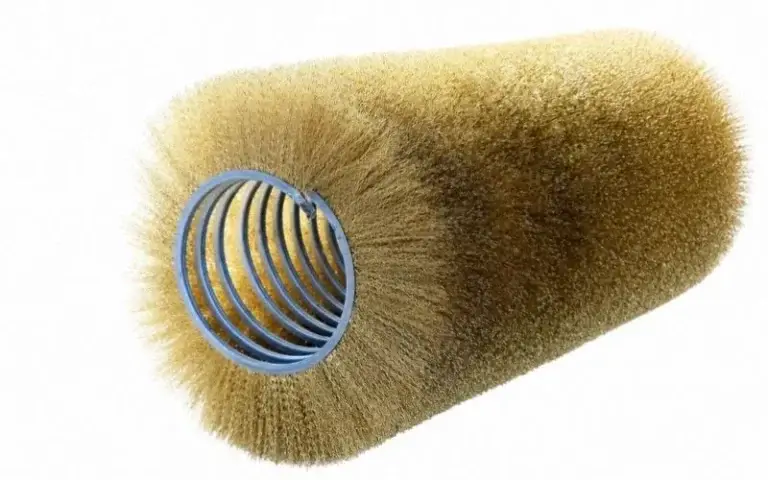
Fabric quality problems on textile lines tend to repeat in threes: lint clinging to the web, static pulling the fabric out of alignment, and stains appearing where no dye was ever applied. Operators blame the dye house, the air handling, or the fabric itself, while the roller that touched the fabric seconds earlier goes uninspected. A web spreader roller sits directly in the fabric path before printing, coating, or stentering, which makes its contact surface the last thing to touch the goods and the first place to look when surface defects appear.
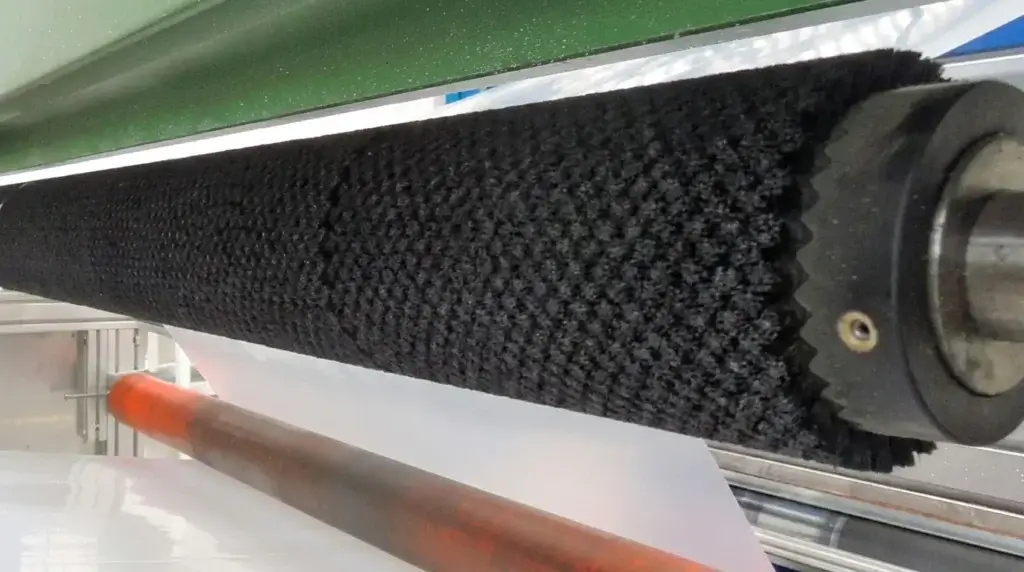
A web spreader roller affects fabric quality primarily through its contact material. Bristle spreader rollers smooth the web edge to edge with minimal contact area, but the filament material decides whether the fabric leaves the roller clean or linted, discharged or charged, and unstained or marked. Synthetic filaments minimize shedding and clean easily, conductive filaments continuously bleed off static charge to a grounded core, and corrosion-resistant cores with color-stable, washable bristles prevent staining at the source. Specify the material against the fabric and the line environment, and all three defect families can be controlled with one roller.
The sections below explain how the contact geometry works, compare filament materials against lint and contamination, cover static control, then address staining and the specification that holds it all together.
How a Brush-Type Web Spreader Roller Contacts Fabric
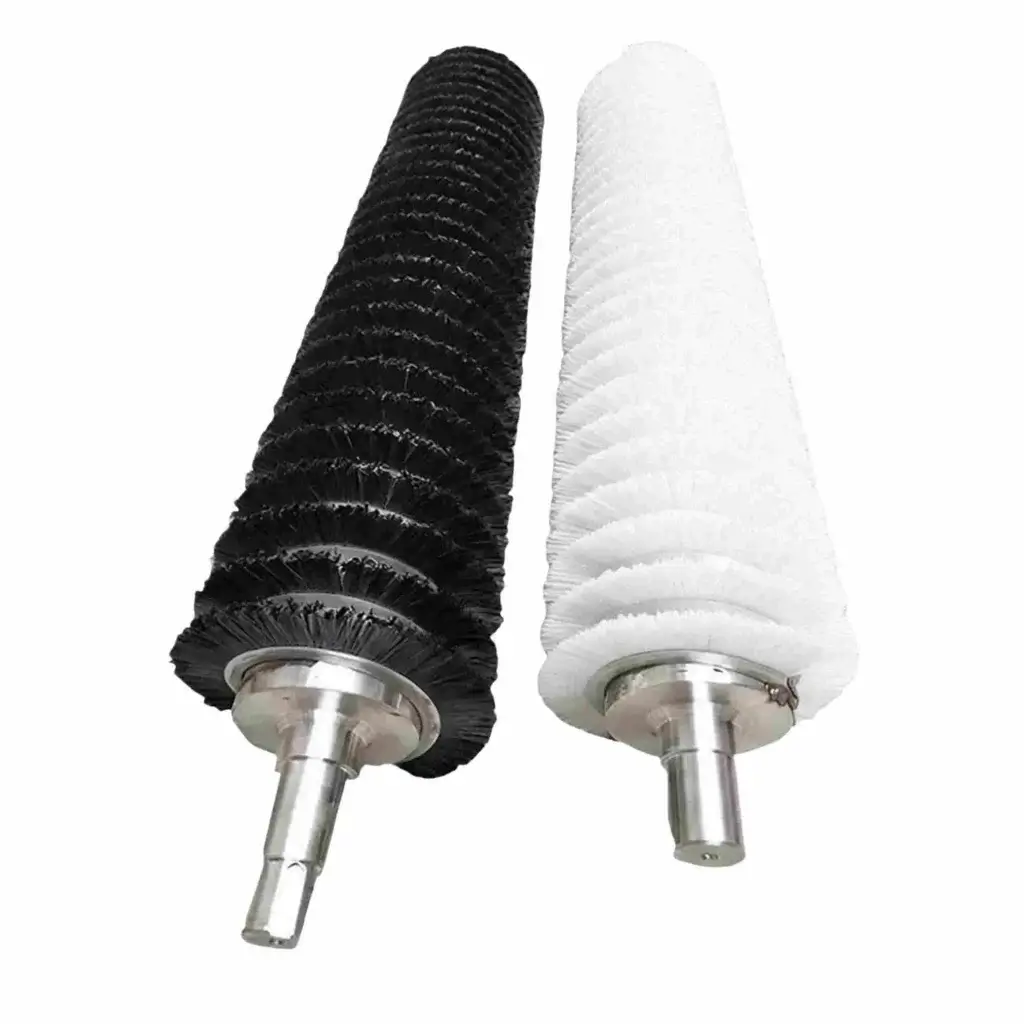
A brush-type web spreader roller spreads fabric through bristle bundles angled outward from the roller center, which bend slightly outward under web tension and push the material flat to the very edge with a contact area far smaller than any rigid roller, and because those bristles are the only surface touching the fabric, their material determines the quality outcome.
The Spreading Mechanism
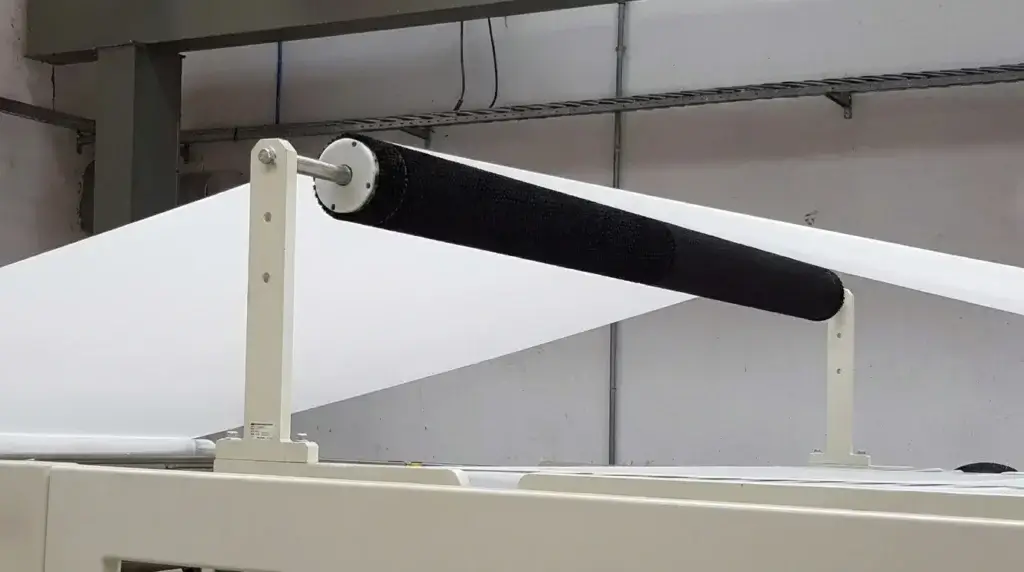
Each bristle bundle deflects outward by tenths of a millimeter as the web passes over it. That movement repeats continuously as the roller turns, producing a gentle, even spreading force across the full width. Because individual bristles rather than a rigid face carry the load, tension peaks are softened, and the web path becomes more stable rather than more stressed.
Why Material Choice Governs Fabric Quality
A rigid deflection roller touches fabric along a line under full tension, so whatever is on that surface transfers directly. A bristle roller touches at thousands of points, which reduces marking, but it also means the filament itself becomes a possible source of shedding, charge, or discoloration. The material is the one variable that touches every meter of fabric.
Where It Sits on a Textile Line
Spreader rollers are normally installed before the critical processes: printing, coating, laminating, and stenter entry. They are free-running, driven by the web itself, and can replace an existing deflection roller one for one, which is why material upgrades rarely require machine modification.
Lint and Contamination: Filament Materials Compared
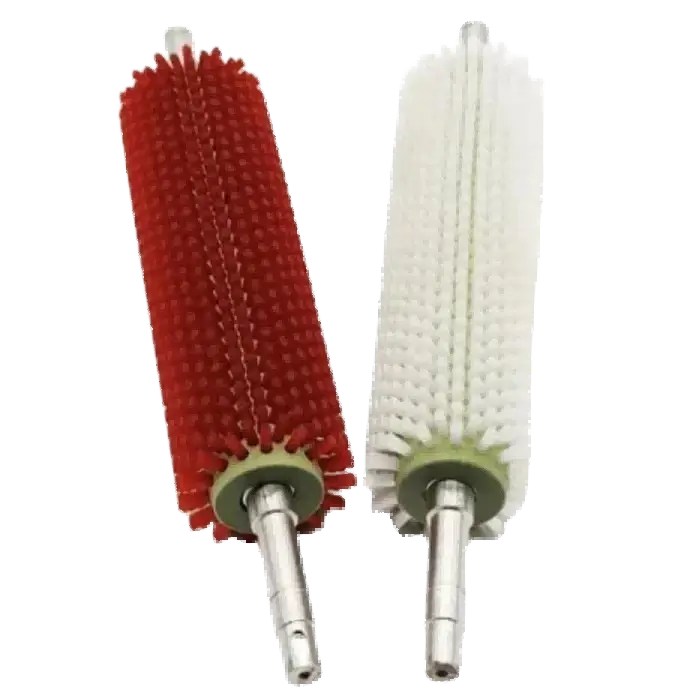
Synthetic filaments shed the least and clean the most easily; natural fibers offer softness and heat tolerance but carry a shedding risk, and the lint that clings to fabric is usually attracted by static rather than produced by the brush, which is why material and static control must be chosen together.
Synthetic Filaments
Nylon 6 and nylon 6.12 offer high elasticity and abrasion resistance, recovering their shape after continuous deflection and suiting most dry fabric handling. Polypropylene resists dye chemicals and moisture, making it suitable for wet paths, but it softens below 60°C and must be kept away from heat sections. High-elasticity polyester filament serves synthetic filament fabrics where anti-static behavior matters more than ultimate softness.
Natural Fibers
Tampico and similar natural fibers tolerate heat well, hold dust rather than releasing it, and provide a soft sweep for delicate surfaces. Horsehair remains the gentlest option for fragile goods. The trade-off is shedding: a stray natural fiber on a printed or coated surface becomes a defect, so natural fiber brushes belong off-line from contamination-critical zones or in constructions that trap strands securely.
Matching Filament to Fabric Type
Static Control: Conductive Bristles and Grounding
Conductive bristle tips continuously discharge electrostatic charge from the fabric through the roller body to ground, so a single web spreader roller can spread the web and eliminate charge at the same time, provided the core is actually bonded to earth.
Why Textile Webs Charge
Dry processing, high synthetic content, and repeated contact with rubber and polymer rollers charge fabric throughout the line. The consequences match the title of this article: static attracts airborne lint to the web, makes fabric stick to rollers and fold onto itself, causes misalignment before printing, and delivers uncomfortable shocks to operators at unwind and inspection stations.
How Conductive Filaments Discharge
Conductive bristle materials, combined with a grounding-compatible core, drain charge continuously through the bristle tips while the web is in contact. Because discharge happens at many small points rather than through a single grounding strip, the charge never accumulates to discharge levels, which protects both the fabric and the operator. The underlying physics of static electricity explains why continuous low-current dissipation outperforms periodic grounding attempts after charge has built up.
Limitations and Complementary Measures
Conductive bristles depend on a reliable earth bond, and their effectiveness varies with humidity. In very dry plants or on extremely high-speed lines, an active static eliminator bar after the roller remains a sensible supplement. The roller should be specified with a verified grounding path, not assumed from a metal frame.
Preventing Staining and Fabric Damage
Staining originates in the roller structure rather than the filament alone: rusting cores, non-stainless staple wire, dye-absorbing bristle materials, and contaminated brush faces all transfer onto the fabric, and each has a construction-level fix.
Staining Sources and How Construction Prevents Them
A stainless 304 or 316 core is the practical minimum on any wet or dyed path, because rust migrating from a carbon steel core ends up in the fabric. Where bristles are staple-set, the anchor wire must also be stainless. Bristle material itself should be color-stable and tested against the dyes and finishes actually running on the line, since a filament that absorbs dye becomes a transfer roller during a shift.
Cleanability and Wear
Washable synthetic filaments allow the roller to be cleaned in place when heavily soiled, and modular constructions allow individual brush segments to be replaced without scrapping the roller. A roller that cannot be cleaned properly becomes a contamination source, whatever its specification sheet says.
Gentle Contact on Delicate Fabrics
Trim length, density, and contact angle together to set how hard the bristles press. Longer trim and lower density flex more and suit knits and elastic fabrics, while the contact angle should be kept to the minimum that still spreads the web, because excessive wrap stretches lightweight fabric and distorts the pattern.
Specifying a Web Spreader Roller brush for Fabric Quality
Six items decide whether the roller protects fabric quality or quietly degrades it, and a short line trial verifies the material choice before it is repeated across a plant.
What Belongs in the Specification
- Fabric type, weight, and sensitivity, plus the defect being targeted
- Working width and required spreading coverage
- Filament material, stiffness, and density
- Trim length and usable wear allowance
- Outer diameter, core material, and mounting
- Contact angle, line speed, and whether conductive bristles with a grounded core are required
Operating Parameters That Affect Fabric
Contact angles from a few degrees to full wrap are possible, and the same angle applies across the whole width, giving equal spreading to the edge. Web thicknesses from thin films upward and line speeds well beyond typical textile rates are within range, provided the roller is dynamically balanced at speed. Wrap angle above what the fabric needs adds tension and stretch without adding spreading.
A Trial That Proves the Material Choice
Run the candidate roller on the same station for at least 2,000 meters per shift. Record crease and wrinkle counts, surface resistance or static readings at the exit, lint and stain defects per shift, and bristle wear. Comparing those four numbers against the incumbent roller converts a material argument into a measured decision.
FAQ
Q1: Can one roller spread fabric and remove static at the same time?
Yes, when specified with conductive bristles and a grounded core. The spreading action and the charge dissipation happen through the same bristle contact, so no additional machine space is required. The grounding path must be verified during installation, since a conductive roller on an isolated frame does nothing.
Q2: Which filament material suits dyeing and wet finishing lines?
Polypropylene resists dye chemicals, alkalis, and moisture and suits wash paths within its temperature limit, while nylon 6.12 holds stiffness better than nylon 6 where warm rinses run. Whichever is chosen, the core must be 304 or 316 stainless and the staple wire stainless as well, because a rusting core contaminates fabric faster than any filament choice can compensate.
Q3: How often do bristle elements for spreader rollers need replacing?
On continuous textile duty, synthetic bristle elements commonly run for years because contact forces are low, and modular designs allow worn segments to be swapped individually. Replace based on measured conditions rather than on a calendar: practical signals include flattened or missing bristles, visible contamination that cleaning no longer removes, or the return of creases and lint defects at the station.